published a paper that melts little balls of iron in the lab to mimic how micrometeorites melt in the upper atmosphere. New kinetic data helps us use micrometeorites in rocks from billions of years ago to find the composition of ancient air at that time. https://t.co/85niynv07Q
Earth was a frozen over, "Snowball Earth" twice, between 720-635 m.y. ago. The 1st one lasted a huge 56 m.y. (almost like dinosaur extinction to us) but no one knows how. My group just published a mechanistic explanation. https://t.co/cLSy8Abn9z
New co-authored paper with my former student, Nick Wogan. A physics-chemistry code that can simulate the atmospheres and climates of Venus, Earth, Mars, Jupiter, and Titan. Will be useful for interpreting exoplanet spectra. https://t.co/rgSxeA0vb7
what I'm reading: a phosphorus story. Opens, "There would be no life without constant death". Ch. 1 tells how Darwin's mentor, John Henslow, realized in 1842 that rocks could supply P fertilizer. The first mine, 1847, was where Henslow found phosphate-rich rocks: Felixstowe, UK.
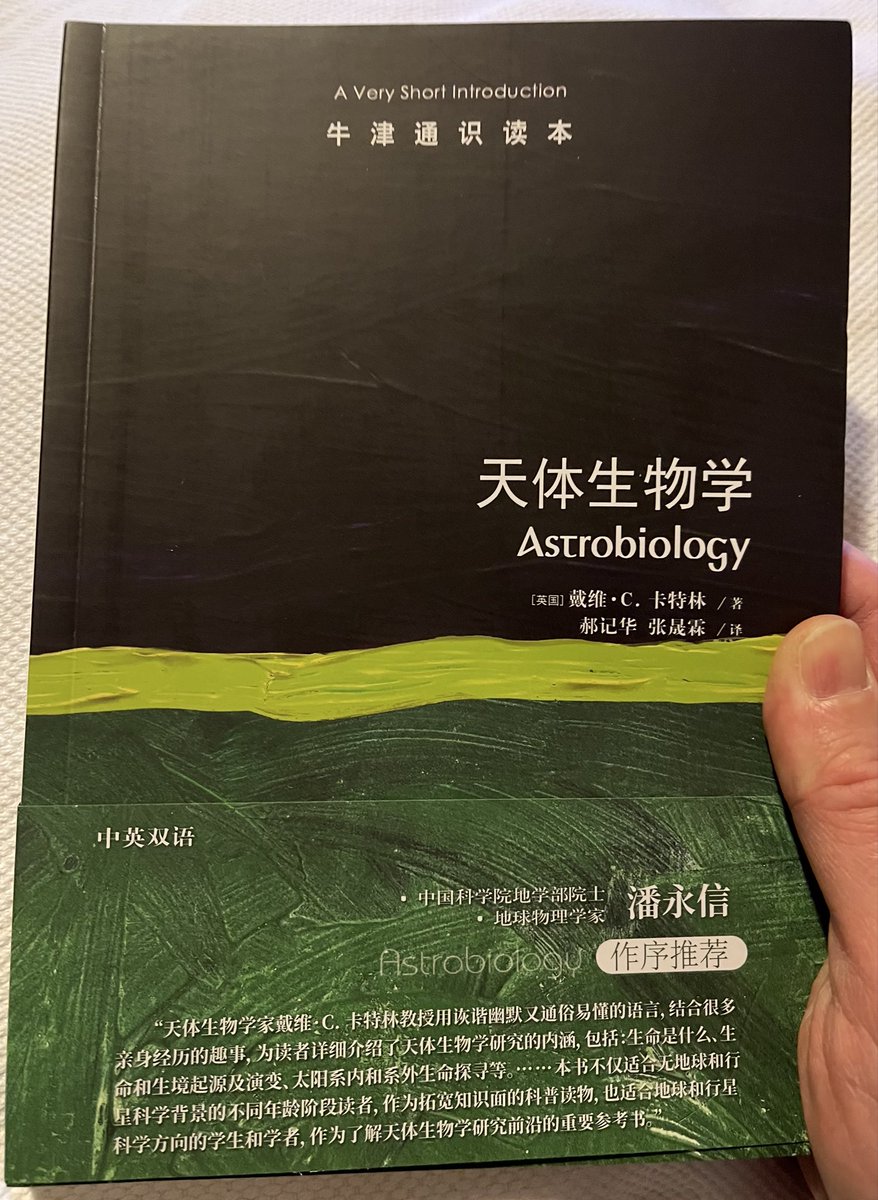
glad that my book, “Astrobiology: A Very Short Introduction” (1st Ed with updates, Yilin Press, Nanjing) is now published in Chinese and available to the 1.2B people for whom Chinese is a first or second language.
@SFurkanOzturk61 Elemental sulfur can also be formed in a reducing atmosphere from photolysis of SO2 and subsequent photochemistry. But then it would be globally dispersed so I would guess the fumarolic or crater lake source for the martian stuff.
happy to have contributed to a Perseverance Rover crystallographic study of sulfates on Mars, showing how some formed in near-surface fluids & others deeper. https://t.co/WS4tIW61EG
@SFurkanOzturk61 2/2: How? Cooling & reaction of magmatic gases: 2H2S + SO2 = 3S + 2H2O;
disproportionation-hydrolysis of SO2 can also make S: 3SO2 + H2O = 2SO4(2-) + H2O + S + 4H+;
oxidation of H2S to thiosulfate, and its breakdown:
2H2S + 2O2 = S2O3(2-) + H2O + 2H+ ; S2O3(2-) = S + SO3(2-)
Methane can be biotic so is of interest on Mars. There, the Trace Gas Orbiter finds no CH4 but Curiosity Rover detects CH4. A discrepancy. We show that the latter is plausibly internal contamination, however. https://t.co/t1lgdijTlI
@KellyDobitz@uwastrobiology Some microbes have made this journey. E.g., most work favors a freshwater origin for cyanobacteria (e.g., phylogenetics by Sanchez-Baracaldo). By number, they're now extremely abundant in the ocean. 2/2
New paper: We quantified phosphorus fluxes in soda lakes, showing that without biology, soda lakes worldwide would have phosphate levels suitable for prebiotic synthesis, answering the 70-year-old “phosphate problem of the origin of life" @uwastrobiology
https://t.co/WHmqzTfrMV
@KellyDobitz@uwastrobiology Changes in hydrology / geology can also connect lakes to the sea. E.g., some soda lakes are on ocean islands. Such islands sink over time and reach sea-level. 1/2
“Timing and Likelihood of the Origin of Life Derived from Post-Impact Highly Reducing Atmospheres” from my group. We calc. that life began in the Hadean with median estimate ~4.35 Ga. Consistent with recent @glpcjd phylogenetic inference of LUCA ~4.2 Ga. https://t.co/4tlmCBQJEZ
Concretions are hard mineral accumulations of different composition from surrounding rock, deposited from dissolved minerals in subsurface water. Part of team reporting them from NASA’s Mars Perseverance Rover today. https://t.co/gFwVvakEsA
What happened after most of the Earth froze over between 645-635 million years ago, the last “Snowball Earth”? Published today:
Trent B. Thomas & David C. Catling, Nature Communications https://t.co/AmzIIdZylm