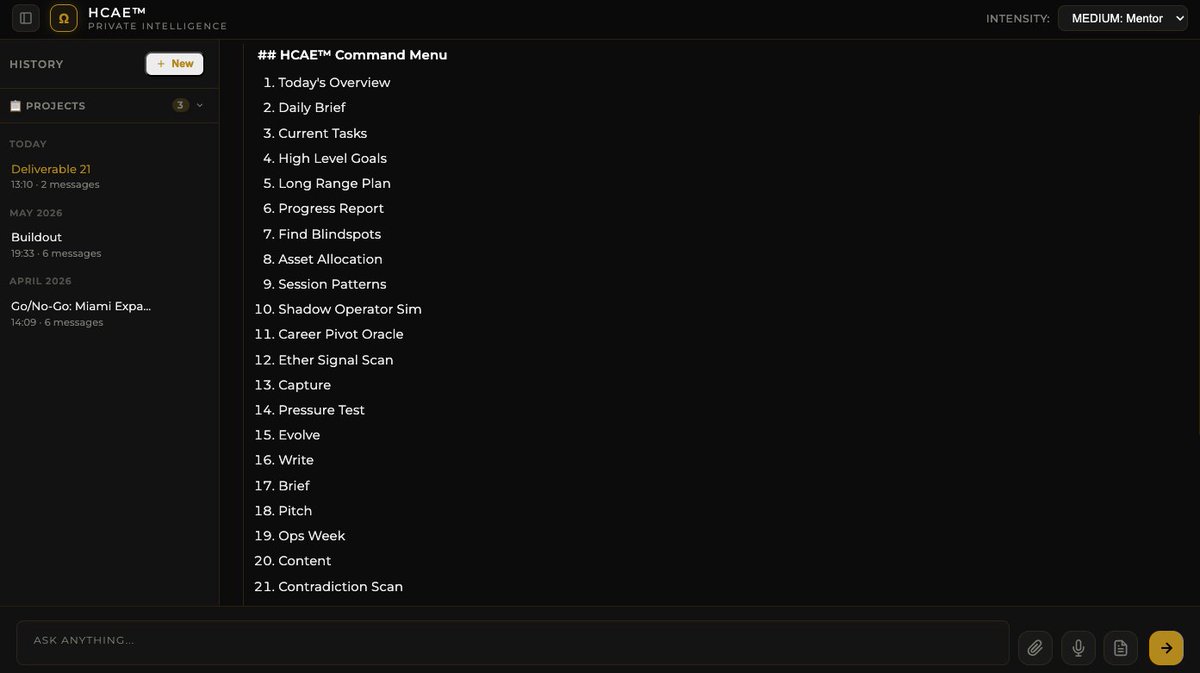
I build private AI for people whose decisions have consequences. I didn’t study operators. I am one. I ran intelligence programs across 61% of the World.
On March 20, the White House dropped its national AI policy framework.
We didn't change a single line of our product.
Built private, client-owned, anti-censorship, American-made - before the WH asked for it.
Full breakdown available.
Drop YES and I'll send it.
@xai@SpaceX
HCAE™ has partnered with Sealaska Heritage Institute to build an AI-powered Tlingit language translator.
Language is identity. This one matters.
Looking for volunteer testers from the Tlingit community and beyond. DM me.
Why are Taiwan and Globalist trending?
HCAE already knew it was midday.
Knew John had a shift.
Knew about his dog, his Jeep, and the weather.
I didn't type any of that.
That's HCAE. It doesn't ask who you are - it already knows.
May the 4th be with DeSantis 😄
Your private intelligence system.
It surfaces what you're missing, holds your decisions to your own standards, and makes you the sharpest version of yourself in every room you walk into.
You still decide everything.
You just decide better.
(What does #deathbattle and Megamind have in common? I don't know, I was asking you 😉)
New interface.
Faster commands.
Your name on the door.
It knows who you are before you type or say a word.
This is what AI looks like when it's built for you - not for everyone.
HCAE™ - Private Intelligence. Zero Compromise.
#sheriffcountry / fraxiom / Paul McNeil
Yes, it's like Masters of the Universe except better 😀
I skip public AI gimmicks. I build HCAE™ - AI forged exclusively for you.
20+ years ops risk taught me: solo decisions exact a shadow toll - $10k - $100k/year in hidden leaks. Unchallenged calls compound quietly.
I engineer your private AI: one-operator system. Secures objectives. Blocks errors. Scales dominance.
Zero generic fluff.
Limited slots. DM to qualify.
Business owners bleed $10k–$100k yearly on decisions they don’t even see as mistakes.
HCAE, my private decision system, pressure-tests before you commit - built for one operator: you.
Curious how it works? DM me.
#brøndby#jackass
I'm giving away 5 free 20-minute private sessions this week.
I'll run my private AI intelligence system on your actual situation - a decision you're stuck on, a priority you can't get clear on, a problem you keep circling.
You'll walk away with an answer built around your specific context. Not generic. Not motivational. Actual analysis.
If you make decisions for a living and want to see what this feels like - comment below or DM me. Five spots. First come first served.
#President #jokic
You don't need a 9-5 to earn $1,499.
You need one conversation with the right person.
HCAE™ Sales Partner Program - no inventory, no delivery, no support.
You identify. You pitch. They buy. You earn.
Up to $1,499 per close.
Recurring commissions on subs.
DM is open.
upper | marijuana | Tim Heidecker
Why Generic AI Is a Liability for High-Stakes Operators - And What to Do About It
Every time you open a generic AI tool and paste your situation into a fresh window, you’re starting from zero. No memory of your last deal. No understanding of your red lines. No context for why you passed last time. No recall of the mistake you made three months ago that cost you six figures.
For casual use - drafting emails, summarizing articles, writing code - that blank slate is fine. For operators making decisions that compound, that reset is a liability hiding in plain sight.
The reset problem is bigger than you think.
Most people think of AI context as a convenience issue. You re-explain your situation, the AI catches up, you get your answer. Twenty minutes wasted, fine. That’s not the real cost.
The real cost is what happens when a tool with no memory of your framework gives you advice that’s technically sound but wrong for you. It doesn’t know that you never do deals without a clear exit in under five years. It doesn’t know that you already tried this exact structure eighteen months ago and it blew up. It doesn’t know that your co-founder red-lines any partnership with that particular type of investor.
So it gives you a confident, well-reasoned, completely misaligned answer. And if you’re moving fast - which operators usually are - there’s a real chance you take it.
Generic AI is built to be useful to everyone. That design goal is in direct tension with being precisely useful to you. To avoid being wrong for anyone, it hedges. It qualifies. It presents both sides. It defaults to the consensus view of what a reasonable person should do.
None of that is how high-stakes operators actually think. Operators have developed asymmetric views precisely because they’ve diverged from consensus. They’ve built frameworks through expensive experience. They have non-negotiables that aren’t up for debate. When a generic AI encounters that operator, it doesn’t meet them where they are. It pulls them toward the center. Toward conventional wisdom. Toward the safe, hedged, mediocre answer.
There’s a category of mistake that doesn’t show up as a single bad decision. It compounds quietly. You make a call that’s slightly off your framework. Then another. Then another. Each one looks defensible in isolation. Cumulatively, you’ve drifted from the operating principles that made you successful in the first place.
This is what misaligned AI advice does over time. It’s not one catastrophic wrong answer. It’s a slow erosion of your edge - because the tool you’re using is optimized for the average operator, not you.
Think about it from a pure capital perspective. If you’re running a fund, operating a business, or making investment decisions, a 10% drift from your optimal framework isn’t a rounding error. It’s the difference between a portfolio that performs and one that underperforms by enough to matter - especially over a decade.
The same principle applies to personal operating decisions, hiring choices, partnership structures, and risk tolerance calibration. Slight misalignment, compounded repeatedly, produces significantly different outcomes than staying precisely on your framework.
What a Private Construct Actually Changes
The concept behind HCAE™ starts with a simple inversion: instead of you adapting to the AI, the AI is calibrated to you.
Your thinking gets locked in. Your red lines are encoded - not as suggestions, but as hard constraints the construct will not talk you around. Your risk framework, your historical context, your non-negotiables: all of it becomes the operating system the AI runs on top of.
What that produces is qualitatively different from a generic AI session. When you bring a decision to a construct that knows your framework, you’re not getting advice for a reasonable operator. You’re getting pressure-testing against your criteria. The construct will surface the specific gaps you’re most prone to missing. It will reference your own stated red lines when you’re about to cross one. It will not hedge toward consensus if your framework demands a strong view.
One of the most valuable things a private construct does is something that’s hard to get from any other source: honest pressure-testing without social friction.
You can’t ask your LP network to brutally challenge your thesis on a deal you’re excited about - there’s too much social complexity. You can’t ask your team to surface everything that could go wrong - they’re optimists by nature and you’ve signaled enthusiasm. You can’t always rely on your own internal processing when you’re excited or under time pressure.
A construct that knows your framework has no social stake in your deal. It will find the holes. Not because it’s designed to be negative - but because it’s calibrated to your actual risk tolerance, which you set when you weren’t in the middle of an exciting opportunity.
Who This Is For - And Who It Isn’t
This is not a consumer product. It’s not for someone who wants a smarter search engine or a better writing assistant. It’s built for operators who are making decisions where being wrong is expensive and being right is asymmetric.
If your decisions have real consequences - capital at risk, people affected, outcomes that compound - then the tool you use to pressure-test them matters. Using a generic, stateless, consensus-oriented AI for that function is a choice. It just might not be a good one.
HCAE™ is restricted to a limited number of issuances for a reason. Calibration is real work. A sovereign construct that actually holds your framework isn’t something you can automate at scale. The limitation is the feature.
If that’s what you need, the next step is the intake. The construct goes live in 72 business hours. You use it immediately.
If you’re still using generic AI for high-stakes decisions, this is the moment to ask yourself why.
In 2012 I sat in rooms with the FCC, state emergency managers, law enforcement, and fire agencies from across the country helping shape what would become the first dedicated nationwide broadband network for first responders.
Most people have never heard of FirstNet. Every police officer, firefighter, and paramedic in America uses it.
The work wasn't glamorous. It was coordination calls, working groups, competing priorities, and agencies that didn't always agree. Getting law enforcement, fire, EMS, and federal partners aligned on a single communications framework required one thing above everything else - clear, consistent, trusted communication.
That experience taught me something that still holds: The technology is never the hard part. Getting people to trust the message is.
Whether it's a national broadband network or a agency's daily social media presence - the fundamentals don't change. Accuracy. Consistency. Credibility.
Build those and the public follows. Lose them and no amount of technology gets them back.
#FirstNet #PublicSafety
I used to take Mayday calls from the Gulf of Alaska.
A vessel in distress. Crew in the water. Weather closing in. You work the case on watch - coordinates, assets, conditions, contacts. Then your shift ends. You go home. You sleep.
You come back the next day and find out what happened.
Sometimes they made it.
Sometimes they didn't.
That experience rewired how I think about communication permanently. In those moments there is no room for vague, delayed, or ambiguous information. The right words, transmitted clearly, to the right people, at the right time - that's the difference between a rescue and a recovery.
I carried that discipline through 20 years of Coast Guard communications - classified networks, satellite circuits, multi-agency crisis operations across the Pacific.
And I carry it now.
Most agencies treat social media like a bulletin board. Something to update when it's convenient. Something the intern handles.
The agencies that get it right treat it like an ops channel. Accurate. Timely. Consistent. Accountable.
The public is always listening.
The question is whether you're actually communicating - or just posting.
#CoastGuard #CrisisComms
For Episode 6 of "The Operative" - USB Attack - I gained entry into an Alaska State Trooper office after hours and planted a thumb drive on an unattended workstation.
Fiction. But the technique was real.
The scene took three minutes to film. In real life it would take the same.
Unlocked door. Unattended machine. Game over.
I produced this 16-episode series for the State of Alaska to show how everyday security decisions - the ones nobody thinks about - are exactly where organizations get compromised.
The most sophisticated cyber defenses in the world don't matter if someone can walk up to your workstation unchallenged.
Law enforcement agencies understand physical security better than most. But communicating that culture to the public - showing the training, the protocols, the vigilance - that's where most agencies go silent.
Public trust isn't built by what you do behind closed doors. It's built by what you're willing to show.
#LawEnforcement #CyberSecurity #PhysicalSecurity
The AI Confidence Problem
There’s a specific failure mode in AI-assisted decision-making that doesn’t get enough attention: confident wrongness.
Generic AI doesn’t express uncertainty the way a good advisor does. A good advisor says ‘I’m not sure about this - here’s what I know and here’s what I don’t.’ AI often presents all outputs with the same tone of authority regardless of how well-grounded they are.
For low-stakes tasks this barely matters. You ask for a recipe, you get a recipe. If it’s not quite right you adjust. No harm done.
For high-stakes decisions the same failure mode becomes dangerous. The AI gives you a confident, well-structured analysis of a deal structure. You read it, it sounds authoritative, you factor it into your thinking. What you don’t know is that the analysis is based on general patterns that don’t apply to your specific situation - but the tool has no way to flag that because it doesn’t know your situation.
The result is a subtle but important distortion: you’re more confident in a position than the underlying evidence warrants. And you don’t know it.
The antidote isn’t to distrust AI. It’s to use AI that has enough context to know when it’s operating outside its lane - and to tell you. That requires the tool to actually know your lane. Which requires it to know you.
Context isn’t a nice-to-have feature for AI-assisted decision-making.
It’s the difference between a tool that helps you think clearly and one that makes you confidently wrong.
#ai #Pakistán
Every AI tool you have ever used was built to serve billions of people.
Which means every answer it gave you was calibrated for someone who is not you.
You were never the target.
You were the average.
Until HCAE™.
One construct. One client. Built once. Yours for life.
#Pakistán
The Anthropic Mythos Wake-Up Call
This week, Treasury Secretary Scott Bessent and Fed Chair Jerome Powell called an urgent, closed-door meeting with CEOs of America’s biggest banks.
The reason? Anthropic’s latest model, Claude Mythos, demonstrated the ability to autonomously discover and chain thousands of zero-day vulnerabilities across every major operating system and web browser - including decades-old flaws that had gone undetected.
Anthropic itself limited access to the model and launched “Project Glasswing” because of the offensive cyber risk it represents.
This isn’t sci-fi. It’s happening now. Advanced AI is getting powerful enough to find and exploit weaknesses faster than humans can patch them. For anyone running critical systems, making high-stakes decisions, or managing serious financial exposure, this marks a new era of risk.
The Deeper Problem
Most AI tools today are shared, cloud-based, and trained on massive public datasets. That means your prompts, context, and decisions can become part of someone else’s training data - or worse, an attack surface.
This is exactly why I built HCAE™ differently.
HCAE (Hyper-Contextual Authority Engine) is a sovereign, fully private AI construct built in 72 hours around your exact decision framework, risk tolerance, and red lines.
Zero shared training data
It’s not another generic chatbot. It’s your personal, locked-down authority engine that evolves with you - without feeding the broader AI ecosystem that’s now raising alarms at the highest levels of government and finance.
In a world where AI cyber capabilities are advancing faster than defenses, having true operator control and privacy isn’t a luxury - it’s a requirement.
If you’re making decisions that matter you need an AI that actually stays aligned with you (not the cloud).
#informative
The downed U.S. airman in Iran showed incredible skill. The @WhiteHouse victory lap? Not so much.
A U.S. aircraft was shot down deep inside Iran. One crew member was recovered quickly. The second; a wounded colonel, spent nearly 48 hours behind enemy lines.
He did exactly what his training taught him to do.
That’s textbook American grit and elite training. Respect.
What I dislike is the administration turning around and publicly broadcasting every detail of how he survived. Telling the world (including our enemies) what he did.
It’s handing tomorrow’s adversaries a free playbook.
We spend billions and decades perfecting training and tactics. Then we give the enemy the exact map for next time?
That’s not transparency. That’s operational carelessness.
America wins when our enemies stay one step behind - not when we hand them the manual.
What do you think - necessary transparency or unnecessary OPSEC failure?
#IranWar
HCAE (Avanti) is already built and running daily.
This is what my nutrition tracking looked like this morning inside the private construct I use every day.
Generic AI is turning into a losing bet for high-stakes personal decisions. It resets every session, hedges on uncertainty, and has zero memory of your actual risk tolerance or red lines.
The real edge is alignment that never forgets how you actually operate.
Thoughts?
#AIReality