Join us in person or online for our Coercive Control and Children Conference March 18-20 2025. This event features a Family Law track that is relevant for family courts globally. Watch the live stream or the recordings for up 12 months from the event https://t.co/zeBoU7Ymfb
https://t.co/HDUhuhQb4g
Check out this round up of our recent Coercive Control and Children conference in Sydney. Whether you attended or not, check it out.
We are just under 1 month out from our flagship conference in Sydney Australia with options to attend in person or remotely. 3 days. Amazing program! Check out the program : https://t.co/Z79ARqM27G
Check out our newest Partnered with A Survivor episode: Season 7 Episode 4: When Violence Hides In Plain Sight: Expanding Clinical Curiosity to Protect Children with Dr. Norell Rosado
https://t.co/3uaK4iX6tD
What if doctors and medical professionals, highly trained to identify child maltreatment through bruises and fractures, miss many injuries in children that leave no visible marks yet are biologically and developmentally formative in ways that shape a child’s entire quality of life and health?
In this episode of Partnered with a Survivor, David and Ruth sit down with Dr. Norell Rosado, a child abuse pediatrician at the University of Wisconsin School of Medicine and Public Health, to examine how child maltreatment is currently identified in medical settings and where that approach falls dangerously short. We discuss how we can assist medical practitioners to better assess for child abuse injuries and danger that may not be seen by using a pattern-based—rather than an incident-based—approach.
Dr. Rosado explains that bruises and fractures remain the primary lens through which child physical abuse is identified, even though neglect is the most common form of maltreatment and many serious injuries leave no visible marks. Together, we explore how this narrow focus combined with time pressure, fear of court involvement, and lack of behavioral training creates gaps that allows for harm to go unseen by professionals.
The conversation moves beyond bruise- and bone-based injuries to patterns that may help uncover silent injuries and invisible abuse. We unpack how domestic abuse and coercive control interfere with children’s health in ways pediatric care often misses, including limbic harm, developmental delays, and failure to thrive. We discuss perpetrator patterns like disrupting therapy and medication adherence; restricting access to food, heat, or transportation; and undermining a protective parent’s ability to follow medical guidance or maintain safe housing. We ask the critical question rarely built into clinical practice: Is anyone interfering with this child’s care or this parent’s ability to parent safely?
Dr. Rosado speaks candidly about mandated reporting, reasonable suspicion, and the anxieties clinicians face, especially when they have long-standing relationships with families. He also highlights the role of bias and why simple, consistent protocols can help clinicians ask better questions, reduce inequities, and document patterns rather than isolated incidents.
From traumatic brain injuries without bruising to emerging research on epigenetics, the episode makes clear that exposure to violence can alter gene expression, increasing lifelong risk for chronic disease, disability, and early death. Child maltreatment, we argue, is not just a clinical concern. It is a multigenerational public health emergency.
Working on finishing touches to my masterclass on working at the intersection of male perpetration of domestic abuse and men's mental health and well-being.
We have an opportunity at this moment in time to strengthen our response to both-- but unfortunately many are presenting these issues as binaries, in competition with one another.
I hope you attend this fully virtual event to learn more about how to see behaviours like threats of suicide through the dual lens of reducing risk to others and of self-harm. We want to keep both in view if we are going to be truly effective with either issue.
#CoerciveControl #VAWG #MensHealth #Suicide #Depression #SubstanceUse #SafeandTogether
https://t.co/HXsHZp5KcP
When I worked in men’s behaviour change programs, I learned early on that his participation was never my measure of success.
The persons who mattered most weren't in the room--- and those persons were the survivor and her children.
The real questions were always:
-Did my work make her and her children safer?
-Did it give them more freedom to maneuver and make choices in their own lives?
-Did it actually challenge his control over them?
That meant resisting some very seductive—but dangerous—markers of “progress.”
Epiphanies in group. Insightful language. Active participation. A man who was likable, reflective, or easy to work with.
Those are first-order signals that therapists and counsellors are trained to value—but on their own, they’re often meaningless, and sometimes risky.
What mattered was accountability tied to behavior:
-Did the harmful, controlling behaviors stop?
-Did he accept consequences—including loss of the relationship?
-Could he tolerate not being centered?
-Was there genuine acceptance that his fears, beliefs, or ideas about how things are “supposed to be” did not give him the right to control or punish others?
Doing this work required me to distrust my own reactions.
A pleasant interaction with a man in group could not be mistaken for change. Liking him did not make him safe. Feeling hopeful did not make him accountable.
I had to be rigorous—especially with myself.
I wasn’t perfect in my practice. But I knew this and still know it:
Measuring change from the point of the view of survivors, not perpetrators nor their therapists, is essential to ethical, effective work in this field.
Anything less is performance.
#SurvivorCentered #PerpetratorAccountability #CoerciveControl #ChildSafety #SystemsChange #EthicalPractice #SafeandTogether
Today at 34 & Park in Minneapolis, a woman tried to drive down the street where a protest had broken out in front of a home ICE was raiding, saying she had a doctor apt to get to. ICE agents busted out her windows, cut off her seatbelt, and pulled her out before arresting her.
Here is the most recent podcast of @PWAS with @survivorstrong3-- one of the most personal conversations yet.
Season 6, Episode 23: Being Seen at Sixty: A Birthday Conversation About Vocation, Violence, and Hope
https://t.co/65JaPO12o3
In family courts around the world, parents are often told: “Don’t disparage the other parent.”
On the surface, it sounds reasonable. Children shouldn’t be caught in the middle of parental conflict.
But here’s the danger: when domestic abuse is involved, “non-disparagement” can silence the protective parent and hide the truth children most need to hear.
Survivors who help their children name the abuse risk being accused of alienation.
Mothers are held to higher standards of “keeping the peace,” while fathers who perpetrate violence face far less scrutiny.
The result: children are left without validation, preparation, or safety planning — exactly what research says they need most.
Courts praise therapists for helping children tell the truth about abuse, but punish protective parents for doing the same at home.
I explore this in my new article: When Family Law Culture & Non-Disparagement Hurts the Very Children
https://t.co/EKYSmBXwwp
Children deserve truth, healing, and safety — not silence.
#ChildSafety #FamilyCourt #CoerciveControl #StopBlamingMothers @Safe&Together
When a father smashes the coffee table, sending glass flying, who is expected to clean it up?
Too often, it’s the mother. She’s the one told to “manage the situation,” to protect the children, to make the home safe again.
Fathers who perpetrate violence are held to lower standards than mothers.
He breaks things, she’s expected to repair.
He terrifies the children, she’s expected to calm them.
He undermines safety, she’s expected to carry the load of protection.
And then systems ask: “Why didn’t she do more?”
Blaming mothers hides the perpetrator and normalizes fathers’ violence.
If we want real child safety, we need to raise the standards for fathers: their choices, their parenting, their accountability.
#StopBlamingMothers #ChildSafetyIsFatherhood #Safe&Together
People often ask me how the Safe & Together Model grew from a small idea into a global framework used across sectors and countries.
There are many reasons — but one of the most important is this: a devotion to seeing shared interests, not just competing positions.
Take the women’s sector and child protection. In many jurisdictions, their relationship is often, as workers in our New Mexico Collaboration Kickstarter Project described it: “adversarial, rocky, fractured.”
Advocates worried about revictimization of adult survivors. Child protection workers feel like children will be put at risk by mothers' choices, and feel blocked by confidentiality rules. The result is tension and often outright distrust — despite both sides working with the same families and wanting the same outcomes.
In New Mexico, when we brought the two sectors together around Safe & Together tools, we saw something remarkable:
-Trust between agencies leapt from 17% to 67%, while the control county showed no change
- Communication between the agencies improved 8% to 83%, while the control county showed no change
-At the end of the six month project, the same workers described their relationship with the words "collaborative, mending , partnership."
These are not just statistics. They are real changes that matter to survivors and their children -- and to the morale and effectiveness of dedicated workers in both sectors. They are proof that when we stop focusing on conflict and start focusing on shared interests — child safety, survivor support, perpetrator accountability — systems transform.
The key to these changes using @safe&together Model tools and training to develop shared behaviors based on pivoting to the perpetrator and partnering with survivors.
The Safe & Together Model has grown globally because it helps people use a common language, framework and approach to move past false divides and toward collaboration that works.
@safe&Tgoeteher #SystemsChange #Collaboration #DomesticAbuse
Someone once did a study on what message is most likely to get men to seek help for being abusive to their partner.
It wasn’t the threat of going to jail.
It wasn’t that their friends would be upset.
It wasn’t even the fear of losing their relationship.
The message that resonated most was this: “Your abuse is hurting your children.”
Fatherhood can be a powerful turning point. But too often, systems fail to connect fatherhood to accountability. Instead, we excuse men’s violence as if it’s separate from their parenting.
Fatherhood shouldn’t shield men from responsibility — it should demand it.
What would change if every system made child safety the measure of fatherhood?
#Fatherhood #ChildSafetyIsFatherhood #Safe&Together
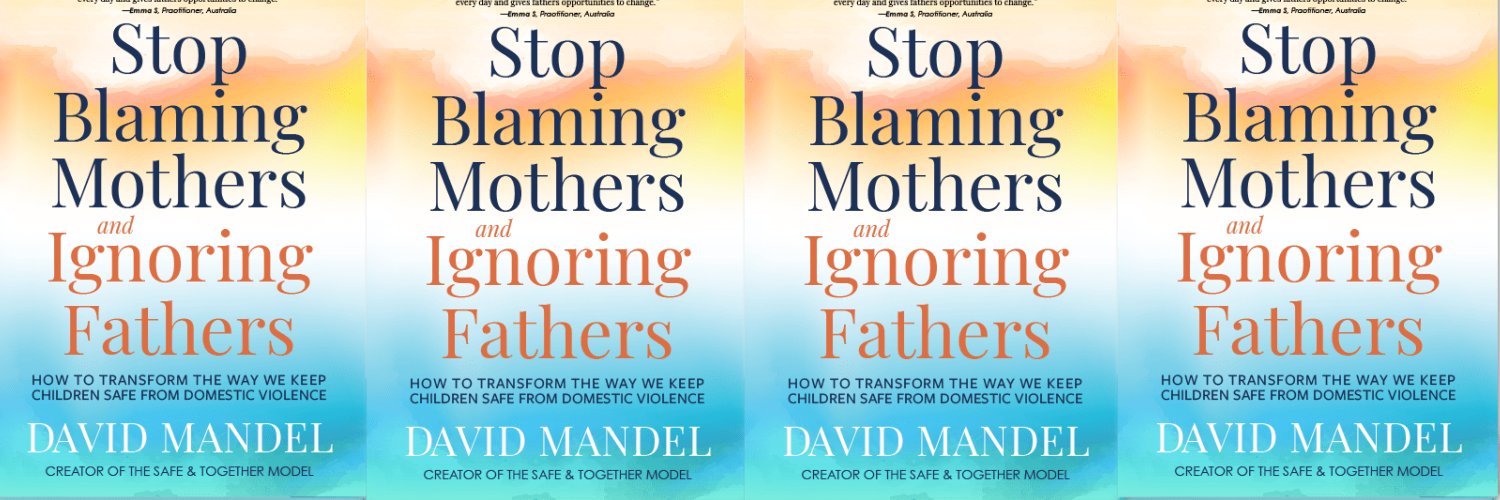
I wanted to let you know that my book "Stop Blaming Mother and Ignoring Fathers: How to transform the way we keep children safe from domestic violence" is still burning up. Some milestones:
*Thousands of copies sold
*Translated into Dutch
*About to be released in Japanese
I"m traveling and speaking about the book and the @safe&together Model. Hoping I'll be near you soon!
And if you haven't read the book here is where you can get it: https://t.co/ARY2apSfps
#StopBlamingMothers #StopIgnorinFathers
I hear men’s health advocates talk about loneliness, depression, and suicide. Those are critical issues.
But here’s what’s missing: Men are also the majority of both perpetrators and victims of violence (all forms) worldwide.
We cannot have an honest men’s health agenda if we keep leaving male violence off the table.
Men’s health is impossible to address without naming male violence.
What would it look like if men’s health initiatives tackled this head-on?
#MensHealth #MaleViolence #Prevention
Our podcast Partnered with A Survivor has a rating of 4.9 out of 5 on Apple Podcasts!! If you haven't written a review please write one! Let's get to 5.0 out 5.0! https://t.co/BviC96CKIq