I figured this would eventually happen, but not as quickly as it seems to be happening and, for this, Paul Krugman should get credit. For years mainstream economists were unable to understand how trade and globalization work because they were locked into trade models that implicitly assumed that trade was balanced (except, occasionally, over short time periods) and that capital flowed towards its most productive use. That is why their understanding of trade had no relevance to the actual world of trade that emerged in the 1970s and 1980s.
But this couldn't last. As the problem of unbalanced trade became more obvious , and as policymakers were increasingly forced to ignore the advice of their economists and respond to real problems, mainstream economists would eventually begin to recognize how, in an unevenly globalized world, countries that aggressively intervene in their domestic economies and externalize the costs through trade surpluses are also effectively intervening in the domestic economies of countries that supposedly remain committed to "free trade".
Most economists still don't understand trade. But with Krugman now acknowledging that tariffs and other forms of trade intervention can be expansionary under some conditions and contractionary under others (as Ragnar Nurkse explained as long ago as in his 1944 book), I suspect that younger economists will develop a completely different understanding of trade, and one that is perhaps a little more realistic.
I figured this would eventually happen, but not as quickly as it seems to be happening and, for this, Paul Krugman should get credit. For years mainstream economists were unable to understand how trade and globalization work because they were locked into trade models that implicitly assumed that trade was balanced (except, occasionally, over short time periods) and that capital flowed towards its most productive use. That is why their understanding of trade had no relevance to the actual world of trade that emerged in the 1970s and 1980s.
But this couldn't last. As the problem of unbalanced trade became more obvious , and as policymakers were increasingly forced to ignore the advice of their economists and respond to real problems, mainstream economists would eventually begin to recognize how, in an unevenly globalized world, countries that aggressively intervene in their domestic economies and externalize the costs through trade surpluses are also effectively intervening in the domestic economies of countries that supposedly remain committed to "free trade".
Most economists still don't understand trade. But with Krugman now acknowledging that tariffs and other forms of trade intervention can be expansionary under some conditions and contractionary under others (as Ragnar Nurkse explained as long ago as in his 1944 book), I suspect that younger economists will develop a completely different understanding of trade, and one that is perhaps a little more realistic.
New paper published in JCP, with Bobby Calder and Brian Sternthal (link to full article below).
"Proliferating endless local theories to account for specific effects risks constraining progress at a higher level. We can end up accumulating one-off theories of effects, rather than converging on broader, unifying explanations."
Money is printed by the federal reserve, but production always comes from those that are working. But more generous Social Security and Medicare in principle lets the young enjoy a greater share of what is produced than the old. If old-age benefits are lower, young people need to save more, which means they consume less today so they can consume more (from their private savings) when they are old. In other words, the old are going to consume part of future output (produced by younger workers) either way. It's just a matter of whether their consumption comes courtesy of public programs or through their private savings.
The energy illiteracy about “buy as much solar as possible” is staggering. Solar in Europe is like drinking from a firehose when you just want a glass of water and getting only a trickle when you’re really thirsty. You still need to spend billions on gas plants that sit idle most of the time, shadow generation capacity, maintained only with massive subsidies.
The electricity market already reflects this dysfunction. On Sunday April 27, Germany’s intraday electricity price fell to a record low of €−480/MWh. Across the border, Hungary hit the absolute regulatory floor of €−500/MWh in day-ahead auctions. On May 1, German intraday prices plunged to an all-time record of €−855/MWh.
So what’s the fix? The typical reply: store the surplus from sunny Sundays, discharge it during cold doldrums, problem solved. Bridging Germany’s interseasonal storage gap requires approximately 36 TWh of storage capacity. According to green think-tank Ember, the current all-in project cost for utility-scale battery storage — including equipment, engineering, and grid connection — is $125 per kilowatt-hour. That’s $4.5 trillion to fill the gap, for a country with an annual budget of about $590 billion.
The renewable lobby’s standard response is that cell prices are falling. They are, but cells are only 20–35% of total system cost. The transformers, inverters, grid connections, civil works, and land that make up the rest have not followed the cell price curve and will not. Even if cells were given away for free, the bill remains in the trillions.
China will, of course, be happy to sell you the batteries. At a 15-year replacement cycle, that’s a forever subscription for them. A curious definition of “the most sovereign energy asset you can buy.”
When I was a PhD student in the mid-oughts very few of the econ PhD students had an interest in economics, they were more interested in the math. @ho_ben was an exception.
Zane is correct. To get in to an econ PhD, anything other than math classes or econ research is a waste of time. However I think it is sad for our profession that this is the case. Economists who write and spend time with policy makers or industry are much more influential.
Zane is correct. To get in to an econ PhD, anything other than math classes or econ research is a waste of time. However I think it is sad for our profession that this is the case. Economists who write and spend time with policy makers or industry are much more influential.
Though not diametrically opposed, our article in Nature Review Psychology on "Experimental Validation Bias," we argue that a bias towards experiments testing interventions "limits the scope and ambition of applied behavioral science." (link to free article below)
Though not diametrically opposed, our article in Nature Review Psychology on "Experimental Validation Bias," we argue that a bias towards experiments testing interventions "limits the scope and ambition of applied behavioral science." (link to free article below)
China is getting worked up about the European preference in the industrial accelerator act, and going public with it.
It shows China needs the EU market, and Brussels is building some leverage Beijing probably didn’t think it’d have the guts to build.
https://t.co/CLjuYOVy2D
An Alien Bargain: Imagine an alien civilization wants to trade with us. Because of their advanced technology, they can produce any physical good we can produce at lower cost. The only thing they want from us is to buy land with the money they acquire from trading with us. Should we trade with them? https://t.co/UR07hqMMID
It is a kind of orientalism to suggest a China is an exception to typical great power behavior.
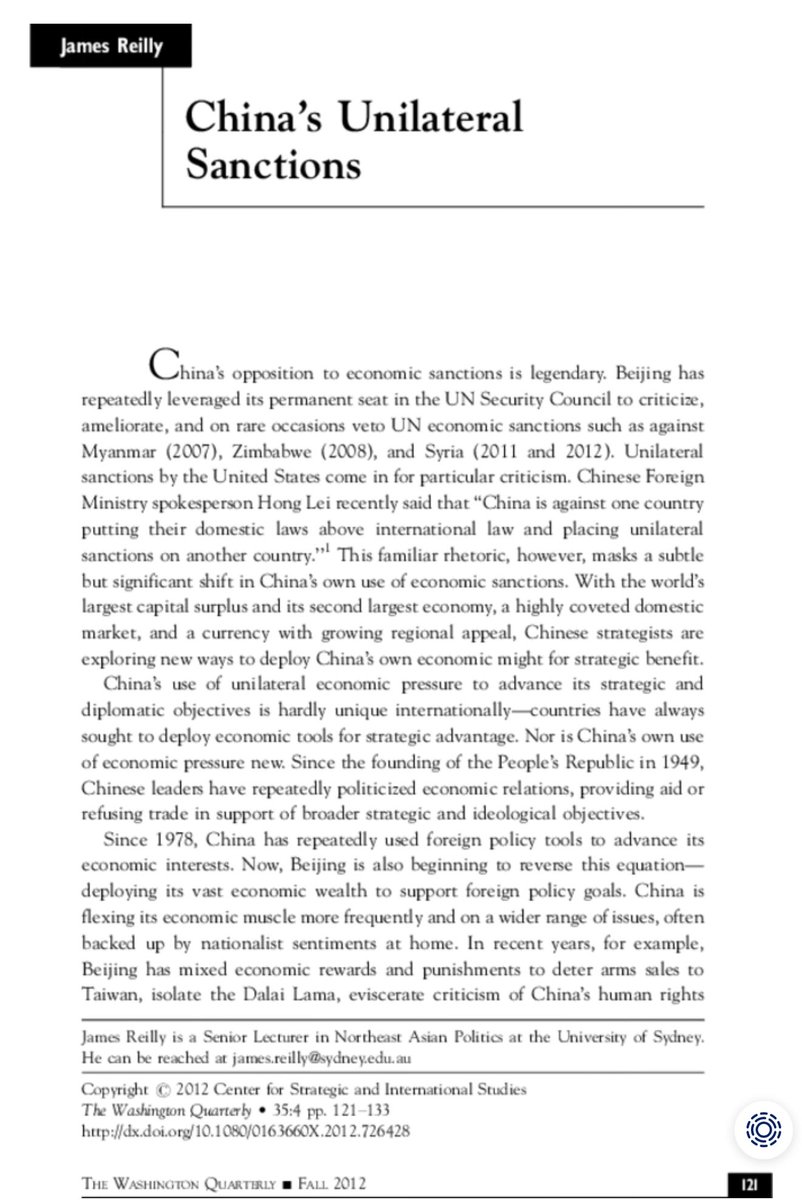
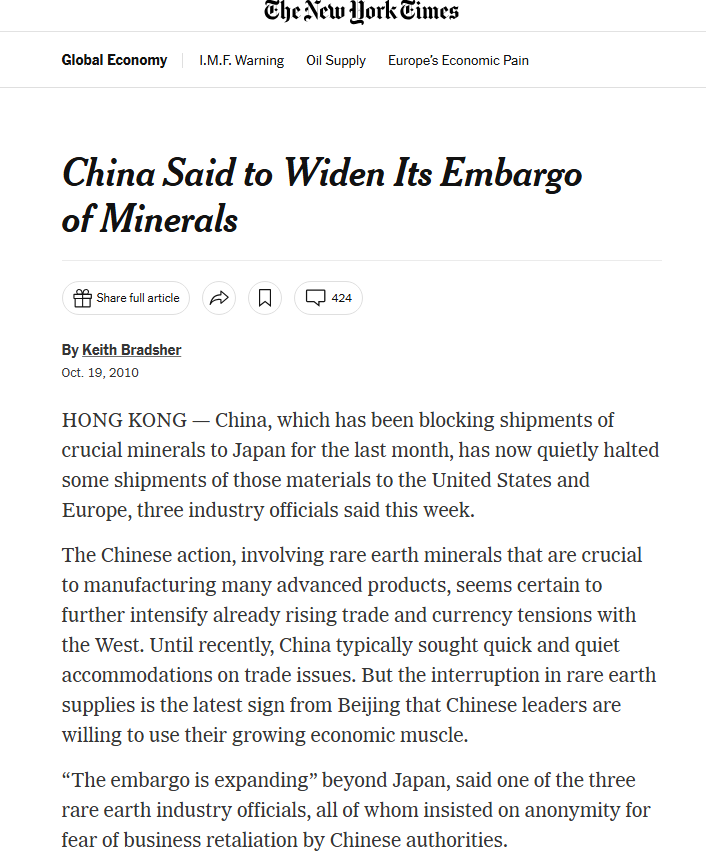
China indeed developed tools for economic coercion long ago.
This article written in *2012* discusses several cases of economic coercion from rare earths to salmon to bananas.
Alien Bargain: Imagine an alien civilization wants to trade with us. Because of their advanced technology, they can produce any physical good we can produce at lower cost. The only thing they want from us is to buy land with the money they acquire from trading with us. Should we trade with them? https://t.co/UR07hqMMID
@haugejostein Weird, because I recall China using rare earths to coerce Japan back in 2010. Are Trump's actions are capable of causing things in the past? Can Trump's time travel abilities be exploited or weaponized?
I mean they basically started advocating for teaching college students the way you teach 2nd graders.
Games, activities, worksheets
Highly infantilizing.
Every campus I’ve ever been on has this crew of hyperactive “amazing teachers” who basically act like Blippi.
Sorry but no
Might @davidgaluic’s Alien Bargain story—aliens can produce anything we want cheaper than us, and they buy up land with the cash they earn selling their wares to us—be a metaphor for how AI might transform our economy?
Part II might have the answer:
https://t.co/RmFP0sZiTl
@Econ_4_Everyone "Control it and you control the counterfactual. Don't understand it and you're telling stories." Except you're always telling stories as you need to persuade people that your experimental findings apply to different settings from those in which you performed your experiment.