This is a visualization of a Rydberg wavepacket.
In simple terms it is a way of showing an electron in a very highly excited quantum state. The Math comes from the Schrödinger equation for hydrogen where the electron is described by a wavefunction rather than as a tiny ball moving on a fixed path.
The yellow sphere at the centre is the proton, not the electron. The colored 3D surface around it shows places where the electron is more likely to be, i.e. a probability cloud.
Cold take but Galfridus Monemutensis' Historia Regum Britanniae is probably 100% real. Only thing I don't believe is the etymologies ("Kaerlud" to "London"? Not believable.)
The new @idler magazine is out. Hooray. My philosophy slot is prompted by @Philip_Goff’s latest book on panpsychism, via @PhilipPullman’s love of the occasion on which William Blake conversed with a fairy. “Every particle of dust breathes forth its joy.” I suspect that’s true.
Why separate Creativity and God? This is the most heretical part of Whitehead's theology from an orthodox monotheistic perspective. For most Jewish, Christian, and Muslim theologians, God is The Creator. Period. By definition God has a total monopoly on creative agency. Everything and everyone else is merely creaturely, that is, created solely by God. There are of course a few examples even in the Abrahamic religions of a more complex picture, eg, in Kabbalah there is Shekinah or divine indwelling; in Christianity there are the core mysteries of Incarnation and the Trinity, both also suggestive of divine indwelling or immanence. But still, God's complete and utter transcendence from the created world and ultimately independent creative power are never questioned.
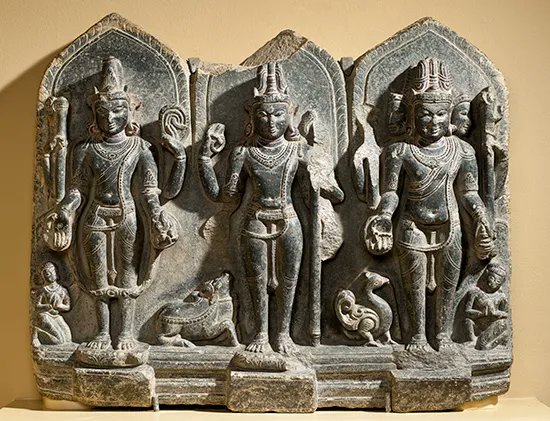
In Vedic theism, there is another view of the divine, the Trimurti or trinitarian conception of Brahma the creator, Vishnu the preserver, and Shiva the destroyer/recreator.
Whitehead's attempt to account for the ultimate nature of reality in terms of Creativity, a Primordial, and a Consequent nature of God is a response to these earlier attempts to conceive the divine nature. Whitehead has no patience for the traditional monotheistic image of God as a dictator or all-powerful ruler determining every last detail of the world. Instead, he imagines a scenario not all that far from the Vedic idea, where Creativity is somewhat akin to Shiva as a principle of unrest necessitating the perpetual perishing of every actual occasions of experience, making room for the new. The Primordial nature of God is nearest to Brahma as the ideal creator, giving at least a potential order to the world even if in Whitehead's view God cannot create from nothing, but must create with Creativity (or you might say, Brahma can only create out of the chaotic material left over by Shiva's destruction). The Consequent nature of God is then something like Vishnu, the preserver or saver of every occasion of experience, that which makes the world whole again despite the wreckage of history.
This is a very loose analogy which does not capture all the unique facets of either view. But perhaps it helps give those new to Whitehead's process theology a sense for why he insists on the distinction between Creativity and God. God is a creature of Creativity, as well as its primordial condition. But by distinguishing the two conceptually, room is opened up again in the universe for the free deeds of individuals to make a difference to the world's further unfolding, and to God's.
In Jung's Last Years, Jaffé quotes Jung, “Man is the mirror which God holds up before him, or the sense organ with which he apprehends his being.”~Jeffrey Raff, Healing the Wounded God
.@haivry describes how four statues were placed atop the new Royal Courts of Justice, symbolising the pillars of English legal tradition: “We would strain our eyes in vain looking for Locke or Bentham or Mill” https://t.co/lfIPjyv9F2
"Religion is about the pursuit of the deepest, truest, highest, and most beautiful guiding story. It is the quest to find the ultimate True Story that all other true stories derive their trueness from." https://t.co/bIjtHb8I1c
“The joy of the architectural experience is emotional and immersive: a kind of mystical union. A beautiful structure pulls your heart... This is what generations of self-appointed 'experts' suppressed through clever manipulation and propaganda.” https://t.co/0XDpGPs1or
I wonder if attachment theory might be a useful frame for understanding modern malaise. Starting with infancy it is with secure attachment that we are whole. But what about attachment to other people? To land? To place? To a home? A town?
In ‘Beginning with Beowulf’ in The Horn Book Magazine, Feb - Dec 1953 (vol 29), Rosemary Sutcliff wrote about the origins of her reading and writing. “At nine years old, I was quite unable to read the simplest sentence, which, as I have pointed out to her since … “
/cont…
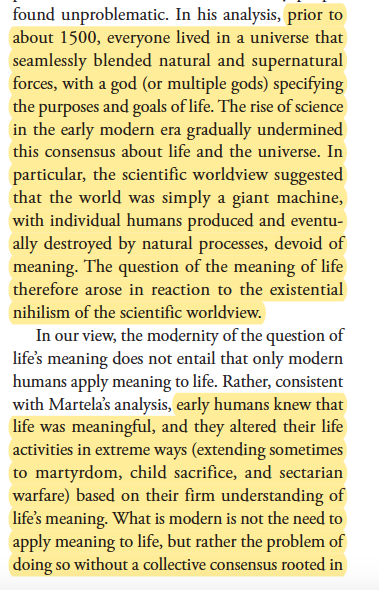
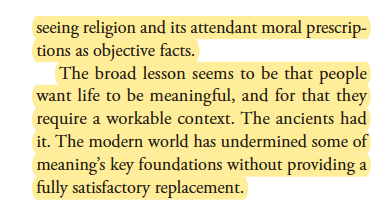
"early humans knew that life was meaningful...What is modern is not the need to apply meaning to life, but rather the problem of doing so without a collective consensus rooted in seeing religion and its attendant moral prescriptions as objective facts" https://t.co/XUEO8B8xOq