1/
Every week in my neurology clinic, I see people lost in the search for a diagnosis.
Sometimes, what’s causing their dementia symptoms is treatable — but was missed for years.
We just published a new AI tool to change that. Here's why it matters🧵
@NaipMayo@MayoClinic#ENDAlz
Struggle to multitask? Try to avoid getting frustrated—that can make multitasking harder for your brain. @MayoClinic neurologist Dr. David T. Jones explains that people can multitask; it just requires practice.
@NBCNews | @DrDavidACox | @DavidJonesBrain https://t.co/Z9lySjEbxZ
@PessoaBrain Would this be consistent with our proposed stochastic latent oscillatory diffusion model? We still use the terms encoding and decoding. https://t.co/e6D0zOcNbs
New results!
Theta rhythms flexibly routing information based on behavior and feedback, organizing local and long-range neural communication.
Theta gates and routes information in the frontal cortex
https://t.co/kPk4vmwwBZ
#neuroscience
If we can connect these concepts to observations in clinical brain imaging we could make progress on delivering on the perpetual promise of clinical translation. Here are eigenbrains of degenerating human brains:
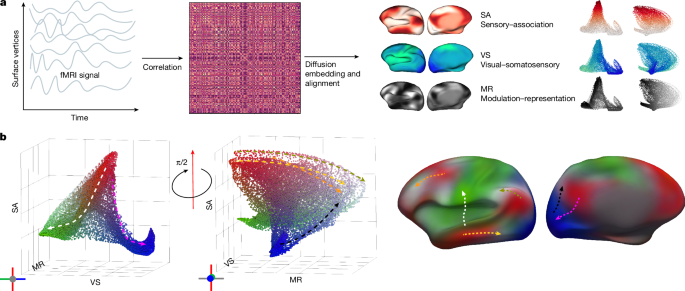
A new atlas reveals that functional connectivity patterns in the human neocortex shift dramatically from birth through old age, organizing brain regions along three dominant axes: sensory-to-association, visual-to-somatosensory, and modulation-to-representation.
https://t.co/A4XyHA9Jpv
PNAS
Traveling-wave transcranial alternating current stimulation (twtACS) causally links neural timing to cognitive function
This study developed a new brain stimulation method called traveling-wave transcranial alternating current stimulation (twtACS). Unlike conventional brain stimulation, twtACS creates electrical waves that move across the brain in a specific direction, similar to natural neural traveling waves.
The researchers showed that these artificial traveling waves could:
Change the timing of neural activity in the brain
Control how signals propagate across brain regions
Improve cognitive performance in humans depending on the direction of the wave
They confirmed these effects using:
Human intracranial recordings
Monkey neural recordings
Human behavioral experiments
The study suggests that traveling waves are not just correlated with cognition but may causally influence cognitive function. This introduces a new way to noninvasively manipulate brain communication and potentially treat neurological disorders.
https://t.co/FnOQwNlB30
@sciqst It would help to have a framework for the physiology related to conscious experience and how that physiology also relates to Alzheimer’s disease. Our new model of hippocampal neocortical interactions outlined what such a framework could look like: https://t.co/e6D0zOcNbs
Fits w/ consciousness in Dysexecutive Alzheimer’s: “Evidence of impaired executive functions are obtained by patient and/or informant reports in conjunction with formal evaluation of cognitive performance on mentally effortful tasks that require conscious active manipulation…”
Corriveau-Lecavalier et al. show that patterns of default mode network dysfunction predict future conversion to amyloid positivity, mild cognitive impairment, and dementia, emphasizing the role of network dyshomeostasis in Alzheimer’s disease. https://t.co/B14bNHaYdf
“…these results suggest that conscious access to memory relies on a separable set of neural mechanisms from those related to neural reinstatement/reactivation”. The aphantasia literature suggests this true for perceptual memory as well. Fits w/ SLOD’s 2 generative streams.
Consciousness is rhythmic.
Alpha oscillations track the projection of reactivated memories into conscious awareness
https://t.co/6YIj2JzBDp
#neuroscience
Consciousness is rhythmic.
Alpha oscillations track the projection of reactivated memories into conscious awareness
https://t.co/6YIj2JzBDp
#neuroscience
Our paper is now out!
https://t.co/qn7xmgh82r
A big question:
1) Is IT cortex well described as a general-purpose feedforward DNN?
OR
2) Are face patches genuinely specialized for processing faces?
Read on to find out the answer. (1/N)
A generative inference framework? Coarse-to-fine denoising, with early prior-dominated step (is this a face?) giving way to a data-dominated step (which face?). “DC subtraction” they describe is subtracting prior to expose posterior. Not just representing. Iteratively solving.
@davideagleman@JRBneuropsiq This new framework has partial explanations for some of these mysteries and is directly tied to clinical reality (dementia) allowing for a robust and translational empiric program: https://t.co/ldapotfemA