I am pleased to broadcast my BioRxiV preprint on the advanced structural bioinformatics illumination of three uncharacterised #apicoplast membrane protein of unknown function from the malaria parasite (Plasmodium falciparum). Many thanks to @DanielRigden
https://t.co/Ae0H7tG2oS
@SuruchiRoy1 Try https://t.co/IJQELlfiRd or maybe https://t.co/p1mC9cIUHn might be of use. Otherwise might be worth them researching online to find more plant-bio specific forums/groups with more info. Best of luck!
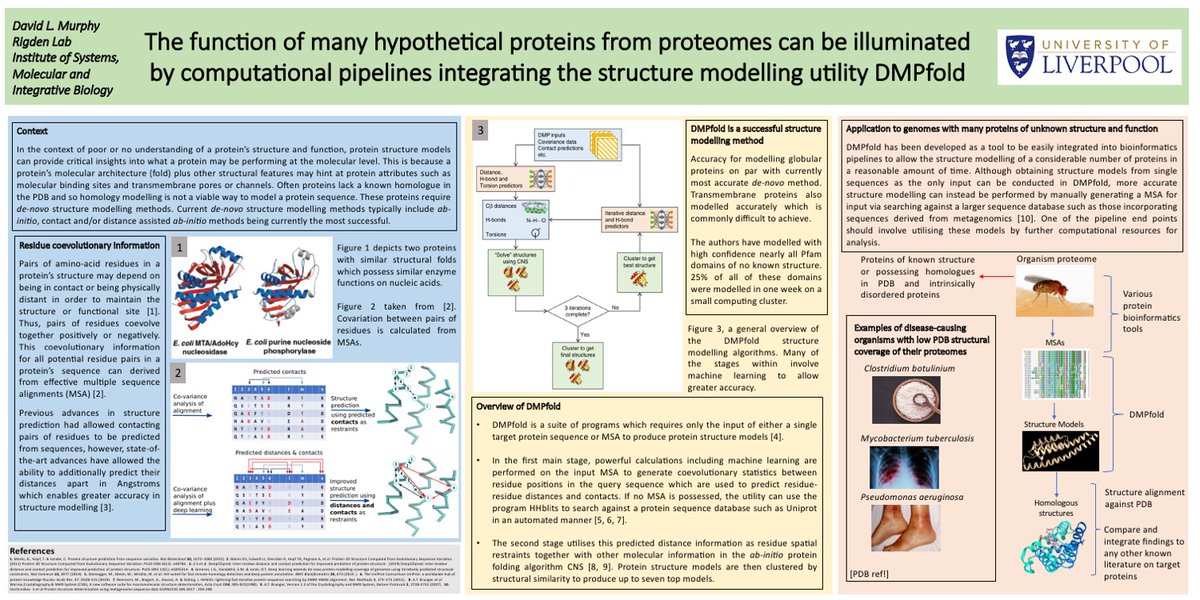
@barsukov_igor Yes I am currently using this on some different types of target proteins of unknown/poorly understood function from a particular type of micro-organism, but at this point in my research project I do not want to say which organisms these are but they cause a nasty disease globally
@simon_too But yes use of a model in the form of a pub file uploaded to a webserver such as DALI or PDBe would be a great way to compare what the model is structurally similar to in the pdb
@simon_too Though there is a simple webserver for DMPfold, it only conducts a small sequence database search, thus models from the webserver are less likely to be accurate overall. However to use the linux version of this tool would require basic structural/protein bioinformatics knowledge
@raphavisses @LippyLiptrott Once we have attained higher quality models from ongoing tests, we can add these changes to my pipeline so that larger numbers of proteins can be modelled even more effectively.
@raphavisses @LippyLiptrott I am applying this work to a particular type of micro-organism which causes a significant disease to us humans globally though currently I am just using it on small groups of proteins as we are trying to make higher quality models from higher quality MSAs and modelling parameters
@LippyLiptrott Ultimately, the last point of the automated pipeline would be the structure alignment against the PDB via programs such as DALI. Yes, then human analysis of these results together with other bioinformatics data and online info would be needed to infer the biological implications.