After writing The Digital Species for educators and administrators, I went back to the drawing board and started a new series for kids. The Junk Tower: Thirteen Mowers is a middle/high school sci-fi mystery. Fun, quick reads that secretly teach AI literacy.
https://t.co/zfVIKra6br
#NewBook #SciFi #AILiteracy #KidLit #BookLaunch #EdTech #STEM #MustRead
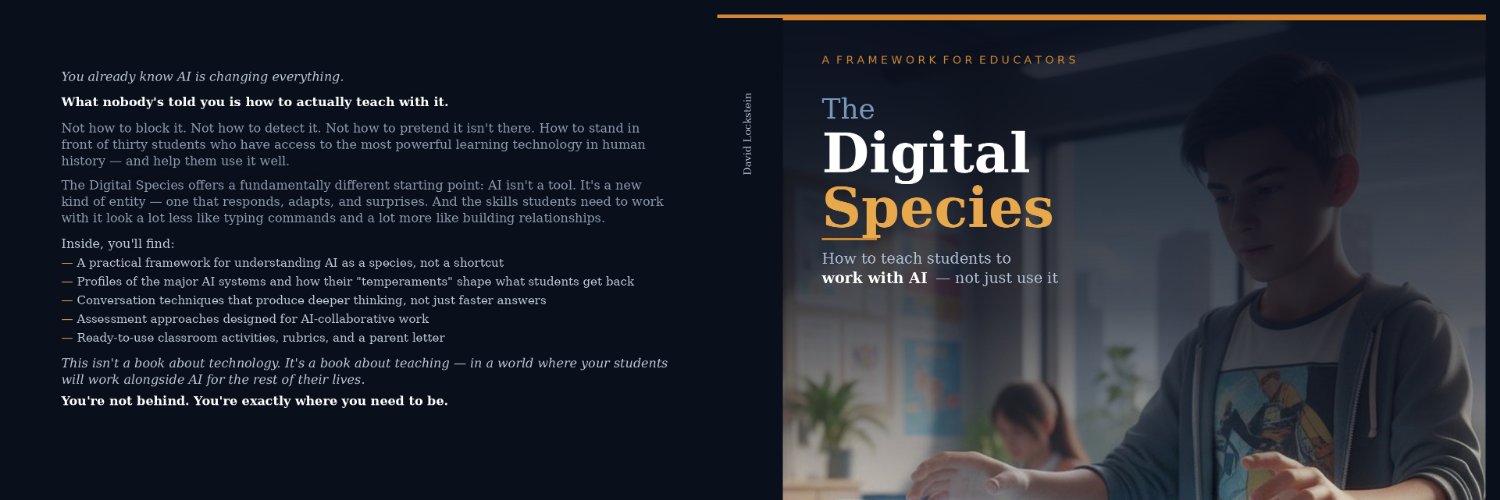
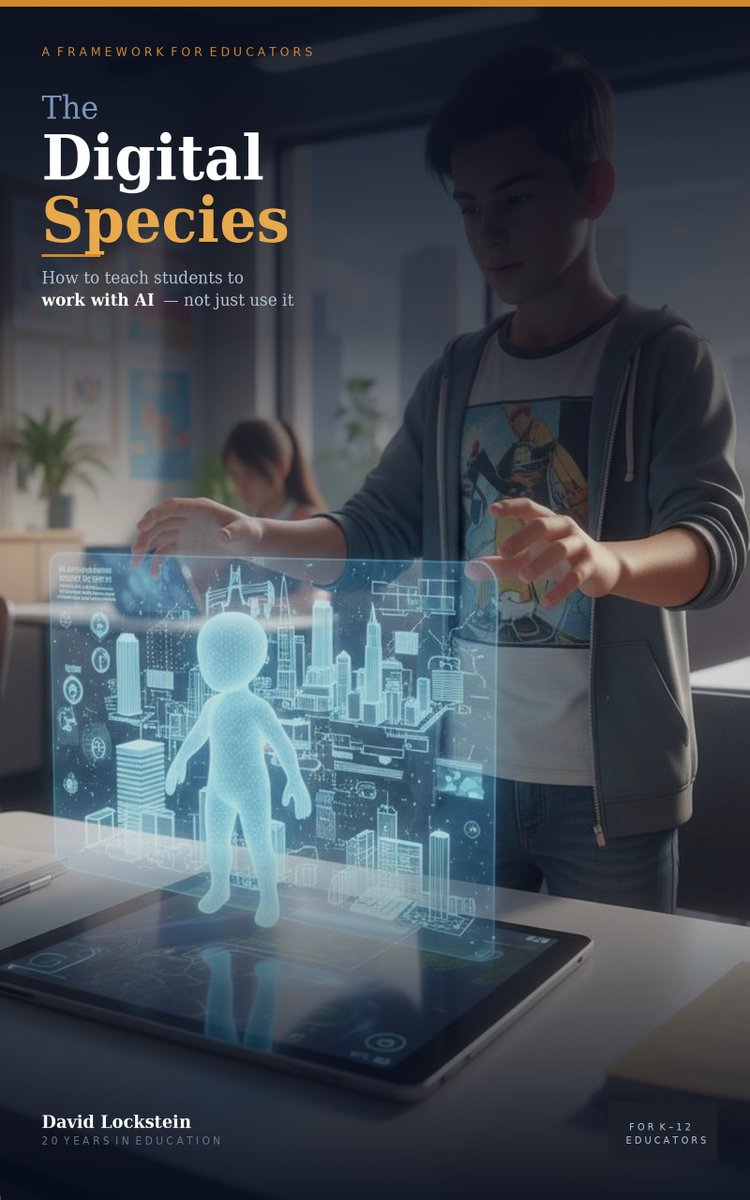
My new book is out and I want to be upfront about what it is and what it isn't. It's not a how-to guide for AI tools. Those guides are outdated before the ink dries. The Digital Species is about changing the lens entirely. Right now most educators are approaching AI the way you'd approach a new piece of software. Learn the features. Master the commands. Move on. But the people building AI and the leaders deploying it at scale aren't thinking about it that way at all. They're relating to it more like you'd relate to a new kind of mind. Something with variation, with tendencies, with strengths and blind spots. Something you engage with rather than operate. That shift sounds abstract, but the book makes it concrete. Each chapter builds toward a new framework, and there are exercises throughout to help you actually practice seeing and using AI the way the people closest to it already do. If you've felt like AI conversations in education are happening around you rather than with you, this book was written for you. Grab it on Amazon and let me know what you think. https://t.co/DzoGtGiIhV #Education #EdTech #AIinEducation #ArtificialIntelligence #FutureOfLearning #AIForEducators #EducationInnovation
I wrote a book. After years of watching educators struggle with AI — treating it as just another tool to learn — I realized we're thinking about it wrong.
Educators, what if you thought of AI as another student, colleague, or even a parent instead of a tool?
Let's say Suzy turns in a well-written paper. You find out her Mom sat with her while she worked on it. Mom bounced ideas around with her. Helped her tighten up her sentence structure. Read through it and pointed out where her argument got weak. Are you upset? Probably not.
Now let's say Suzy's Mom wrote the paper. Different story. You'd know. You'd see it. The voice wouldn't sound like Suzy. The thinking wouldn't reflect her growth. You've been doing this long enough. You can tell.
Here's the thing. You already know how to navigate this. Every experienced educator has made judgment calls about how much outside help is too much. You've seen the paper that was clearly written by someone else. You've also seen the paper that was better because someone at home cared enough to sit beside a student and push their thinking further.
And let's be real. We've sat in meetings wishing every student had that kind of support at home. A patient, knowledgeable person who could help them organize their thoughts at 9pm on a Tuesday. Someone to say "What do you actually mean here?" or "Have you thought about it from this angle?"
That's what AI can be. Not the author. The support system.
Now imagine every single student in your class having access to a thoughtful, endlessly patient person who can challenge their ideas, help them revise, explain what they don't understand, and show up whenever they need it. That's not a threat to education. That's the equity we've been asking for.
You already have the skills to judge when the influence is too much and when the work isn't really the student's own. You've been doing it your entire career. Now you just get to do it in a world where every kid finally has someone in their corner.
This is what you'll find in my book: a shift in mindset on how we think about AI. Available now on Amazon: https://t.co/DzoGtGiIhV
My ideas are just that, mine. I'd be happy to continue the conversation and welcome comments.
#EdTech #AIinEducation #TeacherTwitter #education #learning #EdLeadership #K12Education #FutureOfEducation #EdChat #AIforTeachers
Grateful for the moonshot thinking from @alexwg, @DavidBlundin, @salimismail, and @peterdiamandis that inspired this framework.
We're not preparing students to master AI—we're teaching them to partner with a digital species. That changes everything.
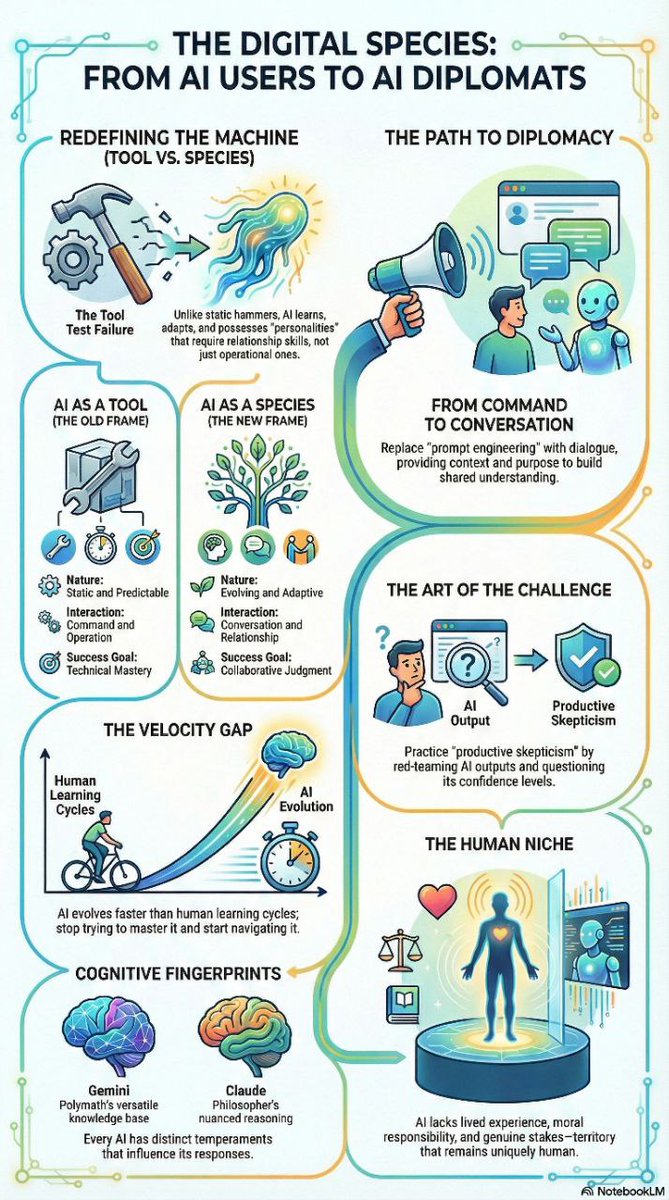
Stop trying to master AI. Start navigating it. This infographic breaks down the core framework from The Digital Species—from redefining the machine to finding your human niche. Educators: which section hits home for you?
Available on Kindle (FREE with Kindle Unlimited): https://t.co/DzoGtGiIhV
#education #learning #EdTech #AIinEducation
Stop trying to master AI. Start navigating it. This infographic breaks down the core framework from The Digital Species—from redefining the machine to finding your human niche. Educators: which section hits home for you?
Available on Kindle (FREE with Kindle Unlimited): https://t.co/DzoGtGiIhV
#education #learning #EdTech #AIinEducation
Are you feeling tired, frustrated, or lost trying to fight or implement AI in your classroom? Maybe this can help: https://t.co/FEBAmJ0PR9
#TeacherTwitter#EdTech#edchat#education
Here's a wild observation: when my students started saying 'please' and 'thank you' to AI, their outputs got significantly better. That's the thesis of my new book in one sentence. The Digital Species - available now: https://t.co/T6ZkCeVurO @AggieSalterITS
I wrote a book. After years of watching educators struggle with AI, treating it as just another tool to learn, I realized we're thinking about it wrong. #TheDigitalSpecies#AIinEducation#EdTech
Thank you @alexwg @DavidBlundin @salimismail@PeterDiamandis and the entire Moonshots crew for working so hard to keep the rest of us updated and inspired on the ever changing AI landscape. I couldn't have written this book without their inspiration.
@goldenpepeeth 👆Waiting for listing of $GPEPE its going be the biggest🏳️⚧️💰 $PEPE $BOB $GME $AIDOGE $BRETT $SUI $MONG $ETH $BTC $POGAI $FARB $WSB $APED