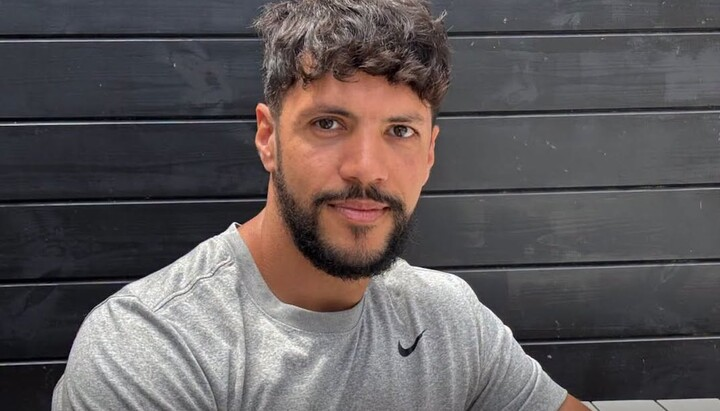
He became a Christian in Morocco. He says he was attacked, hospitalized, and eventually forced to flee the country.
Ari was raised Muslim in Morocco.
He says his journey to Christ began with his older sister, who had secretly become a Christian.
Before she died, she left him a Bible and asked their mother to give it to him when he turned 18.
Years later, Ari finally opened it.
While reading Psalm 1, he says something extraordinary happened.
He says he temporarily lost his sight and heard a message in his heart:
“Continue. Do not give up.”
Ari says that as he continued reading about Jesus, prayer and baptism, he became convinced that God was real and that Christ was calling him.
Eventually, he decided to leave Islam, become a Christian, and be baptized.
But according to Ari’s testimony, his conversion came at a devastating cost.
He says he was violently attacked at his workplace and spent four days in hospital.
He says he was threatened and pressured to return to his former life.
Eventually, he says he had no choice but to flee Morocco.
At one point, Ari says he was living in hostels and even on the streets, simply trying to survive.
But he says he still refused to abandon Christ.
Today, Ari says he continues to pray for his family and share the Gospel with others.
“I have chosen Christ. I don’t know what the future holds, but I believe it is in God’s hands.”
His story is a reminder that following Christ can come with a cost.
Please pray for Ari, his family, and Christians who face pressure or persecution because of their faith.
A Moroccan teacher in Belgium converted from Islam to Catholicism and started openly speaking about his faith on TikTok.
Then people discovered his Christian account.
Now, he says he is struggling to find work so badly that he is considering leaving teaching altogether.
He just wanted to speak openly about his faith.
Is this what religious freedom looks like?
@JamesGaius It is a genuine shame that they took over Morocco. If they had never done so, Morocco could’ve had many native Christians with a long lineage of Christianity.
THE ALMOHADS WIPED OUT CHRISTIANITY IN MOROCCO. 🇲🇦✝️
Before the Almohads, Christianity had existed in North Africa for centuries.
There were churches. Bishops. Monasteries. Entire Christian communities.
Then, in the 12th century, the Almohads conquered Morocco.
Their religious policies transformed the region.
The protected status previously given to Christians and Jews was abolished, and the early Almohads imposed policies of forced conversion.
Christians were among those targeted.
Some were forced to convert.
Some fled to Christian-ruled territories.
Some converted outwardly while secretly holding onto their faith.
And medieval sources also describe executions of those who refused, although historians debate the exact scale of the violence.
This wasn’t the beginning of Christianity’s decline in North Africa, but it was one of its most devastating turning points.
Over time, communities that had survived for centuries became smaller, scattered and eventually disappeared from much of the Maghreb.
The result?
A region that had once been one of the most important centers of Christianity in the ancient world became overwhelmingly Muslim.
And Morocco’s ancient Christian history was almost completely forgotten.
The Christians didn’t simply “disappear.”
They were forced to choose between conversion, exile and, according to some medieval accounts, death.
This is the history that rarely gets talked about.
Morocco had Christians long before the Almohads.
And the story of how they disappeared deserves to be remembered.
A Moroccan prince became Catholic. 🇲🇦✝️
Muley Xeque was born in Marrakech in 1566, a member of the Saadi royal family and claimant to the Moroccan throne.
After being exiled to Spain, he visited the shrine of Our Lady of the Head in 1593 and later converted to Christianity.
He was baptized as Felipe de África and went on to become a Grandee of Spain and a knight of the Order of Santiago.
He never returned to rule Morocco, and died in Italy in 1621.
A fascinating chapter of Moroccan Christian history that most people have never heard about.
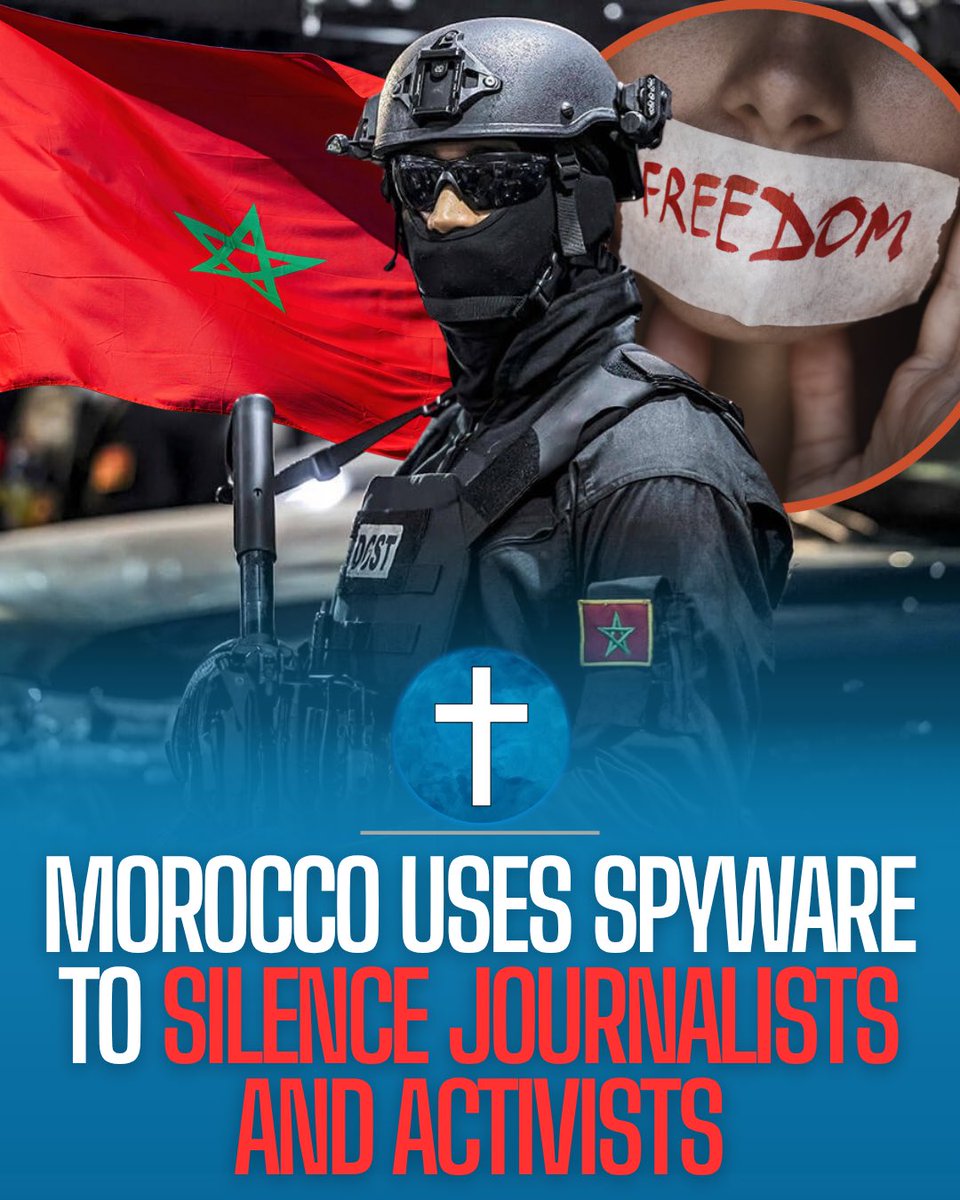
Amnesty’s latest report says Moroccan intelligence has allegedly spied on journalists, activists and other critical voices.
For Moroccan activists, speaking out can come with fear.
As someone who speaks publicly about Moroccan Christians, I know that fear personally. When reports of surveillance and intimidation reach this scale, you start asking yourself: “Is this really something I should be doing?”
But no matter what happens to me, I will keep going. I will keep speaking for my people, the Moroccan Christians, and for those who feel they cannot speak for themselves.
Fear will not silence me. The Lord above protects us. 🇲🇦✝️
This report from Amnesty International is deeply concerning.
According to Amnesty’s investigation, Morocco’s DGST has used an extensive surveillance system against journalists, human rights defenders and other critical voices, including Pegasus spyware, phone interception, location tracking, hidden microphones and other forms of monitoring. Amnesty says it corroborated key elements of a former DGST employee’s testimony with technical evidence, leaked data and interviews with people who were allegedly targeted.
For activists like me who speak publicly about Morocco, this is not some distant issue.
I run Moroccan Christians because I believe Moroccan Christians deserve to have a voice. I speak about religious freedom, human rights and the experiences of people who often cannot speak openly for themselves.
But when reports like this emerge, you cannot simply ignore the possibility of being watched.
You think twice before sending a message.
You think twice before posting something.
You think twice about who you speak to, what information you share, and whether your activism could put you or someone else at risk.
And for Moroccan Christians, there is an additional layer of fear. Many people already feel that they cannot openly discuss their faith or identity without consequences. When you combine that with allegations of sophisticated surveillance targeting activists and critical voices, the result is a climate where people can become afraid to speak at all.
Amnesty says it identified 103 Moroccan phone numbers entered into the Pegasus system between September and December 2017, including 34 human rights defenders, 22 journalists and media workers, five lawyers and four academics.
I don’t share this because I want people to live in paranoia. I share it because people deserve to understand the environment in which Moroccan activists, journalists, human rights defenders and religious minorities are trying to make their voices heard.
Freedom of expression means being able to speak without living in fear of what might happen because you spoke.
Moroccans deserve that freedom. And Moroccan Christians deserve a voice too.
For the first time in Moroccan history, Morocco has a female Prime Minister. 🇲🇦
And honestly, I have a question…
Where did all those extremist Muslim influencers go? 👀
You know, the ones who were always saying that women can’t rule, that a woman can’t be in charge of a country, and that Islam supposedly doesn’t allow women to lead.
Why are you guys so quiet now?
Where is all that confidence you had before? 😂
Or is it that you’re afraid of the consequences when the person you’re criticizing actually has real political power?
Because it’s interesting how some of you suddenly become very quiet when it comes to people in positions of authority, but have no problem attacking ordinary people who are just minding their own business.
If you genuinely believe that women cannot lead a country, then say it.
Don’t only have that energy when the target is someone powerless.
So… where did you guys disappear to? 👀
In 2026, Morocco still silently persecutes Moroccan Christians.
Not always with prison cells on the news. With something quieter. No official recognition. Laws that stay on the books. Pressure that never makes the headlines. Threats. Family rejection. Surveillance. Silence.
We cannot freely practice our faith. We cannot give our children Christian names. We cannot bury our dead according to our beliefs. Sharing our faith can be treated as a crime. The system keeps the image of tolerance for the world, while Moroccan converts are expected to stay invisible.
They can keep trying to silence us. They can keep pretending we do not exist. They can keep the pressure, the threats, the laws, and the silence.
We will not give up.
We come from Casablanca, Rabat, Fes, Marrakech, the Rif, the south, and every corner of this country.
For every voice they try to shut down, more will rise.
We are still here.
We are still Moroccan.
We are still Christian.
I feel like we, as ex-Muslims, have a duty to talk about the rise of these sheikhs and extremist influencers calling for the rise of islam in the west, through any means necessary, even if it means attacking others.
We are seeing popular influencers like @sneako saying absurd things and Sheikhs in Western countries calling for the beheading of ex-Muslims and much more. Yet no one seems to be talking about this truly.
We are living in some genuinely scary times.
1. Islamic Extremism is on a fast rise globally among teenagers and young adults alike.
2. Corruption seems to be at a rate never seen before.
3. Every country looks like it's on the brink of either a war or a civil war through failed peaceful protest attempts due to the Governments not listening.
And the economy looks like it is heading to the ground.
Am I the only one noticing all of this?