7/7 Following the JEPA direction articulated by @ylecun, INTACT asks: can prediction and action share one learned interface?
Paper: https://t.co/vOhduxND7G
Project: https://t.co/CWJEbf6SCC
Repo (code/models to follow): https://t.co/R8KvxTmy4H
Feedback is welcome.
With GEN-1.5 from @GeneralistAI and S1 from @SkildAI, we are seeing exciting progress with in-context demonstration prompting! But can we study this in academia?
In our recent work Behavior Prompting Policy (https://t.co/cWiJZUPTgK), we released open-source sim benchmarks and real-world experiments to study in-context physical/behavior prompting without requiring industrial-scale data collection/compute.
We also released iPhUMI, an UMI gripper for collecting behavior prompts to instantly in-context condition the robot at test time.
Important lessons: (1) prompting improves with task diversity instead of more demos per task, (2) behavior prompts act as dense sub-goal conditioning, like a step-by-step instruction book, (3) adding robot actions in the prompt improves prompt following.
If you want to study this too, everything is open-source!
@KuangYilun@lucasmaes_@yashdagad@randall_balestr@ylecun@quentinlldc Congrats on LpWM! The support/magnitude factorization is especially intriguing. INTACT maps local and goal latent displacements to actions. Do support changes align with action-mode boundaries, making the intent-to-action map piecewise simpler? I’ll test RDMReg in INTACT.🥰
Introducing LpWM: A Case for Sparse Representations in World Models
Dense Gaussian representations are a choice, not a requirement. We find that sparse representations can make latent dynamics easier to model for planning.
📄https://t.co/Il2krEtFi5
💻https://t.co/D1UAVtkwQD
The next frontier for world models is not better pixels. It’s better decisions. @corl_conf
At #CoRL2026 , we’re organizing:
🌍 Grounded 4D Multimodal World Models for Autonomous Driving Decision Making
A workshop at the intersection of:
World Models × Autonomous Driving × Robot Learning × Generative AI
We want to push beyond photorealism toward models grounded in:
→ 4D geometry & occupancy
→ multi-view video + LiDAR
→ physically plausible interactions
→ long-tail & adversarial scenarios
→ planning and control
→ closed-loop safety evaluation
And yes, we explicitly welcome negative results, benchmarks, datasets, position papers, and early ideas.
📅 Nov 12 @ CoRL 2026, Austin
⏰ Submission deadline: Oct 12
📝 Lightweight 2–4 page, non-archival
If your world model can do more than make a cool demo, we want to see it.
🔗 https://t.co/BEeLamalWQ
RTs appreciated — let’s bring the driving world-model community together. 🚀
Good representations reflect world understanding. Mapping them to actions turns intent into control, while action supervision refines the representation. To me, a world model should jointly understand the world and turn that understanding into effective control.👏
@JitendraMalikCV Exactly.
We also should not confuse world models, as per your definition, with video prediction or video generation models.
Understanding the dynamics of a system in order to control it is not the same as producing cute videos.
@JitendraMalikCV Exactly.
We also should not confuse world models, as per your definition, with video prediction or video generation models.
Understanding the dynamics of a system in order to control it is not the same as producing cute videos.
@ylecun@JitendraMalikCV Dear @ylecun! Good representations reflect world understanding. Mapping them to actions turns intent into control, while action supervision refines the representation. To me, a world model should jointly understand the world and turn that understanding into effective control.👏
@seohong_park Really enjoyed this post. Your observations on non-Markovian demonstrations, open-loop action chunking, and test-time distribution shift strongly resonate with issues we are seeing in our RoboTwin sim-to-real experiments. I’ve sent you a DM and would be grateful to exchange ideas
Can we tell whether a world model will actually plan successfully—without running the planner?
We introduce VIScore, a latent-space metric that is interpretable, diagnostic, and strongly correlated with planning success.
TL;DR
MPC-driven planning needs a vision encoder, predictor, planner, and success tolerance to define planning success. However, previous metrics, such as straightness, loss values, physical-state probing, and empowerment, consider only one or two modules, which makes them disconnected from planning success despite their important interpretability. VIScore considers all four parts, forming an interpretable, diagnosable, and success-correlated metric.
arXiv: https://t.co/4ea4O05UTJ
GitHub: https://t.co/gPhkZKw6eU
I think this approach is promising. You don’t have to do action search/planning with JEPA. Instead of only next state prediction, they jointly train next action prediction. Similar to a blog I did on training goal conditioned policies without rl. https://t.co/YBCvtTu10C
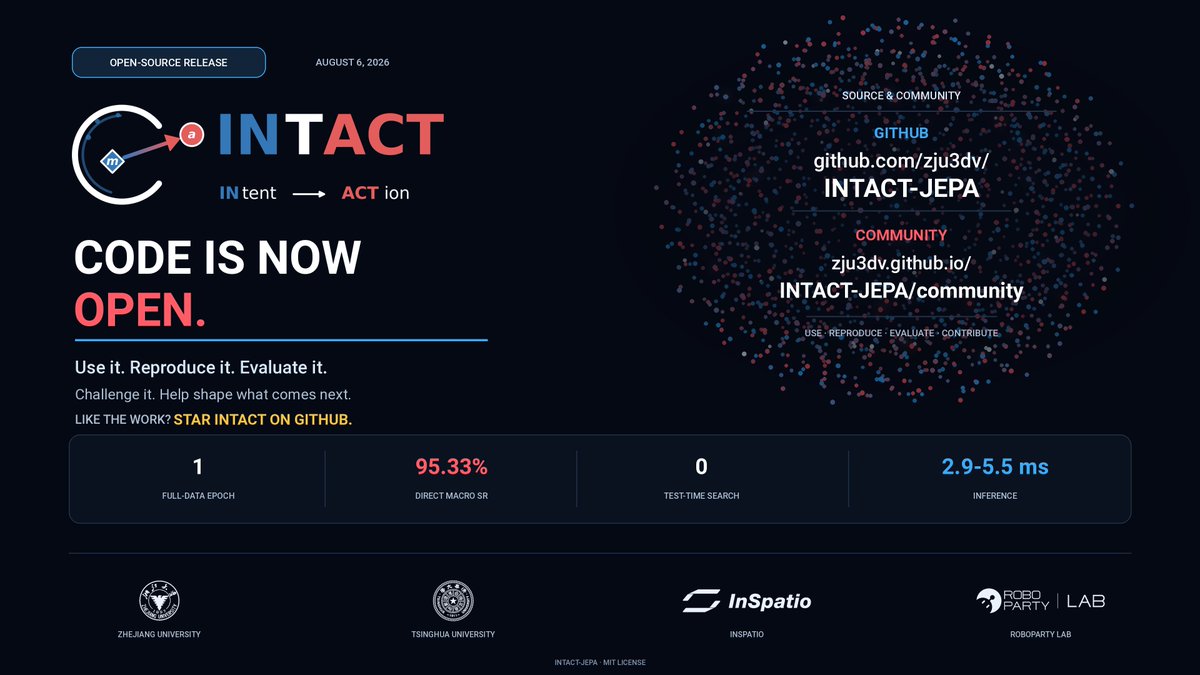
🚀 INTact-JEPA is now open source!
A simple idea: can we learn actionable world representations directly, efficiently, and at scale?
⚡ 1 epoch training
🎯 95.33% direct macro SR
🔍 No test-time search
⚡ 2.9–5.5 ms inference
We hope this becomes a strong and accessible baseline for the World Model community.
Try it. Break it. Improve it. Let’s build the next generation of world models together. 🌍
🔗 Code: https://t.co/mcocYN8OFK
INTACT-JEPA is now open source! 🔓
⚡ 1 epoch · 95.33% Direct macro SR
🔎 0 search · 2.9–5.5 ms inference
Use, reproduce, and evaluate it. Issues and PRs welcome. Join our World Model community. Like the work? Give us a ⭐
💻 https://t.co/R8KvxTmy4H
💬 https://t.co/LhsRcEJvWj
@vineethcyeevani@HaoZhao_AIRSUN Sharp point. I’m Junhan Sun, author of INTACT. Failed rollouts still provide valid dynamics but shouldn’t be imitated. A WM could score/reweight them; INTACT proposes and hybrid search refines. I’d love to discuss how you’d formulate this grader.
@MozarellaPesto I’m Junhan Sun, the author of INTACT, and your thoughtful advice means a lot—it’s both helpful and encouraging.We’re thinking seriously about this for INTACT v2.I’d love to connect and stay in touch. I’ve just sent you a DM! Thanks again for the thoughtful feedback!🥰
@MozarellaPesto Great point, Matteo—thanks for reading INTACT so carefully! Our intent representation is deliberately intuitive, not abstract. Action/history context helps disambiguate some cases, but pure goal conditioning can still merge causally distinct outcomes, exactly as you noted.🫡
I like this. it’s similar to a post I wrote recently. You can treat a video model as an implicit policy, you can also treat a latent action model as a policy.
Only downside with pure goal-conditioning is that goals can be under-specified e.g. glass empty = spilled or drank.
https://t.co/YuO8oLeBJ9
LeWM predicts action effects, but searches 9,000 sequences to act.
Introducing INTACT: an end-to-end unified JEPA that completes the other half of LeWM: intent to action.
Only 1 epoch. 0 search.
95.33% Direct macro SR.
2.9-5.5 ms inference.
~300× lower planning latency.