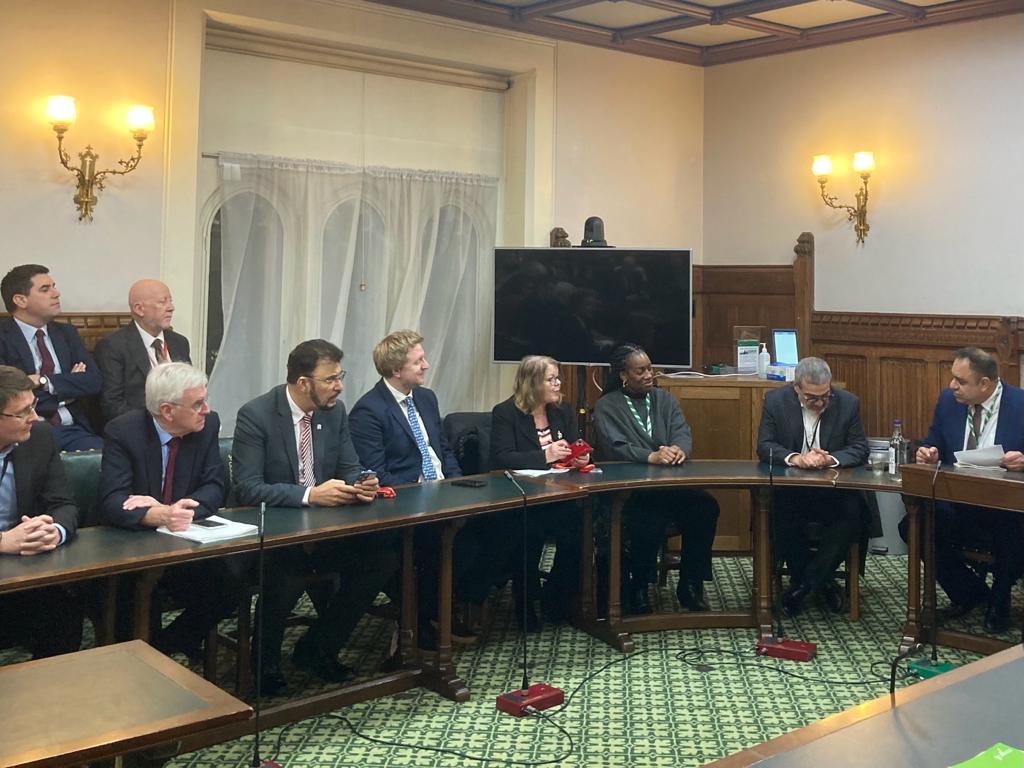
Yesterday, I was privileged to join MPs in a meeting with the heroic Professor Ghassan Abu Sitta.
He provided a harrowing account of his experience working as a surgeon in Gaza over recent weeks.
WARNING: the following thread contains very distressing details. 1/8
I've heard rumors that some of the Savile Row tailoring houses have thought about moving off the Row in response to skyrocketing rents. Why they don't, I don't know. But there are two good reasons to stay clustered around the street. One obvious; one less obvious.
The obvious reason is that Savlie Row has a lot of cachet, and despite all the talk about quality and craftsmanship, the average bespoke customer still gets lured in by romantic stories (which is fine, as fashion is partly about romance). Many want the "Savile Row experience."
The other, slightly more interesting and lesser-known reason is that there are benefits to all these tailors being clustered within walking distance of each other. In his 1960 book, Nothing but the Best, Thomas Girtin chronicles what he saw as the waning years of English craftspeople. He talks about the people who made saddles, canes, single-stick umbrellas, gloves, fishing rods, and hats.
In the chapter about bespoke tailors, one strong theme emerges: the people behind these shops were typically working-class, having grown up in a tailoring family and following in their parents' footsteps. Many entered the trade because they had few other economic opportunities. They were proud craftspeople, but also heavy drinkers. Once they got paid, they would "go on the cod"—indulging in monster drinking bouts until they had spent all their earnings.
At Henry Poole, a beerman named Tom used to come into the workshop twice a day with bread, cheese, and sandwiches stuffed into all of his pockets. He also carried a broomstick stuck with a bunch of nails, from which hung pots of beer. The tailors bought things from him—beer to drink while working, a little snack to munch on. Girtin also noted that tailors would often sneak off to the pub during lunch, and hang out at the pub after work. Some came to work drunk. The head of one firm recalled walking back from lunch and seeing one of his most talented tailors at the bottom of Sackville Street, blind drunk and spouting Shakespeare. He took him back to the workshop, but when the craftsman pitched his head down to enter the basement, he fell about twenty feet onto his head.
J. King Wilson, a cutter who wrote the book The Art of Cutting and Fitting, once neatly summed it up: "Beer and tailoring go hand in hand."
This all sounds very fun and riotous, which I'm sure it was. But beer culture also had an important impact on the trade. These craftspeople worked at different houses along Savile Row, but when they came together at the pub, they would trade notes. "I have a client with this posture, and I'm having trouble fitting him. What do you suggest?" A cutter at another firm would give some ideas. There would be debates about tailoring techniques and gossip about the trades. Suggestions for where to get better cloth. This sharing of knowledge is good for the trade, and it happens naturally in what Ray Oldenburg once termed "third places"—social spaces that are separate from your home and workplace.
A few weeks ago, I interviewed Nina, the head cutter at Edward Sexton. I asked her if his beer culture still existed around Savile Row. She suggested that it's perhaps not as lively as it once was, but yes, it still exists. She informed me that all the tailors used to frequent a particular bar, but since that place has been taken over by finance types, the tailors have moved to a different location. And yes, over drinks, they still discuss tailoring. In fact, someone recently overheard her and a colleague discussing tailoring over drinks, and they came over to chat. This young person was interested in learning how to become a tailor. Nina offered to give this person an apprenticeship if they came over the next day.
So yes, it's possible for tailors to move off Savile Row. Supposedly, some have thought about doing so, as the landlords are squeezing them with rents. But it would be such a great loss if these tailoring houses dissipated. It would be a loss to see this tiny section of the world lose what made it famous, and it would be harder for these tailors to share knowledge. There's a benefit to keeping everyone there.
Our NHS is on its knees. And now big pharma companies are trying to squeeze another £2.5 billion a year out of it, by sabotaging a key medicines pricing deal.
We can’t let the NHS be broken beyond repair – take 30 seconds to sign the petition & urge the UK government to step in
Did you know?
A new £100 million private hospital will be opening next year on the grounds of an NHS trust.
The new hospital will belong to a US-owned private healthcare company, HCA UK.
RT if you think everyone should be aware.
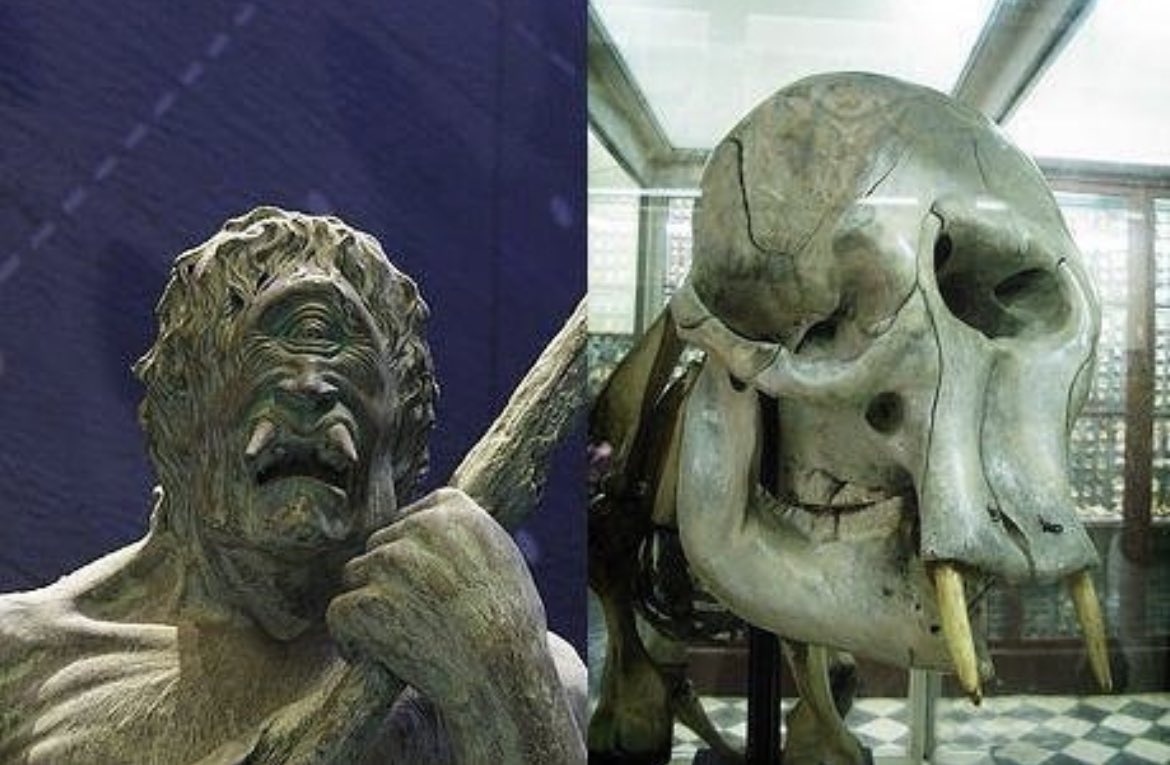
The fossil skulls of Pleistocene dwarf elephants scattered throughout the coastal caves in Italy and the Greek islands most likely inspired the one-eyed Cyclopes in ancient Greek mythology.
During the Pleistocene ice age (2,580,000 to 11,700 years ago), land bridges emerged, allowing ancient elephants to move to emerging islands to escape predators and/or find new food sources. As sea levels rose around the Mediterranean, these ancient elephants became trapped and had to compete for limited food, leading to the island rule, where mammals tend to shrink or grow depending on resource availability in their environment.
The isolated ancient elephants evolved into different species depending on the island they found themselves on. Those on Cyprus were approximately 6 feet tall, nearly double the size of the ones found on Sicily and Malta. Humans arrived on the islands around 11,000 years ago, leading to the over-hunting and extinction of the ancient elephants within a century.
By the time the Romans and Greeks came to occupy the Mediterranean islands, all that remained were skulls twice the size of those belonging to humans, and these massive skulls had a single hole in the center, which the Greeks and Romans mistakenly believed was an eye socket. In fact, it was a socket connected to the trunk of an ancient elephant.
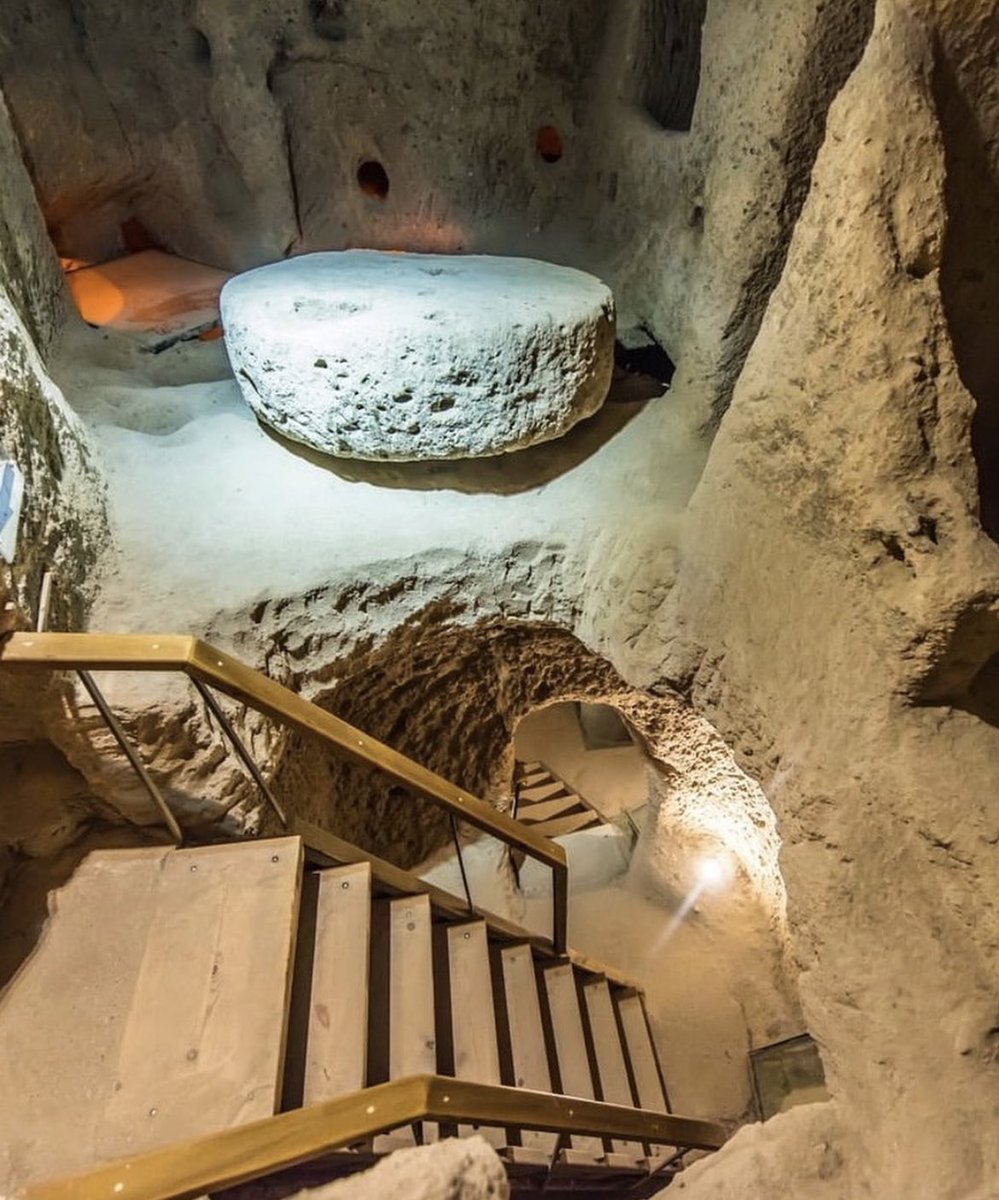
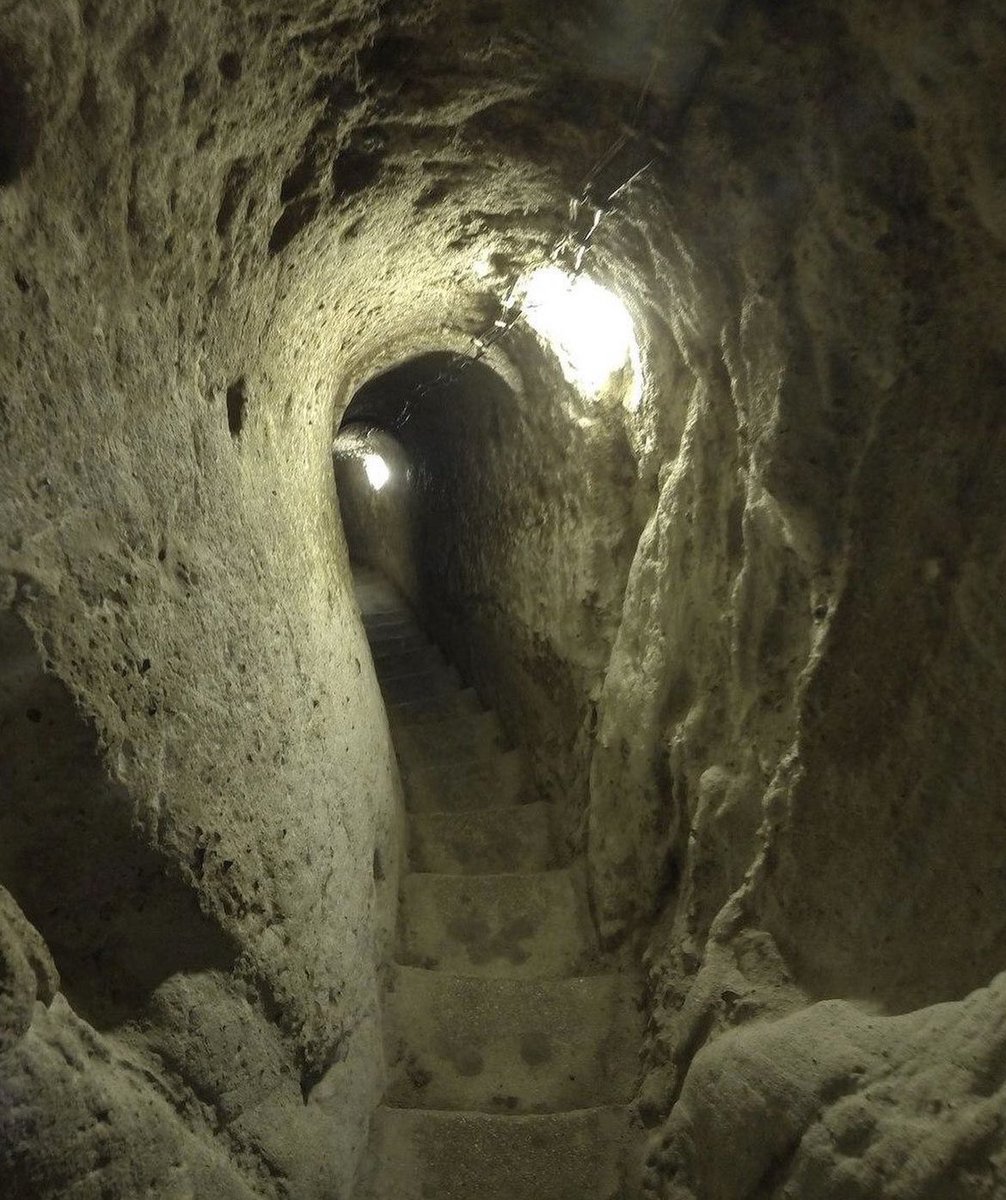
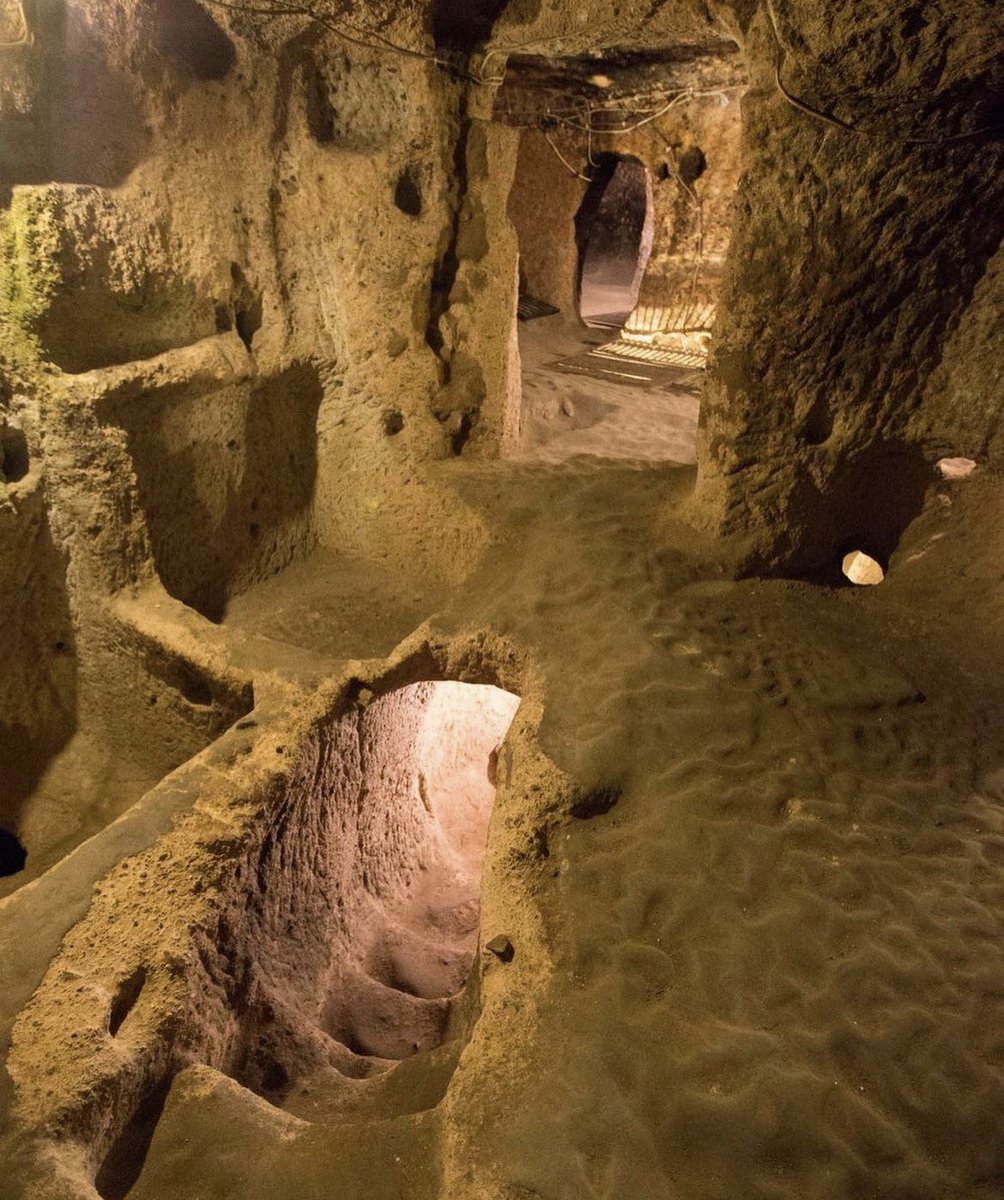
While trying to recapture his runaway chickens in the 1960s, a Turkish homeowner stumbled through the wall, revealing an abandoned underground Turkish city, now known as Derinkuyu,
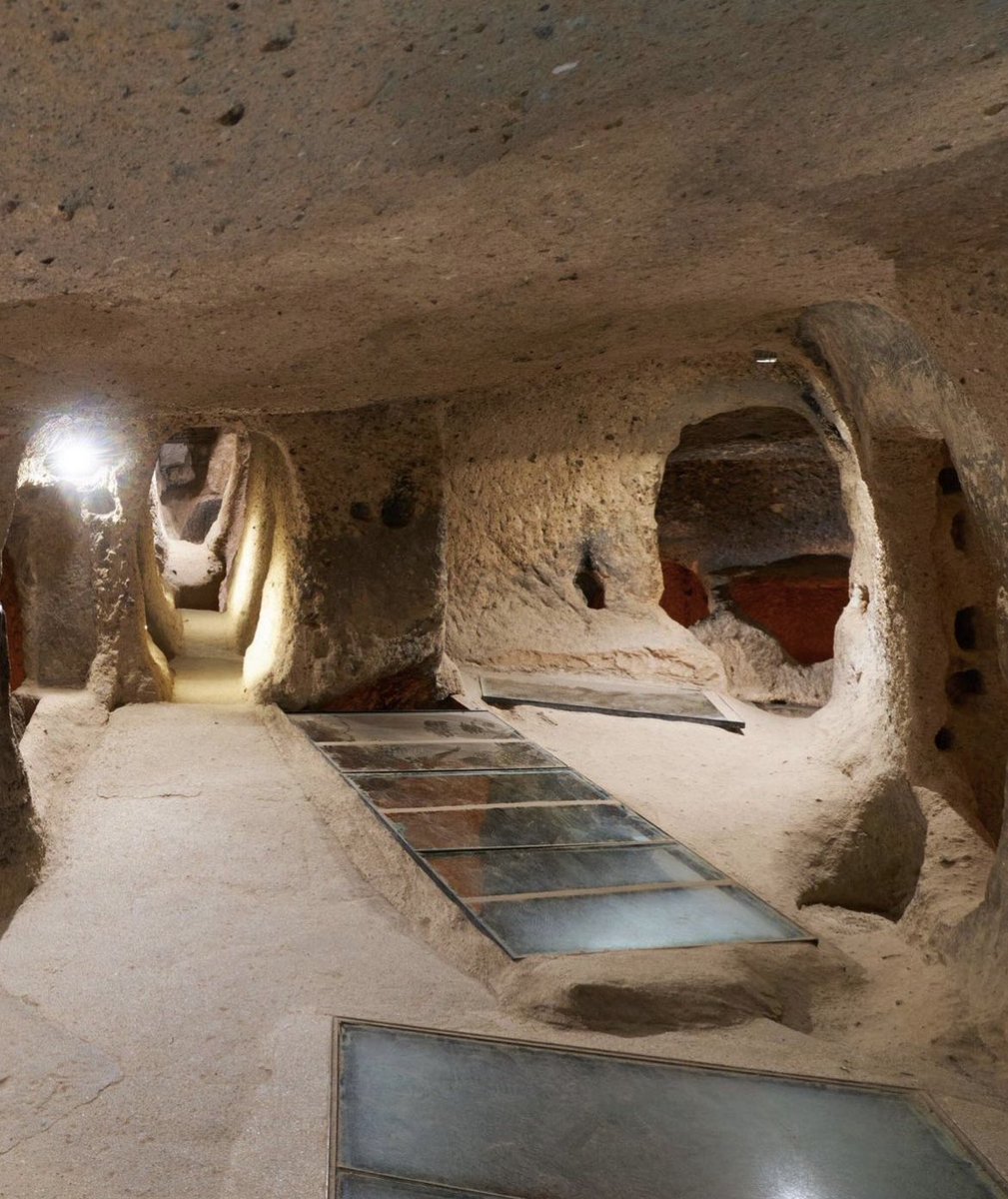
Derinkuyu is the largest excavated underground city globally, burrowed more than 280 feet beneath the Central Anatolian region of Cappadocia. It is believed to connect to over 200 smaller underground cities discovered in recent decades.
Inside, researchers found 18 levels of tunnels containing various facilities like dwellings, food storage, stables, schools, wineries, and a chapel. The city also had a ventilation system to provide fresh air and water.
Its exact construction date is uncertain, but ancient writings dating back to 370 BC mention its existence. The city served as a storage place originally but later transformed into a secure bunker to escape from invaders, designed with narrow, low hallways and blocked doors with movable boulders from the inside.
While the architects remain a mystery, it is thought that the Hittites and later the Phrygians contributed to its construction. Derinkuyu reached its peak population of 20,000 during the 7th-century Islamic raids on the Christian Byzantine Empire.
After two millennia of use, the city was abandoned in 1923 by the Cappadocian Greeks, who fled to Greece after the Greco-Turkish war. Today, Derinkuyu is a UNESCO World Heritage site and welcomes curious visitors keen on experiencing life underground.
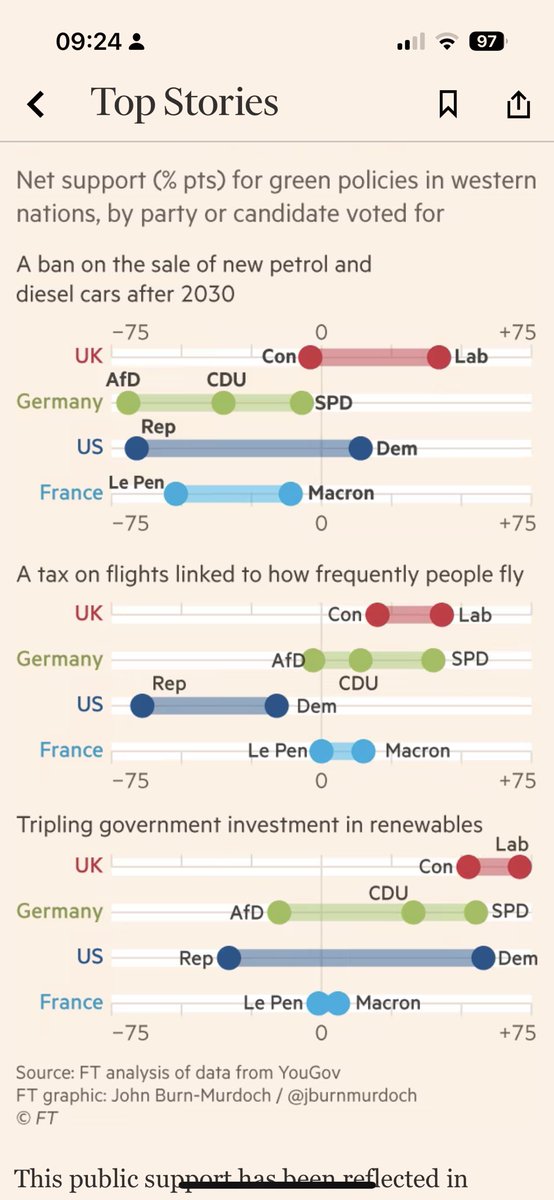
Incredible chart from @jburnmurdoch in @FT which shows how extraordinary the UK’s climate consensus is. Working in an organisation that looks at polarisation in different countries I get to see how despite our problems, we’re relatively far less polarised. https://t.co/7DoZLPqSBV
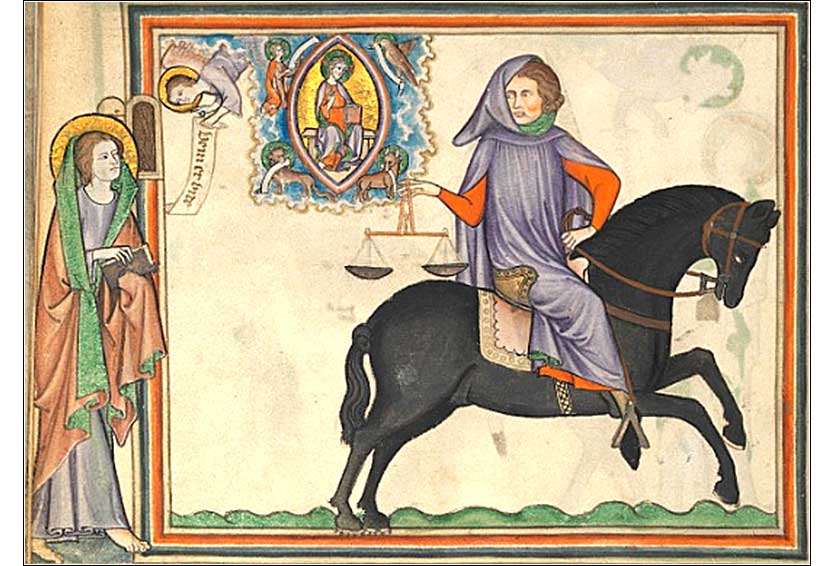
3rd horseman is commonly called Famine, but he specifically does NOT blight crops, does not damage food. His weapon is the scales, and "destroys" not by weather or worm, but market manipulation.
A closer name might be "Inflation" or "Capital" or "Bread Fixing" or "Galen Weston."
Really confused why journalists with children aren’t doing everything they can to demand system change when the science so clearly says climate change is going to kill their children https://t.co/8A4r2QjlSm
It is painful to witness the desecration and decay of the Whitechapel Bell Foundry, especially when we want to buy it to start casting bells again and cherish the historic buildings
Financial Times editor: We need a new Marshall Plan on #climate. There’s too much to do, and given the urgency and the need to get the solution right, this isn’t a task for your favourite ESG-focused portfolio manager or the tech bros. The sheer scale of the physical infrastructure that must be revamped, demolished or replaced is almost beyond comprehension. Governments, not BlackRock, will have to lead this new Marshall Plan. And keep doing it. The western nations that did so much of the damage will have to finance the transition in the developing world — it is astonishing that this idea is still debated. Massive deficit spending will be necessary, not a new ETF. For all the cleantech advances and renewable deployment in recent decades, fossil fuels’ share of total global energy use was 86 per cent in 2000 and 82 per cent last year. Capitalism won’t deliver the energy transition fast enough . . ." Derek Brower, US energy editor of the Financial Times
10,800 Years Ago, Early Humans Planted Forest Islands in Amazonia's Grasslands
An aerial shot of the Llanos de Moxos region in South America shows the strange isolated mounds of trees that grow among expansive grasslands. Scientists’ explanation for these islands: Ancient humans planted and cultivated crops, making them some of the oldest domesticated plants in history.
Every spring, rains and snowmelt swamp vast grasslands that stretch between the Andes Mountains and Amazon rainforest in northern Bolivia. But thousands of tree-covered mounds stand solid, several feet above the flooded grasses.
“They are like islands in a sea of savannah,” says Umberto Lombardo of the University of Bern, Switzerland. In 2006, Lombardo first stepped onto a forest island in this Llanos de Moxos region, puzzling over how such features could form naturally. “As a geographer, I had absolutely no explanation for them,” he recalls.
One theory suggested that over the past few centuries, ranchers had carved away lush rainforest to create pastures, but left scattered groves of about 300 trees each. Yet that didn’t explain why the trees grew on higher ground.
It turns out the forest islands were made by people, and are much older than suspected. Lombardo and colleagues pieced together the history, published in May in Nature: Roughly 10,800 years ago, humans cultivated crops in the Llanos de Moxos — which puts them close in age to the oldest known domesticated plants, cultivated in the Middle East about 12,000 years ago. This confirms Amazonia as one of the first places on Earth where people domesticated wild species.
Their gardens piled up fertile compost, which allowed trees to root above the seasonal flood line. Rather than wrecking the environment, the artificial forest islands enhanced biodiversity, providing habitat for rare species to this day. Lombardo “is a real hero in this … really pushing research,” says José M. Capriles, study co-author and archaeologist at Penn State.
In 2012, he and Lombardo launched excavations, which confirmed that three mounds were made by ancient people, based on burned clay, food scraps and human burials found at the sites. For the new study, Lombardo used Google Earth to map 6,643 forest islands in a region about the size of Illinois. “It was like a Zen activity just surfing and clicking on all these points,” he says.
The researchers probed some and found archaeological debris similar to the fully excavated sites in 64 out of 82 of the tested mounds between 2,300 and 10,850 years old. From that ratio, they estimated humans erected at least 4,700 of the 6,643 forest islands visible on Google Earth.
In the probes, the team also identified microscopic plant remains from the oldest-known squash in Amazonia and the oldest-known crops of the tuber cassava (also known as manioc or yuca) in the world, as well as nearly 7,000-year-old corn — a plant domesticated about 2,000 years earlier in Mexico. It seems people passed seeds from one community to the next, spanning over 2,000 miles from Central to South America.
This 28-year-old chimp was in absolute awe when she went outside and saw the sky for the first time ever. She had survived a research lab in New York, where animals were kept in small cages.
If you only read one bit of news this weekend, make it this one - on the front page of the BBC’s website. In my whole career I have never come across a personal story as extraordinary - and shocking - as that of former Barclays trader Peter Johnson: https://t.co/CuoXGdIcZr