A Celestial Dance Like No Other: The Swapping Moons of Saturn
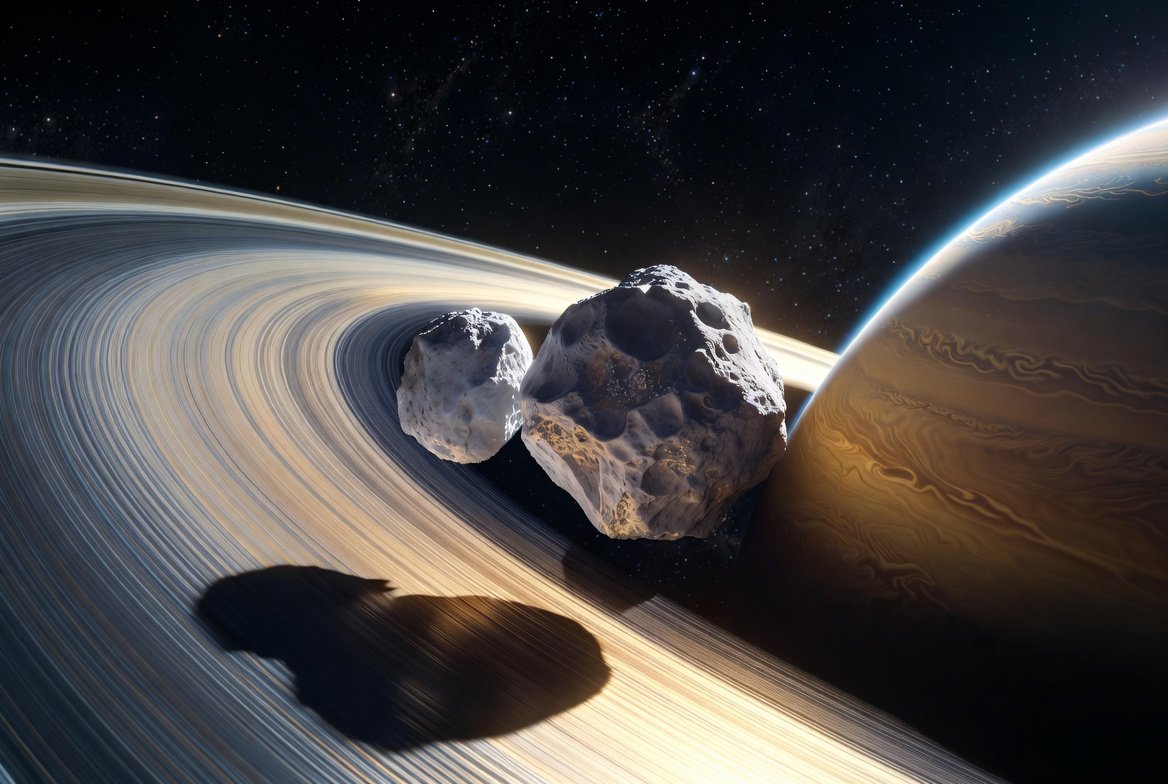
In the vast ring system of Saturn, two small moons perform one of the most extraordinary orbital ballets in the entire Solar System: Janus and Epimetheus.
These two icy worlds share nearly identical orbits around Saturn, separated by just 30 miles (50 km) — a cosmic hair’s breadth in planetary terms. In any normal situation, two objects this close would eventually collide. But nature has found an elegant solution: every four years, they execute a graceful gravitational swap.
As the faster inner moon catches up to its slower companion, their mutual gravity takes over. They gently tug at each other, exchanging orbital paths. The inner moon moves outward into the slower lane, while the outer moon drops inward to the faster one. Then they drift apart again — only to repeat the entire cosmic tango four years later.This intricate dance has been going on for billions of years, preventing disaster while allowing both moons to coexist peacefully in the same orbital “highway.” It’s a phenomenon found nowhere else in the Solar System — a beautiful example of nature’s creativity in maintaining cosmic harmony.Janus and Epimetheus prove that even in the cold, airless reaches of space, gravity can choreograph movements more elegant than anything we could imagine. Beautiful Illustration of the Swapping Moons: