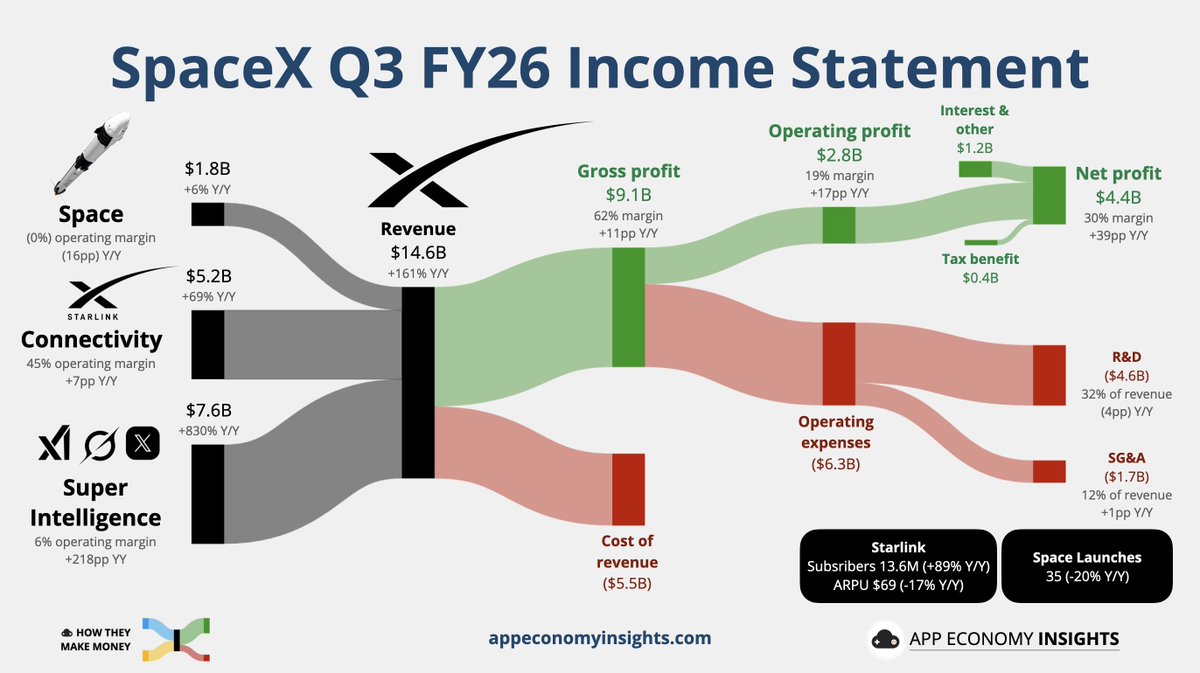
Don't get caught up in capex noise or the concept that $SPCX is an AI and Space business. They're the worlds only sovereign AI company and early in building the what I believe will be the world's most valuable company.
"We are also, frankly, hounded relentlessly by every hyperscaler and by dozens of smaller companies to rent more of our compute. So we could rent out our compute several times over if we said yes to everyone. That's just the situation here."
- Elon $SPCX call
"Our belief is that the value of compute per watt will increase over time, not decrease. And the reason for that, I think it should be obvious to people really is that as you improve the AI software, as the models get better and better, you get more useful intelligence per watt. And the value of that compute is proportionate to the useful intelligence per watt. And that's why you see things like even old computers like H100s renting for more than they rented when they were new. And I think that's likely to continue.
I think we're going to face a shortage of super intelligence compute. And that shortage is going to remain for a long time. So I think the smart move is to do short-term contracts and to and essentially to place the bet on useful intelligence per watt increasing rapidly, which obviously has done. So that's what's happened so far."
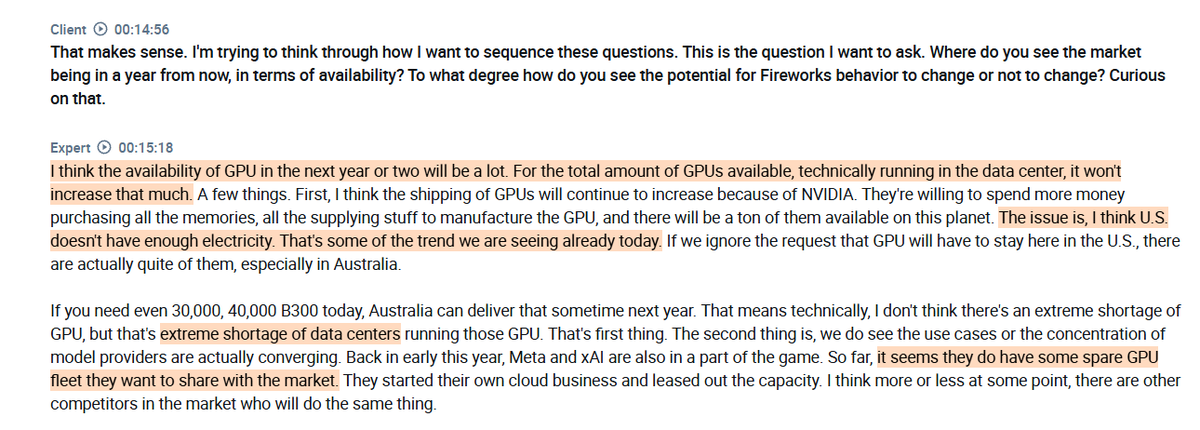
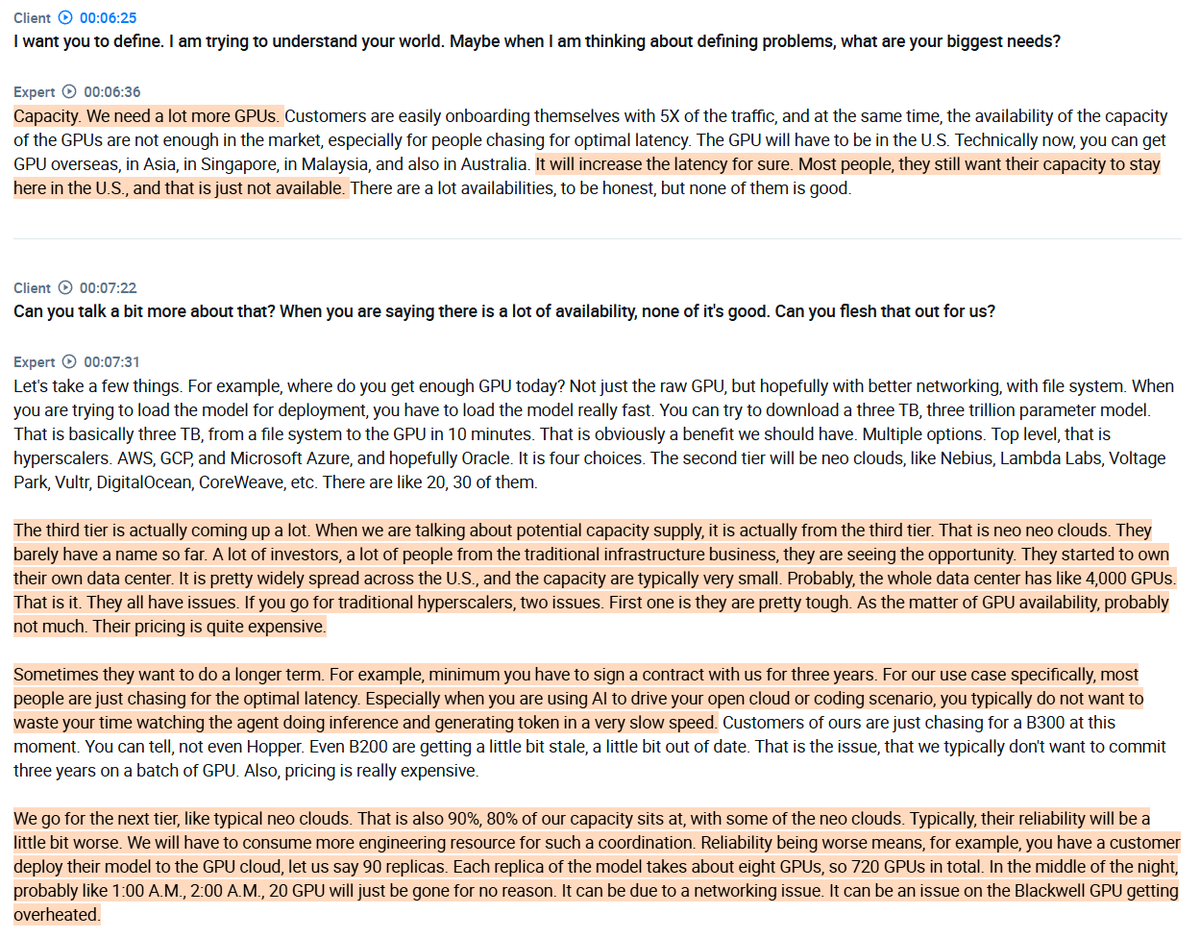
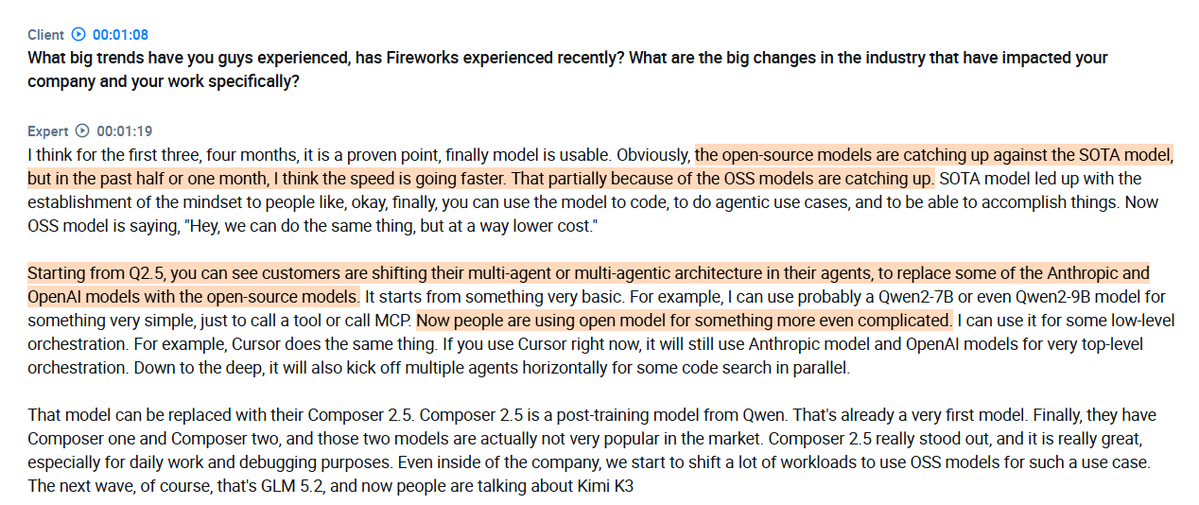
Former $GOOGL employee on why data center capacity and electricity are the real bottlenecks, not GPU production itself, and how unreliable some of the neoclouds are ($AMZN, $GOOGL, $MSFT, $NVDA):
1. According to the expert, open-source models are closing the gap with frontier models faster than expected, with customers increasingly replacing Anthropic and OpenAI models in multi-agent architectures with open-source alternatives starting from Q2 of this year. The shift started with simple tasks like tool calling and MCP, but has moved up the stack to low-level orchestration.
2. The expert identifies capacity as the biggest constraint at the moment, with certain companies' traffic growing 5x while GPU availability, particularly in the U.S. where latency requirements are tightest, simply cannot keep up. Sourcing capacity overseas in Asia or Australia is technically possible but adds latency that most customers will not accept.
3. Hyperscalers offer reliability but are expensive, require multi-year commitments of three or more years, and have limited availability of the latest hardware, with customers already chasing B300s. AI-native companies tend to gravitate toward neoclouds due to hyperscaler pricing and contract rigidity, but neoclouds come with their own reliability issues, with GPUs dropping off unexpectedly and requiring engineering resources to manage fleet stability around the clock.
4. The third tier consists of smaller independent operators who have invested in GPU racks, seeing the opportunity to lease out capacity and recoup costs within a year or two, with the remainder being pure profit. The expert describes these as essentially unusable in practice, with operators who do nothing more than find land, install racks, connect electricity, and set up cooling, with no real cloud management, maintenance, or operational expertise behind them.
5. The expert expects overall GPU availability to increase meaningfully over the next year or two, with $NVDA continuing to ramp production. The real bottleneck is not GPUs themselves but data center capacity and electricity in the U.S. On the supply side, the expert also sees players $SPCX beginning to lease out spare capacity to the market, with more likely to follow.
6. The expert notes that U.S.-based neoclouds typically require 20-30% prepayment upfront, with the remainder paid monthly or quarterly over the contract term, and rebates negotiated at the end for any reliability incidents like traffic loss. APAC-based providers operate differently, with no prepayment required at all.
found on @AlphaSenseInc
“Anthropic is more afraid that the government might enforce rules against Anthropic, than they are worried about the ability of the government to enforce rules against everyone.”
https://t.co/oTPBSje60E
We estimate $414 billion in overall AI ARR by the end of this year (ex-China)
1. $187 billion in ARR from Anthropic and OpenAI (split between the labs and clouds who resell their models).
2. We estimate that ad-based ARRs for the two internet giants - Meta and Google - have been boosted by $95 billion over the past 2.5 years thanks to AI (based on the excess of their realized, high ad growth rates vs normalized growth rates). We estimate that this will increase to $108 billion by year end.
3. The various clouds - excluding frontier lab revenue - should be about $66 billion in AI ARR by the end of this year.
4. AI native apps and SaaS are generating $33 billion in AI revenue.
5. Smaller line items such as other frontier AI (Grok, Gemini subscriptions, etc.) and how AI is benefitting other ad networks (such as Amazon, Applovin, Unity, etc.) add another $20 billion in ARR.
Taking reasonable assumptions, such as a 6 year life for the equipment, this should give an overall 12% IRR on the $931 billion in AI capex made over the past 3.5 years.
Link with the details below
A more capable #AI model with a more accurate world view or relational intelligence won’t solve relationslipping. Human decisions to deepen relationships and connect our augmented capabilities with the people surrounding us everyday will.
https://t.co/coitUJZqLL
We're in war time in a figurative sense, and revolutionary periods are times where change happens very quickly, where you have to make bets and take risks that may or may not pay off, but you have to make them. Not making bets is no longer an option.