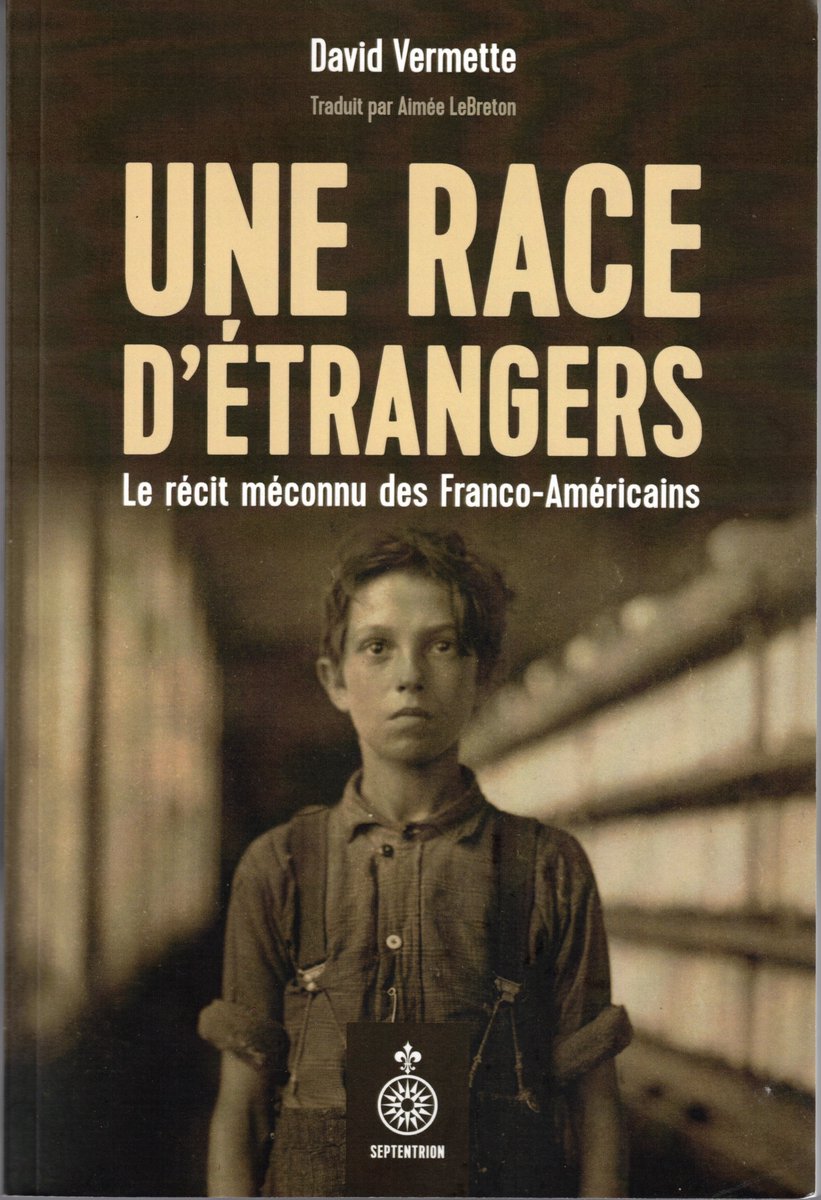
Enfin! Aujourd’hui voit le lancement de la traduction française de mon livre. En 2015, j’ai dit que l’objectif était de le publier en français comme en anglais et que je voulais que Les éditions du Septentrion soit l’éditeur de cette traduction. Après neuf ans, le voici ! #AmFr
@lobbymontreal@RemiFrancoeur1 Cependant, je ne m'attends pas à un déluge d'émigration des États-Unis vers quelconque région du Canada. Je pense que très peu de ceux qui cherchent la citoyenneté déménageront. Ceux qui déménageront seront de bons citoyens du Québec. Le Québec pourrait reconnaître cet avantage.
@lobbymontreal@RemiFrancoeur1 Le Québec devrait être heureux d'accueillir les descendants du Québec et de l'Acadie, car ceux qui cherchent cette citoyenneté le font parce qu'ils respectent l'histoire, la culture et la langue. Si c'est bien géré, leurs enfants parleront français et seront pleinement Québécois.
@VincentGeloso I'm looking forward to reading this since I'm writing an article for a special issue of a popular history journal in QC about the "agricultural crisis" as a cause of emigration to the U.S. I'm arguing that "structural economic change" is a more apt frame than "crise agricole."
Lewiston is a former industrial town where the largest cohort are of French-Canadian descent, the descendants of textile mill workers. When the French-Canadians came in the 1865-1930 period, people said they were "half-savage" and were replacing the "real" white people.
Imagine, someone in the US gov't thought it was a good idea to take thousands of sub saharan muslims directly from Africa and dump them on the small rural historic previously 100% white town of Lewiston ME. Just think of how much they despise you to do this to you.
@OnlyInBOS I remember when it was in the Hingham shipyard, a wooden building with "19" stencilled on the side. It just happened to be Building 19 at the old shipyard.
@st_louis_stan When they were still trading in the West Indies and China, Brahmins put their young men on board ships so they could learn the business from the ground up. They had a teenager running their opium business in China b/c his boss died. They gave young people serious responsibilites.
@Nas_tech_AI Generational categories aren't even a fact, much less someone's interpretation of their respective mental models. Reducing the experience of tens of millions of diverse people to a sentence or two is unlikely to produce anything remotely factual. All this does is confirm biases.
@OldNewYork1664 Consider how often they forget the Catholic Francophone stream in the development of the U.S., e.g. the fact that almost all of the major cities of the midwest developed from settlements founded/co-founded by Francophones.
@VincentGeloso That's a stretch. I grew up with Québécois people outside of Québec and I often tell people that one of the clearest cultural differences b/w my family and our neighbors is that for us the British were enemies while for others they were friends, allies, the mother country even.
I am going to be on the NPR radio call-in show "Maine Calling" tomorrow (3/23) at 11 A.M. to Noon. We will discuss immigrants to that state and the reception they received there. I'll be speaking to the Franco-American story there, of course.
https://t.co/SEwKLqcqOt
#NPR#Maine
But those who were there will recall that the whole period from the oil embargo of the early 70s, through stagflation, and into the nadir of the early 80s was grim as hell and everyone was wondering if young people had a future. ("Go into computers!" said your parents.) (3)
The graphs showing housing prices vs. real income are missing a variable: interest rates. In 1981, rates rose to near 19%. It was incredibly expensive to borrow money back then. And 1981-82 also saw 11% unemployment and inflation at 10%. The worst economy since the 1930s. (1)
The problem with the generational battle over "who had it worse" is that younger people don't rate the real ups and downs that happened over the decades. They think that the whole period from 1945 to 2000 was like a happy 1950s sitcom where everything was easy and wonderful. (2)
One of the lessons of the Little Canadas story is that, in a French-speaking place, it must be economically viable to speak French. An economically vibrant francophone community is a safeguard of the language. If you work in English Mon-Fri the pull can be irrestible.
There were attempts at repression but that's not why the Little Canadas dissolved. The mills moved elsewhere. Economics called those neighborhoods into existence and when the cheap labor was no longer needed away they went. The F-As followed jobs where English was the language.
Le français ne disparaît pas d’un coup. Il s’efface d’abord du quotidien, puis du quartier, puis de la mémoire. Dans ce texte, je raconte ce que j’ai vu dans mon Manchester natal — et pourquoi j’ai choisi le Québec. À lire ici :
https://t.co/7A4pPtDihP
@SpockPQC@AlexClouti86748@RemiFrancoeur1 The "quarter million francophones" (c. 1930) number counts only the Canadian-born. There were many more than that, since U.S. born kids spoke French for a couple generations here. It's credible that there were a million or more French speakers in those states 100 ys ago.
@SpockPQC@AlexClouti86748@RemiFrancoeur1 Remi's ancestors built your country as much as yours did. The Franco population of New Hampshire was not tiny at one time. One half of all the foreign born people in NH were of F-C origin and there were more than quarter million francophones in New England. It's valid analysis.