Tax basics most people don’t actually understand (but should)
1. Taxes are marginal, not “one flat rate”
You don’t pay the same tax rate on every dollar you earn.
Each additional dollar is taxed at your marginal rate, while earlier dollars are taxed at lower brackets. This is why you do not say no to more income.
2. Taxes are progressive
As your income increases, only the income above each threshold moves into higher brackets. Earning more money never makes you worse off.
3. Investment gains are taxed based on time frame
- Short-term gains (held ≤ 1 year) → taxed as ordinary income
- Long-term gains (held > 1 year) → taxed at preferential rates
- Time matters more than most realize. But also be aware of 3.8% Net investment tax on top of this.
4. Deductions ≠ credits
A deduction reduces your taxable income. The actual savings equals your marginal tax rate x the deduction. Credits on the other hand reduce your tax bill dollar-for-dollar. Most are deductions.
5. Lowering taxes today isn’t always the best move
Some strategies reduce taxes now but increase total lifetime taxes. Good planning looks across decades, not just this year’s return. This could mean C Corp even though you pay more tax today but you get QSBS. It could mean Roth conversions or contributions vs pre-tax cause you are in a lower bracket. Think lifetime taxes.
6. Tax savings should not drive every decision
I see business owners make bad business and investment decisions all the time just to “save on taxes.” A bad decision with a tax benefit is still a bad decision.
7. Most people don’t itemize
Because of the standard deduction, many don’t actually benefit from:
- Mortgage interest
- Charitable giving
- State and local taxes
At the end of the day, taxes matter
They are one of the most controllable parts of planning for high net worth folks
But... decisions should not be made ONLY on taxes
What is asset allocation — and what is rebalancing?
Asset allocation is how a portfolio is divided among different types of investments — such as stocks, bonds, and cash.
Rebalancing is the process of bringing that mix back to its original target when it shifts over time.
Why does it shift? Because different investments grow at different rates. A portfolio set to 60% stocks / 40% bonds might drift to 70/30 after a strong equity run — changing the portfolio’s risk profile in the process.
To rebalance, an investor would sell some of the over-weighted asset and add to the under-weighted one.
One practical distinction: in tax-advantaged accounts (IRA, 401(k)), rebalancing generally doesn’t create a taxable event. In taxable accounts, selling appreciated assets may trigger capital gains.
Tax-loss harvesting — how this powerful tool works:
1/ Tax-loss harvesting involves selling a security in a taxable account that has declined in value, in order to realize a capital loss. This loss can then be applied to offset capital gains realized elsewhere in the portfolio.
2/ If realized losses exceed realized gains, up to $3,000 of the net loss may be used to offset ordinary income in a given tax year (per IRC Section 1211(b)). Losses exceeding this threshold carry forward to future tax years.
3/ After selling the security, an investor may reinvest in a different — but not "substantially identical" — security to maintain market exposure. The IRS wash-sale rule (IRC Section 1091) disallows the loss if a substantially identical security is purchased within 30 days before or after the sale.
4/ Tax-loss harvesting applies only to taxable brokerage accounts. It does not apply to tax-advantaged accounts such as IRAs or 401(k)s, where gains and losses are handled differently.
5/ The net benefit of tax-loss harvesting depends on factors including the investor's tax bracket, the nature of the gains being offset (short-term vs. long-term), state tax rules, and transaction costs.
Tax strategies like this should almost always be evaluated in the context of an individual's full financial and tax situation.
How employer 401(k) matching works — the basic structure:
Many employers offer a matching contribution to employee 401(k) accounts. Matching formulas vary by plan, but a common example:
"Dollar-for-dollar match on contributions up to 4% of salary"
Under this structure, an employee contributing 4% of their salary would receive an additional 4% from their employer. An employee who is only contributing 2% would receive 2% from their employer.
The employer contribution is part of the total compensation package. It is separate from — and does not count toward — the employee's annual IRS contribution limit ($24,500 in 2026; $32,500 for those age 50+).
It’s important to note that many plans include a vesting schedule, meaning employer contributions may not be fully owned by the employee until certain tenure thresholds are met. Reviewing your specific plan documents is the best way to understand your match and vesting terms.
Federal employees: FERS is a comprehensive retirement benefit system worth understanding fully:
1/ FERS provides retirement income from three sources:
• Basic Benefit (defined benefit pension)
• Social Security
• Thrift Savings Plan (TSP)
2/ The TSP offers a government matching contribution of up to 5% of salary. Contributing less than 5% means leaving a portion of your total compensation on the table.
3/ The Basic Benefit pension is generally calculated as: years of creditable service × 1% × "high-3" average salary. (Special categories may use different multipliers.)
4/ The FERS Supplement may provide income between early retirement and Social Security eligibility at 62, subject to earnings limitations.
5/ Your Minimum Retirement Age (MRA) is determined by your birth year and affects when you may access unreduced benefits.
The 50/30/20 rule is a popular budgeting framework — not a one-size-fits-all solution.
50% Needs
30% Wants
20% Savings & Debt
If you're carrying high-interest debt, many financial professionals suggest prioritizing debt paydown before increasing discretionary spending.
Every financial situation is different. A framework like this can be a useful starting point, but your specific numbers will depend on your income, goals, and obligations.
10/ Start Early!
The earlier you start a Roth IRA, the more time your money has to grow tax-free. A $5,000 contribution at age 25 could be worth tens of thousands by retirement, thanks to compounding.
7/ Diverse Investment Options
Roth IRAs let you invest in stocks, bonds, ETFs, mutual funds, and more. You’ve got the freedom to build a portfolio that matches your goals and risk tolerance.
9/ No Age Limit for Contributions
As long as you have earned income, you can contribute to a Roth IRA at any age. Keep investing well into your 60s, 70s, or beyond—no age cap!
6/ Estate Planning Perks
Roth IRAs can be passed to heirs tax-free, provided the account meets the 5-year rule. Your kids or grandkids could inherit a tax-free nest egg
5/ Ideal for Young or Lower-Income Earners
Roth IRAs shine if you’re early in your career or in a lower tax bracket. Pay taxes now while your rate is low, and enjoy tax-free withdrawals when you’re (hopefully) in a higher bracket later.
4/ Hedge Against Future Tax Hikes
Pay taxes now at current rates, and you’re set. If tax rates rise in the future, your Roth IRA shields you from higher taxes on withdrawals.
3/ No Required Minimum Distributions (RMDs)
Traditional IRAs force you to start withdrawing money at age 73, even if you don’t need it. Roth IRAs? No RMDs! Keep your money growing as long as you want. Perfect for passing wealth to heirs.
2/ Flexibility with Contributions
Unlike traditional IRAs, you can withdraw your contributions (not earnings) from a Roth IRA at any time, penalty-free and tax-free.
1/ Tax-Free Growth & Withdrawals
With a Roth IRA, you pay taxes on contributions now, but your earnings grow tax-free. Withdrawals in retirement (after age 59½) are also tax-free if the account’s been open for 5 years.
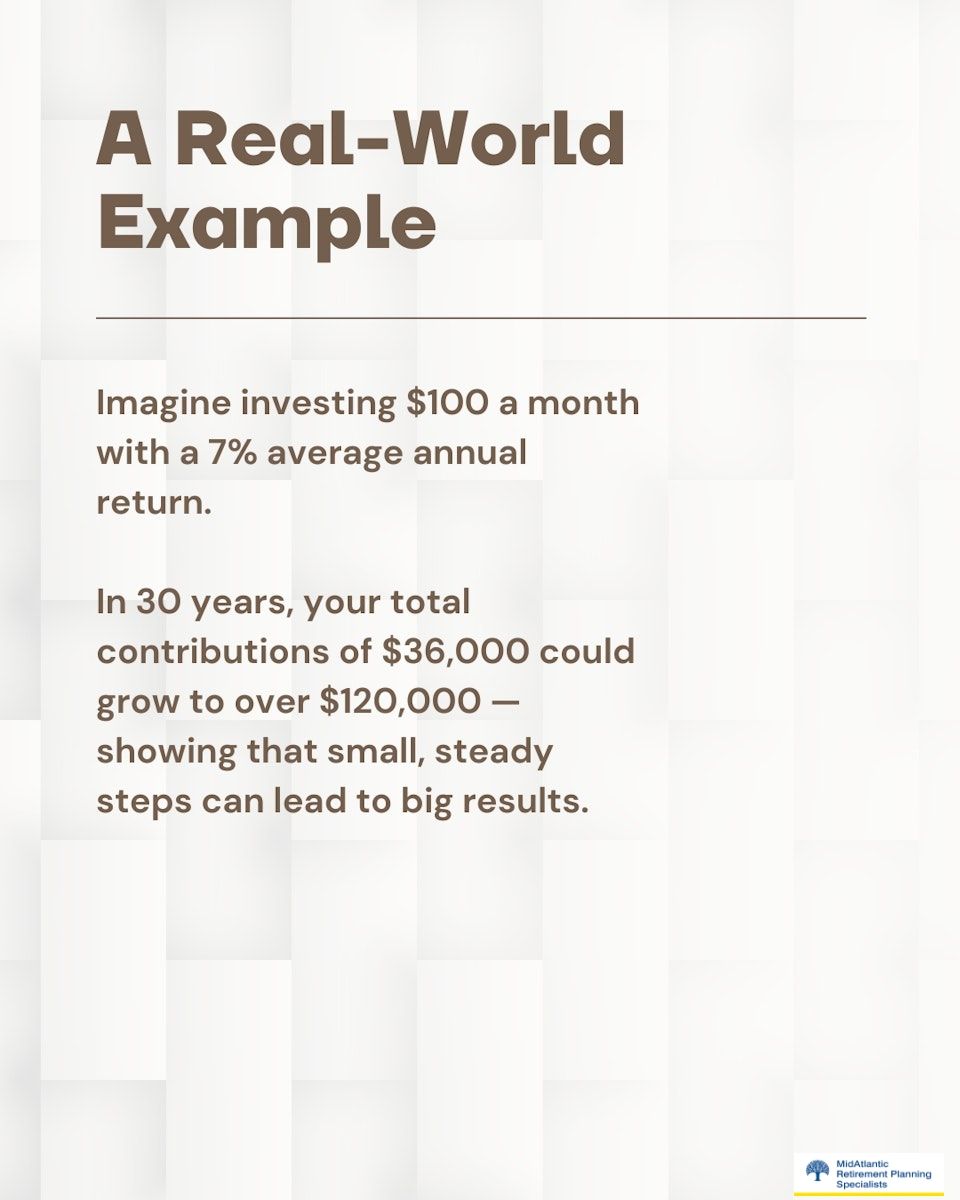
Many believe investing requires a large sum, but the truth is small, steady contributions can be incredibly powerful.
It’s not just about how much you invest today but how consistently you do it over time.