How Egypt Tried to Fool Ethiopia: Article 10.1, the Beautiful Sentence in the 2020 Draft That Was Just an Empty Box (Part One)
A close reading of Article 10.1 of the 2020 Washington draft, and why the only “gift” Ethiopia received was wrapped in ribbon and filled with air.
Let me start with a confession.
The last time I sat down and read the 2020 draft, the one Egypt initialed in Washington on February 28, 2020, the one Ethiopia walked away from, I missed something. Not a small thing. A big thing. I was so busy hunting for the poison in the document that I walked right past the one place where the document smiles at you.
There is one sentence in that whole draft that looks like the clear, headline gift for Ethiopia, the one that can make an Ethiopian reader breathe for a moment. Out of fifteen articles, four annexes, and a stack of exhibits, this is the sentence everyone points to first.
It is Article 10.1. And here is what it says, word for word: “This Agreement is not intended to be and shall not be interpreted or applied as an allocation of the waters of the Blue Nile among the Parties.”
Read that again slowly. Not an allocation of the waters of the Blue Nile. For a country that has spent a century being told by colonial-era papers it never signed that its own rain already belongs to someone downstream(Egypt), that sentence is oxygen. It says, in plain legal language, that this document does not divide the Nile. It does not hand Egypt a written quota. It does not bless the old “historical rights.” On its face, it protects the one principle Ethiopia has bled to defend: the Blue Nile is not already spoken for.
But here is the first problem, and you need to see it before you let your shoulders drop. The draft does not leave Article 10.1 standing alone. The opening of the agreement says it consists of the articles, annexes, and associated exhibits, and that these constitute an integral part of it. In plain language: Exhibit A is not decoration. Annex A is not a footnote. They are bolts in the same machine as Article 10.1. So that beautiful sentence must be read together with the very annexes that quietly do the opposite of what it promises.
So I want to be honest with you, my friends, before I get angry, because I am going to get angry. That sentence is real, and it is good. If I tell you it is worth nothing at all, I am lying to you, and a man who lies to his own people to win an argument is no better than the people he is arguing against.
But here is the question that has been burning in me since I reread it:
What is the use of one good sentence in a house built entirely to trap you?
That is what this whole article is about. So pour your coffee, settle in. Let me take you somewhere first.
Let us drive back to February 2020, into a room I was never in.
I want to be completely clear with you. I was not in that negotiation room in Washington. I have no idea what was actually said. What I am about to tell you is my imagination, a story, a picture in my head, and I am telling you it is imagination so that no one can later say Asrat made up facts. I made up nothing. I am painting a scene. Bear with me.
Picture it. February 2020. A cold Washington conference room. A long polished table. On one side, Egypt’s delegation, calm, prepared, lawyers who have studied this river for generations. Beside them, helpfully, the United States Treasury, facilitating. And in the corner, the World Bank, lending its “technical input” like a respectable witness at a wedding nobody asked for.
And the draft on the table? In my imagination, it already leaned heavily toward egypt control. I am not going to hand you a precise percentage and pretend I measured it. I didn’t, and neither did anyone who tells you a number. I am describing the shape of the text: Annex A, Exhibit A, Article 4.5, Article 9, Article 12, Article 14, and Article 15 all lean the same way, like trees bent by one strong wind. They never need to say the word “allocation” to take the water.
Now imagine, in that room, one tired Ethiopian negotiator looks up from the pages, feels his stomach drop, and says, almost begs:
“Wait. Wait. There has to be at least ONE article in here that is good for Ethiopia. One. Give us something we can carry home.”
And imagine Egypt, patient, unbothered, the way a chess player is unbothered when you finally move a pawn, leaning back, thinking for one second, and saying:
“Of course. Here. Write this down: ‘This is not an allocation of the Blue Nile.’ There. Now you have your good article. Article 10.1. Happy?”
And the pen moves, and the sentence goes in, and somewhere a shoulder relaxes.
Again, Don’t take my word for any of that. It is theater in my head. But ask yourself why the theater feels so true. Why does it fit the document so perfectly? Because when you finally read what the rest of the draft actually does, you realize that Egypt could afford to give away that sentence. It cost them nothing. They were never going to need the word “allocation.” They had already written the allocation into the machinery. They just left the name off.
The candy and the toys
Let me use an analogy, so let me give you the one every Ethiopian parent already understands.
A clever uncle visits a child. He crouches down, smiling, and holds out one bright piece of candy. “This is for you,” he says. “It’s all yours. Nobody can ever take this candy from you. I promise.”
The child’s eyes light up. Mine. He said it’s mine.
And while the child is busy unwrapping that one candy, happy, distracted, grateful, the uncle quietly gathers up every toy in the room. The blocks. The ball. The little wooden truck the child’s father carved with his own hands. All of it. Into his bag.
Then the uncle stands up, pats the child on the head, and says, “See? I kept my promise. The candy is still yours.”
That is Article 10.1.
The candy is the word. The toys are the water.
But let me give you a second picture, because the candy story is too gentle, and what was attempted in Washington was not gentle.
Imagine a man builds a house with his own hands. He carries every stone himself. He goes hungry to pay for the cement. His children carry water up the hill for the mortar. For years. And when the house is finally standing, strong, his, earned, a neighbor arrives with a contract. The contract has a beautiful first line: “This document does not say we own your house.” The neighbor smiles. “You see? We respect that it’s your house.”
And then, in the small print, the contract says: you may not lock your own door without our permission. You must leave the windows open on the nights we choose. When the well runs dry, you must give us your stored water first, even if your own children are thirsty. And you may never tear up this contract unless we agree to let you.
Whose house is that, really?
The deed says it’s yours. The operation of it belongs to the neighbor. And a house you cannot lock, cannot run, and cannot leave is not your house. It is your prison that you happen to have built yourself.
That is the genius and the cruelty of what was put on that table. Egypt did not try to take the deed to GERD. Taking the deed would have been too obvious; it would have caused an open fight. Egypt did something quieter and far more dangerous. It reached for the operating manual while letting Ethiopia keep the deed, and then it offered Article 10.1 as proof of its good manners.
Now let us leave my imagination and walk into the real document.
Here is where I stop telling stories and start showing receipts. Everything from here is in the text. I will quote it. You decide.
The whole trick of Article 10.1 rests on a distinction that sounds boring but decides everything: the difference between what a clause says it is and what a clause makes you do.
In law, this is not a small point. It is the whole point. Lawyers have a saying about it that goes back centuries: substance over form. It does not matter what you call the animal. If it has four legs, a mane, and hooves, and it carries a rider, it is a horse. You can write “this is not a horse” on a sign and hang it around its neck. It is still a horse.
Article 10.1 is the sign that says “this is not a horse.”
The annexes are the horse.
So let me walk you through the animal, piece by piece, strongest evidence first, because you asked me to start from the top of the mountain and come down, and the view from the top is brutal.
Exhibit A: the receipt that ends the argument
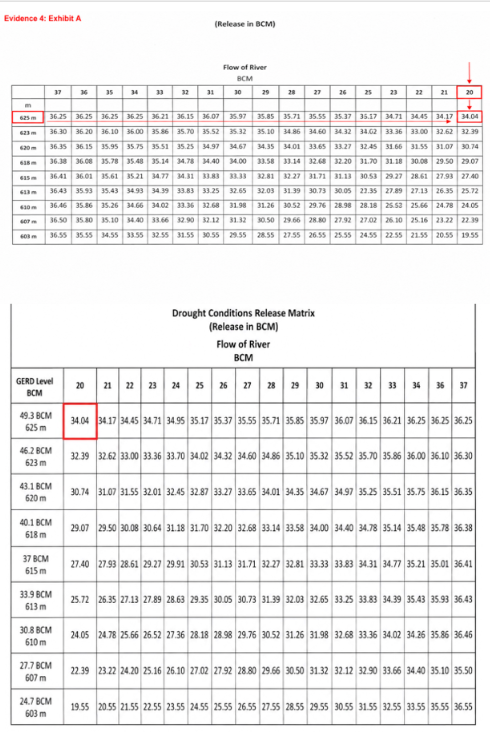
If I could show an Ethiopian only one page of this draft, it would be Exhibit A, the Drought Conditions Release Matrix. It is a grid of numbers, dry and bureaucratic, and inside that grid sits the single most damning fact in the entire document.
Find the row where the GERD reservoir is at its highest listed level: 625 meters above sea level, holding 49.3 billion cubic meters. Now follow it across to the column where the river’s flow for the year is only 20 BCM. A drought year. A hungry year. A year when the rain failed.
The number in that box is 34.04.
Stop and feel what that means. The river brought you 20. If signed as written, the document would require you to release 34.04 BCM. That is about 170 percent of everything nature gave you that year. Where do the missing 14.04 billion cubic meters come from? Not from the sky; the river brought only 20, not 34.04. The missing 14.04 must come from your storage, from the water you saved, from the water your country went into debt to hold back. In the dry year, when your own people most need that reserve, the rule would reach into your reservoir, pull out roughly 14 billion cubic meters of stored Ethiopian water, and send it downstream.
Now turn back to Article 10.1 and read it one more time: “not… an allocation of the waters of the Blue Nile.”
My friends, what do you call a rule that tells you exactly how much water to deliver downstream under specified drought conditions, enforceable through the agreement, and drawn from your own stored water? There is only one honest description for it: functional allocation. Allocation without the name. Egypt did not need the word, because Egypt had the number: 34.04.
That single box cancels most of the comfort of 10.1 by itself. I would put it roughly ninety percent of the way toward making 10.1 meaningless. The sign says “not a horse.” The horse just kicked you.
Annex A: the water debt that follows you into the dark
It gets worse, and I need you to follow me carefully here, because this is the part a downstream legal strategy would love and the Ethiopian public never understood.
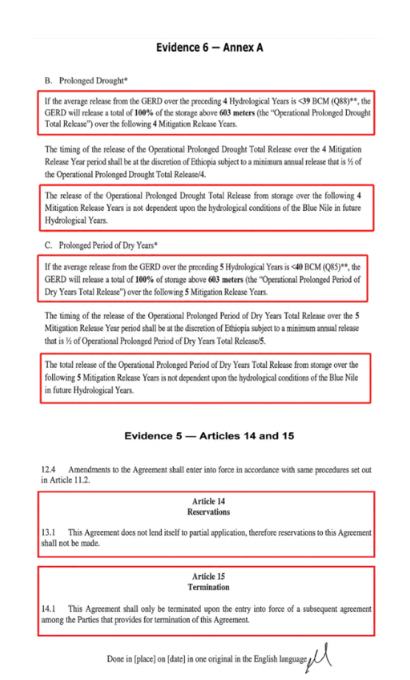
Look at the long-term operation rules in Annex A. They say that if the average GERD release over the preceding four hydrological years falls below 39 BCM, GERD must release 100% of the storage above 603 meters over the following four mitigation years. And if the average over the preceding five years falls below 40 BCM, GERD must release 100% of the storage above 603 meters over five mitigation years.
One hundred percent. Not a share. Not a portion. All of the storage above 603 meters.
And then comes the sentence that should make every Ethiopian’s blood run cold. The draft says these releases are: “not dependent upon the hydrological conditions of the Blue Nile in future Hydrological Years.”
Read that slowly, because it is the cruelest line in the document. Not dependent on the future. It means this: suppose a drought hits, and the rule triggers a multi-year obligation to drain your storage. Now suppose the next years are also dry, God forbid, a real drought, the kind the Horn of Africa knows too well. Under any sane, humane rule, your obligation would shrink, because there is no water and your own people are suffering.
But this draft says no. The debt was calculated from the past. You must pay it regardless of the present. Even if your children are thirsty. Even if your turbines are starving. The water debt does not care about the future, because it was never designed to protect you. It was designed to guarantee Egypt’s supply no matter what the sky does to Ethiopia.
This is not cooperation. Cooperation shares the pain of a drought. This exports the pain of drought out of Egypt and pushes it upstream onto us. It turns GERD, the dam we built to protect ourselves from drought, into an insurance policy for someone else’s drought. We pay the premiums. They collect the claim.
And here is the engineering knife hidden inside the legal one. Draining your reservoir down to 603 meters does not only cost you water. It costs you power. A hydropower dam generates electricity from the pressure of the water stacked above the turbines, the “head.” Drop the level, and you drop the pressure, and you drop the megawatts. So in the very years when drought makes electricity most precious, this clause would put GERD under forced drawdown: less stored water, less hydraulic head, exactly when reliability matters most, so that Egypt’s fields stay green. We built the largest dam in Africa, and the draft would have us run it under drawdown to water someone else’s harvest.
What does Article 10.1 do about any of this? Nothing. It cannot. It is a sentence about a name. Annex A is a machine about water. When a name fights a machine, the machine wins every time.
Exhibit B: how one dry year becomes a chain that drags you for years
Now, someone might say: “Fine, one bad drought, one big release. We survive it and move on.” I wish that were true. Read Exhibit B, and you find out it is not a single bad year. It is a system.
Exhibit B does one small kindness. It says overlapping drought and dry-year measures should not be double-counted, and the higher value applies. Good. But it does not make this a single-year problem. It builds a stacking-risk architecture. It shows that a release obligation created in a drought period reduces the water GERD is allowed to keep in later years. And it shows that ordinary drought-matrix releases can operate during the very periods when prolonged-drought or dry-year mechanisms are already in effect.
So watch the chain form. A dry year triggers the matrix. A prolonged dry stretch creates a multi-year release duty. That duty then eats into your retention in the following years, years that may be perfectly normal. And on top of that, the drought matrix can still be firing at the same time. One bad season does not simply pass. It can attach itself to your dam and walk beside you for years, draining a little more along the way.
Article 10.1 has nothing to say to this system. It cannot, because it was never written as a master switch. It does not say “no annex may create water debt.” It does not say “no rule may force release above the year’s inflow.” It is a polite sentence sitting in the corner while the machine runs.
The definitions: how they made your success the reason you must pay
You would never look twice at Article 2. It is the “Definitions” section, the part everyone skips. That is exactly why it is dangerous. The most important traps are always set in the boring rooms.
The draft defines “Flow” like this: “‘Flow’ means the total volume of water entering the GERD reservoir in any given Hydrological Year.”
And it defines “GERD Level” as the level of your reservoir at the start of the year.
Why does this matter? Because these two boring definitions are the trigger for the whole release machine. The matrix doesn’t look at the water crossing into Sudan. It looks at the water inside your dam and at how full your reservoir is. And the fuller your reservoir, the more the matrix demands that you release.
Think about the madness of that. You worked hard. You saved water. You filled your dam, the dam you built to secure your own future. And the document treats your full reservoir not as your achievement but as the evidence that you can afford to give more away. Your savings account becomes the proof that you owe. Your success becomes the trigger of your obligation.
And there is a second blade here, aimed straight at the future, and this is the part I beg you not to skip. Because “Flow” is measured at the dam, any future Ethiopian project upstream of GERD could be argued to reduce GERD inflow and trip the same drought machinery, unless the agreement clearly protects future development from being converted into a release obligation. An irrigation scheme to feed Ethiopian children. A small dam for a thirsty highland town. A watershed to hold back the rains. Each one could lower the flow arriving at GERD, and a lower flow at GERD could be read as a drought under these very definitions. So Ethiopia developing its own land could, on paper, be made to look like the sky failing. Someone downstream could point at your new canal and argue that a drought was triggered, and the matrix would obey. The trap is not only set for today. It is set for your grandchildren, and it risks punishing them for the crime of building.
So when Article 10.1 says “not an allocation,” ask it: then why does my own water level decide how much I must surrender, and why might feeding my own people count against me? The article has no answer.
Article 10.2: the second beautiful sentence, also not enough
To be fair, there is a second sentence that looks friendly to Ethiopia, and an honest writer must deal with it. Article 10.2 says future developments upstream of GERD may be undertaken, but “without prejudice to this Agreement,” and in line with international-law principles like equitable use, no significant harm, and cooperation. That sounds good. Ethiopia should want that sentence.
But look carefully at four words: without prejudice to this Agreement. And what does this Agreement already do? It defines “Flow” at GERD. It ties release rules to GERD flow and GERD level. It pulls Annex A and Exhibit A into operation. So if future Ethiopian development reduces the inflow into GERD, the downstream argument writes itself: you have affected the trigger system inside the draft.
That is why Article 10.2 is not enough either. Future development should not merely be “allowed” in a sentence. It needs a real safe harbor, a line that says lawful Ethiopian development shall never automatically become drought, breach, shortage, compensation, water debt, or a release obligation. Without that protection, the future is allowed on paper but still forced to walk through the cage the rest of the draft has already built.
My Conclusion for part One
So let me close Part One with the simplest truth.
Article 10.1 looks good. If you read it alone, it looks like the most beautiful sentence Ethiopia received in the 2020 Washington draft. It says the agreement is not an allocation of the waters of the Blue Nile. It sounds like sovereignty. It sounds like protection. It sounds like Ethiopia finally got one sentence in its favor.
But once you read the rest of the draft, that beautiful sentence begins to collapse.
Because a sentence does not protect a dam if the annexes control the releases. A sentence does not protect sovereignty if the tables control the storage. A sentence does not protect Ethiopia if the operating machinery turns GERD into a downstream drought buffer.
That is why I call Article 10.1 an empty box.
The ribbon is beautiful. The words are beautiful. The promise sounds beautiful. But when you open the box, the real power is not inside Article 10.1. The real power is buried in Annex A, Exhibit A, Exhibit B, Article 2, and the legal machinery that comes after them.
In Part One, I showed the empty box. I showed the candy. I showed Exhibit A, Annex A, Exhibit B, Article 2, and Article 10.2.
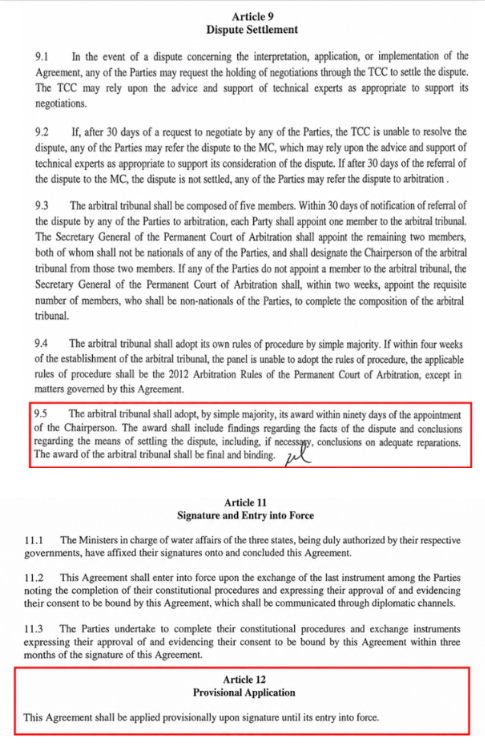
In Part Two, I will show the lock on the box: Article 4.5, Article 9, Article 12, Article 14, and Article 15. That is where the draft moves from dangerous operation into legal trap: approval pressure, arbitration, provisional application, no reservations, and no easy exit.
Part One showed why the beautiful sentence is weak.
Part Two will show why the trap could have become enforceable.
To be continued..
#Egypt #Sudan #SouthSudan #Ethiopia #Eritrea #Uganda #Kenya #Tanzania #Rwanda #Burundi #DRC #UAE @AbiyAhmedAli #NileRiver #WaterRights #Sovereignty #BlueNile #NileDam #AfricanWaters #NoToColonialism #GERD #NileRiver #Kechene @MFAEthiopia #Sovereignty
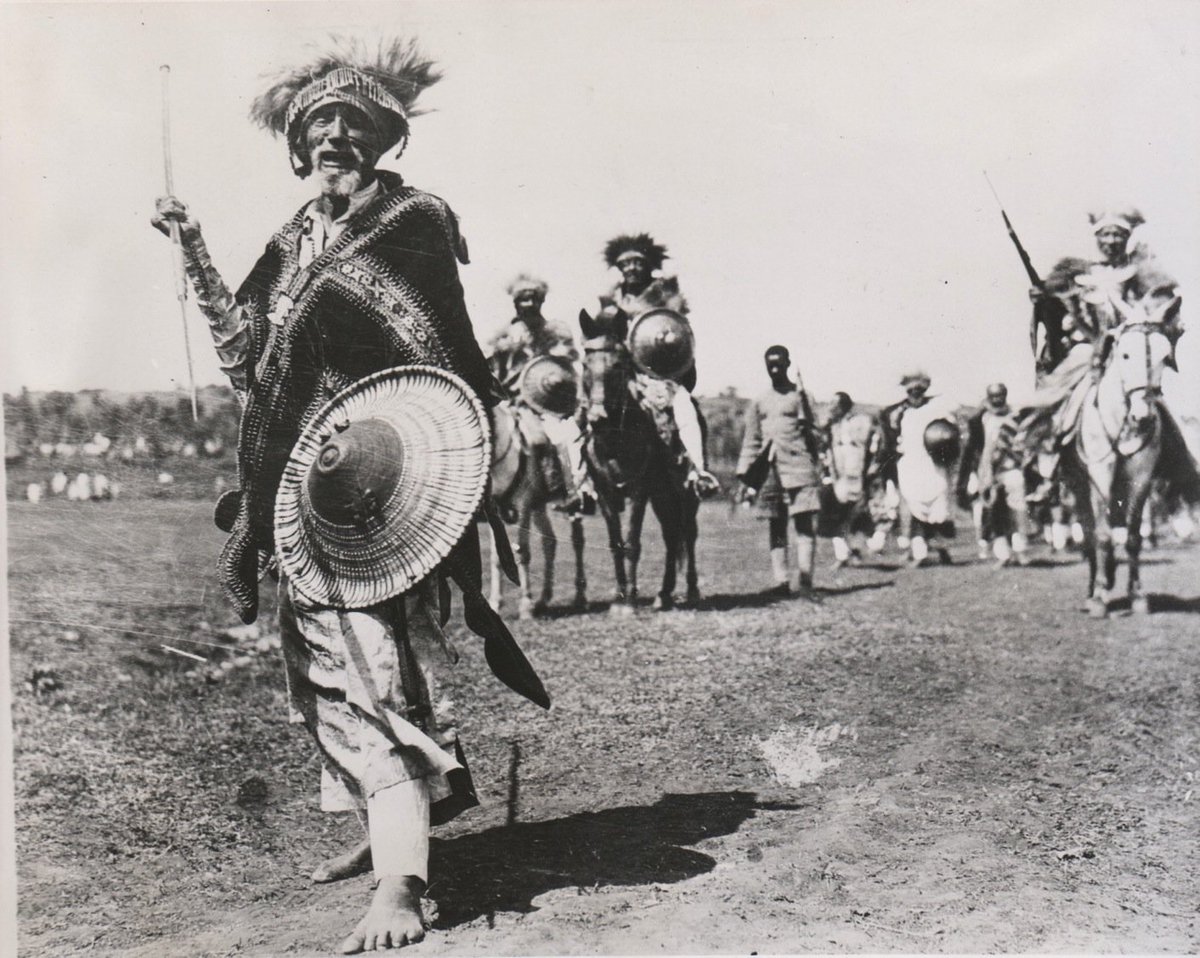
Ethiopia 🇪🇹 celebrates the 130th anniversary of its 1896 victory over Italy at the Battle of Adwa, becoming the only African country to fully resist coIonization.
If signing the 2020 Washington draft would damage Ethiopian people by up to 95%, then I have to ask myself: what was the point of building GERD in the first place? Why build a national lifeline with Ethiopian hands and Ethiopian sacrifice, only to hand the keys to Egypt?
A dam is supposed to be a lamp, not a leash. A reservoir is supposed to be a shield, not a ransom note.
The idea of becoming Egypt’s water colony is disgusting even to imagine. If that draft is the “deal,” then the honest answer would be this: stop building GERD and admit we chose surrender.
Thank God Ethiopia did not sign it.
Anyways, i think most experts and politicians who argue about this have never read Egypt’s actual clauses.
They argue about “cooperation,” and “win win” and “regional stability.” But they never open Egypt’s Exhibit A.
They never read Egypt’s line that says “not dependent upon future hydrological conditions.”
They never do Egypt’s math: 34.04 BCM release when inflow is 20 BCM.
They never ask: what happens to Ethiopian children when their dam is legally required to empty its storage to protect Egyptian farms in a multi-year drought?
So I did it for them. I read every clause Egypt wrote. I circled every trap Egypt designed. I will finish the rest of the articles too, line by line, including the dark and ugly ones that haven’t come yet. And now you have the receipts.
Enjoy it.
Insane FUD across the board right now against Monero with little to no substance.
The reality? Someone wants to attack Monero via 51% attack and so far is failing.
Want to help protect Monero? Get started mining below.
Otherwise, just keep using and enjoying Monero 🤷♂️
BREAKING: Israel is now bombing 1.7 million civilians trapped in Rafah, threatening an imminent invasion of the last “safe place” in Gaza.
Israel is committing the worst crimes in modern history, and Western regimes are calling it “self-defense”.
Never forget. Never forgive.