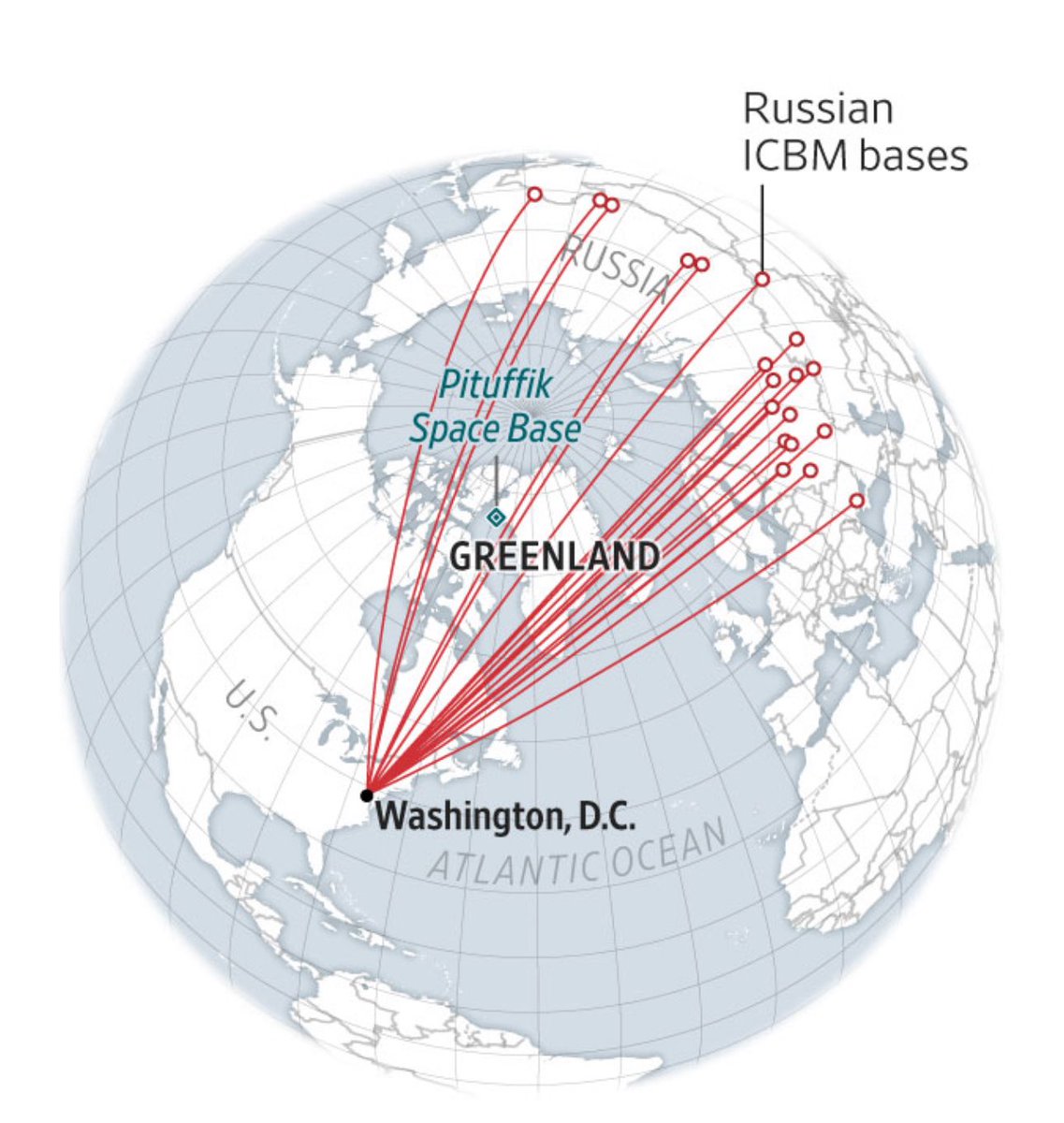
One reason Greenland is strategically important to the US is in fact twofold:
1. It’s the best place to set up anti-missile defenses to intercept ICBMs coming from Russia / China
2. It’s a very good place to set up offensive missile capabilities to threaten Russia / China
The WSJ had a good graphic out a few days ago showing the trajectory of missiles from ICBM sites around Russia to the US would fly overhead or near Greenland, which also happens to be almost directly beneath where those missiles would reach their highest points (“apogee”) which is when they are most vulnerable to interception because they are traveling at their slowest speeds.
If you throw a ball into the air you’ll see the same effect - the ball is slowest at its highest point.
And for an intelligently guided missile capable of trying to evade interception, you have an even better chance to shoot it down from a point directly beneath it since that is the closest path to the missile (i.e. least amount of warning time for the missile to realize an interceptor is coming).
This above is all courtesy of our resident rocket scientist Phil.
The US already has the right to dot Greenland with military installations, and I imagine that extends to intercepting ICBMs. Though Europe might object for some purposes.
@PeterSchiff Tariff is tax, just as pork is meat. English vocabulary often doesn't reflect the complete meaning of a word. This is a defect of the language.
@JanGold_ In the short run, you're right. But in the long run, don't underestimate the appetite of Chinese to save money (in gold)😆.Our people love to save money!😆
@HAOHONG_CFA This is similar to a chess game. US has made a move. China's retaliatory respond can certainly be expected, so does policy measures to further boost the domestic demand.
@HAOHONG_CFA It is very positive that the cultural exchange of this level and scale has happened. This is an eye-opening experience for the common public in both China & USA.
Keep this in the back of your mind when watching markets in the coming days ...
In terms of money:
The 2018 " Campfire" wildfire cost ~$12.5 billion. That was the old wildfire record.
The current wildfires, most often referred to as "Palisades Fires" (even though there are technically five of them), are now estimated (read: educated guesses) to cost $150 to $200 billion. And the fires are still ongoing.
This wildfire is now in the running for the most expensive natural disaster in American History.
So, the financial markets are discussing a POTENTIAL contagion in the Property/Casualty insurance sector and a POTENTIAL extinction-level event for some P&C companies.
The State of California and the City of Los Angeles could face massive clean-up costs, huge subsidies to the affected, and a significant loss of tax revenues in 2025 and beyond. This could lead to significant downgrades of their municipal bonds, POTENTIALLY triggering a contagion in the larger Municipal markets.
---
POTENTIAL means this is all fluid, and these statements make many assumptions.
Nevertheless, this is the discussion all weekend.
Elon Musk is all in.
(0:00) Elon Musk Is All in on Donald Trump
(6:35) Providing Starlink to Victims of Hurricane Helene
(9:22) If Trump Loses, This Is the Last Election
(21:49) The Epstein and Diddy Client List
(33:38) Vaccines
(35:49) The Movement to Decriminalize Crime
(50:22) Gavin Newsom
(53:11) Europe’s Declining Birthrate
(57:02) We Need Religion
(1:08:04) Why Is There So Much Anti-Human Messaging?
(1:19:33) AI and the Woke Mind Virus
(1:43:01) Musk’s Role in a Trump Administration
Includes paid partnerships.
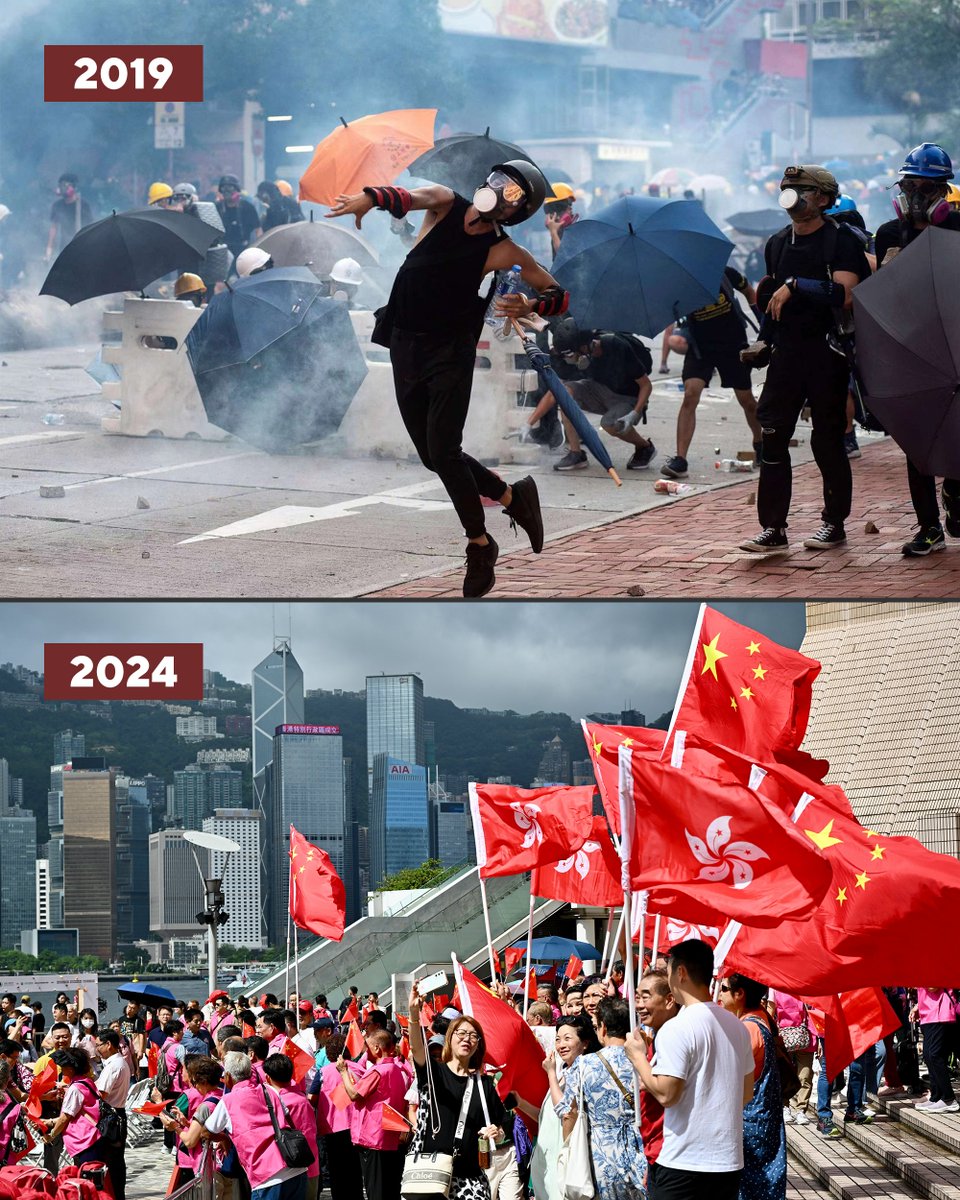
“Black Terror” ➡️ Red Flags
Upper pic: In 2019, “black terror” ravaged Hong Kong. The “Pearl of the Orient” was shrouded in turmoil and destruction.
Lower pic: On July 1, 2024, people in Hong Kong waved red flags in annual celebration of Hong Kong’s return to the motherland.
Smoggy Sky ➡️ Clear Sky
Upper pic: Tian’anmen Square shrouded in smog in Jan. 2012
Lower pic: Tian’anmen Square under a clear and blue sky in Jul. 2024