Big shoutout to the army for doing an unbelievably amazing job at the preplanned explosive event today.
As an army vet, I’ve never been more proud of my brothers and sisters.
You pulled off a miracle today, and while the doomer grifters like MTG, Tucker, Masshole and Alex Jones (who have never served in the military a day in their lives) were actively telling everyone you were incompetent and it was going to be the next dirty bomb Chernobyl, you did your job with professionalism and honor.
I’m so sorry for these losers trying to get doomer clicks off your hard work.
I promise, while they mock you, we love you and we’re proud of you.
“God Be With You Til We Meet Again.”
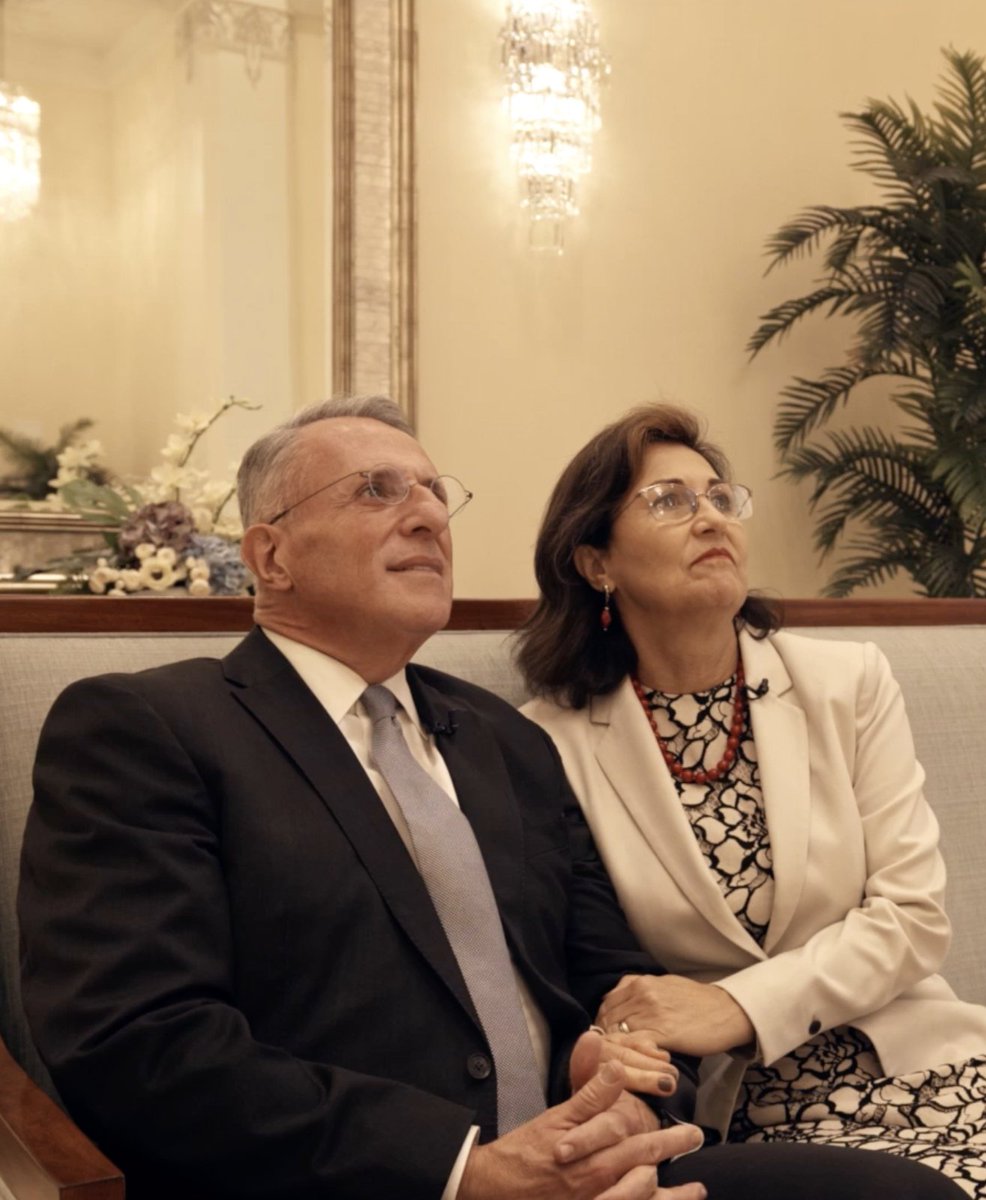
After dedicating the Modesto California Temple on Sunday, Nov. 22, Elder Quentin L. Cook of the Quorum of the Twelve Apostles and his wife, Sister Mary Cook, exited the temple to find attendees lined up and waiting to say goodbye. This was a return to California for Elder and Sister Cook, who lived in the state for more than 30 years. As Elder and Sister Cook walked out, people began singing the hymn “God Be With You Til We Meet Again.”
When the Titanic sank, it carried millionaire John Jacob Astor IV. The money in his bank account was enough to build 30 Titanics. However, faced with mortal danger, he chose what he deemed morally right and gave up his spot in a lifeboat to save two frightened children.
Millionaire Isidor Straus, co-owner of the largest American chain of department stores, "Macy's," who was also on the Titanic, said: "I will never enter a lifeboat before other men." His wife, Ida Straus, also refused to board the lifeboat, giving her spot to her newly appointed maid, Ellen Bird. She decided to spend her last moments of life with her husband. These wealthy individuals preferred to part with their wealth, and even their lives, rather than compromise their moral principles. Their choice in favor of moral values highlighted the brilliance of human civilization and human nature.
Poll Finds Most People Would Rather Be Annihilated By Giant Tidal Wave Than Continue To Be Lectured By Climate Change Activists https://t.co/ZC6ocZa0Zz
Imagine being left alone on top of a freezing 10,000-foot mountain in the pitch dark, surrounded by an enemy army, knowing nobody is coming back for you.
In March 2002, U.S. Air Force Sergeant John Chapman charged uphill through waist-deep snow in Afghanistan to knock out an enemy bunker and save his pinned-down team. He was hit twice and collapsed motionless. Believing he was already dead, his teammates were forced to retreat down the ridge.
For fourteen years, everyone thought his story ended in those first two minutes.
Then modern technology sharpened old thermal video recorded by a drone circling high above the clouds that night. When Pentagon generals watched the enhanced footage, grown combat veterans broke down in tears.
John Chapman hadn't died.
Wounded nine times in total darkness, this thirty-six-year-old father of two little girls woke up alone in the snow. Nobody on earth knew he was alive. He could have stayed quiet in the dark.
Instead, he fought an entire enemy force by himself for over an hour.
Then sunrise broke, and he heard the heavy chop of an American rescue helicopter carrying twenty-three U.S. Rangers flying straight into a waiting rocket trap.
Chapman was safely behind rock cover. If he stayed down, he might survive. If he stayed down, those twenty-three young men in the sky were dead.
On the grainy footage from miles above, investigators watched John Chapman deliberately climb out of cover, stand up straight in the open snow, and fire into the ambush to pull every single gun on the mountain onto his own chest.
He fell as the sun rose, buying twenty-three American families their sons back, thinking nobody would ever know what he did.
The sky was watching you, John.
Thanksgiving is not an official holiday in my native Brazil, but living in the United States has helped me appreciate its beautiful invitation to pause and express gratitude for the blessings in our life.
As I reflect on the blessings that fill my life, I feel deeply grateful for my Heavenly Father’s love and for the gift of His Son, Jesus Christ. I am thankful for the Savior’s Atoning sacrifice, which brings hope, healing, and peace.
I am also grateful for the restored gospel of Jesus Christ and for peacemakers throughout the world who strive to follow the Savior’s example. Most of all, I am grateful for my wife, my children and grandchildren, and the dear friends who love and support me.
May this season turn our hearts toward Heavenly Father and Jesus Christ, and inspire us to share Their love and light with those around us.
When an Islamic terrorist stepped onto
a crowded European high-speed train carrying an AK-47 and 300 rounds of ammunition, an off-duty American airman woke up to pure chaos-and chose to run straight down the barrel of the gun.
U.S. Air Force Airman Spencer Stone was asleep on a train traveling through France when screams and breaking glass pierced the air. Opening his eyes, he saw an armed attacker stepping into the aisle with a fully loaded rifle.
Instead of running, Stone charged completely unarmed down the aisle, sprinting thirty feet straight at the gunman.
In a true moment of divine intervention, the terrorist's rifle jammed right as Stone closed the distance. Stone tackled the attacker fiercely, getting slashed in the neck and hand with a box cutter-nearly losing his thumb in the process.
Ignoring the severe bleeding, he locked in and choked the terrorist unconscious with his bare hands.
A true American hero who saved countless lives that day.
July 3, 1863.
A 22-year-old boy stood behind a low stone wall at Gettysburg, watching 12,000 enemy soldiers march straight toward him.
He didn't know it yet, but in two hours, the fate of the United States would rest entirely on his broken body.
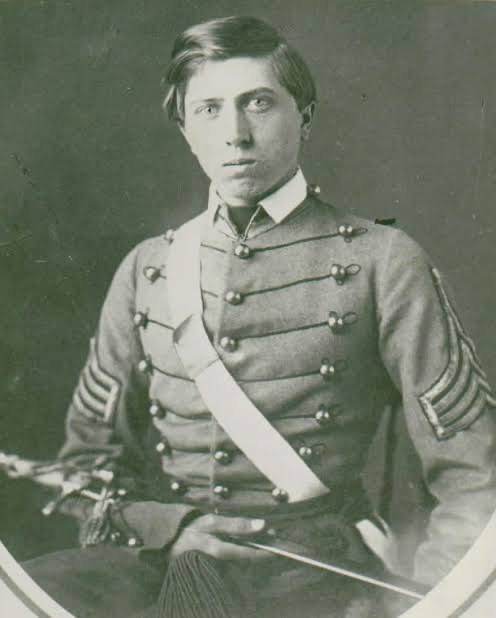
His name was First Lieutenant Alonzo Cushing.
He was young enough to still be dreaming about his future. Instead, he commanded Battery A, 4th U.S. Artillery, at the very heart of the Union line.
If he broke, the line broke. If the line broke, the nation died.
First came the storm. 150 Confederate cannons opened fire at once. The earth shook so violently it felt like the end of the world.
Three of Cushing’s ammunition chests detonated in blinding fireballs. Men and horses vanished in the smoke. Every other officer in his battery was cut down.
A jagged shell fragment tore straight through Cushing’s right shoulder.
He didn't flinch.
Minutes later, shrapnel ripped open his abdomen and groin.
Any other man would have collapsed. Cushing reached down, held his own torn stomach together with one hand, and refused to drop to his knees.
With his other hand, he kept working his gun—pressing his bare thumb over the scorching-hot cannon vent between shots, burning his own flesh to the bone just to keep firing.
His First Sergeant, Frederick Fuger, ran to him through the smoke and begged to carry him to the rear.
Cushing looked at the wall of bayonets closing in.
"No," he said. "I will stay right here and fight it out, or die in the attempt."
He didn't just hold the line. He ordered his last two working cannons rolled forward—right up to the stone wall, straight into the jaws of death.
By then, he was bleeding out. His strength was gone. His voice had failed, swallowed by the deafening roar of the battle.
So Sergeant Fuger stepped beside him, wrapped an arm around his dying 22-year-old commander to hold him upright, and leaned in close.
As the enemy surged within yards of the wall, Cushing—barely alive, held together by pure willpower and the arm of a loyal friend—whispered one final order into Fuger’s ear.
Fuger roared it to the sky: "Double canister! Fire!"
The cannon erupted at point-blank range, tearing through the advancing wave.
Seconds later, a bullet struck Cushing in the face.
He fell dead beside his smoking gun, still holding his ground.
The smoke cleared.
The Union line held.
They buried the 22-year-old at West Point beneath three simple words: "Faithful unto death."
151 years later, the nation he saved finally awarded him the Medal of Honor.
Nations aren't saved by speeches.
Sometimes, an entire republic survives simply because a 22-year-old boy—bleeding, broken, and whispering into the storm—refused to take one step back.
My dear friends, when we give thanks in all things, we see hardships and adversities in the context of the purpose of life.
You and I are sent here to be tested. There must be opposition in all things. We are meant to learn and grow through that opposition, through meeting our challenges, and through teaching others to do the same.
I invite you to thank God for your adversities and to pray for guidance in meeting them. Through that attitude and through your faith and obedience, you will realize the promises God has given you. It is all part of the plan.
When we understand this principle, that God offers us opportunities for blessings and blesses us through our own adversities and the adversities of others, we can understand why He has commanded us again and again to “thank the Lord thy God in all things” (Doctrine and Covenants 59:7).
With love,
President Oaks
One of Hollywood's great monologues: the USS Indianapolis speech in JAWS. Robert Shaw reportedly turned up drunk and messed up the scene. HE apologised to Spielberg then turned up the next day sober, and delivered this...
In 1942, Sandy Bonnyman didn't have to go to war.
He was 32 years old, married with kids, and ran a copper mining business in New Mexico. Copper was a war industry, which meant he could have sat out the whole war at home.
Instead, he enlisted in the Marine Corps as a private.
He fought on Guadalcanal, earned a commission, and by November 1943 he was a first lieutenant landing on Betio, the main island of Tarawa.
On the third day, the Marines ran into one of the biggest strongpoints on the island: a huge bombproof bunker buried under sand, with somewhere around 150 Japanese defenders inside. It had held up the advance for two days.
Bonnyman led a group of Marines with flamethrowers and demolitions straight up the side of it. They reached the top, burned and blasted the entrances, and forced the defenders out.
Then the Japanese counterattacked to take the top back.
Bonnyman stood at the front edge of the bunker and held them off with his men until he was killed. The bunker fell. He was 33.
A combat cameraman caught part of the fight on film. It's believed to be the first Medal of Honor action ever recorded on camera.
He was buried on the island in a battlefield cemetery. After the war, the grave registration teams couldn't find it. For decades, Tarawa's only missing Medal of Honor recipient was listed as unrecoverable.
In 2015, a team from a nonprofit called History Flight dug into a lost burial trench on Betio and found him.
72 years after Tarawa, Sandy Bonnyman came home to Knoxville, Tennessee.
Frank Wright was only 16 when America entered World War II. Too young to enlist in the Marine Corps, he used his older brother’s birthdate and stuffed bananas into his clothes to make the weight. On January 21, 1942, he became a Marine anyway.
He joined the Marine Raiders and fought through the Pacific’s hardest campaigns: Guadalcanal, New Georgia, Guam, and Iwo Jima.
On Guam, a Japanese soldier drove a bayonet into his stomach during close combat. Wright fell on top of the attacker. A corpsman treated the wound and told him to keep going if he could still walk. He did.
Months later, on March 3, 1945, during the Battle of Iwo Jima, machine-gun fire tore through his upper body while he was advancing uphill. The rounds damaged his collarbone, punctured his lung, and exited through his arm. This time the wounds were too severe. He was medically evacuated.
He survived both injuries.
After recovering, he returned to duty and finished his service as a drill instructor. When he was honorably discharged in January 1946, he left as a corporal with two Purple Hearts. He never received the sergeant’s stripes he had hoped to earn during the war.
He went on to earn a business degree, raise a family, and stay connected to the Marine community for the rest of his life. The scars from Guam and Iwo Jima remained with him.
Nearly 80 years later, as he approached his 100th birthday, the Marine Corps prepared something extraordinary. Commandant General Eric M. Smith recommended him for an honorary promotion to sergeant.
On August 31, 2025, in Stockton, California, Frank Wright stood in a World War II-era Marine uniform. His two sons pinned the sergeant’s chevrons onto his collar.
He even joked about whether the new rank came with decades of back pay.
When he spoke about what the Marine Corps meant to him, he said:
“I am a Marine. Not was. Am.”
The promotion was honorary. It couldn’t erase the wounds he carried from Guam and Iwo Jima or bring back the Marines who never came home. But it recognized a teenager who had been willing to risk everything for the uniform before he was even legally old enough to wear it.
Frank Wright left World War II as a corporal. He carried the scars of two of the Pacific’s bloodiest battles for the rest of his life. And when his sons finally pinned those sergeant’s stripes, they honored something that had never depended on rank.
He survived a bayonet to the stomach, machine-gun fire through his chest, and some of the most dangerous fighting of the war. Nearly 80 years later, the Marine Corps gave him the title.
He never stopped being a Marine.
Semper Fi, Sergeant Frank Wright.
With deep respect and sorrow, we remember Carlyle "Smitty" Smith Harris, one of the earliest American pilots captured during the Vietnam War, who passed away at the age of 96. A Navy aviator known for his strength and resolve, Harris was shot down in 1965 while flying a mission against the heavily defended Thanh Hoa Bridge and was taken prisoner in North Vietnam. He spent nearly eight years in captivity at the notorious Hoa Lò Prison, known to American POWs as the "Hanoi Hilton," where he endured brutal conditions, isolation, and torture. Yet even in captivity, his spirit never broke. Harris helped introduce and spread the now-famous tap code, a simple system of knocks that allowed prisoners to secretly communicate through cell walls, restoring unity and morale among the POWS. From flying the Republic F-105 Thunderchief in combat to quietly resisting behind prison walls, Capt. Harris showed extraordinary courage, leadership, and loyalty to his fellow airmen. His life stands as a powerful reminder of resilience, sacrifice, and the enduring strength of the human spirit. Rest in peace, Captain-your service and courage will never be forgotten.
I am often asked questions like “Why does a just God allow bad things to happen, especially to good people?”
While we don’t have all the answers, we do know that we have a Father in Heaven who loves us. His Son, Jesus Christ, will compensate for unfairness. And because of Heavenly Father’s plan of happiness, all wrongs will be righted, and we will have a clearer perspective.
When you face these challenges, please remember that the temple can be a place of refuge and peace.
I was blessed today to dedicate the Modesto California Temple. This beautiful house of the Lord is a great reminder of the peace we can find as we make sacred covenants with the Lord.
Today’s experience was made even sweeter as I reflected on my upcoming 64th wedding anniversary with my beloved wife, Mary. Thanks to the covenants we have made with God and with one another in the temple, our family relationships can last forever.
7 years ago SGT Leandro Jasso was KIA during a raid in Afghanistan.
Sgt. Jasso deployed twice before in support of Operation Enduring Freedom.
At the time of his death, he was serving as a team leader on his third deployment to Afghanistan.
Jasso was kill*d defending his nation, fighting Al Qaeda.
Dear Brothers and Sisters:
We are pleased to announce that the remodel and seismic retrofit of the Salt Lake Temple are now finished. As previously announced, an extended open house will be held from April 5, 2027, through October 1, 2027. From October 4, 2027, through late November 2027, any cleaning or repairs necessitated by the open house will be completed.
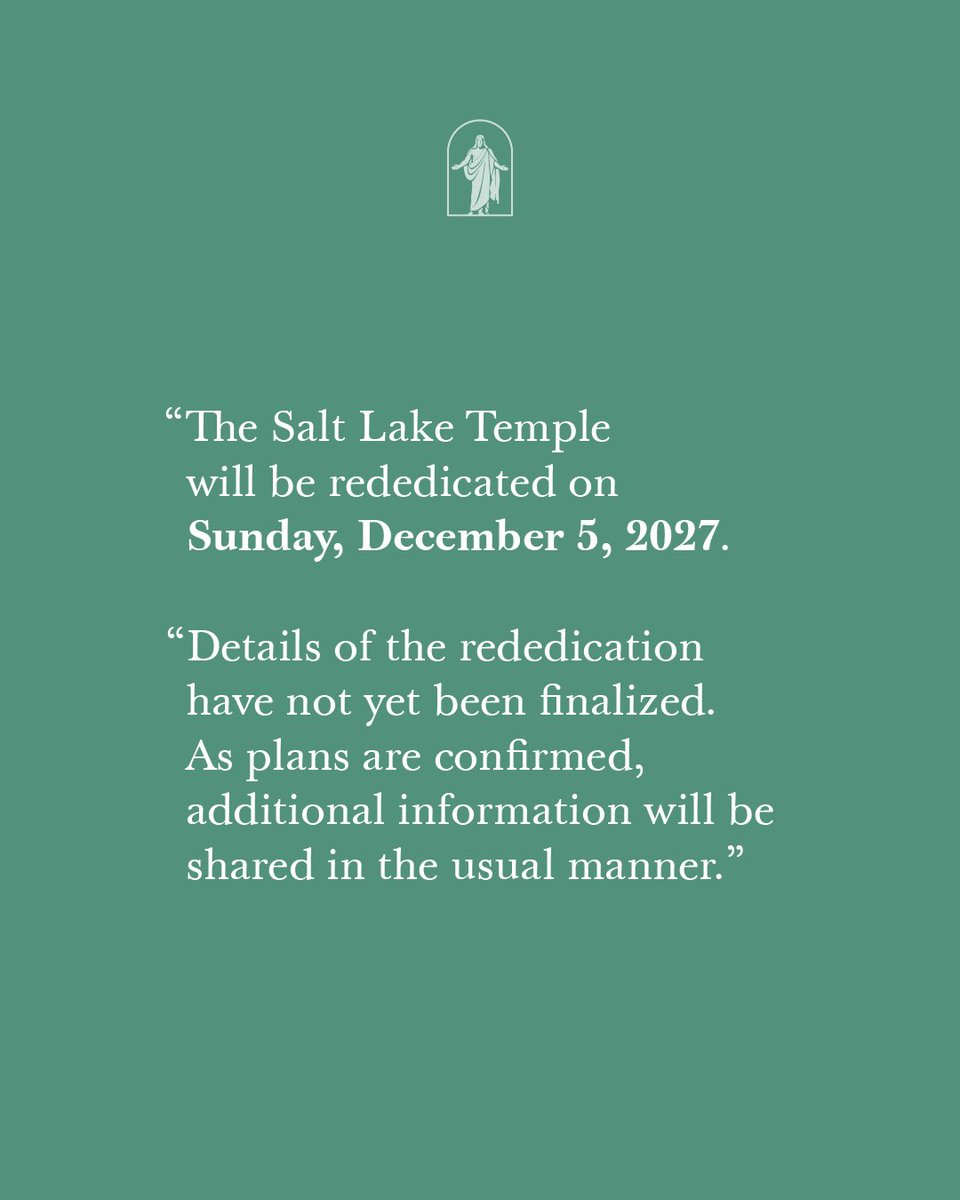
The Salt Lake Temple will be rededicated on Sunday, December 5, 2027. Details of the rededication have not yet been finalized. As plans are confirmed, additional information will be shared in the usual manner.
We rejoice in the completion of the work on this historic and sacred edifice which has stood the test of time and will once again allow the Lord’s children to participate in sacred and eternal ordinances for themselves and their ancestors.
Sincerely yours,
The First Presidency
Dallin H. Oaks
Henry B. Eyring
D. Todd Christofferson
Read more at the link below:
https://t.co/4l6PTE29xd