Kyle Shanahan says a 51% analytics recommendation won’t convince him to go for it because he gets one shot, not an hour at a blackjack table
“I don’t want to hear about it if it’s 51% of the time we should go for it.”
“As I always say, I’m not sitting here playing Blackjack for an hour with no one else at the table, and eventually I’ll get 51% of it. Like, I have this one try, and I have a feel for it. I’ve been doing it too long.”
“But what I want to know from him, when it’s not a feel, when it, no, this is 98%. We don’t even need to talk about it. So we don’t need to talk about it. Tell me when it’s that, and I’ll just do it.”
I am convinced prop firm trading is an entirely different ballgame than trading cash accounts.
Traditional metrics like Sharpe, smooth equity curves and low max drawdown aren’t what you should be optimizing for to maximize prop payouts.
I actually added new fitness functions to find more prop firm compatible strategies
-probability of passing eval
-probability of first payout
-expected return per attempt
It is best to think of prop evals as a call option.
The option premium is the fee
The max loss is the fee
And the upside is essentially unlimited payouts
Options love volatility. Why are you trading the eval like it’s your retirement account?
The best strategy for your own capital is often the wrong one for an eval. Totally different games.
You may not even want the same strategies to pass the challenge as the ones you'll trade once funded.
That's why the prop firm simulator can sort by these different metrics.
I'll be showcasing more of it later this week with a full write up.
A weekend read with some real data and ideas to test.
A simple mean reversion strategy in SP500 that buys when price closes in the bottom 20% of the day's range and sells when price closes in the top 80% of the day's range.
Look at the impact a market regime filter can have.
Big jump in average trade and big reduction in time in market. A great candidate for a position sizing scaler (covered in the article below)
This prop firm math post was pretty controversial despite providing the math 🙃
So I couldn't resist ha! here's prop firm math part 2
47 unsuccessful attempts. 3 payouts. Still profitable.
Consider LucidFlex 50K, assuming a $105 evaluation price.
50 attempts over time would cost:
50 × $105 = $5,250.
Suppose just 3 eventually reach one maximum $2,000 payout request.
After the 90/10 split, you receive $1,800 per payout:
3 × $1,800 = $5,400
$5,400 received
$5,250 spent
+$150 (before other costs).
The other 47 attempts fail and produce nothing.
6% (3/50) reach a max payout while 94% lose.
For this simplified one-payout model there is an
Expected profit per attempt =
Probability of reaching payout × $1,800 − $105.
So break-even is approximately 5.83%
The question is, do you think you can build strategies or (better yet) a portfolio of strategies that get to one payout 6% of the time? If so, you print.
150 on 5250 invested is 2.86% return. If you run this every month, you're north of 30% per year while failing 94% of challenges. Uncomfortable? Yes. Profitable? Yes. That's usually how trading works.
These prop firms are mostly math. Many traders build one strategy, fail and claim it is a scam. Turn the odds in your favor by understanding your numbers.
More on the BA prop simulator soon..
Prop firm math is CRAZY. A losing strategy can become a winning strategy under a prop firm structure.
Imagine a strategy that:
• Wins $200 on 90% of days
• Loses $2,000 on 10% of days
Trading your own capital, its expected daily P&L is:
90% × $200 − 10% × $2,000 = −$20 ❌
Now imagine a hypothetical prop arrangement:
• $100 total fee per attempt
• Five winning days to pass the evaluation
• Five more winning days in the funded account to receive an $800 cash payout
• Any losing day closes the account
• No additional costs or payout restrictions
Assuming independent daily outcomes, the probability of reaching that payout is:
90%^10 = 34.9%
Your personal cash outcomes become:
• Reach payout: $800 − $100 = +$700
• Fail before payout: −$100
Expected profit per attempt:
34.9% × $800 − $100 ≈ +$179 ✅
The strategy has negative trading expectancy, but this hypothetical "prop" contract gives the trader positive cash expectancy.
Why? Because you absorb the evaluation fee instead of the strategy’s full trading losses. This opens up what strategies and portfolios can look like.
It is a completely different design and optimization problem for strategy and portfolio development.
This week I will be sharing more about the prop firm simulator I've built and what it can do.
The last week or so I’ve covered four different signals and filters for context-aware systematic trading. Here’s a recap for wknd readers.
Gamma Exposure: option market maker positioning. Dealers will quiet directional price moves when long gamma and will extend directional price moves when short gamma.
Commitment of Traders Report: understand how different players are positioned. Large speculators are net long and retail is net short is different than large specs net short and retail extremely bullish.
Market Breadth: what’s going on under the hood. Is this rally well supported or only due to a few names. Will there be follow through?
Event Conditioned signals: sequence matters. If last hour yesterday rallied hard, what does that mean for today’s open? How we got here is as important as where we are.
Links in the comment for full explanation and example signals you can test.
If you like this type of content let me know with a comment. I have more haha
Markets have memory. Most trading signals don’t.
The same signal can mean something completely different depending on what happened earlier in the session.
And what happened earlier changes what happens next.
Think of a football game's score. 21–17 tells you the state of the game. It matters if the team down 17–0 has just scored three straight touchdowns, or was ahead 21–0 and is collapsing.
That’s the idea behind event-conditioned signals. A trading signal conditioned on an earlier event.
Examples:
• Yesterday’s last hour was strong → does today’s first hour follow through?
• Opening range closed higher → does the last hour tend to rally?
• Price was above VWAP at noon → does that strength persist into the close?
• Today’s opening range is unusually large → are breakouts more likely to continue?
I've added a ValueWhen function that stores what happened at a specific time or event, then we can use that information later or even the next session.
Available in the custom editor and the prompt to signal feature.
This greatly expands the types of signals and strategies possible.
I put together 168 ready-made event-conditioned signals covering:
• Last-hour behavior
• Opening-range behavior
• VWAP checkpoints
• Open / ORH / ORL relationships
• Body-to-range ratios
• High/low-of-day structure
Then you can mix them with Build Alpha’s other built-in signals and/or your own custom signals and let Build Alpha + AI test which combinations actually survive validation.
The more context your strategy has the more robust it can be.
A simple strategy I saw posted on here a day or so ago makes a nice example of the flexibility of the new prompt to signal feature.
No judgement on the strategy itself. Tested on QQQ over the last 25 years. Fixed sizing. Worth exploring.
Three entry signals
-RSI(3) less than 22
-EMA(100) higher than 5 bars ago
-Price 1% or more below 10-day rolling VWAP
Exit
-RSI(3) above 55
Connect your AI of choice but your strategies remain your own. The only items shared with the LLM are settings and simulation performance metrics.
Build Alpha generates strategies using the built-in signals and your own custom signals. AI reviews progress and can change settings, parameters, add its own signal ideas, etc.
But none of your signals or strategies are shared with AI. Strategies remain your own. Too many are giving these frontier models all their trading ideas...
Review a full report of what AI has found, changed, discovered round by round.
The strategy that would have saved your worst drawdown is sitting in your reject pile.
You threw it out because it looked bad. Nobody keeps an ugly strategy.
This is one of the major flaws in how most strategy development works. We (system traders) typically evaluate strategies on a standalone basis.
Best profit, best sharpe, smoothest equity curve, whatever. Then just mash them together in a portfolio and pray they work together.
It’s why I built Portfolio Search
You pick a saved portfolio and instead of generating the best single strategies, it generates strategies that contribute to what you already have.
The fitness function (optimization goal) becomes marginal contribution to that portfolio instead of the strategy's own backtest.
Portfolio Lift toggles every metric so you can see the percentage improvement from adding each candidate strategy.
Portfolio View lets you click through and watch the combined equity curve change.
The ugly strategy that you discarded but actually need is now discovered on purpose and presented with data. A more thoughtful way to develop.
The best trading research workflow is one you don’t have to sit and supervise.
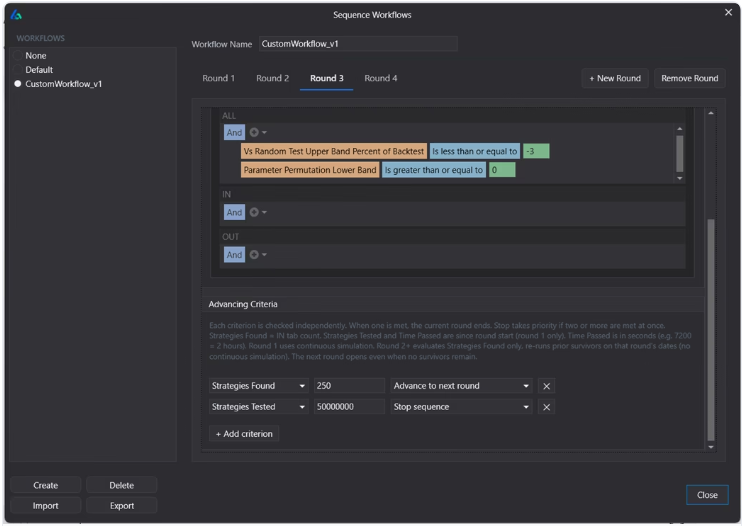
That’s the idea behind Sequence Workflows in Build Alpha.
Instead of:
Run a broad search on 10 years of data
Wait, then manually
Take the survivors and test the last 3 years
Wait, then manually run
Run Robustness Tests like Monte Carlo
Wait, then manually
Test on another date range as a final check
…you can now configure the entire research pipeline once and let Build Alpha run it end to end.
Each round can have its own:
• Date range
• Performance filters
• Robustness filters
• Advancement criteria
Example:
Round 1 → mine until you find 2500 candidates
Round 2 → first out of sample test
Round 3 → Monte Carlo Permutation
Round 4 → Noise Test, Vs Random
Round 5 → final out of sample test
You can also tell it:
“Advance when 200 strategies pass, OR after 3 hours, whichever comes first.”
No more manual babysitting. No more coding.
Set the sequence. Hit start. Come back and see either
· surviving strategies
-or-
· a clear answer where things broke down
Both are actually useful and save a lot of time.
What if your settings or prompts aren’t good?
That’s the next-gen backtester in Build Alpha.
Connect Claude, GPT, Gemini, Grok, Open Router, etc.
Build Alpha begins generating candidate strategies. The connected model monitors the results
• checks for performance plateaus • changes settings, entries, and filters • authors new signals to try • advances winners to robustness tests • rejects anything that fails • exports code to NT8, MT5, TradeStation, Multicharts, TradingView, ProRealCode or Python
• stores its learnings in local memory so the software gets smarter each time you use it
Some strategies work. Most don’t. You need to find out at computer speed.
Search → test → reject → redirect → repeat. 24/7