Every blockchain transaction answers what happened.
Very few can protect how it happened.
That difference becomes increasingly important as AI agents, enterprises and financial applications begin making autonomous decisions on chain.
The outcome may need to be public.
The reasoning often should not be.
◈ @FlutonIO is exploring infrastructure where computation can remain confidential while the final result is still verifiable.
Powered by Fully Homomorphic Encryption (FHE), encrypted data can be processed without exposing the underlying inputs throughout execution.
That opens the door to a different class of applications.
An AI agent can evaluate sensitive business data without revealing it.
A trading protocol can execute a proprietary strategy without exposing its logic beforehand.
An enterprise can automate internal decisions while keeping confidential information protected.
Verification doesn’t require revealing every intermediate step.
Sometimes the only thing that needs to be public is the final outcome.
As autonomous systems become more capable, I think confidential execution will be just as important as transparent verification.
The future isn’t about hiding results.
It’s about protecting the reasoning that leads to them.
That’s a direction @FlutonIO is helping bring to Web3.
Privacy shouldn’t depend on who operates the infrastructure.
Today, using a cloud service often means trusting the provider with your data.
Using blockchain improves trust in execution, but confidential data can still become exposed if applications require it to be decrypted during processing.
That creates a familiar dilemma.
Trust the infrastructure.
Or protect your privacy.
◈ @FlutonIO is working toward a future where that tradeoff no longer exists.
By leveraging Fully Homomorphic Encryption (FHE), computation can be performed directly on encrypted data. The infrastructure carries out the work without ever accessing the underlying information.
That changes the trust model entirely.
Cloud providers don’t need to read your data.
AI services don’t need access to your prompts.
Financial applications don’t need to expose sensitive transactions to process them.
The infrastructure becomes a compute engine rather than a data owner.
I think that’s an important shift.
As more of our digital lives rely on shared infrastructure, privacy can’t depend on trusting every operator in the system.
It should be guaranteed by the technology itself.
That’s the direction @FlutonIO is helping bring closer through confidential execution.
Topic: The Best Crypto Questions Aren’t Simple
The most valuable questions in crypto rarely have simple answers.
Is this project worth watching?
Why is this protocol gaining momentum?
Is this rally driven by real adoption or short term speculation?
Questions like these can’t be answered by looking at a single chart or reading one article. They require multiple signals, different perspectives and the ability to connect information that doesn’t seem related at first.
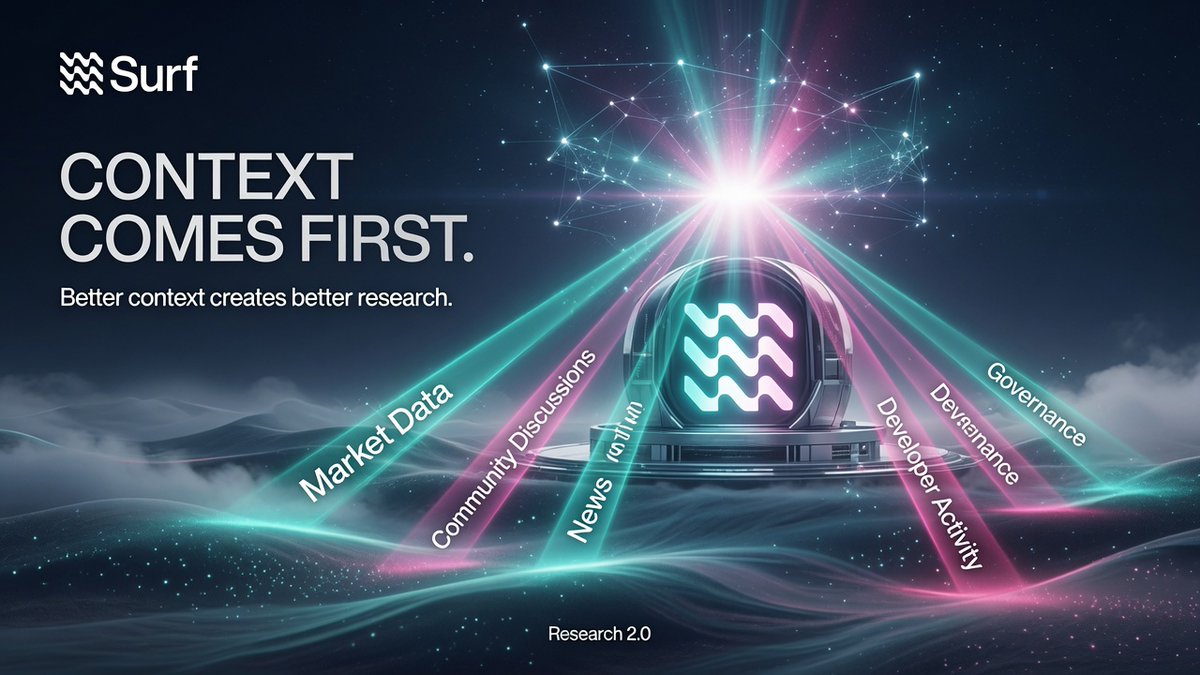
◈ That’s what makes Research 2.0 from @SurfAI interesting.
Rather than treating research as a quick search, it encourages a deeper process. It combines market activity, on chain behavior, ecosystem updates, community discussions and AI reasoning to build answers that reflect the broader context instead of isolated facts.
The most useful research doesn’t simplify complex questions.
It helps you understand the complexity well enough to make better decisions.
Topic: AI Is Only As Good As the Context It Receives
Most AI models can answer questions.
The difference lies in what they know before they answer.
If an AI only relies on general internet knowledge, its understanding of crypto is often incomplete. Markets move every second, ecosystems evolve daily, and important signals are scattered across dozens of different sources.
Without the right context, even a well-written answer can miss what actually matters.
◈ That’s one of the ideas behind @SurfAI.
Before generating a response, Surf gathers relevant crypto context from multiple sources, including market activity, on-chain data, ecosystem developments, and community discussions. Instead of treating every question as a standalone prompt, it builds a broader picture before reasoning through the answer.
The quality of AI isn’t determined only by the model.
It’s determined by the quality of the information the model is able to understand first.
And in crypto, context is often the difference between an answer that’s merely correct and one that’s genuinely useful.
The Future of Domain Ownership Isn’t Individual. It’s Programmable.
For years, owning a domain has been a simple relationship between one owner and one registration record. That model worked well for the early internet, but it offers very little flexibility for today’s digital economy, where assets need to move across applications, organizations, and autonomous systems.
@domaprotocol is reimagining what domain ownership can look like without changing the internet itself. By bringing real DNS domains onchain, ownership becomes programmable instead of static. A domain can support shared ownership, interact with smart contracts, participate in decentralized governance and integrate directly with financial protocols while continuing to function as a normal website or online identity.
This opens the door to entirely new use cases. Communities could collectively own premium domains, businesses could build tokenized products around valuable digital brands, and AI agents could securely manage internet assets using transparent, verifiable ownership records. The domain remains familiar to users but its capabilities expand far beyond what traditional infrastructure allows.
The internet has spent decades perfecting how domains connect people to information. The next step is enabling domains to connect with applications, capital and intelligent systems in the same seamless way. Doma is building the infrastructure that makes that evolution possible.
Another productive week for @domaprotocol and what stood out wasn’t just a new milestone. It was how product development, ecosystem growth, and real world experimentation all moved forward together.
The platform surpassed $195M in total volume, approached 24M transactions, reached 228K+ tokenized assets, onboarded 55K+ wallets, and now has 620+ domain tokens launched. Those numbers suggest DomainFi isn’t just an idea anymore. It’s becoming an active ecosystem.
On the product side, Doma continued refining the user experience with improvements to the swap page, AI chat, FAQ section, wallet flows and overall interface. Small updates like these often have the biggest long term impact because they make the platform easier to use every day.
One of the week’s most interesting launches was https://t.co/3PGnBffRu6, a modern take on the famous Million Dollar Homepage. Instead of simply buying pixels, users own tokenized portions backed by onchain assets turning a nostalgic internet concept into a DomainFi experiment.
It’s another reminder that Doma isn’t only building infrastructure. It’s also showing what becomes possible when real DNS domains evolve into programmable digital assets.
Privacy shouldn’t depend on who operates the infrastructure.
Today, using a cloud service often means trusting the provider with your data.
Using blockchain improves trust in execution, but confidential data can still become exposed if applications require it to be decrypted during processing.
That creates a familiar dilemma.
Trust the infrastructure.
Or protect your privacy.
◈ @FlutonIO is working toward a future where that tradeoff no longer exists.
By leveraging Fully Homomorphic Encryption (FHE), computation can be performed directly on encrypted data. The infrastructure carries out the work without ever accessing the underlying information.
That changes the trust model entirely.
Cloud providers don’t need to read your data.
AI services don’t need access to your prompts.
Financial applications don’t need to expose sensitive transactions to process them.
The infrastructure becomes a compute engine rather than a data owner.
I think that’s an important shift.
As more of our digital lives rely on shared infrastructure, privacy can’t depend on trusting every operator in the system.
It should be guaranteed by the technology itself.
That’s the direction @FlutonIO is helping bring closer through confidential execution.
The biggest challenge for confidential computing isn’t cryptography.
It’s performance.
For years, Fully Homomorphic Encryption (FHE) was seen as a breakthrough with limited practical use because encrypted computations were simply too slow for real-world applications.
That perception is starting to change.
◈ @FlutonIO is focused on making confidential execution practical not just possible.
As FHE technology continues to improve, the goal is no longer to prove that encrypted computation works. It’s to make it efficient enough for developers to build applications that people can actually use.
That unlocks a new generation of possibilities.
AI models can process encrypted prompts.
Financial applications can analyze sensitive transactions.
Businesses can automate confidential workflows.
All without exposing the underlying data during execution.
Privacy isn’t valuable if it comes at the cost of usability.
The real breakthrough happens when confidential computing becomes fast enough that developers don’t have to choose between security and performance.
That’s why I’m watching @FlutonIO The future of privacy won’t be defined by stronger encryption alone but by making that encryption practical at scale.
Topic: AI Is Only As Good As the Context It Receives
Most AI models can answer questions.
The difference lies in what they know before they answer.
If an AI only relies on general internet knowledge, its understanding of crypto is often incomplete. Markets move every second, ecosystems evolve daily, and important signals are scattered across dozens of different sources.
Without the right context, even a well-written answer can miss what actually matters.
◈ That’s one of the ideas behind @SurfAI.
Before generating a response, Surf gathers relevant crypto context from multiple sources, including market activity, on-chain data, ecosystem developments, and community discussions. Instead of treating every question as a standalone prompt, it builds a broader picture before reasoning through the answer.
The quality of AI isn’t determined only by the model.
It’s determined by the quality of the information the model is able to understand first.
And in crypto, context is often the difference between an answer that’s merely correct and one that’s genuinely useful.
The best communities don’t just wait for updates.
They help shape them.
@SurfAI is now collecting community questions for the upcoming AMA, giving everyone a chance to hear directly from the team about the topics that matter most.
Whether you’re curious about Research 2.0, Cryptopedia, Surf Studio, the Ambassador Program or the project’s long term vision, now is the perfect time to ask.
📝 Submit your question here:
https://t.co/2o0PNx1XvK
The team will answer as many community questions as possible during the live AMA.
I’m looking forward to seeing what everyone asks and hearing the discussion. 🌊
Another productive week for @domaprotocol and what stood out wasn’t just a new milestone. It was how product development, ecosystem growth, and real world experimentation all moved forward together.
The platform surpassed $195M in total volume, approached 24M transactions, reached 228K+ tokenized assets, onboarded 55K+ wallets, and now has 620+ domain tokens launched. Those numbers suggest DomainFi isn’t just an idea anymore. It’s becoming an active ecosystem.
On the product side, Doma continued refining the user experience with improvements to the swap page, AI chat, FAQ section, wallet flows and overall interface. Small updates like these often have the biggest long term impact because they make the platform easier to use every day.
One of the week’s most interesting launches was https://t.co/3PGnBffRu6, a modern take on the famous Million Dollar Homepage. Instead of simply buying pixels, users own tokenized portions backed by onchain assets turning a nostalgic internet concept into a DomainFi experiment.
It’s another reminder that Doma isn’t only building infrastructure. It’s also showing what becomes possible when real DNS domains evolve into programmable digital assets.
The best communities don’t just wait for updates.
They help shape them.
@SurfAI is now collecting community questions for the upcoming AMA, giving everyone a chance to hear directly from the team about the topics that matter most.
Whether you’re curious about Research 2.0, Cryptopedia, Surf Studio, the Ambassador Program or the project’s long term vision, now is the perfect time to ask.
📝 Submit your question here:
https://t.co/2o0PNx1XvK
The team will answer as many community questions as possible during the live AMA.
I’m looking forward to seeing what everyone asks and hearing the discussion. 🌊
Surf is taking another step toward making crypto research more accessible to everyone.
The upcoming Surf Official AMA EP #2 will explore the newly launched Cryptopedia, a knowledge hub designed to help users discover valuable insights, uncover alpha opportunities and improve their Web3 research experience.
The session will also introduce the Surf Ambassador Program, covering how the ecosystem works, the benefits of becoming an ambassador, and what it takes to join the growing global Surf community.
I’m especially looking forward to hearing from @yuta1922521 and @kevin_lur, who will take a deep dive into Cryptopedia, explain the ambassador program and answer questions directly from the community.
If you’re interested in AI-powered crypto research or want to become more involved with the Surf ecosystem, this is definitely a session worth following.
@SurfAI 🌊