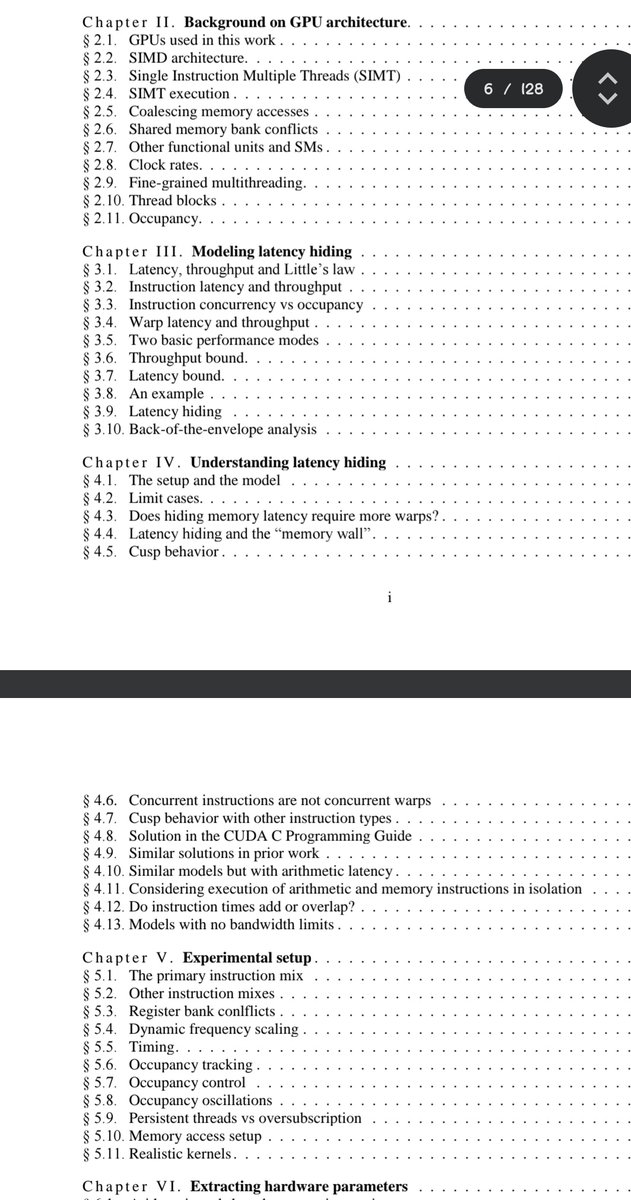
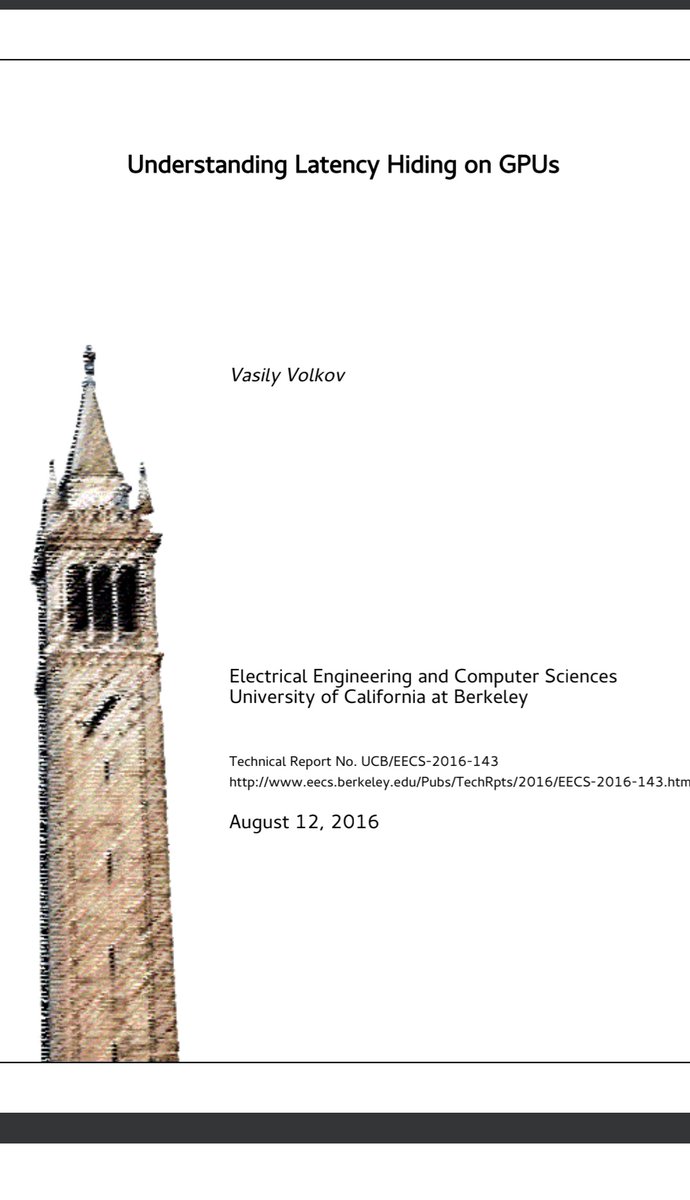
Doom scrolling led me to an unexpected gem: Understanding Latency Hiding on GPU by Vasily Volkov (UC Berkeley). It explains many GPU architecture and performance concepts that even Programming Massively Parallel Processors doesn't cover in depth.
As an AI Engineer. Please learn
>Harness engineering, not just prompt engineering
>Context engineering, not just long prompts
>Prompt caching vs. semantic caching tradeoffs
>KV cache management, eviction, reuse, and memory pressure at scale
>Prefill vs. decode latency and why they optimize differently
>Continuous batching, paged attention, and throughput optimization
>Speculative decoding vs. quantization vs. distillation tradeoffs
>INT8, INT4, FP8, AWQ, GPTQ, and when quantization hurts quality
>Structured output failures, schema validation, repair loops, and fallback chains
>Function calling reliability, tool contracts, argument validation, and idempotency
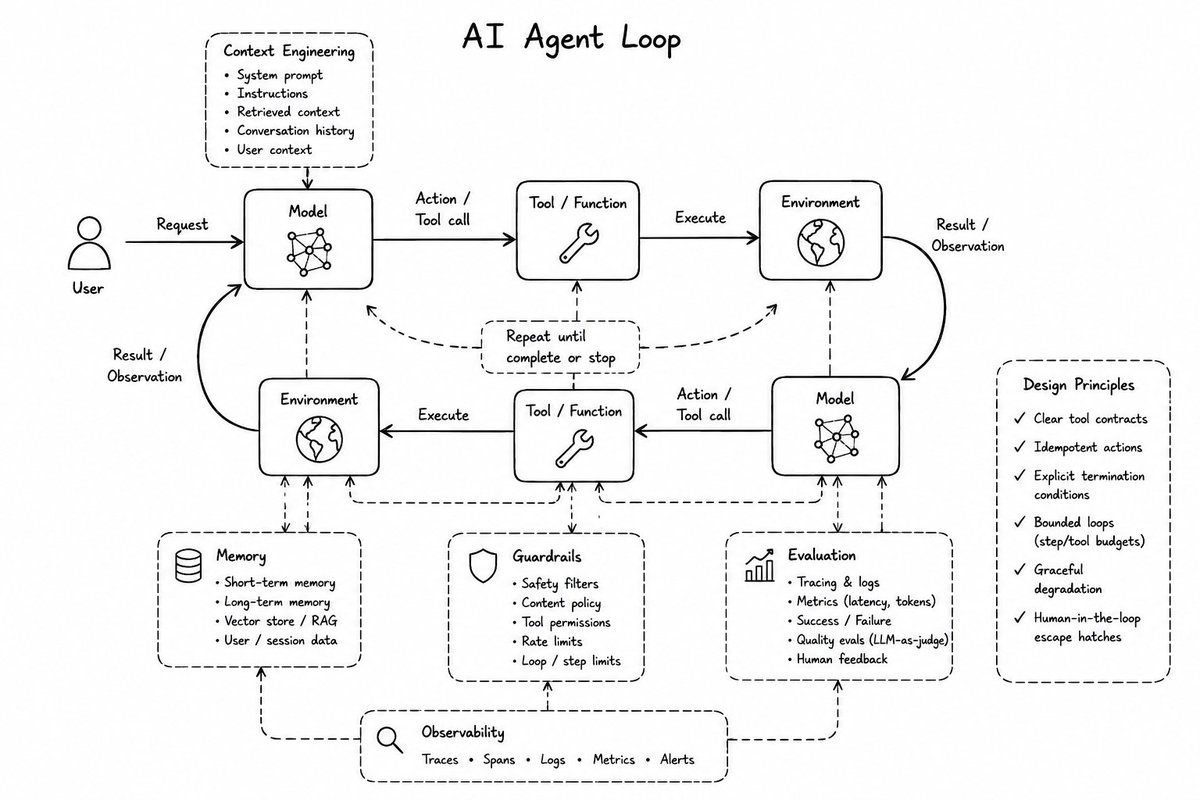
>Agent guardrails, loop budgets, tool budgets, and termination conditions
>Model routing, graceful fallback logic, and degraded-mode UX
>RAG architecture: chunking, embeddings, hybrid search, reranking, and freshness
>Retrieval evals: recall, precision, grounding, attribution, and citation quality
>Evals: golden sets, regression tests, adversarial tests, LLM-as-judge, and human evals
>LLM observability as a first-class discipline: traces, spans, tokens, latency, errors, and drift
>Cost attribution per feature, workflow, tenant, and user journey not just per model
>Safety engineering: prompt injection defense, data leakage prevention, and permission boundaries
>Multi-tenant isolation, cache safety, and cross-user context contamination prevention
>Fine-tuning vs. in-context learning vs. RAG vs. distillation and when each is the wrong tool
>Latency, quality, cost, and reliability tradeoffs across the full inference stack
>Production failure modes: hallucinated tool calls, malformed JSON, stale retrieval, runaway agents, and silent eval regressions
Razorpay Interview Experience
Compensation: 34L base + 18L ESOPs
Position: SDE-2 (Backend)
Application Mode: Referral
4 Years of Experience
𝗥𝗼𝘂𝗻𝗱 𝟭: 𝗗𝗦 & 𝗔𝗹𝗴𝗼 - 𝟭
- Sliding window: longest substring with at most K distinct characters
- HashMap-based frequency grouping and anagram detection
- Follow-up: optimize for streaming data with memory constraints
𝗥𝗼𝘂𝗻𝗱 𝟮: 𝗗𝗦 & 𝗔𝗹𝗴𝗼 - 𝟮
- Graph problem: find all connected components in a payment network
- BFS vs DFS tradeoff discussion
- Edge cases: disconnected nodes, cycles, self-loops
- Time and space complexity analysis for each approach
𝗥𝗼𝘂𝗻𝗱 𝟯: 𝗟𝗼𝘄 𝗟𝗲𝘃𝗲𝗹 𝗗𝗲𝘀𝗶𝗴𝗻 (𝗟𝗟𝗗)
- Design a Payment Retry System
- Key requirements:
- Idempotency across retries
- Exponential backoff with jitter
- Failure state transitions
- Write clean OOP code with clear class boundaries
- Walk through extensibility and failure scenarios
𝗥𝗼𝘂𝗻𝗱 𝟰: 𝗛𝗶𝗴𝗵 𝗟𝗲𝘃𝗲𝗹 𝗗𝗲𝘀𝗶𝗴𝗻 (𝗛𝗟𝗗)
- Design a Webhook Delivery System
- Decisions:
- Guaranteed delivery and ordering guarantees
- SQL vs NoSQL for event storage
- Retry logic and dead-letter queues
- Scalability:
- Async processing with Kafka
- Rate limiting per merchant
- Observability and alerting
𝗥𝗼𝘂𝗻𝗱 𝟱: 𝗛𝗶𝗿𝗶𝗻𝗴 𝗠𝗮𝗻𝗮𝗴𝗲𝗿 𝗥𝗼𝘂𝗻𝗱
- Walk through your most complex backend system
- How do you handle disagreements on architecture decisions?
- A time you improved reliability or performance of an existing service
- What does ownership mean to you as an engineer?
As an AI Engineer. Please learn
>Harness engineering, not just prompt engineering
>Context engineering, not just long prompts
>Prompt caching vs. semantic caching tradeoffs
>KV cache management, eviction, reuse, and memory pressure at scale
>Prefill vs. decode latency and why they optimize differently
>Continuous batching, paged attention, and throughput optimization
>Speculative decoding vs. quantization vs. distillation tradeoffs
>INT8, INT4, FP8, AWQ, GPTQ, and when quantization hurts quality
>Structured output failures, schema validation, repair loops, and fallback chains
>Function calling reliability, tool contracts, argument validation, and idempotency
>Agent guardrails, loop budgets, tool budgets, and termination conditions
>Model routing, graceful fallback logic, and degraded-mode UX
>RAG architecture: chunking, embeddings, hybrid search, reranking, and freshness
>Retrieval evals: recall, precision, grounding, attribution, and citation quality
>Evals: golden sets, regression tests, adversarial tests, LLM-as-judge, and human evals
>LLM observability as a first-class discipline: traces, spans, tokens, latency, errors, and drift
>Cost attribution per feature, workflow, tenant, and user journey not just per model
>Safety engineering: prompt injection defense, data leakage prevention, and permission boundaries
>Multi-tenant isolation, cache safety, and cross-user context contamination prevention
>Fine-tuning vs. in-context learning vs. RAG vs. distillation and when each is the wrong tool
>Latency, quality, cost, and reliability tradeoffs across the full inference stack
>Production failure modes: hallucinated tool calls, malformed JSON, stale retrieval, runaway agents, and silent eval regressions
🏆The Kaggle Book — Master Data Analysis and Data Science Competitions with Machine Learning, GenAI, and LLMs [2nd Ed.]: https://t.co/hrVstwy4zH v/ @PacktDataML
Table of Contents:
🔶Introducing Data Science Competition
🔷Organizing Data with Datasets
🔶Work & Learn with Kaggle Notebooks
🔷Kaggle Models
🔶Leveraging Discussion Forums
🔷Detailing Competition Tasks & Metrics
🔶Designing Good Validation Schemes
🔷Modeling for Tabular Competitions
🔶Hyperparameter Optimization
🔷Ensembling & Stacking Solutions
🔶Modeling Image Classification & Segmentation
My Review (on Amazon):
This 700-page masterpiece of writing covers everything you need—start to finish—to be a competitive coder, specifically for Kaggle data science competitions. The book covers the mechanics of the competitions (platform, resources, rankings, leaderboards), then the infrastructure (notebooks, GitHub, data sets, frameworks, discussion forums), and then nearly 500 pages devoted to "Elevating Your Game" (in-depth coverage of modeling techniques, evaluation metrics, validation strategies, hyperparameter optimization, ensembles, stacking, and various categories of competitions: tabular data, computer vision, NLP, Gen AI, simulations). The book concludes with a valuable section on building your Kaggle portfolio for career advancement and new opportunities. This is an outstanding data science / AI / Machine Learning training resource for anyone, even if you are not into the competitions, though especially if you are a dedicated Kaggler.
I am giving you free access to my complete 50 Days SQL Superstar Program.
The earlier SQL playlist helped millions, but interviews today need more depth.
So I am rebuilding everything from scratch to help you crack top product based companies.
I am also organising it in one clean portal with daily videos, notes, datasets, quizzes and certificates.
24 days are already live.
To get the enrolment link just:
- Follow me so that I can DM you
- Like and Retweet
- Comment "SQL Superstar"
Free access available for a limited time.
These 50 days can change your life!
#sql #dataengineering #databases







![KirkDBorne's tweet photo. 🏆The Kaggle Book — Master Data Analysis and Data Science Competitions with Machine Learning, GenAI, and LLMs [2nd Ed.]: https://t.co/hrVstwy4zH v/ @PacktDataML
Table of Contents:
🔶Introducing Data Science Competition
🔷Organizing Data with Datasets
🔶Work & Learn with Kaggle Notebooks
🔷Kaggle Models
🔶Leveraging Discussion Forums
🔷Detailing Competition Tasks & Metrics
🔶Designing Good Validation Schemes
🔷Modeling for Tabular Competitions
🔶Hyperparameter Optimization
🔷Ensembling & Stacking Solutions
🔶Modeling Image Classification & Segmentation
My Review (on Amazon):
This 700-page masterpiece of writing covers everything you need—start to finish—to be a competitive coder, specifically for Kaggle data science competitions. The book covers the mechanics of the competitions (platform, resources, rankings, leaderboards), then the infrastructure (notebooks, GitHub, data sets, frameworks, discussion forums), and then nearly 500 pages devoted to "Elevating Your Game" (in-depth coverage of modeling techniques, evaluation metrics, validation strategies, hyperparameter optimization, ensembles, stacking, and various categories of competitions: tabular data, computer vision, NLP, Gen AI, simulations). The book concludes with a valuable section on building your Kaggle portfolio for career advancement and new opportunities. This is an outstanding data science / AI / Machine Learning training resource for anyone, even if you are not into the competitions, though especially if you are a dedicated Kaggler.](https://pbs.twimg.com/media/HI9p8P6WcAAK-8g.jpg)