In Mere Christianity, CS Lewis has an awesome opening riff about how most people know the difference between right and wrong, but they justify acting immorally by appealing to "special exception." They know they shouldn't hit a friend, but what if that friend was being so mean? They know they shouldn't steal a seat a bus, but what if that person got up and created a moment's confusion and then the seat was up for grabs? Etc.
When I read this section, I thought a lot about contemporary politics and the way that people justify their politics, not by appealing to higher principles, but rather by appealing to "special exception" to argue that their admitted indecency is justifiable in context.
A lot of MAGA vice is justified by special exception. Trump's defenders rarely defend his crookedness directly. They don't say "it's wonderful to use trade policy to enrich the Oval Office, it's really awesome." They say: Well, look, it doesn't really matter, because the left is so dangerous, Biden maybe did something similar 3 years ago, Democrats would do the same in power, and so forth.
I heard something similar in that NYT conversation everybody's talking about. You even see it in the headline: ‘The Rich Don’t Play by the Rules. So Why Should I?’ Why, hello, special exception. When you start arguing that stealing food and French paintings is justifiable in the context of political protest in an age of prevailing distrust, you're similarly not arguing *for* any kind of a universal principle. Nobody actually wants 300 million people stealing fruit from the grocery store. Nobody actually wants every Louvre visitor trying to rip a Manet off the walls. These virtues don't scale. (Because they're not virtuous!)
Sap that I am, I want us to get to a place where politics is about fighting for what is right and decent, not about justifying what sort of indecent behavior might be somewhat understandable or technically justifiable given the other side's vice or the prevailing levels of indecency. The point is to build the kind of goodness that scales.
https://t.co/iPF65NuyeU
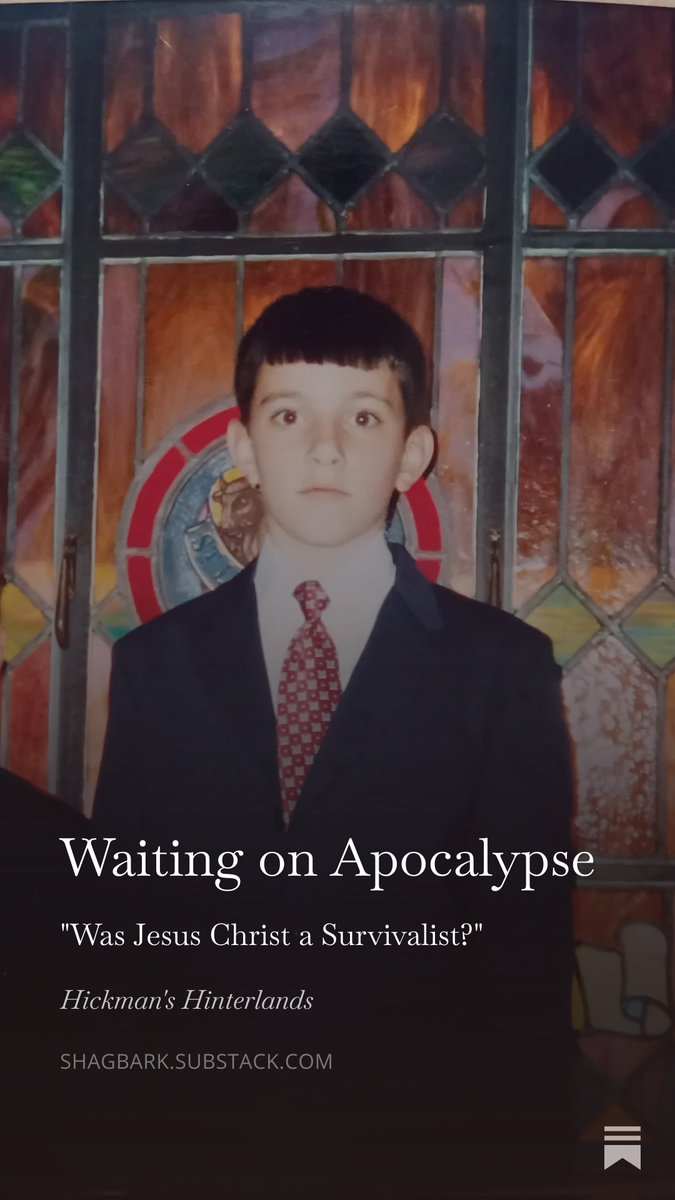
Over the last couple of years, quite a few people have asked me to write down and publish the story of my reversion to the Catholic Church.
I've done that here, though I found that in order to do it, I had to simultaneously write a critique of survivalism and "apocalyptic" thinking.
This essay is the first installation of a two-part series.
@father_rmv Fr. Vierling, did you know there is a Chesterton Academy in East Norriton, PA? More info in the link below, or my bio. Want to visit? Coffee, tour, and maybe a school Mass? Please DM me, or, if Twitter makes that complicated, please use the "contact" form on the school website.
@FeserEdward Could you connect this with a theological anthropology? In other words, in a Catholic account of the human person, with a theological or philosophical rather than culturally contingent premise, what makes these intrinsically masculine virtues?
We may have heard about the importance of mental prayer. But as far as approaching it, we’re not always sure how.
Jacques Philippe, in "Time for God", gives one of the best guides I’ve ever read on this.
Here's a brief summary of his thoughts. 🧵
@LarryChappGS22 I love the poor. I worry about my salvation. I do not want to ignore Lazarus. But also, I worry about addiction, mental health, squalor, crime, danger, and being hijacked by sentimental multiculturalism. Longing for a movement that loves the poor but also beauty, safety, learning
“This is what Friedrich Nietzsche knew, and what today’s liberal humanists will too often deny: if you knock out the pillars of a sacred order, the universe itself will change shape. At the primal level, such a change is experienced by people as a deep and lasting trauma, whether they know it or not. No culture can just shrug off, or rationalise away, the metaphysics which underpin it and expect to remain a culture in anything but name—if that.” — Against the Machine,
Paul Kingsnorth, 2025