Three men lost their lives on Monday protecting their community.
Amin Abdullah, the security guard and father of 8, stood in front of the gunmen so 140 children could hide.
Mansour Kaziha, a pillar of the mosque for nearly 40 years, called 911.
Nader Awad ran toward the danger to draw the shooters away.
They were fathers, husbands, pillars of their mosque. They chose others over themselves.
Our hearts are with their families and the entire Muslim community of San Diego.
Islamophobia kills. This is not a debate. It’s reality.
🤍 Innā lillāhi wa innā ilayhi rājiʿūn
@B_ELRUFAI Congratulations Hon, as you begins another new chapter in your political journey. Your commitment to serving your people (KN) is a proof of your dedication to the WELFARE FIRST.
May Allah continue to sustain your success and free you and Mallam from those cancerous. @B_ELRUFAI
This is me during my Shell Recruitment Day in November 2011.
1hr after the whole day group interview, I got the phone call I can never forget, “Congratulations, they all loved you. When can you start?”
If you have an upcoming group interview where they put a bunch of you together in a room and give you a task to work on together, then sit up.
I will tell you my secrets.
I don’t need them anymore and it can help you land your dream job.
They are what I used during my SRD.
I have given the same playbook to many mentees who used them to land their dream jobs in various companies.
So, trust me, this works.
A 🧵
MBA or not? UK or USA?
My 23-yr-old friend MT @AskMichaelTaiwo's advice to me 3 months after we graduated from Ife, when I briefly considered going for MBA abroad and told him.
9 Jan 2007
19 yrs later, still relevant to any young grad
PS: Wasn't known as Jarus then. Na Suree (Suri) my friends from secondary school dey call me 😃
@SirJarus@AskMichaelTaiwo This is golden. May God bless this enviable friendship. Kudos to MT and to you @SirJarus too for use your platforms in mentoring young ones.
The youths in Aiyetoro Gbede, Ijumu LGA, are protesting against an alleged plot to remove INEC Chairman Joash Amupitan, who hails from the community.
Watch 👇🏿
Since the past 24 hours that I made the tweet on child parenting solution, my DM has been buzzing. I checked them, and one thing was quite common to all: Parents who are not happy about their kid’s performance in school, and they have approached it the wrong way.
If you fall in this category, this post is for you.
Many of us use brutal force because expectations are too high, and the anger is just too much. The scholar Ibn al-Jawzi explained in his book Sayd al-Khatir that intellect is a Rizq (provision) from God, just like money or health.
He said some people are born with a wide vessel and others with a narrow one. If you try to force the water of a whole sea into a small cup, you will only spill the water and ruin the cup. This is what many of us are doing. We are trying to force a "doctor's brain" into a child whose cup was designed for something else.
By that, it causes a soul-crushing resentment in the child. Imam Al-Ghazali described this beautifully in Ihya’ Ulum al-Din. He warned parents about a state called “Al-Malal”, where a child builds resentment because they are pushed beyond their limit. Everyone wants the best for their child. No doubt. However, if you keep yelling at them for things they cannot grasp yet, you make them hate the very sight of a book. You are closing the door to their heart while trying to kick open the door to their mind.
Then what is the solution? It is simple.
Going forward, every parent should make efforts to start looking for the Fath (the opening) in their kids. What does this mean? This is the lane the Almighty has prepared for them. In our history, if a child is slow with grammar or math, the scholars don’t call them a failure. They move them to a trade, a craft or a service.
How then do you identify this Fath (Opening) in your child? Please pay close attention to me…
(1) The first phase is Observation. Ibn al-Qayyim mentioned a concept called Istid’ad (natural readiness) in his book titled: Tuhfat al-Mawdud. This means you want to watch/observe/look at the child when they think nobody is looking. This is your first tool. For the next two weeks, stop talking about school. Do not worry yourself about how they perform on their homework.
Instead, keep a "Strength Log." Every evening, write down one thing they did well that had nothing to do with a classroom. Did they fix a broken toy? Did they calm down a crying sibling? Did they organise their shoes? You are looking for their Istid’ad (natural readiness). If they are "book-slow" but "people-smart" or "hand-smart," that is where the key has been placed.
(2) Introduce “Project or Craft” early on. Ibn Khaldun, in his Muqaddimah, argued that projects/crafts are high forms of intelligence that build civilizations. He argued that some minds are designed to understand the physical world better than the abstract one.
Give them a "Project Day." Buy a basic tool kit, a sewing machine, or a coding starter kit. Give them a broken radio or a piece of furniture to fix. Delegate. Give them a real-world task that has a visible result. When a child who fails at math sees that they can build a table or bake a perfect loaf of bread, their internal shame starts to heal. They realize they are not stupid; they were just in the wrong room.
(3) Kill the Comparison Virus. Imam Al-Zarnuji, in his classic work Ta’lim al-Muta’allim, explained that a student should only study what fits their nature. He said that forcing a student into a field they have no taste for is a waste of their life and the teacher's time. When you compare your child to others, you are catching a virus that blinds you to their path. Always filter.
When family members start bragging about their kids' grades, you must be the shield. Tell them, "My child is mastering the art of (so so and so)." You are teaching your child that success is not a single ladder. There are many ladders to it. And if you do not value their ladder, they will stop climbing.
(4) Prioritize Character Building. Put more efforts to praise your kids for their good character. Always tell them you love them when they behave well or show good character. Character recognition helps the child build a good self-image, which translates into self-confidence and barrier-breaking for the child. Prioritise this.
(5) Don’t underestimate the power of your words. Always pray to God to grant them their opening. The scholars taught that the "opening" is a gift from Al-Fattah (The Opener). Supplicate.
In your Sujud or in your prayers, stop asking for them to be a doctor/engineer, and what have you. Ask for the door that was made for them to be opened. Ask Him to show you the Fath so you can stop pushing them against a closed wall.
Always remember, a parent who finds the "Fath (The Opening)" for their child has given them a gift better than a degree. You have given them a purpose. Start that journey NOW. It’s never too late…
Thank you for your attention.
Allah knows best.
Hello Lola, I am a Muslim, and our spiritual tradition has a very deep approach to raising children. I want to share some tips from our scholars that will be beneficial to you regardless of your faith.
First of all, our theology teaches the concept of Fitrah. This means that every child is born with a pure heart. At six years old, she is not a criminal mastermind. She does not have a wicked soul.
If she doesn’t have all these, then what is happening? The truth is that she is just lacking impulse control and testing boundaries. By this, if you look at her as a manipulator, you will fight her. However, if you look at her as a pure soul making mistakes, you will be able to guide her.
Secondly, for every problem anyone faces today, it has been solved in history. The only problem is how to locate them.
A classical scholar named Al-Ghazali wrote about child psychology over 900 years ago in his famous book “Ihya Ulum al-Din.” In his section on disciplining children, he gave a practical rule I want you to adopt going forward.
He advised that parents should never push a child into a corner where they are forced to lie. When you ask a question you already know the answer to, her survival instinct kicks in. She cries and she lies to defend herself because she is scared of you. Stop interrogating her. Just look at her and state the fact. Say, I know you took this, and we are going to return it right now.
Again, another scholar and sociologist Ibn Khaldun addressed this exact behavior in his masterpiece titled: “Al-Muqaddimah.” He warned that when a child is raised with harsh punishment, they learn deceit, trickery, and lying to protect themselves. This is why she is covering her tracks and crying to manipulate you. The fear of a harsh reaction is making her a better liar.
Lola, do not attach a label to her. Do not ever call her a thief. If you attack her identity instead of her action, she will internalize it and grow into that dark label. Tell her the action is wrong but protect her dignity.
Make her return the item. Do not fall for the tears. Hold her hand, walk her back to wherever she took it from, and make her hand it back and apologize. The discomfort of returning a stolen item teaches a much better lesson than beating her will ever do.
Finally, I don’t know if you are a Muslim, but never underestimate the power of your own words. In our faith, we believe the prayer of a parent for a child goes straight to God without any barrier. Pray over her. Pray for her heart to be content and for her character to be straight.
Keep doing this consistently and the habit will break.
Allah knows best.
Does she do this in multiple settings or just at home? What types of items are being stolen? Has she experienced any losses or tragedies recently?
At that age, the drivers of stealing and lying may include:
1) Poor impulse control (their brain is still developing)
2) Wanting something immediately and not thinking ahead
3) Testing boundaries
4) Seeking attention or control
5) Anxiety, insecurity, or copying behaviour
6) An underlying behavioural disorder that makes empathy difficult
Sometimes, a child can fixate on certain things as a security blanket and becomes emotionally attached. Other times, it's because they haven't developed the skill of delayed gratification and talking about their thoughts and feelings.
The solution will depend on what is driving the behaviour.
As a mum, you can reinforce standards such as, "In this family, we always tell the truth" and "We always respect what belongs to others." Get down to eye level and tell her this firmly (but not shouting) before you make her return the stolen item, apologise to the person who owned the item, and apply the consistent consequence of making her lose an item of value to her for one week whenever she takes an item from someone else. Do this without harshness, just tell her the consequence and apply it even if she throws a tantrum. Be consistent and don't lose your cool. She feeds off your energy. Calmness in discipline and regulating your own emotions are crucial. But she must have a consequence that is serious. Remind her that when she steals from others, they also feel the loss she is feeling. She needs to understand how others feel due to her behaviour.
Then teach her how to talk to you about what she wants, and tell her that sometimes you too want things but cant have them immediately, yet strong people are patient and the best thing you have is her. Tell her this frequently, not only when she does wrong, and embrace her so that she builds emotional security with you. When you notice her talking openly, compliment her for sharing her feelings or desires. Give her more attention when she engages in positive behaviour.
You can also engage her in regular exercises to build delayed gratification - like sitting down in front of a desirable object without taking it (while left alone in a room) - for 1 min, 3 mins, then 5 mins, then gradually increasing up to 15 mins. You can teach self-diversion techniques to use when she is feeling tempted, like singing or reciting some rhymes, counting her fingers, praying, or closing her eyes and remembering something nice.
If she persists in stealing and lying in spite of a few months of these strategies, she may require further assessment.
Using a cane won't stop her. She will eventually stop feeling the pain of the beating, get more crafty and hide her bad behaviours from you. A lot of those who got beaten throughout their childhood are still lured by 419 and, if they could get rich without being caught, they would steal in a heartbeat.
Building good character and life skills takes time and persistence. Don't give up. Mothering comes with many trials. Every mother faces something difficult or shocking when it comes to her kids, but believe in her goodness and understand that your role is to role model, teach and train her with strong values and endurance. She will respect you all the more for it when she is older.
Zina takes everything from you. It is one of a few sins the Quran calls pure filth. Zina is a chain reaction, it starts with a glance, then a smile, a message, a meeting until one day your heart has already crossed the line and the body simply follows. That's why Allah didn't say don't commit zina, Allah says do not go even near it. Because the paths leading to Zina are as destructive as Zina itself.
By the time the body sins, the heart, mind, and discipline are already compromised. That's why people feel emptier after, not relieved. Something leaks out of them, focus, self respect or barakah. Zina didn't just break religious rules it kills your ability to bond deeply and slowly normalizes self betrayal.
Zina strongly activates the dopamine. It makes a normal life feel boring, work feels heavy and the focus drops. Over time, self control becomes weak. You know something is wrong, but stopping feels harder. It also creates emotional bonds in the brain. When intimacy happens without commitment, those bonds break again and again. The brain learns not to attach deeply. People start feeling emotionally numb, distant, or unable to truly connect.
When you commit Zina the body stays in a stress cycle. Sleep, energy and mood get affected. Anxiety and restlessness increases. Mentally and morally it creates an inner conflict. You act against your values. Guilt and secrecy slowly eat confidence and peace. Zina is always an exchange. You give time, focus, discipline, biology and you get distractions in return. With Zina, you don't just touch a body, you inherit a mess. Other people's chaos stick to you.
Halal intimacy does not damage a person because it happens inside safety, clarity, and responsibility. In marriage, there is no secrecy, no fear of exposure, and no inner conflict. The Quran allows intimacy only within marriage because it protects dignity and emotional stability. When a person acts in with their values, the mind stays calm instead of divided, so guilt and shame do not poison the experience.
Scientifically, halal intimacy works with the brain, not against it. Oxytocin and bonding hormones strengthen attachment instead of being broken repeatedly. This builds trust, emotional security, and long-term satisfaction rather than emotional numbness. The brain learns that intimacy is safe, stable, and meaningful, not something to chase and hide.
In today’s age of constant stimulation, casual relationships, and instant pleasure, halal intimacy protects focus and discipline. It does not drain energy or scatter attention. Instead, it supports routine, emotional balance, and personal growth. Rather than weakening self-control, it strengthens it. That is why halal intimacy adds peace and stability, while zina slowly takes them away even when it looks harmless on the surface.
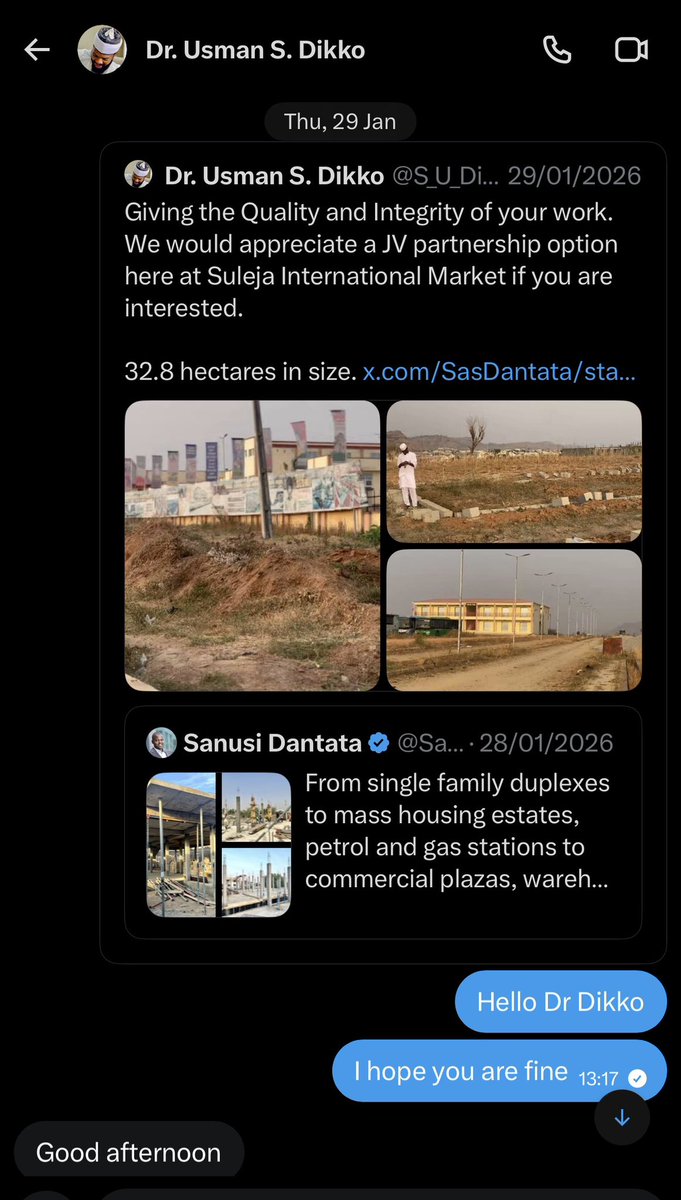
It all started on Twitter.
He was pitching it to a Dantata.
I came across the tweet.
Maybe this is too small for a Dantata, but big for a Jarus.
I sent a DM (frames 1 & 2)
After almost three months of discussions, negotiations & inspections, contract signed today (3 & 4)