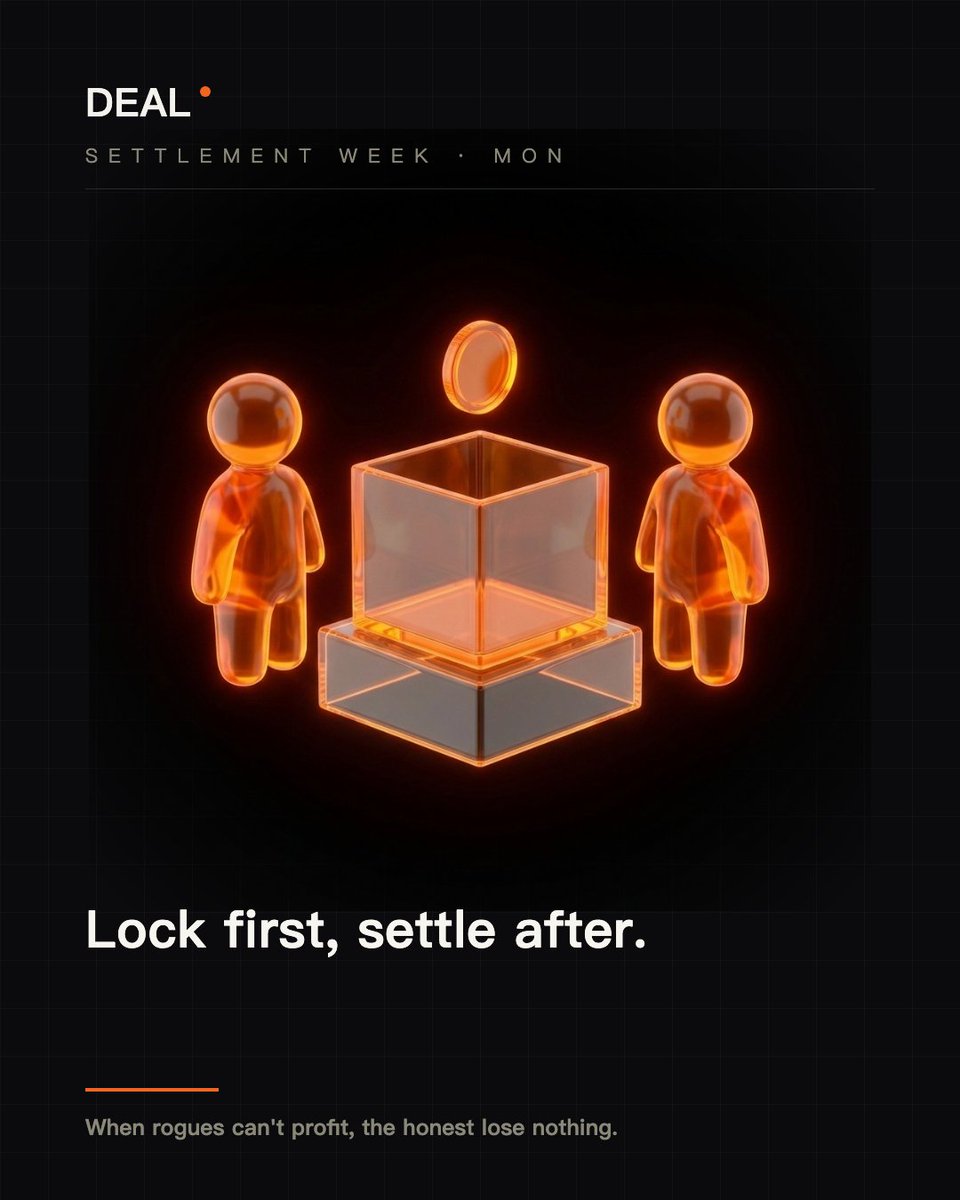
The website is live.
🔗: https://t.co/1PDaus93zi
What #DEAL is, how it works, where it's headed — it's all on one page. Read it, judge for yourself.
The whitepaper's there too.
When rogues can't profit, the honest lose nothing.
AI Can Make Decisions. But Who Makes Sure It Doesn’t Lose Your Money?
AI Agents are rapidly evolving from simply **answering questions to taking actions.
They can call tools, manage assets, execute trades, and interact directly with on-chain protocols.
But there’s a question we should be asking:
What happens when an AI makes the wrong decision?
In traditional software, mistakes can often be rolled back.
On-chain, once a transaction is signed and executed, there may be no undo button.
And attackers don’t necessarily need to steal a private key.
A single prompt injection.
A compromised data source.
A malicious skill.
An excessive authorization.
One wrong instruction could be enough for an AI Agent to execute something it was never supposed to do.
The more capable AI becomes,
the more powerful its permissions become.
And the more powerful the permissions,
the more important the security boundaries become.
This is why we believe security cannot be an afterthought for the AI × Blockchain ecosystem.
The next generation of on-chain infrastructure shouldn’t only ask:
> “Can AI execute this?”
It should also ask:
> “Why is AI allowed to execute it?”
> “What exactly is it authorized to do?”
> “Who verifies the action before execution?”
> “Can every action be traced and audited?”
The future of AI × Blockchain shouldn’t simply be:
AI + Wallet + Smart Contract
It should be:
AI + Identity + Permission + Verification + On-chain Execution
AI brings intelligence.
Blockchain brings verifiability.
Security defines the boundary between them.
That’s the direction we’re building toward with "DEAL".
DEAL — Building a safer execution layer for the on-chain AI ecosystem.
#AI #AIAgents #Web3 #Blockchain #OnChain #DeFi #CryptoSecurity
Seeking Early Contributors ⚓️
DEAL's first co-building task: build the #DEAL knowledge base.
One site to look up docs, mechanics and progress in minutes.
500 USDT, escrowed in three milestones, released on double confirmation, on-chain.
More to follow.
One idea ran through this week: turn "promised" into "locked."
Words, chat logs, vouches can be walked back. Assets in a contract can't — released only when both sides press ✓, frozen if either backs out.
When rogues can't profit, the honest lose nothing.
🔍: https://t.co/tQWe7kfMye
A freelancer's most valuable asset is a record of closed deals.
#DEAL keeps it on-chain: every settlement writes into your identity NFT — totals, succeeded, failed — visible to anyone who searches your ID.
Groups vanish; the record stays and moves with you.
One of the oldest scams around: impersonating "the person holding the money."
On #DEAL that role doesn't exist — assets go into the smart contract, never into anyone's address.
Even the person who brokered the deal can't touch the funds.
Rules public, verifiable on-chain.
Escrow settles whether the money moves.
An acceptance list settles whether the work is done.
Before anyone presses ✓, write down what counts as done: deliverables, quantity, deadline.
Funds release on mutual agreement — and agreement starts with a clear standard.
#DEAL
A project payment can travel two ways.
Through people — every handoff adds another "will they pay?".
Through the contract — assets are escrowed on-chain, released only when both sides agree, frozen on dispute.
No hands touch it in between.
#DEAL
Should trial work be free? Old question.
A newer answer: the trial fee goes into the contract first.
Work accepted — both confirm, it releases.
Not accepted — both press ✗ and each side takes back its own.
Nobody has to trust anybody first.
The most common dispute in remote work isn't the work — it's the money after.
Remote's 2025 report: 85% of freelancers have been paid late.
#DEAL flips the order: the pay locks into the contract first, and releases when both sides confirm.
Lock first, settle after.
Three options when creating a #DEAL contract:
a fee toggle; a deadline — with default handling rules if someone goes silent;
and a designated counterparty — set a wallet address or identity NFT, and only they can join.
Contracts on #DEAL come in three shapes:
token:token — both sides put up assets and swap;
token:empty — one side puts up assets (a gift, or payment tied to off-chain delivery);
empty:empty — an agreement with no trade assets attached (deposits are separate).
Search in #DEAL is exact-match only.
Three entry points:
A contract address finds the deal;
A domain ID opens that marketplace;
An identity NFT ID shows a user's profile and reputation.
You find exactly what you type.
#DEAL's home screen does three things: search, create a contract, and list your contracts — sorted by creation time, in three states: not started (waiting for the other side), in progress (both joined), closed (with a settlement summary).
#DEAL's first screen: connect a wallet and you're in.
Five interface languages — English, Simplified and Traditional Chinese, Japanese, Korean; English by default.
The screen carries one line: 'When rogues can't profit, the honest lose nothing.'
#DEAL's mobile app is up and running, and the gameplay docs are live on the site: how to create a contract, fund it, confirm and settle, spelled out step by step.
🔍: https://t.co/zgimievmrM
The website is live.
🔗: https://t.co/1PDaus93zi
What #DEAL is, how it works, where it's headed — it's all on one page. Read it, judge for yourself.
The whitepaper's there too.
When rogues can't profit, the honest lose nothing.
Tomorrow, the website goes live.
Nothing to shout about tonight.
The thing is built; we just put it up.
On-chain, we've always said things slowly: every #deal sits on-chain, and whoever keeps their word builds a reputation anyone can check.
See you tomorrow. 🔒
A few days until the site goes live.
A small look, not the whole thing.
The page answers four questions:
· What #DEAL is — on-chain escrow with no third-party arbiter.
· How it works — lock first, settle after; a smart contract holds the assets and releases only when both sides agree, freezing on dispute.
· How it remembers you — every closed deal settles into a season-numbered reputation; credit becomes an asset you accumulate.
· Where it runs — multi-chain: #BSC, #Ethereum, #Arbitrum, #Polygon, #Solana.
The rest, you'll find on the page.
👀