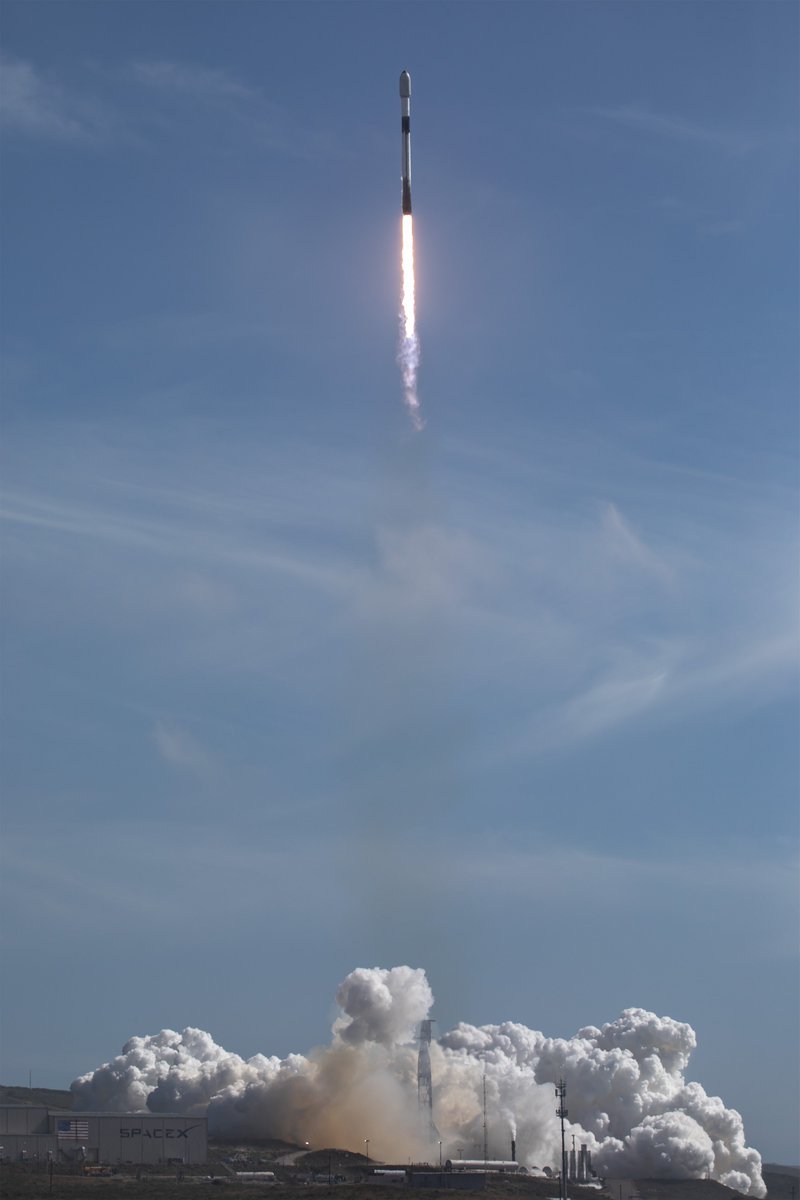
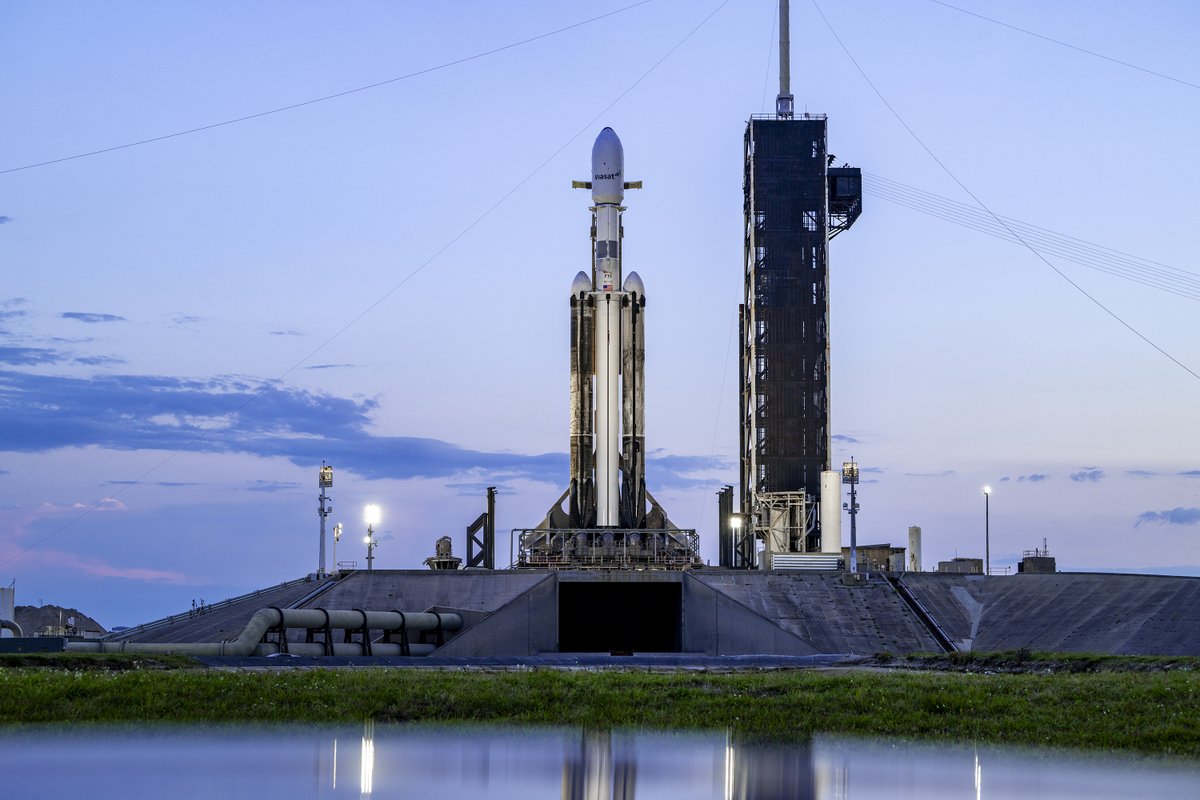
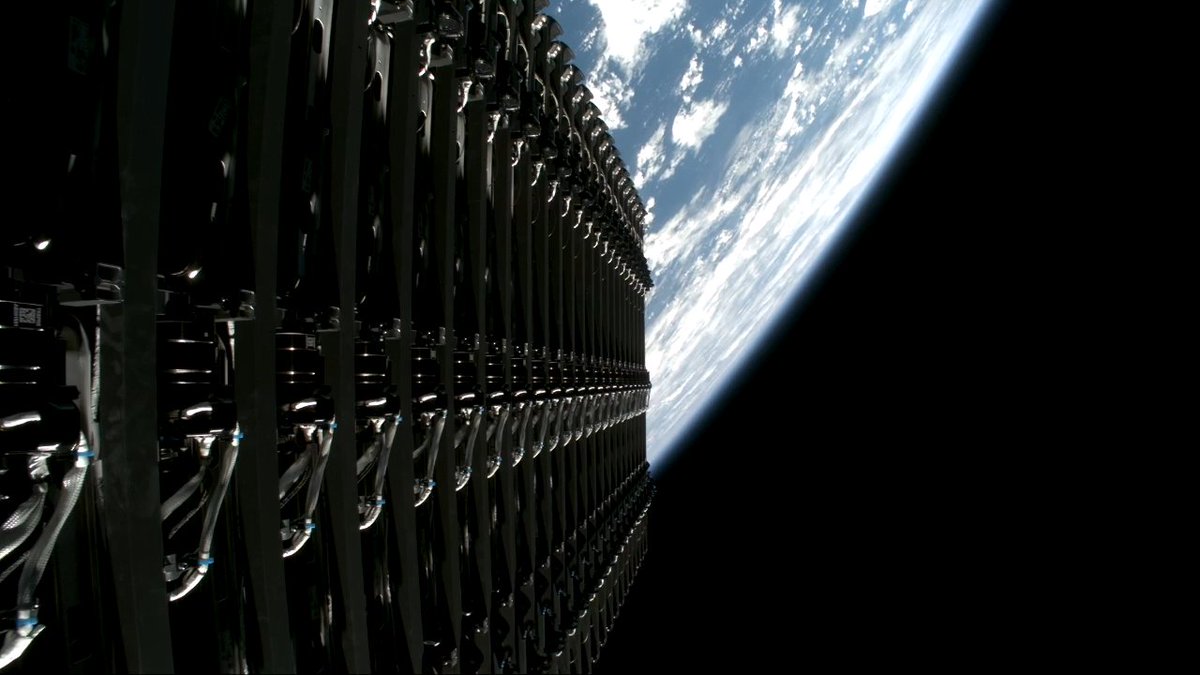
T-1 hour until Falcon Heavy’s launch of the @viasat-3 F3 mission. Teams continue to monitor weather, which is currently 55% favorable for liftoff. The webcast will go live approximately 15 minutes before launch → https://t.co/IP0cm3wEd5
@syouth1@ERShares LOL ERshares should add Easter to the list. VCX pumped 1,740% in 4 days at 30x NAV and rugged retail investors. Where is your 120 questions and coverage for them?
@donlriley@EricBalchunas@kgreifeld@scarletfu Nah, sec has never done that . The breach was passive , caused by redemptions, not buying. A plan with regulators is confirmed and in place . He says this in the video. SpaceX IPO converts the asset to liquid and resolves it automatically. That’s the opposite of your scenario.
DYOR, I've always suspected something was off with $XOVR coverage by Morningstar.
CFA & Meier Watkins is no joke.. the Dominion lawyers. Excessive negative coverage targeting one fund by single analyst there.
Judge for yourself
https://t.co/bE3MXeseWg
@LaMonicaBuzz Lumping these together as “SpaceX funds” is too simplistic
$XOVR has still been moving much more with the broader market, at least until the SpaceX piece gets repriced in an IPO
That’s a very different setup from the price action in $DXYZ and $VCX
 ELON MUSK: ""I don't really think about competitors. I just think about making the product as perfect as possible. What we want to achieve is the platonic ideal of the perfect product. As long as you focus on that, you will have a compelling product."
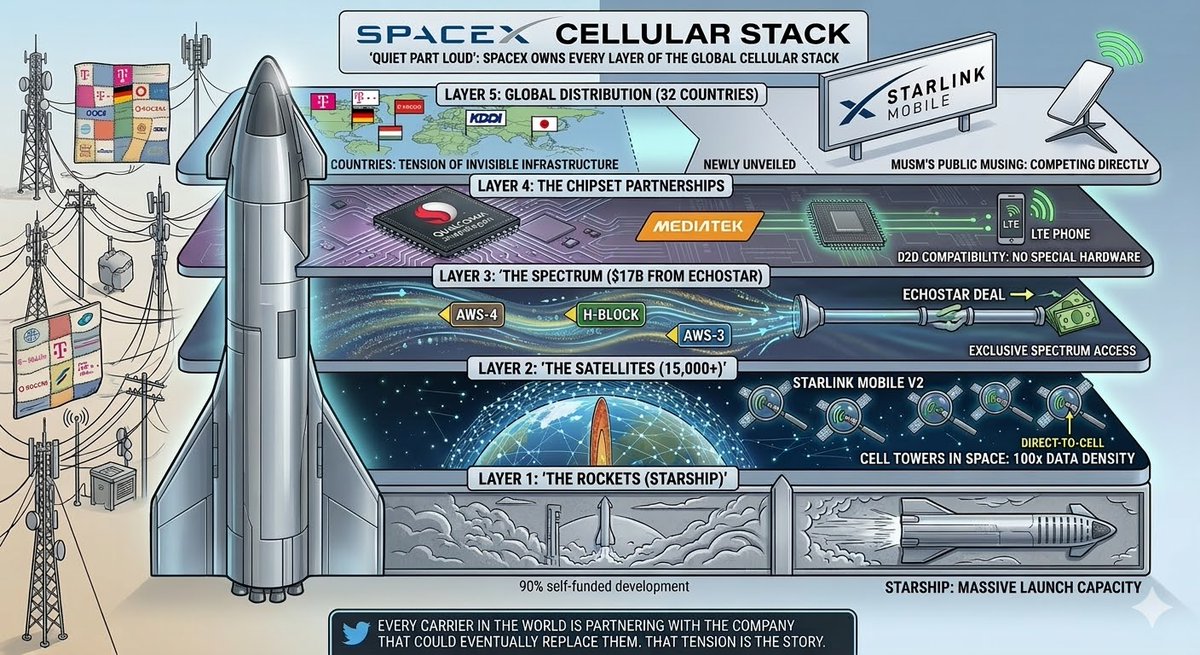
Quiet part loud: SpaceX now owns every layer of the stack needed to be a global cellular carrier. And now has a plan to beam it direct to your cell phone.
Starlink Mobile v2 sits on top of:
- The rockets (Starship)
- The satellites (15,000 approved)
- The spectrum ($17B from EchoStar)
- The chipset partnerships (Qualcomm, MediaTek)
- Carrier deals across 32 countries on six continents
They're currently partnering with T-Mobile and a dozen more carriers serving as invisible infrastructure underneath.
But Elon has publicly talked about competing directly with carriers. Just last week they laid out their plan launch 1,200 satellites in six months starting mid 2027
50 per Starship. Each satellite carrying antennas five times larger than the current fleet. Hundred-foot solar arrays. Custom SpaceX silicon. 20 times the throughput of what's in orbit today. 100x data density of V1
The result: 150 Mbps download speeds beamed directly from low Earth orbit to the phone in your pocket anywhere on earth
70% of the planet has no service. Starlink will make that 0% and now every carrier in the world is forced to partner with the company that could eventually replace them
SpaceX is engineering a $50B+ automatic buy wall before the stock even trades.
Here’s why this is so much bigger than people realize.
Normally, a company IPOs, waits 6-12 months of “seasoning,” then maybe gets considered for S&P 500 or Nasdaq 100 inclusion at a quarterly rebalance. That waiting period exists so the stock can establish a trading history, prove liquidity, and show it won’t collapse 30 days in.
SpaceX wants to skip all of that. And Nasdaq is literally rewriting its rules to accommodate them.
Nasdaq just proposed a “Fast Entry” rule that lets any new listing with a market cap in the top 40 of current index constituents join after just 15 trading days. The old minimum was three months. SpaceX’s expected IPO valuation of $1-1.5 trillion would make it a top-10 constituent on day one.
The math on why this matters: roughly $16 trillion in assets directly track or benchmark against the S&P 500 and Nasdaq 100. Index funds like SPY, VOO, and IVV alone manage over $2 trillion combined. When a stock enters one of these indexes, every passive fund and ETF tracking it has to buy shares in proportion to the company’s weight. For a company valued at $1 trillion+, that forced buying could easily exceed $50 billion in the weeks following inclusion.
SpaceX is pre-negotiating an artificial demand floor before a single retail investor places an order.
Think about what this tells you about how Musk and SpaceX’s advisers view the IPO risk. They’re targeting a valuation of 60-70x sales on $22 billion in expected 2026 revenue. At that multiple, the stock needs constant buying pressure to hold. Index inclusion creates that pressure mechanically, through fund inflows that happen regardless of whether any human analyst thinks the price makes sense.
Tesla rallied 60% between its S&P 500 inclusion announcement and actual addition in December 2020. SpaceX watched that playbook, and now they’re trying to compress the timeline from months to days.
Meanwhile, index providers are now competing to attract the biggest IPOs by weakening the very rules designed to protect index integrity. Nasdaq is proposing Fast Entry. S&P will face pressure to match or lose the listing. The indexes are turning into customer acquisition tools for trillion-dollar debuts.
And every passive investor in a 401(k) will automatically become a SpaceX shareholder at whatever price the market sets in those first 15 trading days, whether they want to be or not.