@hedera@hashgraph@The_Hashgraph shouldn’t one of you as the official representative of the Hedera Hashgraph LLC make an official statement to the community on this significant development. It should have been done before the lawsuit was filed. That’s just good governance.
What makes HNC different?
You can:
• require approvals before execution
• restrict counterparties
• apply transaction limits
• separate initiator and approver roles
• maintain audit trails across chains
Most wallets only ask:
“Can this transaction be signed?”
HNC asks:
“Should it execute?”
#Hsuite #XRPL #Web3
570M users across emerging markets is a sovereignty story, not just a growth number.
The KYC/onboarding layer for that user base shouldn’t route biometrics and IDs through US cloud vendors.
On-device document recognition exists and works at scale — the infra is there for stablecoins that take user sovereignty seriously.
Tether just released its quarterly attestation for Q1 2026.
Tether had a great start of the year, with more than 1B in net profits, despite highly volatile global markets.
USDT user base grew throughout the first quarter of 2026, reaching the new all-time-high of 570M, boosted by new demand of dollars across all emerging markets, fueled by the current period of geopolitical uncertainty. 67B USDT are currently held as savings across many millions of users especially those located in developing countries.
Highlights as of 30 April 2026:
* ~1.04B in net profits for Q1 2026.
* ~183.5B total issued USDT, end of Q1 2026.
* ~191.7B total assets/reserves, end of Q1 2026.
* ~8.2B excess reserves, on top of the 100% reserves in liquid assets that back all issued tokens, end of Q1 2026.
* ~141B in US treasuries (direct + indirect exposure), end of Q1 2026.
Thank you very much for the continued support ❤️
🔸️Why does this matter?
Because DeFi today has a major flaw:
It rewards passivity
It over-inflates tokens
It dilutes value
Early insiders benefit the most
That model is broken.
11/
Dynamic APY introduces GameFi mechanics into DeFi 🎮
Instead of “deposit & forget”:
👉 You are incentivized to:
• Drive volume
• Grow your pool
• Stay active
• Think strategically
🔸️This isn’t just for founders.
It’s for everyone:
• Token teams
• Communities
• Holders of any HTS token
You can now actively market-make your own ecosystem
🔸️And the most important part:
Every pool is treated equally
No favoritism
No hidden advantages
Just performance
🔸️To qualify for rewards, pools must meet a minimum threshold:
• TVL: 10,000 HBAR (~$950)
• Volume: 1,000 HBAR (~$95)
That’s it.
Accessible. Fair. Open.
🔸️Dynamic APY will continue evolving.
But the goal remains:
👉 Turn DeFi from passive → active
👉 Reward contribution → not just capital
👉 Build a healthier, sustainable ecosystem
Welcome to GameFi-powered DeFi on @Hedera at Silk Suite 🟪
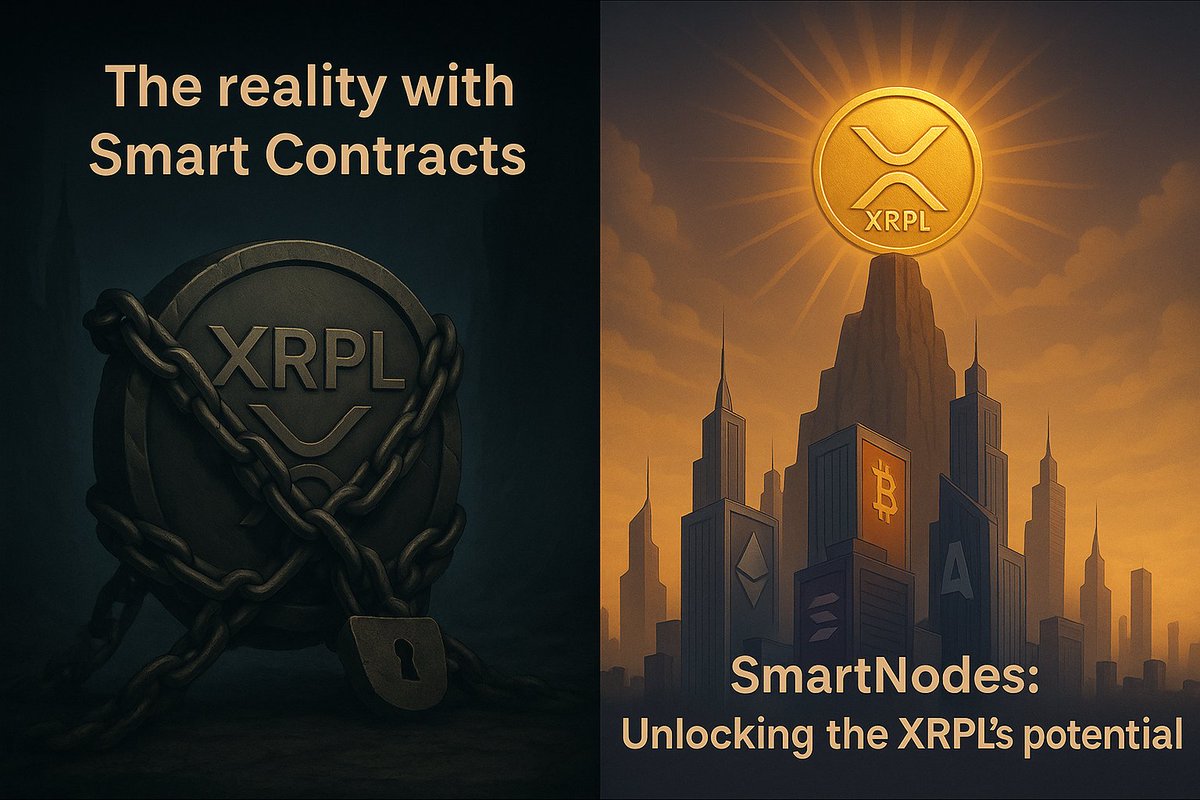
SmartNodes on XRPL: Unlocking Scalable Programmability
XRPL’s Smart Contract Gap:
The XRP Ledger (XRPL) is known for speed, low fees, and built-in features like a DEX, tokenization, escrow, and NFTs . But it has never supported arbitrary smart contracts. This was a deliberate choice by its creators, who prioritized stability and security over the complexity of Turing-complete code . Ripple CTO David Schwartz has described XRPL as a “fixed-function ledger,” leaving complex logic for other systems.
This foresight spared XRPL from common vulnerabilities, but it also limited programmability. Developers wanting DeFi protocols or dApps have had to look elsewhere. To bridge the gap, XRPL has explored Hooks (lightweight scripts, still in development) and an EVM-compatible sidechain, launched in 2025. The latter saw over 1,400 smart contracts deployed in its first week, showing strong demand. But sidechains bring bridge risk and added complexity. XRPL still needs a scalable, secure approach to programmability.
Why Smart Contracts Struggle:
Traditional smart contracts enable DeFi, NFTs, and dApps—but at a cost. On Ethereum and similar chains, every node executes every contract. This creates high fees, congestion, and security risks. Vulnerabilities are permanent once deployed, and billions have been lost to exploits . Recent attacks even used Ethereum contracts to distribute malware via NPM packages .
Smart contracts also depend on external oracles for real-world data , which can be compromised. The result: a powerful tool that too often proves inefficient, expensive, and fragile. XRPL’s founders foresaw these issues—which is why XRPL avoided them at its core.
Enter SmartNodes:
SmartNodes, pioneered by HSuite on Hedera, provide programmability without burdening the base ledger. They run off-chain but anchor results to the blockchain, offering what HSuite calls a “Layer 1.5” model .
Key advantages:
👉Scalability: Off-chain execution means near-unlimited complexity, no gas or memory caps.
👉Security: Bugs can be patched; redundant nodes ensure reliability.
👉Oracle-Free: SmartNodes can pull data from any API or chain directly.
👉Developer-Friendly: Built in common languages like TypeScript.
👉Cost Efficiency: Up to ~80× cheaper than on-chain contracts.
In short: XRPL stays lean, while SmartNodes handle complex logic off-chain.
Why This Matters for XRPL:
SmartNodes could unlock what XRPL has long lacked: flexible programmability at scale. Potential impacts include:
👉DeFi & DApps: Lending, trading, and derivatives platforms can run logic via SmartNodes while settling transactions on XRPL.
👉Cross-Chain Bridges: SmartNodes can coordinate assets across XRPL, its EVM sidechain, or other blockchains.
👉Enterprise Adoption: Businesses can integrate XRPL with real-world systems, keeping logic private but settlement public.
👉Mass Adoption Ready: Offloading computation keeps XRPL fast even with millions of users.
HSuite is actively expanding from Hedera to XRPL . Their vision: “write once, deploy anywhere,” enabling SmartNodes across multiple chains. For XRPL, this could mean catching up to—and even surpassing—Ethereum-style programmability, but with greater efficiency and security.
Conclusion:
XRPL’s creators avoided embedding smart contracts to protect the network. That decision left XRPL stable, but limited in scope. SmartNodes provide the missing piece—programmability without the pitfalls.
By combining XRPL’s trusted settlement with off-chain computation, SmartNodes could transform it from a payments-focused ledger into a platform for DeFi, dApps, and cross-chain services. For the XRP community, this isn’t just an upgrade; it’s a game-changer for XRPL’s future growth.
Why Smart Contracts Fall Short
Smart contracts were revolutionary, but they carry structural weaknesses that limit their long-term potential:
🎯Scalability: Ethereum’s base layer handled ~15 TPS, and even Hedera’s EVM tops at ~300 TPS . Popular apps like CryptoKitties clogged Ethereum , showing how fragile throughput can be.
🎯Cost: Every operation costs gas. Under heavy load, fees spike to tens or hundreds of dollars. Failed transactions still burn gas .
🎯Security: Code is immutable and hard to audit. Exploits (e.g., The DAO hack in 2016 ) and DeFi breaches continue to cause major losses .
🎯Inflexibility: Once deployed, contracts are extremely hard to upgrade or patch .
🎯Oracle Dependency: Contracts can’t access outside data natively. Reliance on third-party oracles adds vulnerabilities .
Despite these flaws, smart contracts dominate due to Ethereum’s first-mover advantage, strong developer community, and established standards (ERC-20, ERC-721) .
[1/5 👇]
According to The Edge, BNM views asset tokenisation in Malaysia as a promising enabler of innovation in the financial sector.
Especially tokeniising real worl assets in financial services.
BNM discussion paper (which will be released later this yea) outlines: co-creation approach, guidance on deceloping tokenisation use cases and safeguarads to support exploration and adoption.
BNM said there was potential for tokenised deposits to serce as on-chain settlement assets to complement a wholesale CBDC.
Tokenised depoits issued by banks are a claim against an issuing bank. Tokenised deposits allow banks to benefit from programability and atomic settlement, while preserving trust in the system.
1. What is the name of this Token???
@HbarSuite
2. What is the real value it add to the World?
#SmartNode technology, the Smart-Contract evolution
3. Why?
It is #Securer, #Scalable and #Multichain enable.
4. Where to buy $Hsuite after Doing My Own Research?
@BitMartExchange
Discover how the Neuroverse redefines spatial context through decentralized sensor intelligence, enabling AI agents to reason and act in the real world.
Location-based context will underpin everything from logistics to agriculture to disaster response.
At the heart of Ecosphere’s mission is the Neuroverse. This is our Planetary Neural Network powered by edge AI, sensor data, and decentralized infrastructure.
We're not just building a network.
We're building a brain for the planet……..@HbarSuite and @hedera.
The @hedera Hello Future Hackathon has returned, kicking off with Origins — the first chapter in an exciting three-part innovation series. With a total prize pool of $150,000, participants can compete across four dynamic tracks. Powered by Hedera, the event offers expert mentorship and cutting-edge tools to transform bold ideas into scalable, secure, and sustainable solutions.
Hello, Future. Built on Hedera.
Learn more at ➡️ https://t.co/rgmJNAbrxW
@quillaudits_ai@ChainPatrol You “keep contracts bulletproof”? Based on the hack of @SirioFinance that’s factually incorrect. Your audit recommendation specifically removed the guard and created the vulnerability and then published it to the world that this vulnerability was available to be exploited
Want to improve your security posture? Consider not using smart contracts, especially for extended periods.
Smart contract risk exists for the entire duration of your use, so storing your tokens in an account managed by a smart contract exposes you to that risk for the duration of your deposit, vs a one-off swap.
@cryptojourneyrs@HbarSuite Yes, @HbarSuite is the first layer 1.5 being built on Hedera #hbar . Currently there are 50 community nodes in testnet. It’s an entire ecosystem about to launch at the end of February. You should have me on a show sometime. Launch memes, NFTs, or banking, ai, and delivery apps


![HSuiteNetwork's tweet photo. Why Smart Contracts Fall Short
Smart contracts were revolutionary, but they carry structural weaknesses that limit their long-term potential:
🎯Scalability: Ethereum’s base layer handled ~15 TPS, and even Hedera’s EVM tops at ~300 TPS . Popular apps like CryptoKitties clogged Ethereum , showing how fragile throughput can be.
🎯Cost: Every operation costs gas. Under heavy load, fees spike to tens or hundreds of dollars. Failed transactions still burn gas .
🎯Security: Code is immutable and hard to audit. Exploits (e.g., The DAO hack in 2016 ) and DeFi breaches continue to cause major losses .
🎯Inflexibility: Once deployed, contracts are extremely hard to upgrade or patch .
🎯Oracle Dependency: Contracts can’t access outside data natively. Reliance on third-party oracles adds vulnerabilities .
Despite these flaws, smart contracts dominate due to Ethereum’s first-mover advantage, strong developer community, and established standards (ERC-20, ERC-721) .
[1/5 👇]](https://pbs.twimg.com/media/Gz6kQjqXMAAYzMG.jpg)