Launch sequence complete: @DeconStellar is LIVE! 🚀
Former believer. Left faith when science outshone scripture.
Now?
Deconstructing Stellar Claims through a scientific lens—one star at a time.
Thread: Who I am, why I’m here, and why Andromeda is my mirror. #ExChristian
@DanielChapter12@DivinelyDesined Yes, but also no. Mutations CAN degrade an organism, but not in every case. The importsnt thing is, mutations from one generation to the next are tiny, but compound over time. And if mutations degrade an organism too much, it doesn't survive long term.
@DivinelyDesined > If the creature doesn't survive, the gene is not passed on
This process naturally favors beneficial mutations, and compounds over thousands of generations.
The entire species doesn't get the mutations all at once.
@DivinelyDesined How evolution actually works
> Random gene mutates, altering a particular feature of the affected creature
> Alteration may have a positive or negative impact on the vreature' survival
> If the creature survives long enough to procreate, the mutated gene is passed on
1/x
@AgainstAtheismX "Why" is one of my favorite questions. And actually, the lack of compelling answers to this simple question is what dissuade me of Christianity. So I'll be calling "cap" on claiming that Atheists are afraid of it.
@AgainstAtheismX If we're discussing integrity relating to Christmas, I would hope you plan to mention the fact that Christmas wasn't even a Christian holiday before it was taken over by the early church.
@darwintojesus Pretty sure the sin concept and unchanging nature is pretty integral to the Yahweh religion. So if this god 1, changed his mind, and 2, didn't care about sin, I'm pretty sure that would make it a different god.
@DivinelyDesined Close. A Theory is our best current understanding based on a wide and highly supported set of facts. You are correct that a While it's true that a Theory is not fact, due to their high degree of reliability and repeatability, they are often spoken of in the same degree.
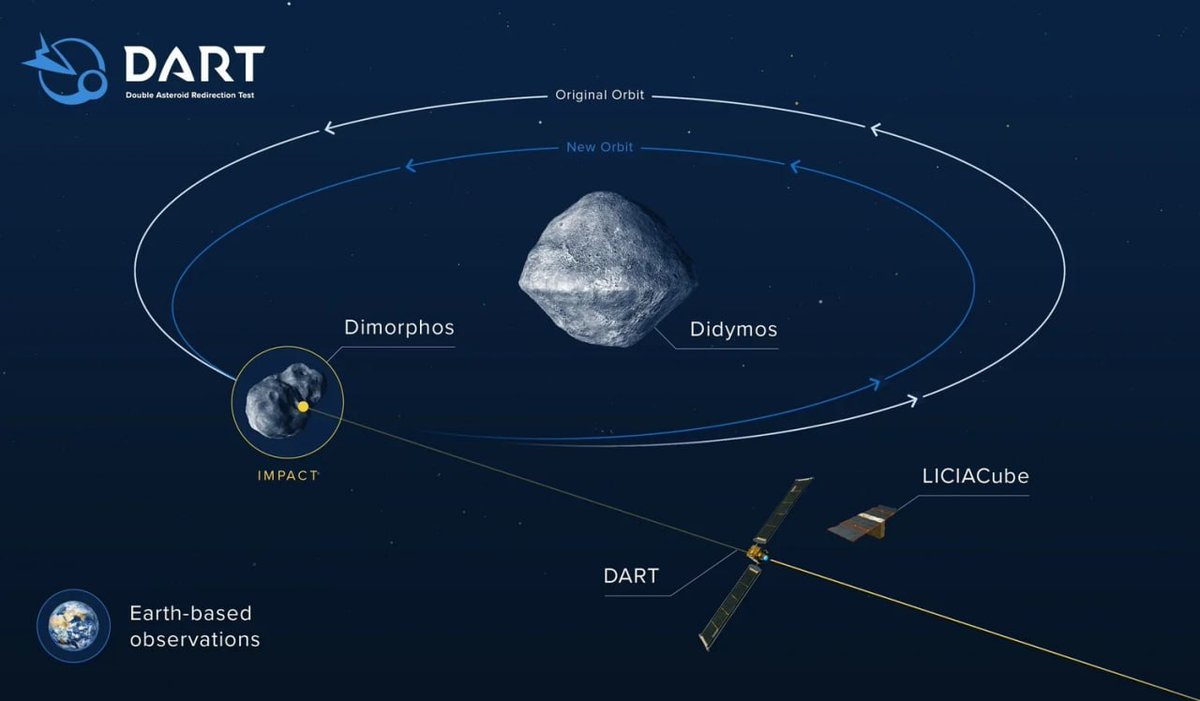
A new study has shown that the DART spacecraft's collision with the moon asteroid Dimorphos in September 2022 had more significant consequences than previously thought.
The impact not only altered Dimorphos's trajectory around its larger companion, Didymos, but also shifted the orbit of the entire binary system around the Sun.
Didymos and Dimorphos are gravitationally bound and orbit a common center of mass, forming a so-called binary system. Therefore, any change in the motion of one asteroid inevitably affects the other. Analysis showed that their 770-day orbital period around the Sun was shortened by a fraction of a second after DART impacted Dimorphos. This marks the first time a human-made object has significantly altered the trajectory of a celestial body around the Sun.
The mechanics of this effect are as follows: when DART collided with Dimorphos, the impact ejected a huge cloud of rocky debris into space. As these fragments escaped the asteroid, they generated thrust. The more debris ejected, the stronger the thrust. According to new data, the momentum gain factor was approximately two. This means the ejected rock doubled the impact force generated by the spacecraft itself.
Previously, astronomers determined that Dimorphos's 12-hour orbit around Didymos was shortened by 33 minutes. Now it turns out that the amount of ejected material was so large that it altered the orbit of the entire binary system around the Sun—by approximately 0.15 seconds. This is a minor change in orbit, but over time, even a small deviation can lead to a significant change in trajectory.
It is important to emphasize that Didymos never threatened Earth. However, this tiny change in orbital velocity provides crucial evidence of the effectiveness of kinetic impactor impactors. This method could be used to deflect potentially dangerous objects if they are ever detected on a collision course with our planet.
To prove that DART impacted both asteroids, and not just the small Dimorphos, scientists needed to measure Didymos's orbit with exceptional precision. To do this, in addition to radar and other ground-based observations, they used the stellar occultation method. This involves tracking the moments when an asteroid passes directly in front of a distant star, blocking its light for a fraction of a second. Such observations provide highly accurate data on the speed, shape, and position of a celestial body.
This task is extremely complex: astronomers must be in the right place at precisely the right time, deploying multiple observing stations several kilometers apart to track the asteroid's predicted path in front of a specific star. This work is highly dependent on weather conditions and often requires travel to remote regions with no guarantee of success. Amateur astronomers from all over the world played a key role in this effort. Between October 2022 and March 2025, they managed to record 22 such stellar occultations.