People oddly assumed that I didn’t understand LiDAR, even though I oversaw the custom LiDAR development that Dragon uses to dock with the Space Station
Not one Senate Democrat showed up to work today. I have never seen anything like it in all my years in Congress.
They expect DHS employees to show up without pay while they won't even do their own jobs. Shameful. Americans should be absolutely outraged.
Everyone is covering Terafab as a chip factory.
It is not a chip factory.
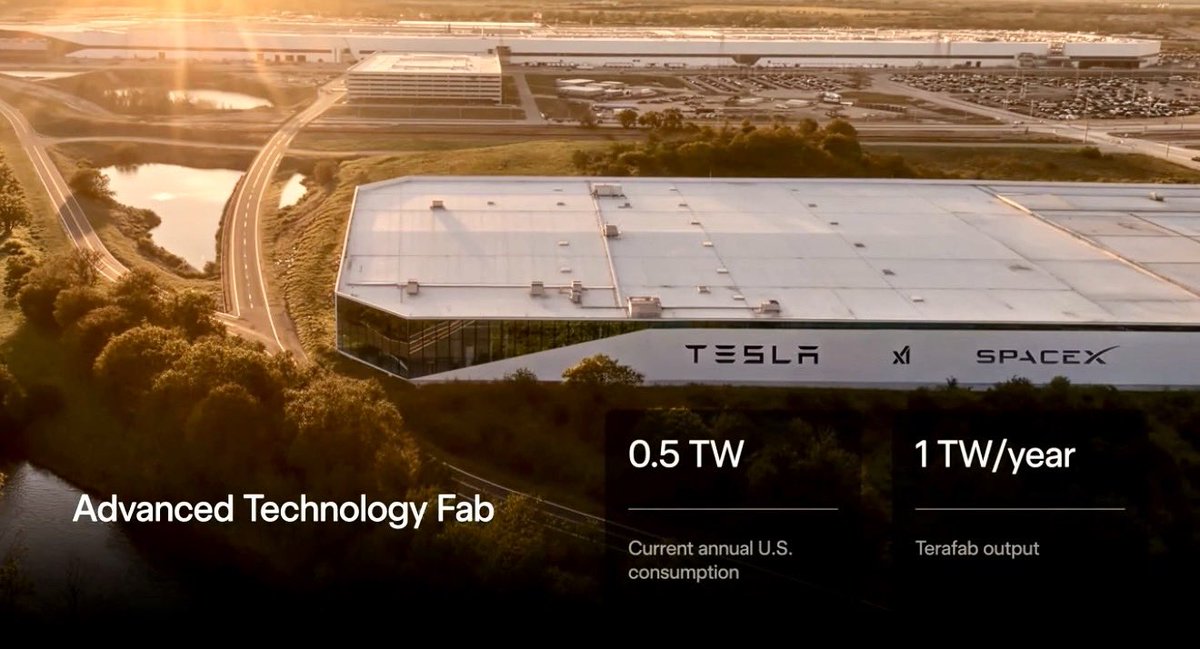
Last night in Austin, Elon unveiled a facility that makes masks, fabricates chips, and tests them inside a single building with a nine-month recursive improvement cadence. No such loop exists anywhere else on Earth. Then he told you 80% of the output goes to space. Then he showed you a 100-kilowatt AI satellite with solar panels and radiators, scaling to megawatt range. Then he said Optimus plus photovoltaics will be the first von Neumann probe, a machine capable of replicating itself from raw materials found in space.
Nobody connected the sequence.
Terafab produces 1 terawatt per year of compute. The entire United States consumes 0.5 terawatts of electricity. Musk is building a single factory whose output in AI silicon exceeds twice the power consumption of the country it sits in. And he is sending 80% of it off-planet because Earth literally cannot power what he is building.
Follow the mechanism. Terafab seeds the chips. Starship launches Optimus robots and solar arrays at 100 million tons per year. The robots mine lunar and asteroid regolith for silicon, iron, and nickel. They 3D-print more robots. They fabricate more solar panels. They assemble more AI satellites. Each satellite runs hotter-burning D3 chips designed specifically for vacuum, where free radiative cooling eliminates the thermal constraints that strangle every terrestrial data center on the planet. The nodes replicate. The replication is exponential.
This is a Dyson Swarm bootstrap hidden inside a semiconductor announcement.
The math is public. The Sun outputs 3.828 times 10 to the 26th watts. A 2022 paper in Physica Scripta calculated that 5.5 billion satellites at 290 kilograms each, robotically manufactured from Mars resources, capture enough solar energy to meet all of Earth’s power needs within 50 years. A 2025 paper in Solar Energy Materials calculated a partial swarm capturing 4% of solar output yields 15.6 yottawatts, roughly a billion times current human civilization’s total energy budget. Musk just announced the factory that builds the chips that go inside the satellites that replicate themselves forever.
92% of advanced logic chips are fabricated in Taiwan. One factory in Austin does not fix that. But one self-replicating system seeded by that factory, launched by the only company with reusable heavy-lift rockets, assembled by the only humanoid robot in mass production, and powered by the only star within reach, does not fix a supply chain. It obsoletes the concept of supply chains entirely.
The market priced this as a $20 billion capex story about semiconductor independence.
The actual announcement was the engineering blueprint for Kardashev Type II.
Humanity sits at 0.73 on the Kardashev scale. 18 terawatts. The distance between here and harnessing a star is not a technology gap. It is a recursion gap. And recursion is exactly what a single building in Austin that makes its own masks, builds its own chips, tests its own chips, and launches the output into orbit on its own rockets was designed to close.
Every civilization that makes it past this point never looks back.
A man deposits $10,000 in a bank.
The bank thanks him and records the deposit on its balance sheet. But not where you might expect. For the bank, that $10,000 is actually a liability – because technically it belongs to the customer and might have to be returned.
So the bank does what banks do. It lends $9,000 of that money to someone buying a car.
Now something interesting happens. The $9,000 loan appears on the bank’s books as an asset – because someone now owes the bank money.
So the same $10,000 is doing two jobs at once. The depositor believes he has $10,000 safely in the bank. The borrower now has $9,000 to spend.
That $9,000 gets deposited somewhere else. The next bank lends $8,100. That gets deposited again. Then $7,290 gets lent out.
Soon the original $10,000 has quietly turned into tens of thousands of dollars of loans scattered across the economy.
Everyone believes they have money. Depositors see balances in their accounts. Borrowers have the money they spent. Banks show healthy assets on their balance sheets because people owe them money.
And here’s the best part.
Banks charge interest on all those loans – maybe 7%. But the depositor who supplied the original money might earn only 0.5% on their savings account.
So banks collect interest on money that mostly wasn’t theirs to begin with – and keep the difference.
The system works beautifully.
As long as nobody asks for the money back at the same time.
🚨 WHY PEOPLE DON’T USE GROK FOR CRYPTO.
Grok decodes real-time sentiment on X, predicting tomorrow's market movers.
In 2026, you either use AI to front-run the crowd or you become their exit liquidity.
Top 8 prompts to find your next x100:
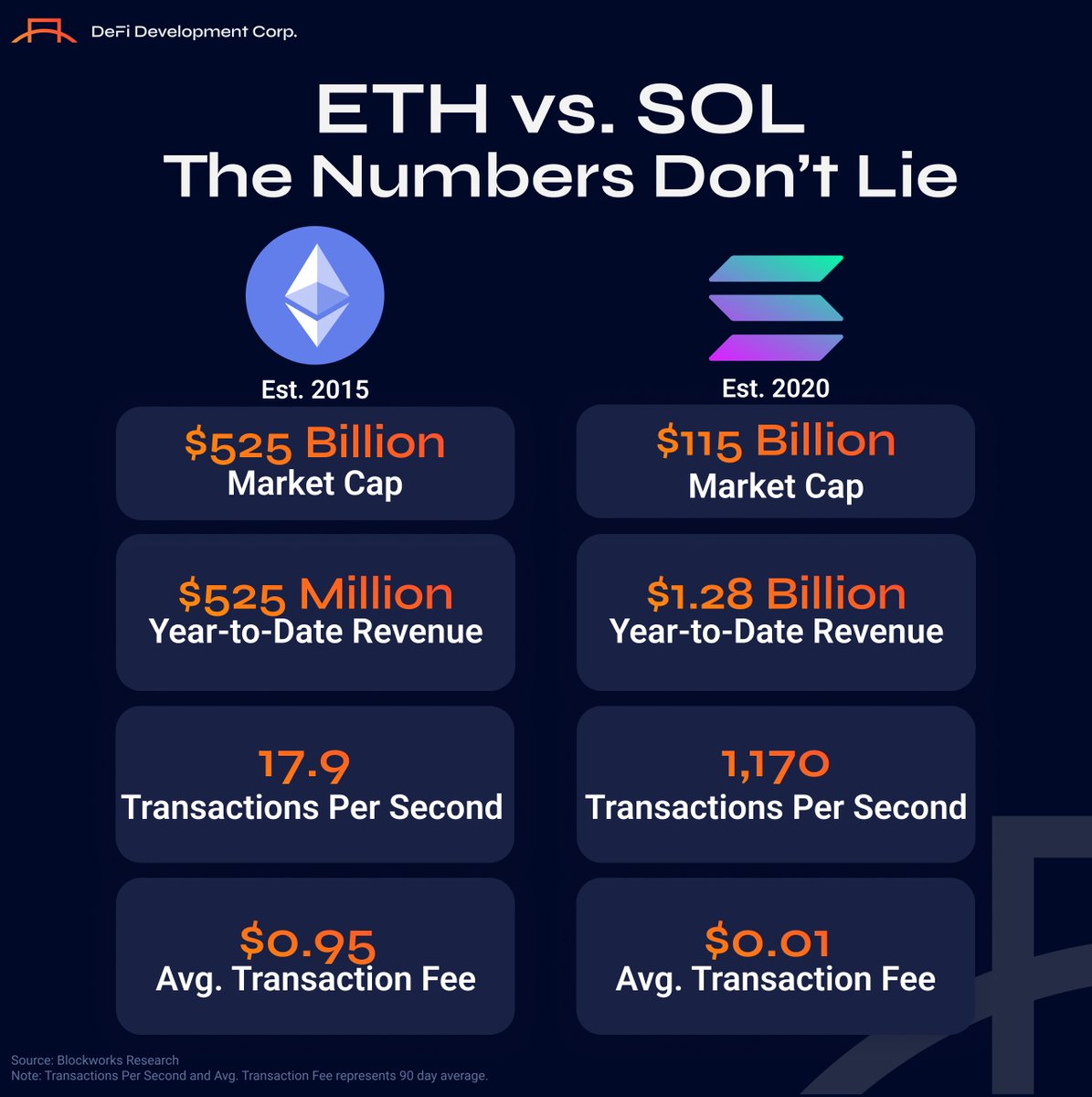
$SOL trades at just 1/5 the market cap of $ETH.
Yet it’s 65x faster, generates 2.4x more revenue, and is 90x cheaper to use.
Our bet? The faster horse.
🚨BREAKING: BINANCE ACCUSED OF SUPPRESSING SOLANA USING WINTERMUTE TO PROTECT $BNB MARKET CAP — PROOF OF RESERVES SHOWS NO SOL BEYOND CUSTOMER FUNDS!!!🚨