Noble $NE lands $1.3B in new awards and pushes floater utilization to 92%.
Rates remain broadly in line with recent contracts — no meaningful repricing.
The big win is redeploying idle rigs and locking in long-duration work.
Strategy focused on stability and fleet activation rather than chasing future peak dayrates.
Stronger backlog, steady pricing, tighter global supply
That part of the contract can be a big win for Golar. But we’re talking about a 20-year deal, and honestly, nobody knows where gas prices will be in 10, 15, or 20 years. It looks good now, but things can flip fast.
The cleanest way to think about that upside is just as an option. Using something like Black-Scholes, as in the analysis you shared, gives you a rough idea of what that “above $8/MMBtu” exposure might be worth. It’s not perfect, but it provides a useful ballpark. $GLNG
4/
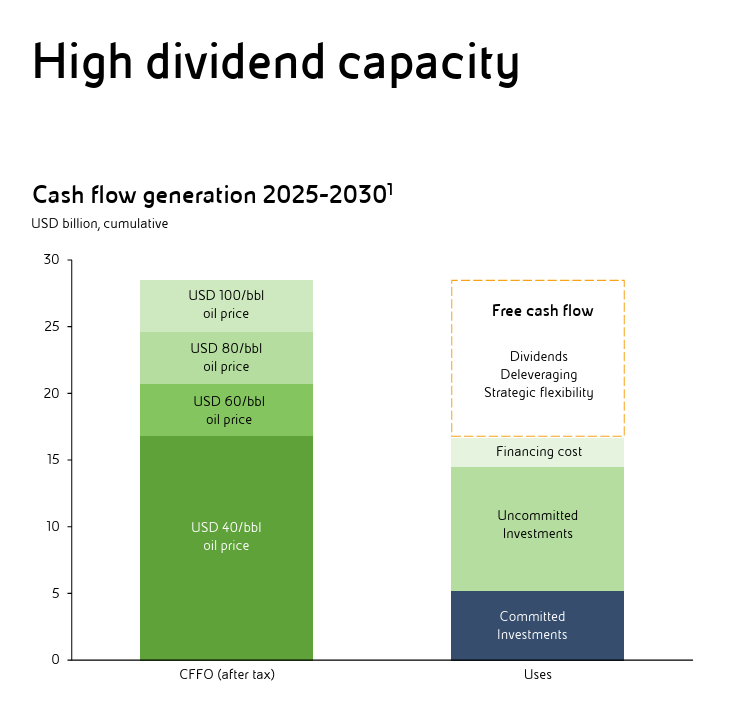
Bottom line: the 14% dividend yield is not sustainable at current prices. To safely support a USD 1.2bn payout, Vår Energi would need Brent closer to USD 75/bbl.
1/
Vår Energi advertises a dividend yield close to 14%, but at current market conditions the company doesn’t generate enough free cash flow to support it. Their 2025–2030 plan forecasts USD 5–9bn FCF, a range that hinges directly on prices of USD 65–85/boe.
$VAR.OIL #TTF#OOTT
3/
Meanwhile, the dividend commitment for 2026 is USD 1.2bn, meaning today’s cash generation doesn’t fully cover it. CAPEX can be deferred to bridge the gap temporarily, but doing so pressures future output and limits how long the company can stretch this approach.
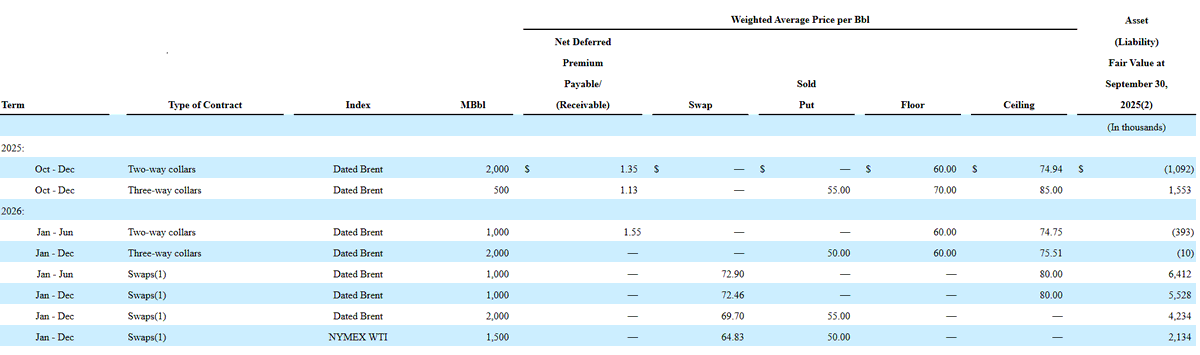
They haven’t disclosed any hedges for 2027–2028.
The latest 3Q25 filing only shows open positions through 2026. With the recent pickup in oil prices, they may have more flexibility to add new hedges.
PetroNor E&P Update
Good News: PetroNor reports Q4 2025 net working interest production of 4,608 bopd, up from 4,116 bopd in Q3. Production efficiency remained strong at 91%. The Axima jack-up rig completed five infill wells at Tchibouela East, all now onstream and adding 6,500+ bopd gross, pushing the PNGF Sud 2025 exit rate above 32,000 bopd (net 5,400 bopd). The Company sold 540,000 barrels in November and is building inventory at 100,000 barrels/month, with another lifting expected in Q1 2026 $PNOR.OL
I’ve also read everything Gabriel has written about Kosmos, and I don’t think the current management is doing a bad job. Given the circumstances, I believe they’re doing everything reasonably within their control to address the situation and meet their obligations. At this point, a recovery really depends on Brent moving higher. That said, I agree that if a year from now Brent is still at these levels and the company isn’t generating meaningful cash to handle its upcoming maturities, things could get complicated.
A striking passage from Goehring & Rozencwajg underscores how massive the investment needs would be to revive Venezuela’s heavy-oil output:
“Restarting Venezuelan heavy-oil production would require capital investment on an extraordinary scale. As one illustrative example, an older industry document indicates that supermajors spent approximately $23 billion in 2010 to bring 600,000 barrels per day of heavy-oil capacity online—roughly $40,000 per flowing barrel. More recent rules of thumb for Canadian heavy oil suggest figures closer to $100,000 per flowing barrel, implying that adding one million barrels per day could require on the order of $100 billion once the cost of an upgrader—an essential component of heavy-oil production—is included.”
#Oil #OilandGas #EnergyMarkets #Venezuela #HeavyOil #EnergyGeopolitics