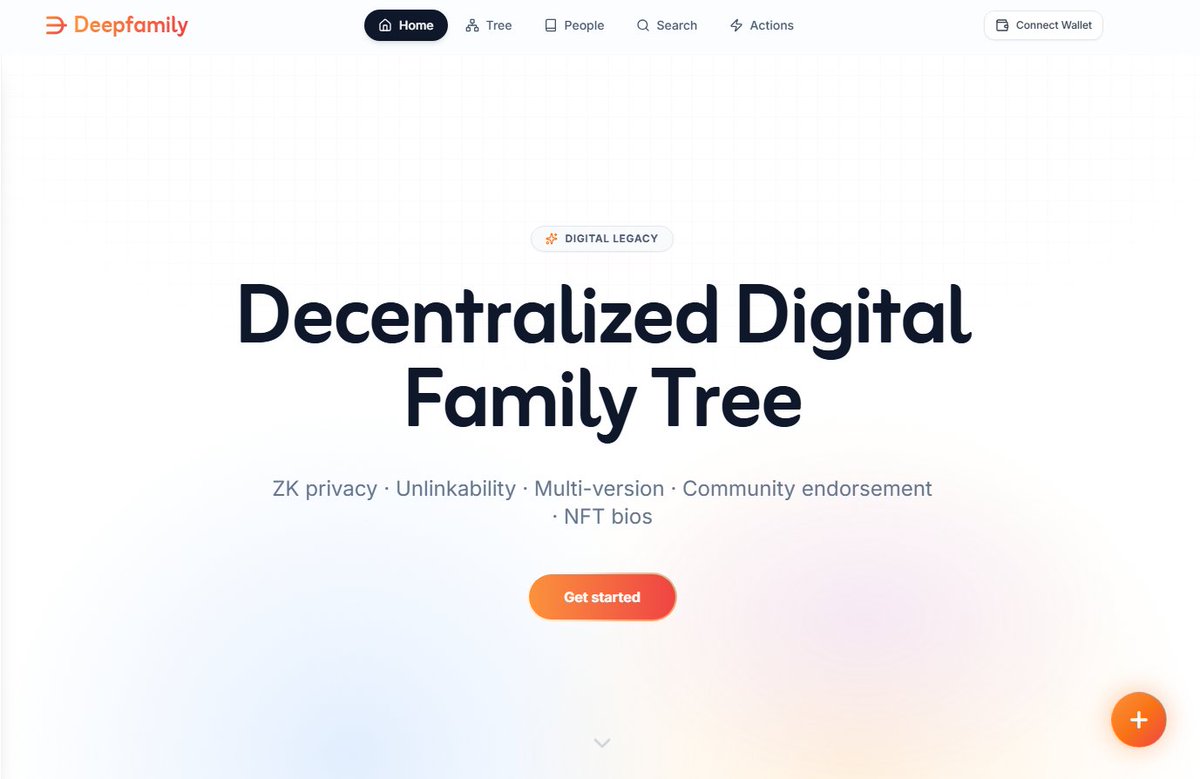
Preserve Your Family Legacy On-Chain
#DeepFamily is an open-source protocol for decentralized digital family trees:
1. Zero-knowledge proofs for privacy protection
2. Blockchain immutability for permanent records
3. Community governance for data integrity
Our redesigned UI is now live on the #ConfluxTestnet
We'd love for you to try it out and share your feedback.
Website: https://t.co/kDL80D58lS
eSpace Faucet: https://t.co/ATTXVKi5Vi
@Conflux_Network@ConfluxDevs
#Conflux #Web3 #ZKP #ZeroKnowledge #Blockchain #NFT #OpenSource #DApp #Decentralized #Privacy #FamilyTree #DigitalHeritage #BuildInPublic #ConfluxNetwork #ZK #Genealogy
Proud to support builders like @DeepFamilyLabs, one of our Hackathon winners 🙌
DeepFamily is building an open-source protocol for decentralized family trees, combining privacy with on-chain permanence.
Their redesigned UI is now live on Conflux Testnet. Please try it out and share feedback.
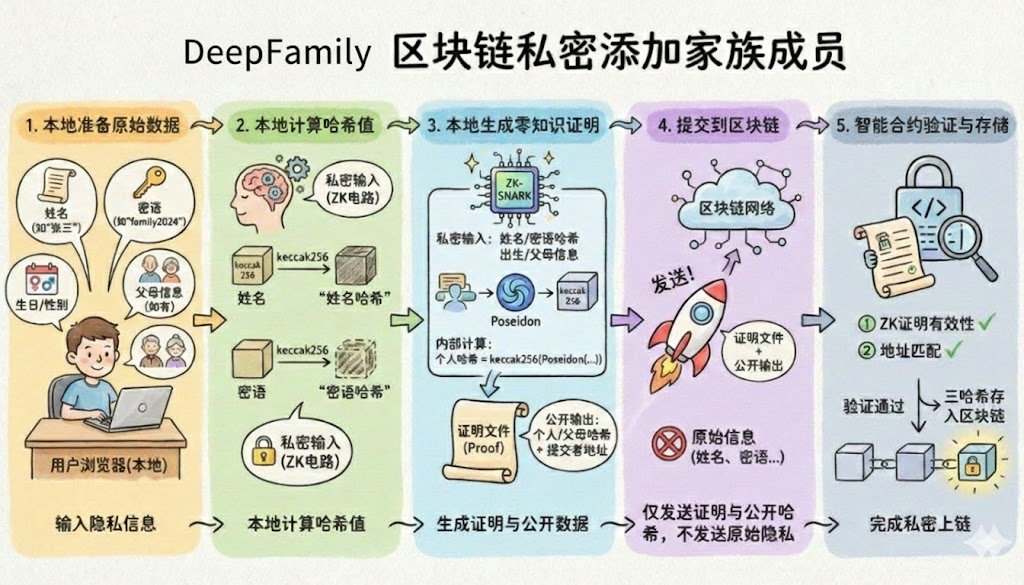
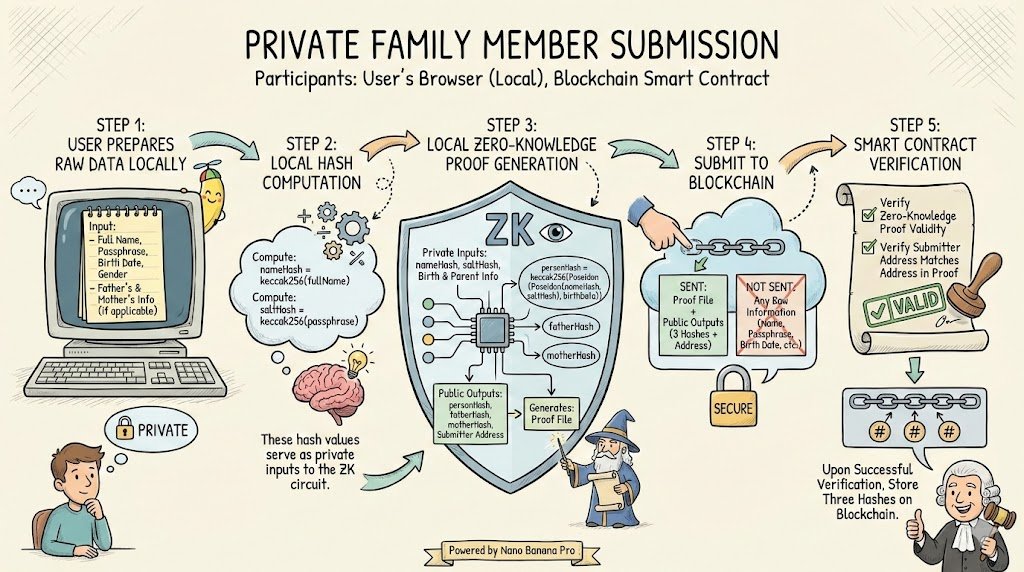
Why Zero-Knowledge Proofs Are Essential for Protecting Family Privacy
When we put a family tree on a blockchain, we run into a fundamental conflict:
on-chain data is public and permanent, but a family tree contains sensitive information such as names, birth dates, and genders.
So how can we enjoy the immutability of the blockchain without sacrificing the privacy of family members?
A natural first idea is to use a hash function. We can take a person’s data (name, birth date, gender, etc.), format it locally, compute a hash, and only store that hash on-chain. Because hash functions are one-way, others cannot recover the original data from the hash. This does help protect privacy.
However, it creates a new problem: data validity.
When a smart contract receives a hash, it has no way to tell:
1. whether this hash was actually computed from “name, birth date, gender” following the agreed format and rules, or
2. whether the submitter just made up some arbitrary data or even a random string.
If the system cannot distinguish between well-formed, legitimate records and garbage or fabricated data, then the credibility of the entire on-chain family tree collapses.
This is exactly where zero-knowledge proofs (ZKPs) come in.
A zero-knowledge proof allows the submitter to prove to the smart contract that:
“This hash was computed from a set of fields (name, birth date, gender, etc.) that follow the protocol’s rules and formula”
without revealing any of those fields themselves.
The contract only needs to check that the proof is valid. If it passes, the contract can be confident that the hash corresponds to a properly structured, protocol-compliant record, even though it never learns the underlying personal data.
In other words:
The hash function hides the actual data and protects privacy.
The zero-knowledge proof certifies that the hidden data is well-formed and valid.
Only by combining both can we build an on-chain genealogy system that is privacy-preserving while still being trustworthy and verifiable.
What is “community endorsement”?
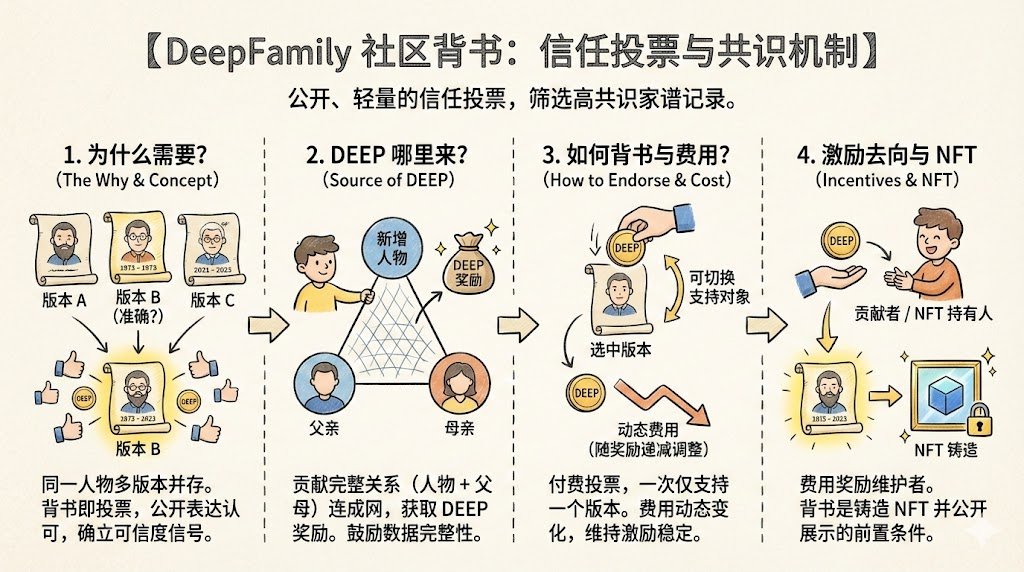
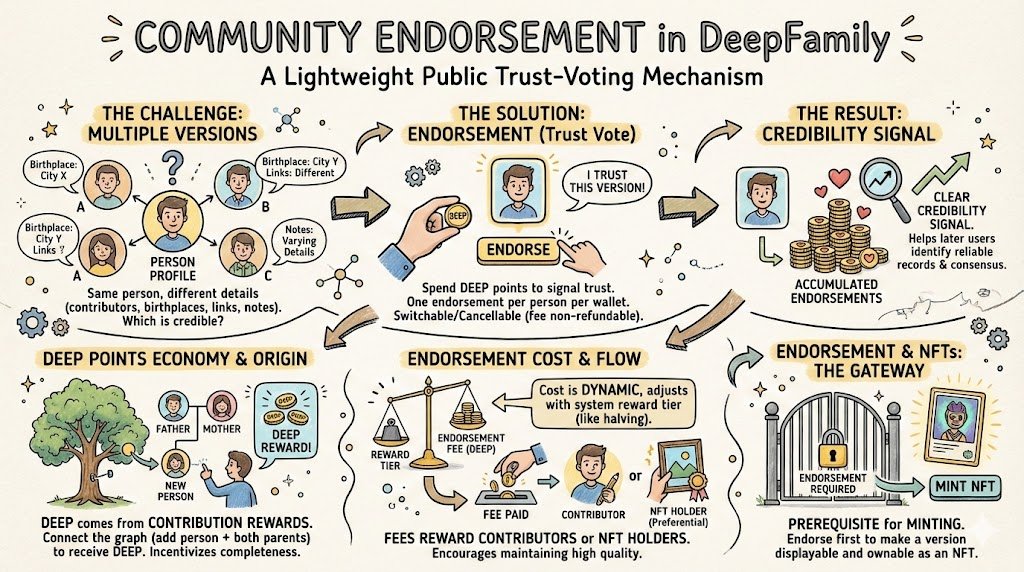
In #DeepFamily, “community endorsement” can be understood as a lightweight but public trust-voting mechanism. Users spend a small amount of platform points (DEEP) to endorse a specific “person profile version,” allowing the community to gradually filter among multiple versions and surface genealogical records that are more credible and better aligned with consensus.
Endorsement is necessary because the same person often has more than one version—submitted by different contributors, or differing in birthplace, relationship links, notes, and other details. The purpose of endorsement is to make “I trust this version” explicit and visible. As endorsements accumulate, they form a clear credibility signal that helps later users judge which version is more reliable and worth referencing.
The process is straightforward: among the multiple versions for a person, you pick one and click “Endorse.” Note that each wallet address can endorse only one version of the same person at a time. If you later determine another version is more accurate, you can switch your endorsement. You can also cancel an endorsement to withdraw support, though the fee you paid is typically non-refundable.
Endorsement is not free. Each endorsement requires paying a certain amount of DEEP, and the cost is not fixed—it changes dynamically based on the system’s current reward tier. This is because protocol rewards gradually decrease over time (similar to a halving mechanism), and endorsement fees adjust accordingly to keep the overall incentive structure stable.
So where does DEEP come from? In DeepFamily, the primary source of DEEP is “contribution rewards.” When you add a new person version and complete both parental links—father and mother—you are integrating that person more fully into the family network. In that case, the protocol issues a DEEP reward to the submitter. If only one parent is provided, or neither is provided, you generally won’t receive this reward. The design intent is clear: use incentives to encourage users to “connect the graph,” reduce isolated nodes, and improve the completeness and usability of the data structure.
Who ultimately receives the endorsement fees? Mechanically, most of the endorsement fees flow back to the contributor of that version. If the version has already been minted as an NFT, the reward is directed preferentially to the NFT holder. In other words, endorsements not only signal trust but also economically encourage contributors to maintain and refine high-quality versions.
Endorsement is also closely tied to NFTs. It is not only a “vote,” but also one of the prerequisites for minting that version as an NFT. Only after endorsing can you mint the version as an NFT and present its information more publicly. Put differently, endorsement is both a tool for building community consensus and a gateway for a version to become “displayable” and “ownable.”
@Conflux_Network@ConfluxDevs
#Conflux #Blockchain #FamilyTree
What is “community endorsement”?
In #DeepFamily, “community endorsement” can be understood as a lightweight but public trust-voting mechanism. Users spend a small amount of platform points (DEEP) to endorse a specific “person profile version,” allowing the community to gradually filter among multiple versions and surface genealogical records that are more credible and better aligned with consensus.
Endorsement is necessary because the same person often has more than one version—submitted by different contributors, or differing in birthplace, relationship links, notes, and other details. The purpose of endorsement is to make “I trust this version” explicit and visible. As endorsements accumulate, they form a clear credibility signal that helps later users judge which version is more reliable and worth referencing.
The process is straightforward: among the multiple versions for a person, you pick one and click “Endorse.” Note that each wallet address can endorse only one version of the same person at a time. If you later determine another version is more accurate, you can switch your endorsement. You can also cancel an endorsement to withdraw support, though the fee you paid is typically non-refundable.
Endorsement is not free. Each endorsement requires paying a certain amount of DEEP, and the cost is not fixed—it changes dynamically based on the system’s current reward tier. This is because protocol rewards gradually decrease over time (similar to a halving mechanism), and endorsement fees adjust accordingly to keep the overall incentive structure stable.
So where does DEEP come from? In DeepFamily, the primary source of DEEP is “contribution rewards.” When you add a new person version and complete both parental links—father and mother—you are integrating that person more fully into the family network. In that case, the protocol issues a DEEP reward to the submitter. If only one parent is provided, or neither is provided, you generally won’t receive this reward. The design intent is clear: use incentives to encourage users to “connect the graph,” reduce isolated nodes, and improve the completeness and usability of the data structure.
Who ultimately receives the endorsement fees? Mechanically, most of the endorsement fees flow back to the contributor of that version. If the version has already been minted as an NFT, the reward is directed preferentially to the NFT holder. In other words, endorsements not only signal trust but also economically encourage contributors to maintain and refine high-quality versions.
Endorsement is also closely tied to NFTs. It is not only a “vote,” but also one of the prerequisites for minting that version as an NFT. Only after endorsing can you mint the version as an NFT and present its information more publicly. Put differently, endorsement is both a tool for building community consensus and a gateway for a version to become “displayable” and “ownable.”
@Conflux_Network@ConfluxDevs
#Conflux #Blockchain #FamilyTree
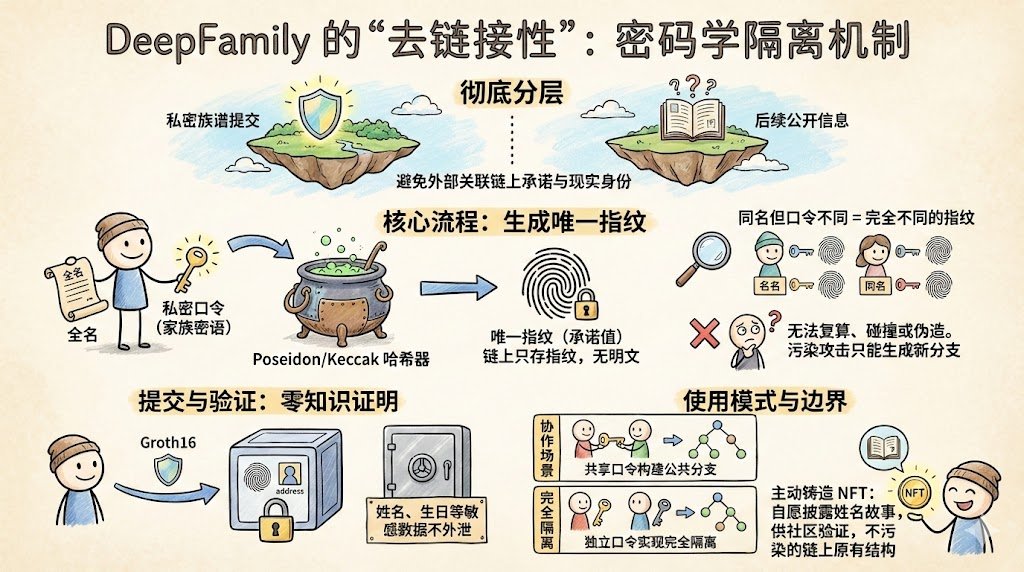
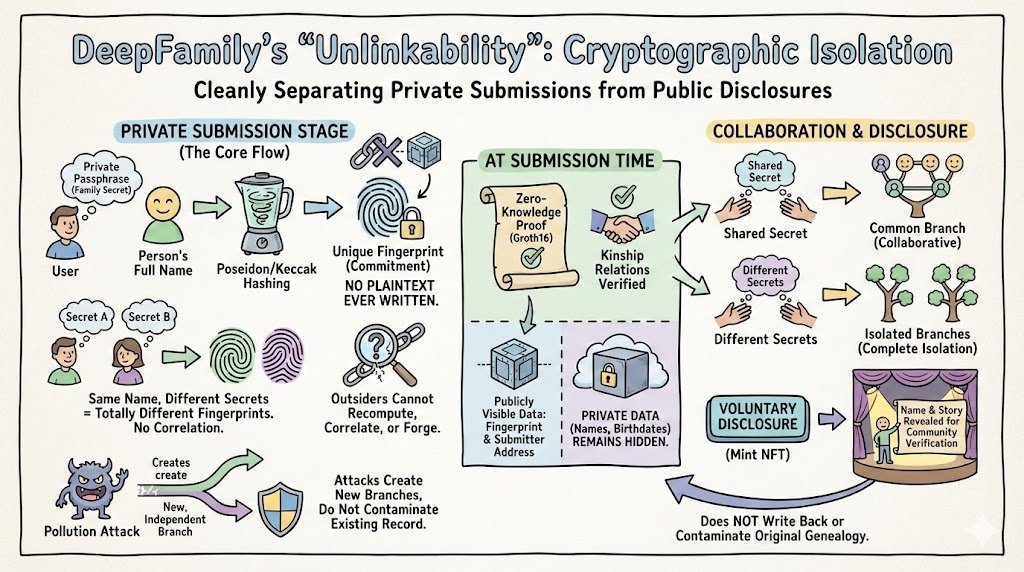
DeepFamily’s “unlinkability” is a full cryptographic isolation mechanism. It cleanly separates private family tree submissions from any later public disclosures, preventing outsiders from correlating on-chain commitments with real-world identities or other records.
The core flow is straightforward. For each person, the user chooses a private passphrase known only to themselves (a family secret). The system hashes the person’s full name together with that secret using a Poseidon/Keccak combination to produce a unique fingerprint (a commitment). Only this fingerprint is stored on-chain—no plaintext is ever written. The effect is that two people with the same name but different secrets will produce completely different fingerprints. Without the secret, outsiders cannot recompute or collide your fingerprint, cannot tell whether two records refer to the same person, and cannot forge a fake record that points to your node. So-called “pollution” attacks can only create new hashes and form independent branches; they do not alter or contaminate the existing family tree.
At submission time, a zero-knowledge proof is used to verify that the claimed kinship relations are correct. Publicly visible data is limited to the fingerprint and the submitter’s address; sensitive details such as names and birthdates remain private.
In practice, teams can share the same secret in collaborative settings to build a common branch. Alternatively, they can assign different secrets to different branches to achieve complete isolation. The boundary is explicit: unlinkability protects the private submission stage. When a user later chooses to mint an NFT, the name and story are revealed to the community for verification—but this is a voluntary disclosure of an existing commitment. It does not write back to, or contaminate, the original on-chain family tree structure. #DeepFamily #BlockChain
DeepFamily’s “unlinkability” is a full cryptographic isolation mechanism. It cleanly separates private family tree submissions from any later public disclosures, preventing outsiders from correlating on-chain commitments with real-world identities or other records.
The core flow is straightforward. For each person, the user chooses a private passphrase known only to themselves (a family secret). The system hashes the person’s full name together with that secret using a Poseidon/Keccak combination to produce a unique fingerprint (a commitment). Only this fingerprint is stored on-chain—no plaintext is ever written. The effect is that two people with the same name but different secrets will produce completely different fingerprints. Without the secret, outsiders cannot recompute or collide your fingerprint, cannot tell whether two records refer to the same person, and cannot forge a fake record that points to your node. So-called “pollution” attacks can only create new hashes and form independent branches; they do not alter or contaminate the existing family tree.
At submission time, a zero-knowledge proof is used to verify that the claimed kinship relations are correct. Publicly visible data is limited to the fingerprint and the submitter’s address; sensitive details such as names and birthdates remain private.
In practice, teams can share the same secret in collaborative settings to build a common branch. Alternatively, they can assign different secrets to different branches to achieve complete isolation. The boundary is explicit: unlinkability protects the private submission stage. When a user later chooses to mint an NFT, the name and story are revealed to the community for verification—but this is a voluntary disclosure of an existing commitment. It does not write back to, or contaminate, the original on-chain family tree structure. #DeepFamily #BlockChain
Why Should Family Trees Be Decentralized?
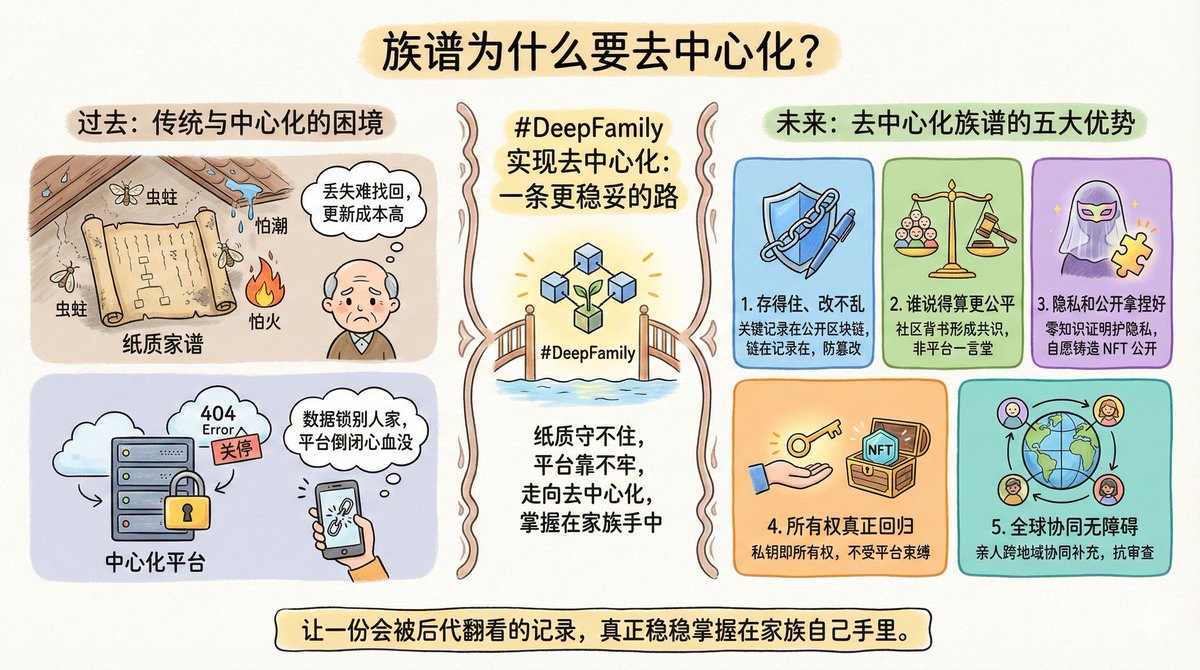
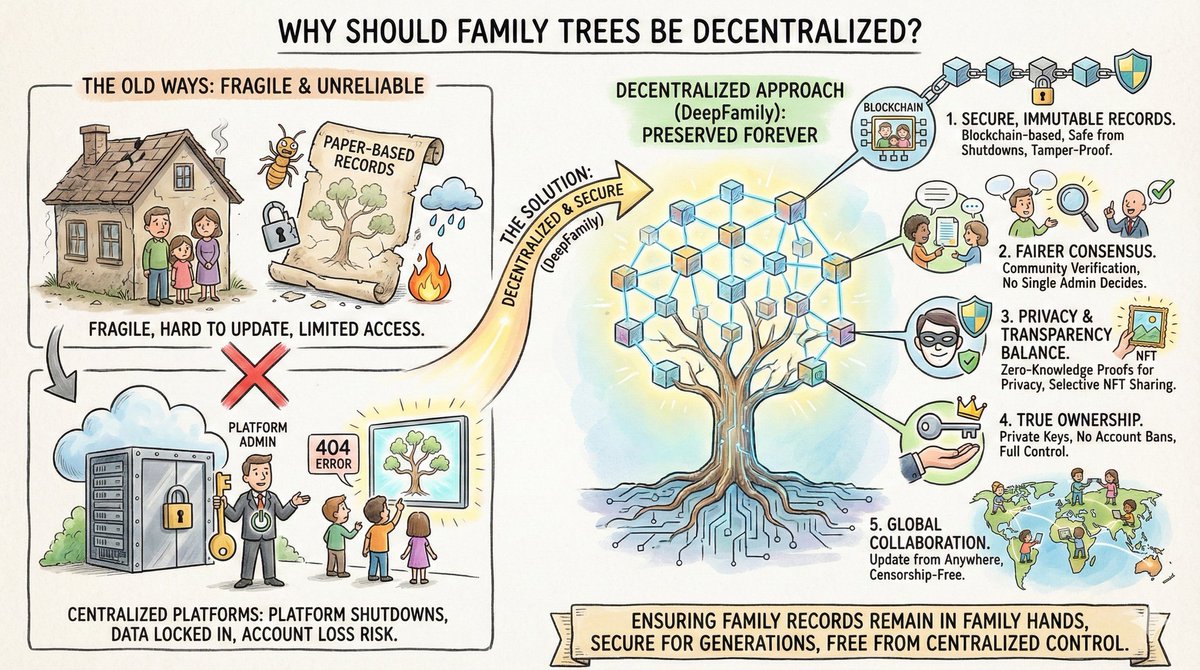
When most people think of a family tree, they still imagine the old paper-based genealogy books stored in their grandparents' house. While these paper records carry a sense of tradition and history, they come with many challenges: they are vulnerable to insects, humidity, and fire; once lost or damaged, they are nearly impossible to recover fully; they can only be stored in one place, making it hard for distant relatives to access the most up-to-date version; and updating them is costly and time-consuming—many families simply stop updating them altogether, leaving the tree stuck in the past.
Later, family tree websites and apps appeared to address these issues, seemingly solving the problems of storage and sharing. However, new risks emerged: platforms can shut down at will, rules can change without warning, and all your data is locked in someone else's server. If you lose access to your account or the platform goes offline, years of effort could be lost.
DeepFamily’s decentralized approach offers a more secure solution, ensuring that family trees are preserved outside of both paper and centralized platforms:
1. Secure, Immutable Records: Key family relationships and stories are stored on the public blockchain. As long as the blockchain exists, the family tree remains intact, safe from company closures or platform shutdowns, and difficult to tamper with.
2. Fairer Consensus: When multiple versions of a family tree arise, it’s not up to a platform’s administrators to decide which version is true. Instead, different versions are presented for family members and the community to review and collectively decide which one is most credible.
3. Privacy and Transparency Balance: Using cryptographic methods like zero-knowledge proofs, sensitive information remains private. Details only become public when the family voluntarily turns a specific story into an NFT to be displayed.
4. True Ownership: Whoever holds the private keys controls the ownership of the associated NFTs, without the risk of account bans, platform migrations, or restrictions imposed by a centralized entity.
5. Global Collaboration: Family members can collaborate, update, and verify the family tree from anywhere in the world without restrictions based on geography or censorship.
Paper-based family trees are fragile, and centralized platforms are unreliable. Decentralizing family trees isn’t just a trend—it’s about ensuring that a record, passed down from generation to generation, remains in the hands of the family itself, free from the risks of centralized control.
Why Should Family Trees Be Decentralized?
When most people think of a family tree, they still imagine the old paper-based genealogy books stored in their grandparents' house. While these paper records carry a sense of tradition and history, they come with many challenges: they are vulnerable to insects, humidity, and fire; once lost or damaged, they are nearly impossible to recover fully; they can only be stored in one place, making it hard for distant relatives to access the most up-to-date version; and updating them is costly and time-consuming—many families simply stop updating them altogether, leaving the tree stuck in the past.
Later, family tree websites and apps appeared to address these issues, seemingly solving the problems of storage and sharing. However, new risks emerged: platforms can shut down at will, rules can change without warning, and all your data is locked in someone else's server. If you lose access to your account or the platform goes offline, years of effort could be lost.
DeepFamily’s decentralized approach offers a more secure solution, ensuring that family trees are preserved outside of both paper and centralized platforms:
1. Secure, Immutable Records: Key family relationships and stories are stored on the public blockchain. As long as the blockchain exists, the family tree remains intact, safe from company closures or platform shutdowns, and difficult to tamper with.
2. Fairer Consensus: When multiple versions of a family tree arise, it’s not up to a platform’s administrators to decide which version is true. Instead, different versions are presented for family members and the community to review and collectively decide which one is most credible.
3. Privacy and Transparency Balance: Using cryptographic methods like zero-knowledge proofs, sensitive information remains private. Details only become public when the family voluntarily turns a specific story into an NFT to be displayed.
4. True Ownership: Whoever holds the private keys controls the ownership of the associated NFTs, without the risk of account bans, platform migrations, or restrictions imposed by a centralized entity.
5. Global Collaboration: Family members can collaborate, update, and verify the family tree from anywhere in the world without restrictions based on geography or censorship.
Paper-based family trees are fragile, and centralized platforms are unreliable. Decentralizing family trees isn’t just a trend—it’s about ensuring that a record, passed down from generation to generation, remains in the hands of the family itself, free from the risks of centralized control.
Why Zero-Knowledge Proofs Are Essential for Protecting Family Privacy
When we put a family tree on a blockchain, we run into a fundamental conflict:
on-chain data is public and permanent, but a family tree contains sensitive information such as names, birth dates, and genders.
So how can we enjoy the immutability of the blockchain without sacrificing the privacy of family members?
A natural first idea is to use a hash function. We can take a person’s data (name, birth date, gender, etc.), format it locally, compute a hash, and only store that hash on-chain. Because hash functions are one-way, others cannot recover the original data from the hash. This does help protect privacy.
However, it creates a new problem: data validity.
When a smart contract receives a hash, it has no way to tell:
1. whether this hash was actually computed from “name, birth date, gender” following the agreed format and rules, or
2. whether the submitter just made up some arbitrary data or even a random string.
If the system cannot distinguish between well-formed, legitimate records and garbage or fabricated data, then the credibility of the entire on-chain family tree collapses.
This is exactly where zero-knowledge proofs (ZKPs) come in.
A zero-knowledge proof allows the submitter to prove to the smart contract that:
“This hash was computed from a set of fields (name, birth date, gender, etc.) that follow the protocol’s rules and formula”
without revealing any of those fields themselves.
The contract only needs to check that the proof is valid. If it passes, the contract can be confident that the hash corresponds to a properly structured, protocol-compliant record, even though it never learns the underlying personal data.
In other words:
The hash function hides the actual data and protects privacy.
The zero-knowledge proof certifies that the hidden data is well-formed and valid.
Only by combining both can we build an on-chain genealogy system that is privacy-preserving while still being trustworthy and verifiable.
The project has been deployed on the #Conflux testnet. We warmly welcome everyone to try it out, test the features, and share your feedback.
Test Information:
Test website:https://t.co/X1msG4bUU4
eSpace faucet (test tokens): https://t.co/77zVhn4UHp
The project has been deployed on the #Conflux testnet. We warmly welcome everyone to try it out, test the features, and share your feedback.
Test Information:
Test website:https://t.co/X1msG4bUU4
eSpace faucet (test tokens): https://t.co/77zVhn4UHp
#DeepFamily is an open-source protocol for decentralized digital family trees. Leveraging zero-knowledge proofs, blockchain immutability, and community governance, it provides decentralized infrastructure for preserving global family histories.
Our Code Without Borders — SummerHackfest 2025 virtual hackathon has officially ended. Today, we proudly announce the winners who demonstrated exceptional creativity and innovation during this six-week event.
https://t.co/iDofdp9dI2
13 Conflux eSpace projects were showcased, covering areas such as gaming, DeFi, AI, social platforms, and developer tools.
A huge thank you goes out to our participants, judges, mentors, and sponsors: @dForcenet, @shui_finance, @GinsengSwap, @mesonfi, and @Kalp_Studio. Your support fueled the builders and the Conflux community.