Interesting lessons from today's concalls:
1. PG Electroplast: the denominator can distort the margin story. CFO said: “We actually focus on a per-unit margin, which is an absolute amount”.
AC's bill of materials has risen from about ₹14,000 to ₹18,500 over two years, while its manufacturing income per unit is broadly unchanged.
Passing on expensive components can lift revenue and lower percentage margins simultaneously. For this business, units produced and rupees earned per unit explain more than revenue growth alone.
2. Unimech: Even the top engineering talent needs solid capital-allocation discipline.
Management said: “we will not be a shop where we will just keep doing FAIs (First Article Inspections) for you”.
These are initial part inspections for customer qualification. Unimech has declined work without visibility of subsequent serial production. The useful question is how much repeat business each engineering effort can unlock, especially when skilled capacity is scarce.
3. Vivid: payment terms can be worth a small margin sacrifice.
For a Chennai data-centre project, management accepted roughly a quarter-percentage-point margin reduction for up to 90% LC-backed payment terms, expecting faster collection.
Site commissioning delays can otherwise leave equipment suppliers waiting months after delivery. Faster cash collection could allow the same capital to support more orders. The negotiated terms still need to show up in cash flow.
4. Info Edge: AI's impact depends on who owns the customer relationship.
Naukri can sell AI hiring tools through its existing recruiter base and use its proprietary data to improve outcomes. At Shiksha, management says AI-led search is reducing referral traffic, pushing it towards direct student counselling.
The same technology is creating an opportunity in one business and disrupts distribution in another.
5. Radico + ABDL: established brands can pay for the move upmarket.
Radico attributed 510 basis points of gross-margin improvement to premiumisation, versus 85 from price increases. At ABDL, management highlighted Officer’s Choice as a cash generator funding premiumisation; the mass-premium brand earns around 45% gross margin. That is a useful mental model in this theme: a lower-priced brand with strong cash generation can finance the premium portfolio being built around it.
6. Waaree: policy risk can change where a company earns.
US import-policy uncertainty has forced an export-order reset. Waaree is leaning on US-local manufacturing, more internally produced cells and its domestic retail network. The interesting defence is distribution: installers and service partners give new products a ready route to customers. But management expects domestic pricing pressure next year, so integration and utilisation must protect profit as selling prices soften.
Disc: Not a recommendation
Open the spreadsheet your month-end close depends on and count the tabs that hold a rule or a decision. Each is a rule your ERP does not hold yet, and often one person keeps it running.
🚨 𝗝𝗨𝗦𝗧 𝗜𝗡: @Waymo x @tryramp 👉 autonomous finance meets autonomous vehicles!
Here's what the new integration means:
When employees take a Waymo for Business ride, the receipt can now automatically flow into Ramp and match the corresponding card charge.
No searching for receipts.
No uploading PDFs.
No manual expense reconciliation.
The integration also allows businesses to:
→ Pay for Waymo rides with a Ramp card
→ Automatically match receipts to transactions
→ Generate audit-compliant PDF receipts
→ Track team ride spend in real time
→ Switch between business and personal cards inside Waymo
And interestingly, Ramp says no paid Ramp plan is required to use the integration.
Waymo for Business is increasingly targeting corporate travel, employee commutes and events, while Ramp continues expanding well beyond the traditional corporate card.
Two very different forms of automation coming together.
Self-driving cars + self-managing expenses.
That feels like a pretty good glimpse of where business travel is heading.
What should they automate next?
$29 AN HOUR. Single parent. One kid.
$29 x 40 hours = $1,160/week
That's $60,320/year.
Take-home after taxes, a 6% 401(k) and health insurance: roughly $3,550/month.
Now the month:
Rent (2-bedroom): $1,750
Daycare: $1,100
Groceries: $520
Car payment + insurance: $590
Utilities + phone: $310
Gas: $175
That's $4,445.
$895 SHORT. Every single month.
Before diapers. Before school clothes. Before a single doctor visit.
The national 2-bedroom housing wage is $34.73 an hour.
$29 an hour isn't even close.
That's how a full-time worker with a decent wage still ends up on credit cards just to make it to the next paycheck.
It's not a spending problem. It's a math problem.
The IRS just told a room full of tax pros it wants to make confessing your tax sins cheaper. Crypto included.
Here's what was said, and what it doesn't fix.
At the UCLA tax controversy conference, IRS Criminal Investigation Chief Jarod Koopman said a revised voluntary disclosure program is coming before December.
The goals: resolve cases within 120 days of a complete submission, substantially lower penalties, and the option to pay through installment plans or an offer in compromise.
That's real progress. Today the process can drag on for a year or more.
But read the fine print.
The IRS voluntary disclosure program is built for willful noncompliance. People whose conduct could expose them to criminal prosecution.
Most crypto investors I talk to aren't that.
A typical case: someone traded on three exchanges in 2021, used a couple of DeFi apps, lost track of transfers, and filed with whatever their software spit out.
That's a mess. It's not a crime.
There's also no separate track for digital assets, and no penalty numbers yet.
So the honest-mistake crowd is still stuck choosing between:
• Amending and hoping
• Doing nothing and waiting for a letter
• Walking into a program designed for people facing criminal exposure
That gap is exactly why I helped write Section 502 of the Digital Asset Tax Certainty Act, and why I've met with 60+ congressional offices and the Ways and Means Committee.
It creates a path for people who made unintentional crypto reporting errors to come forward and fix them. It cleared Ways and Means in September.
Faster IRS disclosure is good news. It's just the right tool for a different problem.
If your past crypto returns have gaps, step one is the same either way: rebuild your transaction history and know your number before the IRS does.
We’re proud to lead @HyphenateAI's $45M Series A as they build the autonomous finance platform for the CFO’s office.
Finance teams spend their week on work that needs doing but not their judgment. Hyphenate takes it off their plate.
Founded by @ramkris and @ajkrish95, Hyphenate runs order-to-cash, treasury, accounting and reporting on top of a company’s existing systems.
Customers see 90% less repetitive work, 75% fewer audit exceptions, and month-end close cut from 3 weeks to 1 day.
Congratulations to the Hyphenate team!
@oneabhishek
Risk becomes easier to act on when it’s translated into business terms. A “medium” or “high” rating doesn’t show leaders where to invest, but the potential impact on revenue, cash flow, margins, and assets can.
In this video, our Global Sustainability Leader Lynne Baber, talks about putting weather risk into financial terms, preparing for disruption before a crisis hits, and building resilience through stronger supply chains, scenario planning, and faster decision-making.
Our report explores how executives can turn that insight into action: assessing the financial impact of severe weather, modelling high-impact events, and making informed resilience investments.
Read the full report: https://t.co/WaJaa39Rj9 #Sustainability
Weight loss works a lot like paying off debt... calorie debt.
Everything is tight while you're in the deficit paying it off.
But once you get to maintenance you get roughly 300-700 calories a day back.
Maybe more in some cases.
Thats your:
• Muffin with your coffee
• Cheese on the burger
• Ranch on the salad
The fun stuff.
Once you've paid off the calorie debt, you've earned the room to spend calories more freely.
Most CEOs focus on the P&L.
That's a big mistake.
Join my next free live executive masterclass and learn to look past the P&L before it blindsides you → https://t.co/nM1LGQWZUT
A company can be profitable today and still fail to:
Scale
Attract investors
Create long-term shareholder value.
Why?
Because CEOs focus on earnings instead of cash flow strategy.
Without a plan to generate, allocate, and invest cash, you risk:
↳ Chasing revenue instead of high-ROIC investments
↳ Wasting capital on low-impact initiatives
↳ Carrying debt that weakens financial flexibility
↳ Failing to attract the right capital at the right time
↳ Missing opportunities to scale sustainably
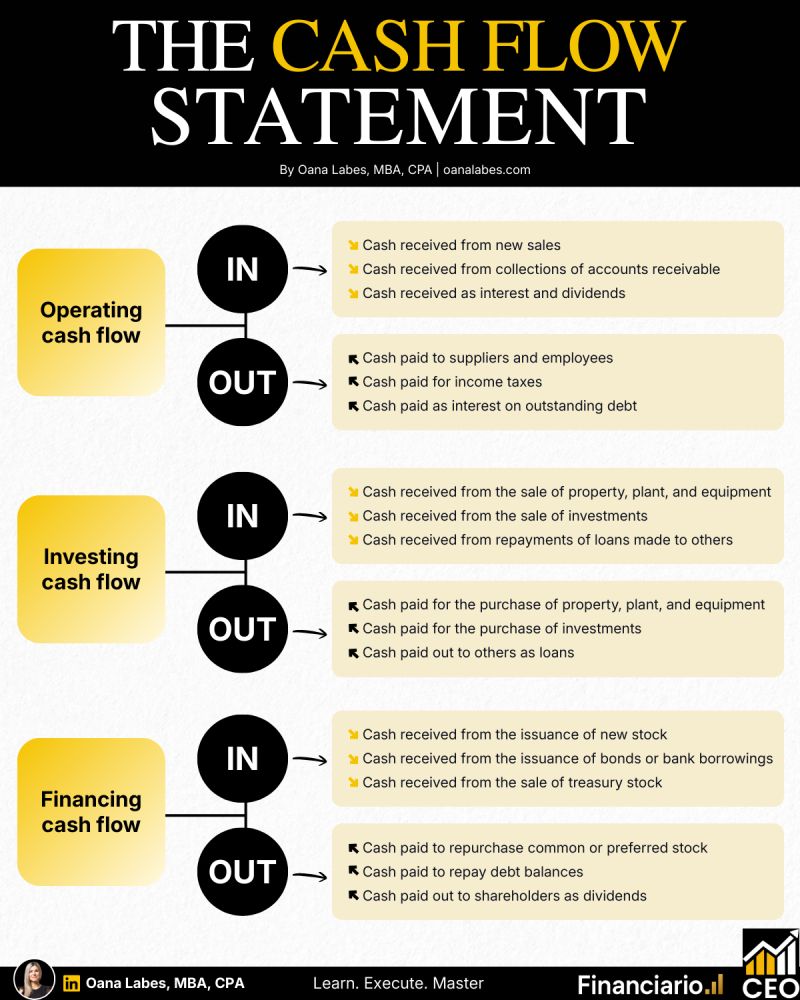
That’s why the Cash Flow Statement is the most important financial report in your business.
Here’s how it actually works (and how to master it).
1. Operating Activities = The Cash Engine
This is the heartbeat of your business, where cash is created or destroyed in daily operations.
Where cash comes from:
↳ Sales collected in cash
↳ Payments received on past receivables
↳ Interest and dividends received
Where cash goes:
↳ Payments to suppliers and employees
↳ Interest on debt
↳ Taxes
How to master it:
↳ Optimize your cash conversion cycle.
↳ Use sensitivity analysis to stress-test your plans.
2. Investing Activities = The Growth Playbook
This is where strategy meets execution. How you deploy cash to drive enterprise value.
Where cash comes from:
↳ Selling equipment or investments
↳ Loan repayments from others
Where cash goes:
↳ Buying property, equipment, or investments
↳ Lending cash to others
How to master it:
↳ Prioritize investments using NPV and IRR.
↳ Align investments with sustainable operating cash flow growth
3. Financing Activities = The Capital Structure
This determines how you fund your expansion — through debt or equity.
Where cash comes from:
↳ Issuing stock
↳ Taking on new debt
Where cash goes:
↳ Paying dividends
↳ Buying back stock
↳ Paying off debt
How to master it:
↳ Optimize your capital structure.
↳ Align dividend and stock repurchase policies.
The Takeaway:
Most CEOs focus on profit first.
But real financial intelligence starts with cash flow strategy.
Because the businesses that win aren’t just profitable.
They leverage their cash to maximize enterprise value.
♦
Follow @IAmOanaLabes for daily strategic finance.
EVERY AI app on the iPhone Duo reviewed
Grok Bot really good, but the only major AI app not yet optimized for the Duo
ChatGPT and Claude both GREAT to use
But Meta Muse is something completely different (10 out of 10). All 4 reviews below
📚 Cash Conversion Cycle (CCC):
A Critical Metric Every Investor Should Understand
A company can report rising profits and still struggle to generate cash.
Why? ⤵️
Because profit is an accounting number, but cash pays the bills.
One metric that helps investors understand this difference is the Cash Conversion Cycle (CCC).
It measures how many days a company takes to convert its investment in inventory and other operating expenses into cash collected from customers.
The formula:
Cash Conversion Cycle = Inventory Days + Receivable Days − Payable Days
Let’s understand the three components:
Inventory Days:
How long does the company take to sell its inventory?
Receivable Days:
How long does it take to collect money from customers after making a sale?
Payable Days:
How long does the company take to pay its suppliers?
Why does CCC matter?
A shorter cash conversion cycle generally means the company recovers its cash faster, reducing the need for working capital and external borrowing.
A longer cycle can tie up cash in unsold inventory and unpaid customer bills.
What should investors look for?
• A consistently declining CCC can indicate improving working capital efficiency.
• A rising CCC may signal inventory accumulation, slower customer payments or weakening operational efficiency.
• Compare CCC with industry peers. A manufacturing company and a software company will have very different working capital requirements.
• Study the trend over several years rather than relying on a single year’s figure.
• Check whether improving CCC is driven by genuine efficiency or unusually delayed supplier payments.
One important caveat:
A negative CCC is not necessarily a bad sign. Some businesses collect cash from customers before paying suppliers, creating a structural working capital advantage.
My takeaway:
When analysing a company, don’t stop at revenue growth, profit growth, ROE or ROCE.
Examine how efficiently the business converts its reported performance into actual cash.
Because sustainable wealth creation depends not just on profits earned, but also on cash generated.
#FundamentalAnalysis #StockMarketEducation #CashFlow #Investing
Charging less doesn't make you kind
Your D-clients would be another firm's A-clients
Your next A-client should let you drop 3 C-clients
Pricing morality is stopping you from pricing reality
Your most skilled people are wasting time on admin
You'd rather overserve a few than underserve many
Doing more work for more money isn’t better. It's more
Begrudingly serving C-clients at a discount isn't charity
Grade clients by enjoyment and profitability, not volume
Hiring to maintain C-clients is how sweatshops are born
An owner's top priority must be work only the owner can do
If your list was full of A-clients you'd earn double in half the time
Your best clients are showing you who you need to find more of
A-clients more happily pay top rates than D-clients pay a discount
Nobody cares what you think your work is worth. Clients set the price
Being an accounting department pays better than being a bookkeeper
Noisy clients that consume your headspace aren't your money-makers
Using a bad industry vertical ledger pays better than using QuickBooks
Say yes to every request and you end up selling accountants by the hour
The quiet clients you aren't thinking about are the ones making you money
A $6,000 credit card balance at 22%. Pay the minimum every month and it takes 20 years and 9 months to clear. Pay the same first payment every month and it takes under 5.
The first minimum on that balance is $170: $110 of interest plus 1% of the balance. That's a common formula for how the minimum is set.
The catch is that the minimum is recalculated every month. As the balance falls, the payment falls with it. By year 9 the statement asks for about $65.
Table 1 shows the two paths. Same balance, same rate, same first payment of $170.
Pay the minimum: 249 months and $9,933 in interest. You pay back $15,933 for $6,000.
Keep paying $170: 58 months and $3,746 in interest.
The difference is $6,187 and 16 years. Nothing else changed.
Watch Fig. 1. The fixed line hits zero before year 5. The minimum line is still above $1,000 after 12 years.
The person paying the minimum never missed a payment. They did exactly what the statement asked.
The case for the minimum: it keeps the payment small when money is tight, and a smaller payment is better than a missed one.
Here's the lesson: the minimum payment is built to fall with your debt. Don't let your payment fall with it.
Do you pay the minimum, or a fixed amount?
The Shrinking Payment
Repayment Time and Interest Cost Under Credit Card Minimums