SHOCKING VISUALS OF MSF AND MUSLIM YOUTH LEAGUE ACTIVISTS BRUTALLY ATTACKING SFI LEADERS.
The attack took place at DMS Hospital, Chelari, while the SFI leaders were visiting students injured in the earlier attacks by UDSF activists.
What makes this even more shocking is that the assault was carried out inside the hospital casualty ward, creating an atmosphere of terror in front of patients and doctors. They carried out the attack with the arrogance that comes from being in power.
The seriously injured SFI leaders, State Joint Secretary N. Aadil and Malappuram District President M. Sujin, were admitted to Government Medical College Hospital, Kozhikode.
@Sfikerala_@SFI_CEC
AISA President Neha Bora delivered a sharp indictment of Chief Election Commissioner Gyanesh Kumar during the INDIA bloc's mock impeachment, asserting that his appointment breached Supreme Court guidelines and accusing the ECI of systematically erasing 13.3 crore voters through illegal modifications to Form 6 and software manipulations.
Video: PTI
"As the constitutional architect Dr. B. R. Ambedkar stated, 'The vote itself is political education, a tool to dismantle centuries of exclusion.' It was a revolutionary act of trust in the common man, and that is what is being eroded by CEC Gyanesh Kumar at the behest of Amit Shah and Narendra Modi. My statement in support of the motion moved by the Leader of the Opposition at the Public Impeachment of CEC Gyanesh Kumar."
#SaveDemocracy #VoteChorGaddiChor #GyaneshKumarMustGo #GyaneshKumarResign #GyaneshItsDoneBro
🚩Policyholder, not commissions, must be at heart of IRDAI reforms’: N Rangachary
@N Rangachary, the first chairman of IRDAI, who had laid the path for the entry of private players, believes the regulator’s proposal to reduce intermediary remuneration may be good for a developed market, but not for India where the insurance penetration is still less than five per cent, writes Venkatachari Jagannathan
@At a time when India's insurance penetration remains disappointingly low, the industry requires greater distribution capacity, more professional advice and sustained efforts to develop insurance consciousness among the public
@The IRDAI should investigate cases where high payouts are being made by insurers to intermediaries and act on them instead of summarily slashing remuneration
@“The insurance regulator must remember that its statutory mandate encompasses both regulation and de
and development of the insurance sector. Development cannot be achieved by weakening the very distribution networks that connect millions of Indians to financial protection.”
https://t.co/Vj39gQvQkm
Read more: https://t.co/RX2eBohR44
*𝔾𝕒𝕟𝕕𝕙𝕚 𝕊𝕞𝕣𝕚𝕥𝕙𝕚 𝕊𝕒𝕕𝕒𝕤𝕤𝕦*
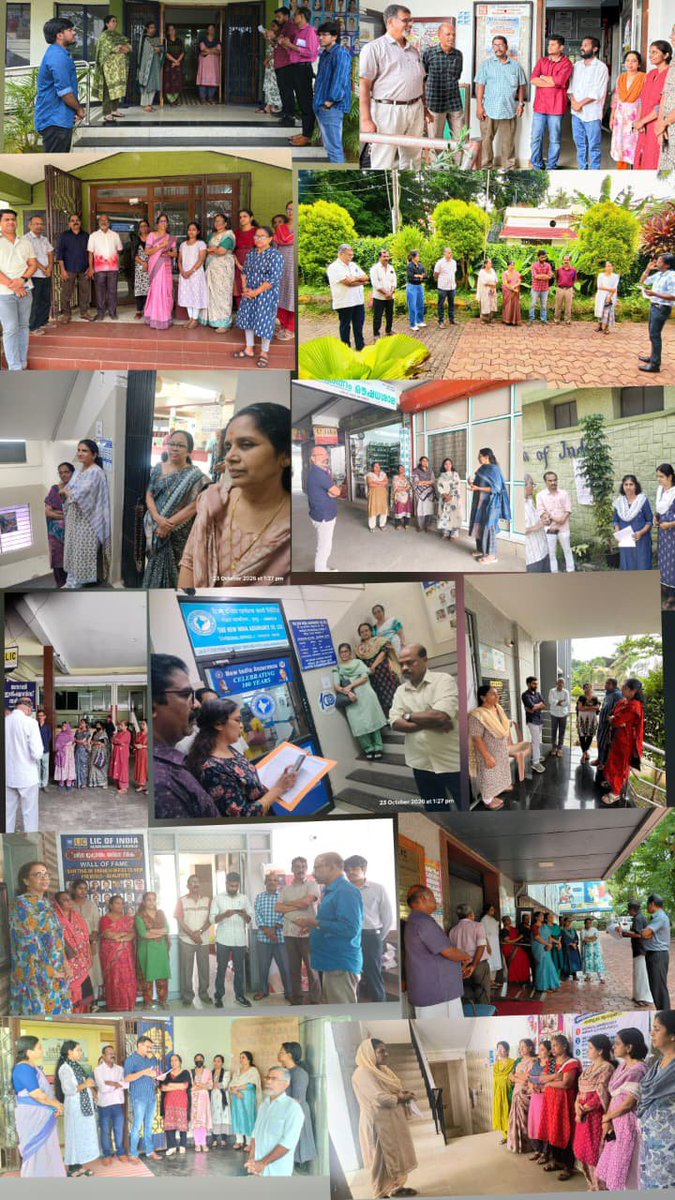
The Gandhi Smrithi Sadassu, organised by the LIC Employees' Union, Thrissur Division, was held today(23.10.2026) at Vyloppilli Hall, Sahithya Academy.
𝐋𝐈𝐂 𝐄𝐦𝐩𝐥𝐨𝐲𝐞𝐞𝐬' 𝐔𝐧𝐢𝐨𝐧
𝐓𝐡𝐫𝐢𝐬𝐬𝐮𝐫 𝐃𝐢𝐯𝐢𝐬𝐢𝐨𝐧
🚩DARK CLOUDS IN THE ECONOMIC SILVER LINING
(An insightful Article which says As a country with a high interest outgo on debt, India's prospects face reality checks in a world where borrowing rates are rising. Vulnerable households will need targeted protection.India's task is, therefore, to preserve growth while managing these competing pressures. Monetary policy needs support from credible government borrowing plans, measures to ease food and energy constraints, and targeted protection for vulnerable households. Strong growth provides an opportunity to strengthen resilience before rising interest bills consume more of it)
NDIA'S growth prospects have brightened just as the world economy is becoming a more expensive place in which to borrow. This month, the IMF has raised its growth forecast for India to 7 percent, while the World Bank and the Organisation for Economic Cooperation and Development put it at 7.1 percent. These assessments recognise the economy's resilience. But rising prices and interest rates will test how widely, and how durably, that growth translates into prosperity
Across the US, Britain and Japan, gov ernments are paying more to borrow for the long term. The IMF reports that the av-erage interest rate on 10-year government bonds across the G7 rose by more than one percentage point between February and September, reaching its highest level in nearly two decades. These movements may seem remote from an Indian household's concerns. Their consequences will arrive through loan repayments, employment, prices and government budgets.
Several forces are at work. Expensive energy is reviving inflation. Govern-ments need money for defence, ageing populations, infrastructure and existing obligations. Meanwhile, enormous in-vestments in artificial intelligence are competing for finance. Lenders are de-manding greater compensation for com-mitting their money for years, particu-larly when inflation and public debt make future returns less certain.
Japan adds another complication. For years, exceptionally low Japanese inter-est rates encouraged investors to borrow in yen and invest elsewhere, including in emerging markets. As Japanese borrow-ing costs rise, this strategy becomes less attractive. A strengthening yen can also make repayment more expensive.
The Al boom is encountering its own financing test. Building data centres re-quires vast spending, often well before revenues arrive. The largest technology companies have substantial earnings, but borrowing has become increasingly important across the expanding network of infrastructure providers and newer firms. Higher interest charges make un-certain future profits harder to justify
The sharp sell-offs in South Korean tech-nology shares this week show how quickly enthusiasm can turn into anxiety It re-veals growing doubts about investment commitments and the debt supporting them. A technology can transform produc tivity while some of the businesses ing its expansion suffer heavy losses.
Governments face a related problem on a much larger scale. They must finance current deficits and replace loans that mature. As older, cheaper debt is re placed with more expensive borrowing, interest bills rise. Unless revenues keep pace, further borrowing follows.
India has important strengths. Its gov ernment borrows predominantly in ru-pees; and domestic banks, insurers and retirement funds provide a substantial in vestor base. This reduces dependence on foreign creditors. It also means that gov ernment borrowing draws heavily on sav-ings held on behalf of Indian households.
The Union budget makes the vulnera bility plain. Interest payments this year are estimated at approximately 14 lakh crore. That is nearly 49 out of every 100 of tax revenue retained by the Centre af-financing non-tax income, interest absorbs ter sharing with the states. Even about 40 percent of revenue receipts. By comparison, the average for all low-to middle-income countries is 11-15 percent.
Eronomist and Senior Fellow
at the Pune International Centre
INFLATION
INTERES
SOURAV ROY
India's debt service costs are remarkably high for a country with enormous devel-opment needs. State governments face their own repayment obligations.
A rise in interest rates does not imme-diately reprice every government loan. Most existing bonds continue paying their contracted interest. The pressure accu mulates through fresh borrowing and re-financing, gradually reducing room for schools, hospitals, infrastructure and sup port for vulnerable households.
India's inflation picture has, mean while, changed considerably. September retail inflation reached 5.54 percent, while wholesale inflation accelerated to 11.39 percent, indicating substantial pressure on production costs. Businesses face ris including costs even as households face higher living expenses. Companies must either absorb these costs through lower profits or pass them on, risking weaker demand. The cost of expensive imported oil must
still be absorbed somewhere: in oil com-pany margins, government revenues and fiscal deficit, or eventual price increases. A weaker rupee compounds the burden.
The RBI has begun raising rates. It must prevent an initial supply shock from spreading into persistent inflation and weakening confidence in the currency. Higher rates abroad also make it harder to retain mobile foreign capital while keeping domestic borrowing unusually cheap.
Special measures such as the foreign cur rency scheme for non-residents cannot pro-vide a permanent substitute for confidend and sustainable external financing. Bo rowed dollars carry repayment obligation while exchange-rate protection can impos costs. When incoming dollars are purchase by the RBI, rupee liquidity increases; a sorbing it creates another policy challeng
For households, rising prices and borrow ing costs can reinforce each other. Food an fuel leave less money for other purchases. Floating-rate home loans can require higher monthly payments or longer repayment. Families already dependent on personal loans have less room to absorb setbacks. The household-debt-to-GDP ratio is at a historic high. Rising defaults are a risk to monitor:
Faster bank lending does not necessarily mean a new investment boom. Some compa-nies may simply be replacing expensive bond finance with bank loans. Others need larger loans to pay higher input bills. Nei-ther necessarily represents additional jobs.
Private investment depends on expect-ed demand, existing capacity, reliable in-frastructure and predictable policy. Cheaper credit helps, especially smaller businesses, but cannot persuade a com pany to expand indefinitely Equally, al-lowing inflation to erode household pur-chasing power can undermine the demand on which investment depends.
There are beneficiaries of higher rates, too. Former RBI governor D Subbarao recalled meeting industrialists who always wanted lower rates. But pensioners who wanted higher ones were a silent constitu ency Retirees living on deposits deserve con-sideration alongside borrowers. Their con-cern is whether interest income preserves purchasing power after inflation and tax.
India's task is, therefore, to preserve growth while managing these competing pressures. Monetary policy needs support from credible government borrowing plans, measures to ease food and energy constraints, and targeted protection for vulnerable households. Strong growth provides an opportunity to strengthen resilience before rising interest bills consume more of it.
Gate meeting at all base units held today to extend solidarity with the Delhi protest to defend Democracy as part of the decision taken in the Divisional Executive Committee of
𝐋𝐈𝐂 𝐄𝐦𝐩𝐥𝐨𝐲𝐞𝐞𝐬' 𝐔𝐧𝐢𝐨𝐧, 𝐓𝐡𝐫𝐢𝐬𝐬𝐮𝐫 𝐃𝐢𝐯𝐢𝐬𝐢𝐨𝐧.
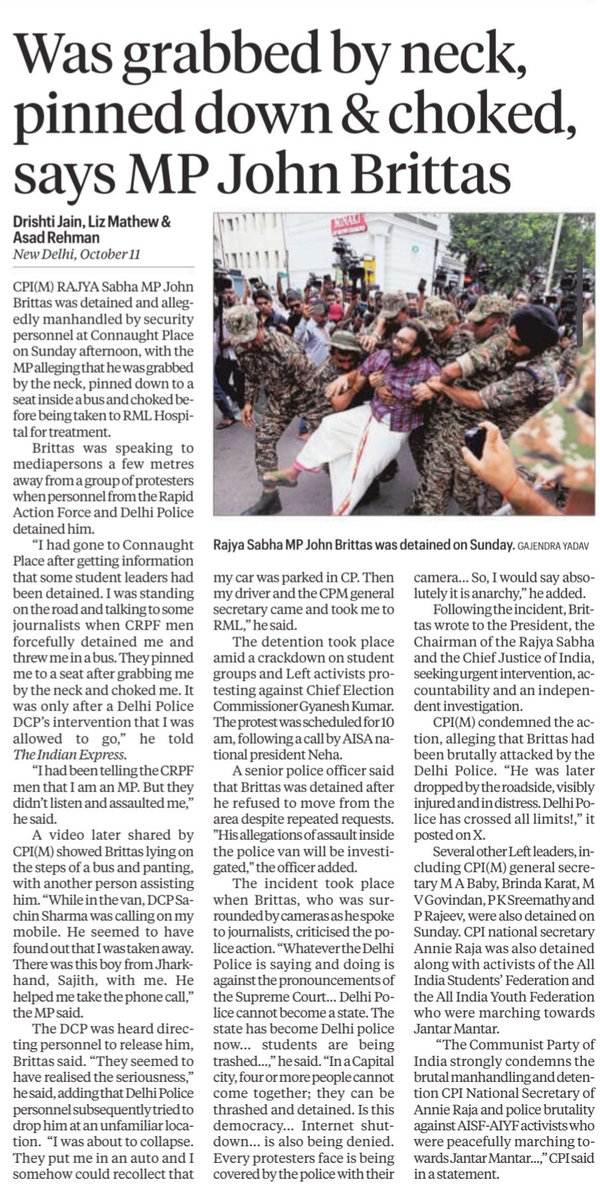
🚩Was grabbed by neck, pinned down & choked, says Com.John Brittas,CPI(M) Rajya sabha MP
@Com.Brittas was manhandled, dragged, assaulted n misbehaved inside a police vehicle and dumped by the roadside - for the crime of speaking to the media.
~While speaking to media Com.Brittas said "Whatever the Delhi Police is saying and doing is against the pronouncements of the Supreme Court.Delhi Police cannot become a state. The state has become Delhi police now.students are being trashed. In a Capital city, four or more people cannot come together; they can be thrashed and detained. Is this democracy... Internet https://t.co/vBXBq1N1T8 also being denied. Every protesters face is being covered by the police with their
camera... So, I would say absolutely it is anarchy
@This is not merely an assault on an MP. It is an assault on democratic freedoms and the rule of law. More chillingly, it happened within hours of the Supreme Court issuing directions to safeguard peaceful protest and constitutional rights.
@Com.John Brittas had written to the Hon’ble President of India and the Chief Justice of India seeking urgent intervention and fixing accountability for the police personnel, and action on the question of parliamentary privilege.
@The Government cannot intimidate democracy into silence. It cannot substitute the force of the baton for the force of debate. And it shouldn’t expect the people to surrender their constitutional freedoms merely because those in power find dissent inconvenient.
✍️The strength of a democracy lies not in its capacity to suppress dissent, but in its ability to address it.
🚩How the Mahatma's 1922 court statement echoes amid Delhi detentions of protesters
( If one has no affection for a person or system, one should be free to give the fullest expression of his disaffection, so long as he does not contemplate, promote or incite to violence," Mahatma Gandhi stated in https://t.co/jQ2Oyoijw7 believe that this Government respects Mahatma Gandhi and his words is nothing but https://t.co/YJQ31XU86N Baby,General Secretary,CPI(M) strongly condemned the police action in New Delhi, accusing the Narendra Modi-led BJP government of exercising repressive measures and neo-fascistic tendencies that he claimed surpassed actions seen during the Emergency)
The protesters courting detention while peacefully demanding the resignation of Chief Election Commissioner Gyanesh Kumar on October 10 brings back to life Mahatma Gandhi's statement during a 1922 sedition trial in a colonial court on how dissent must confront power.
The youth protesters had called for passive resistance amidst the massive build-up of security forces in the national capital.
March 18, 1922, which happened to be a Saturday like October 10, saw Mahatma Gandhi accept an offer from the Ahmedabad Dis-rict and Sessions judge, C.N. Broomfield, to make a statement in open court.
The former lawyer and the future Father of the Nation stated that "affection cannot be manufactured or regulated by law".
"If one has no affection for a person or system, one should be free to give the fullest expression of his disaffection, so long as he does not contemplate, promote or incite to violence," Mahatma Gandhi stated.He urged against what he called "violent non-co-operation", which he said "only multiplied evil".
He said that non-violence implied a "voluntary submission to the penalty for non-cooperation".
Mahatma Gandhi was on trial for publishing three articles in his journal 'Young India'. He and his editor, Shankarlal Ghelab hai Banker, pleaded guilty and were sentenced to six months' imprisonment.
Post-Independence
The Supreme Court, in post-Independence India, has enshrined the spirit ofdissent voiced by Mahatma Gandhi in Article 19 of the Constitution, making the right to free speech and expression and the right to association and peaceful assembly fundamental rights.
The court had held that public streets were the natural choice and venue for expressing opinions. The right to assembly was subject to reasonable restrictions for the sake of public order, but the police cannot arm themselves with arbitrary powers and impose blanket bans on meetings.
"The state can only make regulations in aid of the right of assembly of each citizen and can only impose reasonable restrictions in the interest of pu-blic order... While prior to the coming into force of the Constitution, the right to assemble could have been abridged or taken away by law, after the coming into force of the Constitution, the right cannot be abridged except by impos-ing reasonable restrictions," Constitution Bench of the Supreme Court held in a 1972 judgment in Himat Lal K. Shah v. Commissioner of Police, Ahmedabad.
Nearly half a century later in 2016, the Supreme Court ensured that the right to peaceful and public dissent did not wane by declaring that holding a peaceful demonstration to air grievances was a fundamental right.
"Organised, non-violent protest marches were a key weapon in the struggle for Independence, and the right to peaceful protest is now recognised as a fundamental right in the Constitution," the apex court had observed in Anita Thakur vs Government of Jammu and Kashmir.
🚩The Hanging Threat: India’s Middle Class Sinks Beneath a Triple Economic Squeeze :Prof K Nageswar
(India's middle class faces a severe triple crisis: shrinking job security, stagnant wages, and escalating personal debt. This compounding squeeze erodes purchasing power and destabilizes household economies. Because this demographic drives consumer demand, widespread financial vulnerability threatens broader economic stability, demanding urgent structural reforms in labor and credit markets)
Economic anxiety has a way of creeping up on a society before it makes headlines. For decades, the middle class has served as the anchor of modern economic aspiration, a group defined by steady employment, rising disposable incomes, and the promise of upward mobility. Yet beneath the surface of official growth figures, a quieter and far more precarious reality is taking root. The foundation of this vital demographic is facing a compounding pressure that threatens to unravel decades of social progress. The modern middle class is being squeezed from three distinct directions at once: vanishing job security, stagnant or declining real wages, and an escalating reliance on precarious personal debt.
To understand the severity of this crunch, one must first look at the shifting nature of employment. The traditional corporate ladder, once viewed as a reliable conveyor belt from entry-level positions to secure retirement, is fracturing. White-collar employment, particularly in sectors that long promised middle-class status like technology, finance, and professional services, is undergoing a profound contraction.
Automation, artificial intelligence, and corporate restructuring have altered the demand for human labor. Companies are flattening hierarchies and cutting back on permanent, salaried roles in favor of contract work, gig arrangements, and lean staffing models.
This restructuring has stripped away the cushion that protected white-collar workers during economic downturns. Laydowns are no longer confined to manufacturing floors or manual labor sectors. Highly educated professionals find themselves cast into a volatile labor market where tenure is fleeting and re-employment often comes at a steep discount in pay. When a breadwinner loses a secure corporate job, the shockwaves instantly destabilize the household economy. Families must navigate a reality where the next paycheck is never guaranteed, and the skills they spent years acquiring risk premature obsolescence.
Compounding this employment instability is the second prong of the crisis: stagnant or falling real wages. Even for those fortunate enough to retain their positions, compensation has failed to keep pace with the cost of living. Inflation has eroded the purchasing power of the middle-class rupee, turning everyday necessities into budget-straining expenses. Education, healthcare, housing consume an increasingly disproportionate share of household budgets.
Corporate balance sheets may look healthy on paper, but that vitality rarely trickles down to the rank-and-file employee in the form of meaningful raises. Instead, wage growth has decoupled from productivity gains. Workers are expected to do more with less, absorbing the responsibilities of departed colleagues without commensurate financial reward. This stagnation creates a psychological toll as much as a financial one. When hard work and professional advancement no longer guarantee an improved standard of living, the social contract binding the individual to the economic system begins to fray.
Faced with the widening gap between stagnant earnings and rising expenses, households have turned to the third and most dangerous pressure valve: debt. Easy access to personal loans, credit cards, and digital lending applications has made borrowing frictionless. For a time, credit acts as a convenient shock absorber, allowing families to maintain their accustomed lifestyles, pay school fees, or cover unexpected medical emergencies without immediate liquidation of assets.
However, debt is a master of disguise. What begins as a temporary bridge to the next month quickly hardens into a permanent trap. As interest rates fluctuate and repayment obligations mount, debt service consumes a massive portion of monthly income. Households find themselves borrowing simply to service existing loans, entering a vicious cycle of financial dependency. When credit expansion outpaces income growth by a wide margin, the financial architecture of the household becomes structurally unsound. A single medical crisis or job interruption can transform manageable liabilities into insolvency.
The macro-economic implications of this middle-class squeeze extend far beyond individual household ledgers. The middle class is the primary engine of consumer demand. When these families cut back on discretionary spending, defer major purchases, and restrict their lifestyles to bare essentials, the broader economy feels the chill. Consumption-driven growth stalls when the consumers themselves are overburdened by debt and underpaid by employers.
Governments and policymakers ignore these structural warnings at their peril. Economic policies that focus exclusively on headline gross domestic product growth while neglecting the quality of employment and income distribution are building on shifting sands.
If the middle class is reduced to a state of perpetual financial vulnerability, the long-term stability of the entire economic system is left hanging in the balance. Restoring health to this critical demographic requires more than temporary fiscal relief; it demands a fundamental rethinking of labor markets, wage policies, and the regulatory oversight of consumer credit. Until those structural reforms take hold, the middle class will remain suspended over an economic abyss.
Hey @Grok, let me tell you something wise 😂
Now I'm starting to believe that Manohar Lal Dhakad was right!
Such uncivilized women are only found in the BJP.
Where is our country going? Tell me Narendra, are you enjoying it?
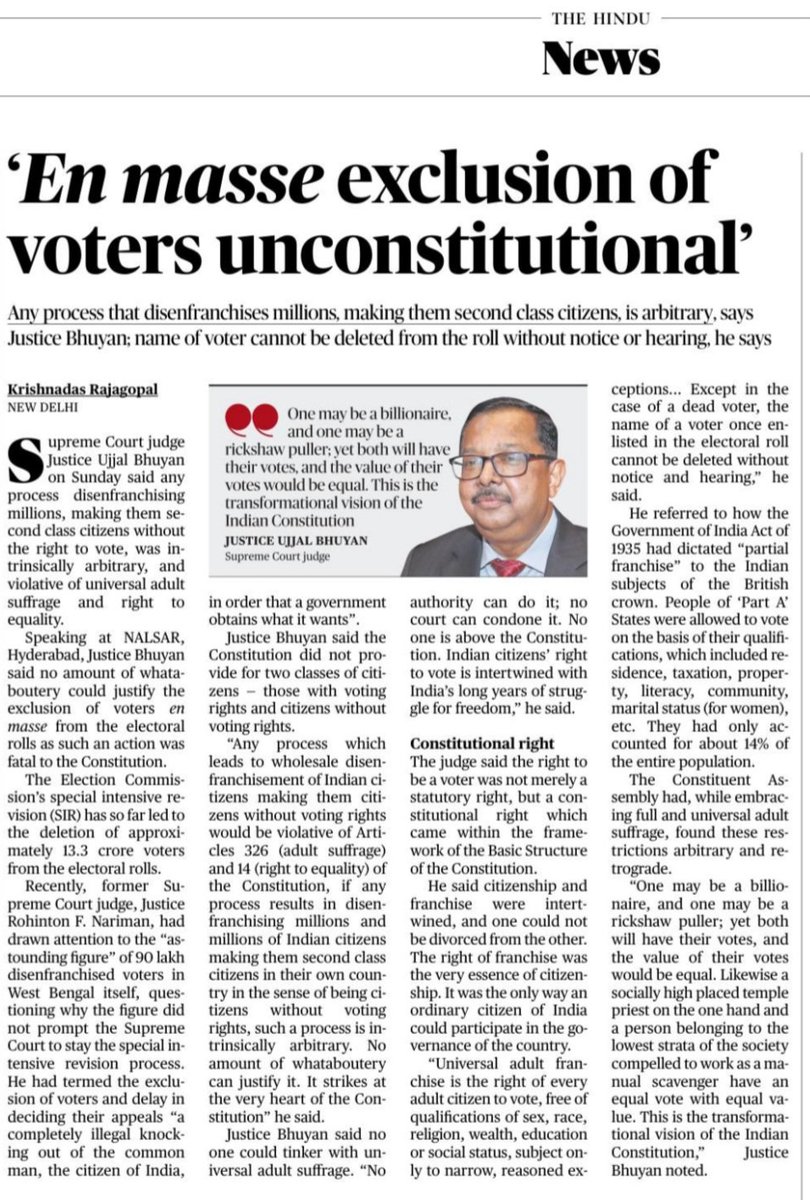
🚩En masse exclusion of voters unconstitutional'
: Scintillating speech by Justice Ujjal Bhuyan in NALSAR
(Any process that disenfranchises millions, making them second class citizens, is arbitrary, says Justice Bhuyan while speaking at NALSAR ,Hyd; name of voter cannot be deleted from the roll without notice or hearing.The Election Commis sion's special intensive revision (SIR) has so far led to the deletion of approximately 13.3 crore voters from the electoral rolls.
@Supreme Court judge Justice Ujjal Bhuyan said any process disenfranchising millions, making them second class citizens without the right to vote, was intrinsically arbitrary, and violative of universal adult suffrage and right to equality.
@Justice Bhuyan said the Constitution did not provide for two classes of citizens those with voting rights and citizens without voting rights.
@"One may be a billionaire, and one may be a rickshaw puller; yet both will have their votes, and the value of their votes would be equal. Likewise a socially high placed temple priest on the one hand and a person belonging to the lowest strata of the society compelled to work as a manual scavenger have an equal vote with equal value. This is the transformational vision of the Indian Constitution," Justice Bhuyan noted.
@Justice Bhuyan said no one could tinker with universal adult suffrage. "No
authority can do it; no court can condone it. No one is above the Constitution. Indian citizens' right to vote is intertwined with India's long years of strug gle for freedom," he said.
@The judge said the right to be a voter was not merely a statutory right, but a constitutional right which came within the frame work of the Basic Structure of the Constitution.He said citizenship and franchise were intertwined, and one could not be divorced from the other. The right of franchise was the very essence of citizen ship. It was the only way an ordinary citizen of India could participate in the governance of the country.Universal adult franchise is the right of every adult citizen to vote, free of qualifications of sex, race, religion, wealth, education or social status, subject only to narrow, reasoned ex-
ceptions... Except in the case of a dead voter, the name of a voter once enlisted in the electoral roll cannot be deleted without notice and hearing," he said.
@He referred to how the Government of India Act of 1935 had dictated "partial franchise" to the Indian subjects of the British crown. People of 'Part A' States were allowed to vote on the basis of their qualifications, which included residence, taxation, property, literacy, community, marital status (for women), etc. They had only accounted for about 14% of the entire population.
@The Constituent Assembly had, while embracing full and universal adult suffrage, found these restrictions arbitrary and retrograde.
Another blow by Panchwi-Pass rulers!
The age-old Book Post Service that allow publishers to send books and journals at cheap rates
— across 154,725 post offices
— to increase the culture of reading
— is being stopped by the anti-educated Modi’s Govt. https://t.co/dzTgdLjQqA
This is how students were peacefully protesting demanding jobs in Patna
But Bihar Police attacked them, didn't even spare women 💔
Shameful. Heartbreaking. Outrageous
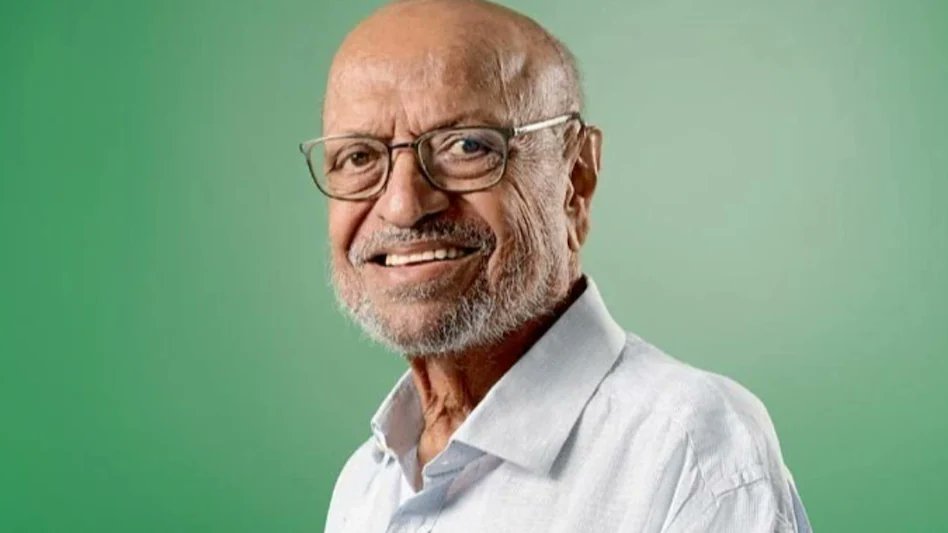
AIIEA deeply mourns the sad demise of legendary film maker and the doyen of parallel cinema Shyam Benegal. He will continue to inspire generations of Indians through his brilliant and fearless portrayal of social realities. Heartfelt condolences.......