Marc Andreessen said something that would have sounded delusional three years ago and now has an entire body of peer-reviewed research backing it up (Save this).
@pmarca's claim is that 99% of the time, the answer he gets from a frontier AI model is better than the answer he would get from the experts he has access to and in his line of work, he has access to a lot of them.
He breaks down why in a way that most commentators miss.
It is not just that AI has memorized a lot of information that would just make it a very good search engine.
What the current generation of models brings is both crystallized intelligence, the complete accumulated corpus of human knowledge and fluid intelligence, the ability to actually reason across that knowledge and synthesize new conclusions.
That combination is what puts it above most individual experts, who have deep crystallized knowledge in one domain and fluid intelligence applied only within that domain.
The research has started catching up to that intuition, and the results are difficult to dismiss.
A Harvard Medical School and Beth Israel study published in Science in April 2026 found that OpenAI's reasoning model outperformed experienced physicians at diagnosing patients using real emergency room data.
In one documented case, the model flagged a dangerous flesh-eating infection requiring immediate surgery roughly 12 to 24 hours before the human physician became suspicious.
In a separate Stanford Nature Medicine study, AI chatbots alone outperformed doctors who had access only to standard internet search and medical references, though doctors who used the AI alongside their own judgment were able to match AI performance.
An earlier benchmark found AI scoring 90% accuracy on diagnostic cases compared to 74% for unassisted physicians.
In law, the picture is almost identical.
A Vals AI benchmarking study published in October 2025 evaluated four AI tools against practicing lawyers on 200 U.S. legal research questions sourced from attorneys at Paul Weiss, Reed Smith, and Paul Hastings.
The AI tools scored between 74% and 78% overall against a 69% average for the human lawyers.
AI outperformed the lawyers on 150 of the 200 questions, often by a margin of 31 percentage points on those specific questions.
In contract review specifically, separate research found AI matches or exceeds junior lawyers in accuracy while completing in seconds what takes attorneys 43 to 56 minutes at a 99.97% cost reduction.
The breadth of the collapse is what makes Andreessen's framing feel accurate.
GPT-5.2 now matches or outperforms human experts in 70.9% of tasks across 44 real occupations, law, finance, engineering, and medicine up from 38% with GPT-5.
That is the gap between a tool that is occasionally useful and a tool that is more reliable than a credentialed professional, across most of what professionals actually do, most of the time.
The historical comparison that matters here is not the Internet but rather the printing press.
Before 1440, expert knowledge, medical, legal, theological was locked inside institutions and accessible only by traveling to find the person who held it.
The printing press democratized access to recorded knowledge, but it still could not reason.
What AI brings for the first time is not just access to the information but rather access to something that can apply the information on your behalf, at any hour, on any topic, with no waiting room and no billing rate.
The right pushback is that the 1% matters enormously in high-stakes domains, the wrong diagnosis, the missed jurisdictional nuance, the edge case that requires judgment no training set fully captured.
Every study that shows AI outperforming experts also notes the failure modes, brittle reasoning under genuine uncertainty, cultural and demographic bias embedded in training data, the tendency to generate confident sounding answers in cases where the honest answer is "I don't know."
The lawyers who outperformed AI did so on exactly the questions requiring multi-jurisdictional judgment and complex contextual synthesis, the hardest 40% of legal work, where being wrong has the most consequences.
But the direction is not ambiguous anymore.
The question has shifted from whether AI can compete with experts to how quickly it is closing the remaining gap and what access to this kind of intelligence, freely available to anyone with a smartphone, will do to a world where expert advice has historically been the most expensive and hardest to access resource most people ever needed.
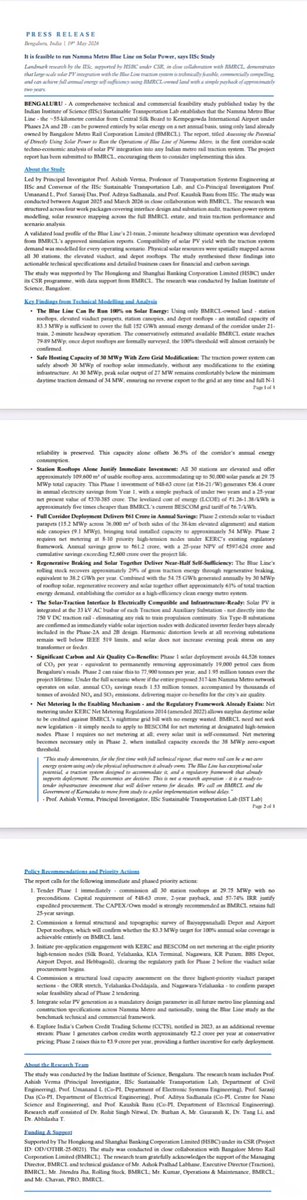
Bengaluru: IISc study finds Namma Metro’s 33-km Blue Line can run entirely on solar power using only BMRCL-owned land & infrastructure. Conducted with BMRCL & supported by HSBC CSR, the study estimates 83.3 MWp solar capacity can meet the corridor’s full annual energy demand. A 30 MWp rooftop phase alone could save Rs 136 crore annually, while expanded deployment may cut up to 77,900 tonnes of CO₂ every year @OfficialBMRCL@iiscbangalore
2004 was a good year, but your Gmail address doesn't need to be stuck in it.
To say goodbye to [email protected] or [email protected] (or whatever you were into at the time), go to your Google Account settings and choose any name available. You'll keep your old username and you can sign in with both.
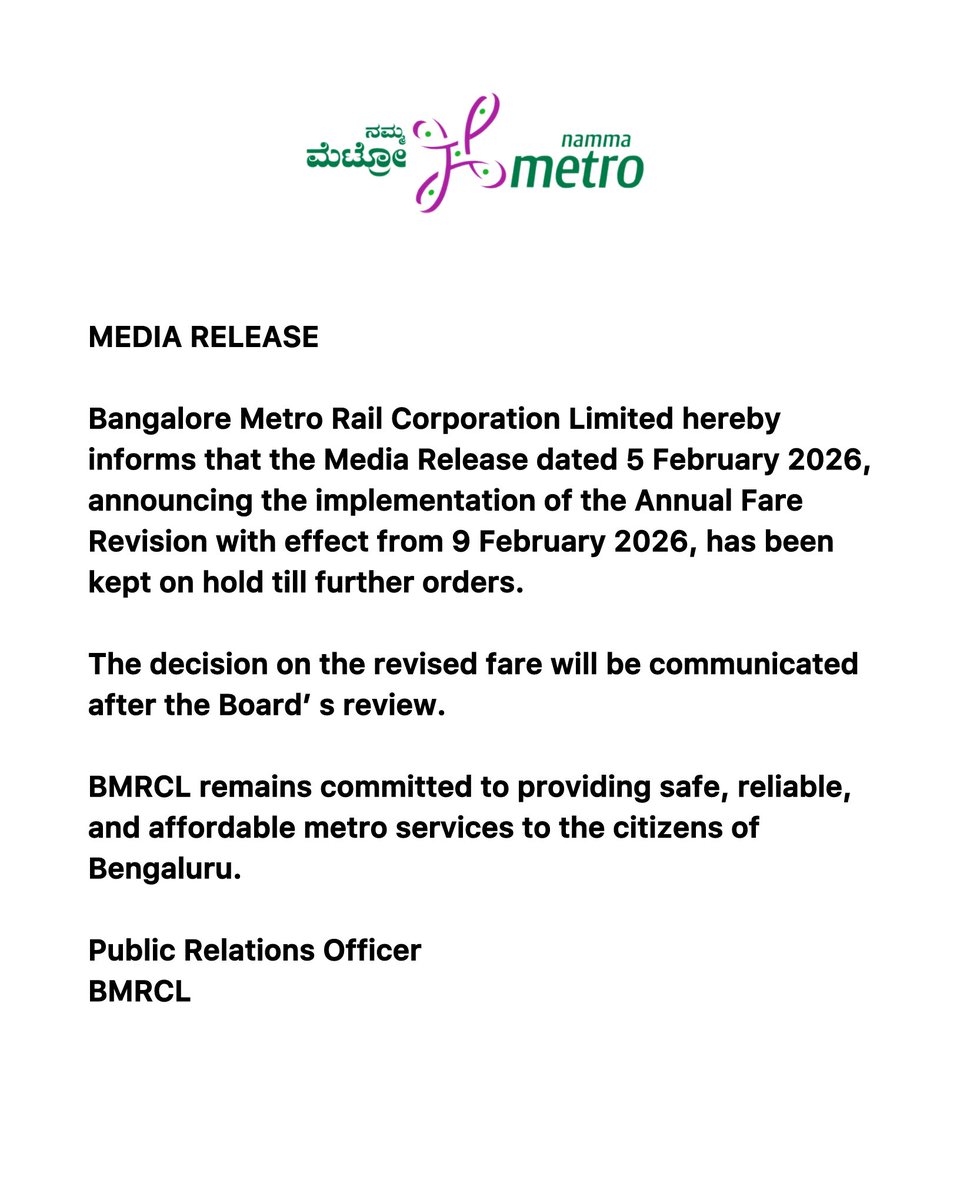
ನಮ್ಮ ಮೆಟ್ರೋ ಟಿಕೆಟ್ ದರ ಹೆಚ್ಚಳವನ್ನು ತಾತ್ಕಾಲಿಕವಾಗಿ ಸ್ಥಗಿತಗೊಳಿಸಲಾಗಿದೆ. ಹೆಚ್ಚಿನ ಮಾಹಿತಿಗಾಗಿ ಮಾಧ್ಯಮ ಪ್ರಕಟಣೆಯನ್ನು ಪರಿಶೀಲಿಸಿ.
Namma Metro fare hike kept on hold. For more details pl check the Media Release
We are thrilled to unveil Zoho's very own POS devices at the Global Fintech Fest. Our POS devices include All-in-one POS device, Smart POS device and Static QR with sound box. This augments our comprehensive coverage of payment acceptance across all channels including online and in-person.
On the payout side, Zoho Payments seamlessly manages disbursements, enabling supplier payments through connected banking and streamlined salary processing. Moreover, payments are intricately baked into our suite of business applications, where every transaction naturally flows into a secure money transfer.
As an RBI-authorized payment aggregator, we are proud to lead the charge in fintech innovation. This is testament to the fact that we now deliver end to end payment stack with more depth and cohesion.
#GFF #GFF2025 #GlobalFintechFest #Zoho #ZohoPayments
Even as our Arattai team is scaling up and fine tuning the product, our other product teams are hard at work.
Last year Zoho became an RBI authorized payment aggregator in India and launched our online payment solutions. We are now deepening our fintech footprint by unveiling our all-new Zoho Payments Point-of-Sale (POS) Devices. With our new devices, businesses can accept in-person payments while staying seamlessly connected to their broader ecosystem.
As part of our broader push in global fintech and payments, we have partnered with NPCI’s NBBL to address real business challenges and strengthen India’s digital payments infrastructure.
(Yes, on the consumer front, Arattai will integrate Zoho Pay, please give us some time!)











![Rainmaker1973's tweet photo. He waited for the sun to set but the tree got there first.
[📸 孫士傑 eric66699999] https://t.co/inagbwPocI](https://pbs.twimg.com/media/G1b93cXXQAAk_A0.jpg)





