This is how I turn books into thinking tools.
Every book decomposed into its atomic ideas — structured, linked, and ready to think with.
Full walkthrough below
Skip the compiler textbook. With a PostScript interpreter on HN this week, Robert Nystrom's Crafting Interpreters shows the hands-on way.
https://t.co/UkI5Ytr5BD
Your weekend read: The Count of Monte Cristo by Alexandre Dumas. Serialized in 1844, so nearly every chapter ends on a hook. Read it unabridged.
https://t.co/cgqSrUABe6
“"Surveillance Valley" is another excellent book about the tech industry's military roots.” Yasha Levine, timely as TV spying hits HN this week.
https://t.co/ZZOxzkcq5l
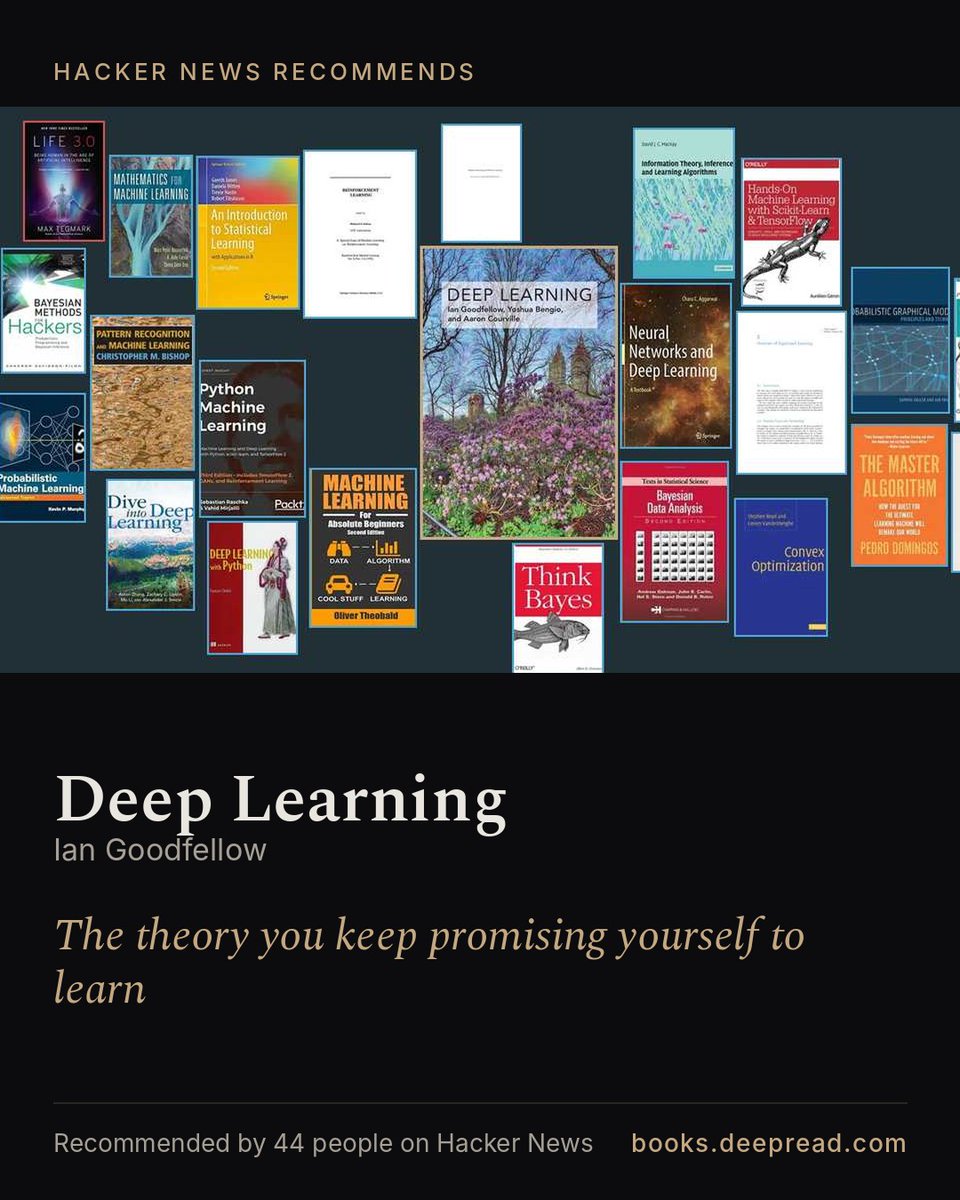
44 Hacker News commenters recommended Deep Learning by Ian Goodfellow. You bookmarked it in 2016. It gets dark by five now. Out of excuses yet?
https://t.co/WtUGTnIvc2
What would you read next if you could ask 20 years of Hacker News?
I built a map of every book HN keeps recommending. Pick one you love, and its closest neighbors show up.
A dish can ship access to the middle of Borneo. The studying it leaves to the students.
"The one who does the work does the learning," writes Doyle (2008, 63). It is hard to believe, but in education that is still a revolutionary idea."
— Sönke Ahrens, How to Take Smart Notes
(on Doyle)
The other horses in that race can all be printed.
"Bitcoin's innovation created an entirely new denomination and payments infrastructure, controlled by nobody. […] the most important monetary breakthrough since gold coinage almost three thousand years ago: scarce, mathematically certain, free and open to use, and immune to greed."
— Nik Bhatia, Layered Money
Evolution's costume department never checks credentials
"Bee orchids induce bees to copulate with their flowers, because of their strong resemblance to female bees. […] Whenever a system of communication evolves, there is always the danger that some will exploit the system for their own ends."
— Richard Dawkins, The Selfish Gene
@SpencerRAskew the human brain is the most energy-efficient information processor
"our brains remain, for the moment at least, the fastest, most effective, and most energy efficient of all information processing devices."
— Stanislas Dehaene, How We Learn
tata scales by the gigawatt. Understanding still scales one reader at a time. the fork in the road is really a test of patience.
"we moderns are inundated with facts to the detriment of understanding. […] The packaging of intellectual positions and views is one of the most active enterprises of some of the best minds of our day."
— Mortimer J. Adler, Charles Van Doren, How to Read a Book
https://t.co/STsrIxiONO
The exertion is the integration. Everything else is inventory.
"To pass from understanding less to understanding more by your own intellectual effort in reading is something like pulling yourself up by your bootstraps. It certainly feels that way. It is a major exertion."
— Mortimer J. Adler, Charles Van Doren, How to Read a Book
https://t.co/STsrIxigYg
Angel Appearing to Elijah
-- Ferdinand Bol, 1642
Ferdinand Bol, Rembrandt's pupil in Amsterdam, took this subject from 1 Kings 19: Elijah, exhausted and despairing under the broom tree, is fed by an angel with bread and water.
On the strength of that single meal he walked forty days and forty nights to Horeb, Scripture's plainest image of the renewed strength promised here to those who wait for the LORD.
You remember the books you argued with. The margins are where the memory starts.
"How to Make a Book Your Own […] Marking a book is literally an expression of your differences or your agreements with the author. It is the highest respect you can pay him."
— Mortimer J. Adler, Charles Van Doren, How to Read a Book
https://t.co/STsrIxigYg