When we feel unloved in any capacity or in any relationship
When we feel mistreated
When we feel somehow belittled
It's a natural reaction to want revenge
The problem is, when you seek revenge, you destroy yourself.
Honestly this is what a lot of people are going through quietly. Some haven’t seen their parents or siblings in over 5 years and it’s really not easy. I can’t even imagine that, I make sure I go home every year sometimes twice, just to be around my family. I pray I return home soon finally, may God make it easy.
This girl was using a Lexus and iPhone 17 to brag, as this guy revealed he owns a Dodge and lives in Kuwait, she switched from bragging to begging him to be his girlfriend and for him to send her some cash😂💔
President Tinubu, I'm the Chief Security Officer of Osun State, and I'm passing this message to you. Osun will not accept any rigging. If anybody tries to do otherwise, the political crisis of 1983, when some people tried to rig Michael Ajasin out of power in Ondo State, may repeat itself again. President Tinubu, the Accord Party has endorsed you as its presidential candidate. Why are we suffering again?
- Governor Adeleke sends a message to President Tinubu ahead of the August 15 governorship election in Osun State
@ChuksEricE The truth is, many of the cars being sold as tokunbo were actually involved in accidents and then rebuilt piece by piece before being put back on the market. Sad reality!
@seyimakinde What’s really going on with Fayemi? Man is neither here nor there, and he doesn’t seem bold enough to publicly state where he stands. Always wearing that fake smile too.
@egi_nupe They’ll mock your progress, but deep down, they wish they were making the same moves.
Some people laugh at what they can’t bring themselves to achieve.
@eludayo_1 Interlocking is the better choice. It allows rainwater to seep into the soil and helps reduce flooding. Cement stamping, on the other hand, blocks natural water percolation and can easily cause water to build up in the compound.
Some comments here are trying to downplay the value of ₦30 million naira, and honestly, that’s a very unserious take. Easy money from fraud, scams, and social media payouts has made some people forget what real capital means. If those things stopped tomorrow, which honest business would you point to that makes ₦30M look like nothing? Name it.
Respectfully, this is a brilliant submission, but it would be stronger if you shared the sources behind it. None of us was alive in 1800-1000 BC, so I think it’s better to be careful with absolute statements on something like Oduduwa and the origin of the Yoruba. From what I understand, this kind of history is usually pieced together from oral tradition, archaeology, linguistics, and written records, and then scholars try to see where the evidence overlaps. So I’d say it’s fair to present it as a strong view, but not as final fact unless the research trail is clear.
Good evening!
If Nigerians ever see the full list of people who turned “poverty‑alleviation” grants and loans into personal jackpots, this app will be very quiet.
Funny thing about this “advice” some people keep dropping on here is that many of the loudest voices were neck‑deep inside the same social investment schemes they now pretend to be holier than. Many of them shamelessly rode on fPMB’s name and image to perpetrate shady deals, hiding behind his reputation while he, in his usual trusting style, blindly believed in their capacity and loyalty.
We all remember how TraderMoni, MarketMoni and FarmerMoni were rolled out under the Buhari-Osinbajo administration as collateral‑free microcredit for petty traders, farmers and artisans nationwide, with millions of beneficiaries targeted through the GEEP programme. The idea on paper was simple: give N10k-N300k interest‑free loans to market women and small traders, they repay, and then qualify for higher amounts.
But by the time the dust settled, reports had already started coming out about illegal deductions, agents taking cuts before disbursement, opaque records, and beneficiaries refusing to repay after treating it like “free money” instead of actual loans. Even officials inside the system raised concerns that many beneficiaries were deliberately dodging repayment and questioned the transparency and impact of the whole structure.
And when you zoom out from the small loans to the big boys at the top, the picture is even worse. The EFCC is probing several former Buhari ministers for staggering corruption claims, with billions of naira allegedly diverted, including huge sums and dozens of properties linked to former Attorney‑General Abubakar Malami alone, assets valued in the hundreds of billions. That’s just one example from one powerful cabinet member, not even counting the others still under investigation.
Yet a lot of these same “beneficiaries” and power brokers, from microcredit hustlers to overnight landlords, are on this same Twitter today, endlessly attacking the current government, forming conscience and analyst, because their quiet pipeline has dried up and the era of easy, unaccountable cash is over. They won’t tell you they collected government money meant for ordinary traders and farmers, they won’t tell you they never repaid, they won’t tell you they turned anti‑poverty schemes and recovered public assets into personal jackpots. They just come online to shout “bad policy” and “bad leadership” at every turn.
Regardless of all their shenanigans and self‑interest, one thing remains certain: God is not mocked. What was done in darkness will keep coming into the light, and every hidden deal, every hijacked loan, every stolen opportunity from genuine market women and small business owners will be exposed in due time.
Nigeria is bigger than any clique of overnight millionaires and self‑appointed spokesmen. Their tantrums can slow nothing. In the end, their schemes will crumble, their hypocrisy will be obvious to everyone, and this country will still move forward and triumph by the grace of God.
OPERATION HADIN KAI TROOPS CRUSH ISWAP INFILTRATION ATTEMPT IN CROSS KAUWA, INFLICT HEAVY LOSSES…Preliminary Forensic Findings Point to Foreign Facilitators Behind Failed Attack
Troops of 19 Brigade, Sector 3, Joint Task Force North East, Operation HADIN KAI (OPHK), have decisively foiled an attempted infiltration by ISWAP terrorists into Cross Kauwa, Kukawa Local Government Area of Borno State, inflicting heavy casualties on the attackers and forcing them to retreat in disarray. The successful defence of the location further demonstrates the vigilance, combat readiness and operational effectiveness of troops who continue to deny terrorist elements freedom of action across the North East Theatre.
The failed attack occurred at about 2220 hours (10:20 p.m.) on 11 July 2026, when the terrorists attempted to exploit the cover of darkness to breach the troops' location. Alert troops swiftly detected the hostile movement and responded with coordinated and overwhelming firepower, compelling the terrorists to abandon their mission of looting cholera medical supplies and withdraw in confusion after suffering severe losses. The attempted looting further lends credence to recent intelligence reports of a cholera outbreak within terrorist enclaves, as well as reports of the execution of some affected members by the group.
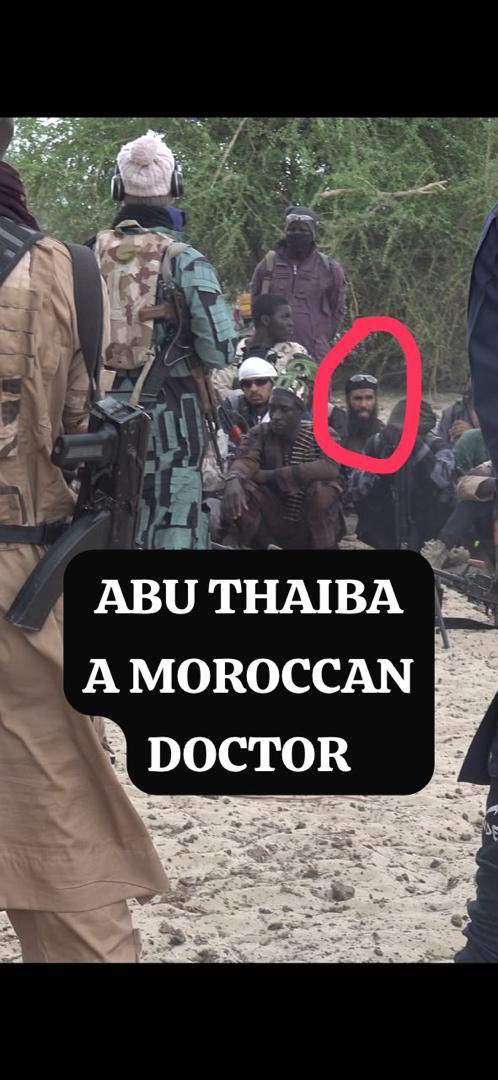
The neutralisation of a terrorist cameraman during the failed assault led to the recovery of a Sony camcorder containing highly sensitive recordings of terrorist activities, including operational footage and propaganda materials. Preliminary forensic analysis of the last available video recorded prior to the attack indicates that the operation was coordinated by four senior ISWAP commanders (Qai'ds), alongside three foreign terrorist facilitators. They include a Palestinian Arab identified as Abu Ishaq, assessed to be ISWAP's overall trainer; a Moroccan Arab identified as Abu Thaiba, a medical doctor serving within the terrorist network; and another Arab operative whose identity is yet to be established. The presence and active involvement of these foreign nationals further reinforces intelligence assessments that ISWAP continues to benefit from external support, specialist expertise and transnational terrorist linkages.
Following the successful engagement, troops immediately dominated the area and conducted exploitation operations to ascertain the full extent of the terrorists' losses. During the operation, troops recovered the Sony camcorder, several rounds of PKT and 7.62 mm Special ammunition, terrorist uniforms and other combat enablers. Initial analysis of post-engagement satellite imagery revealed terrorists evacuating the bodies of some of their neutralised fighters during their withdrawal. This has since been corroborated by credible human intelligence sources, which confirmed that the terrorists suffered heavy casualties, with many others sustaining gunshot wounds during the engagement. Two soldiers sustained gunshot wounds during the firefight and were promptly evacuated by air for advanced medical care. Both personnel remain in stable condition.
The failed infiltration attempt represents yet another significant operational setback for ISWAP and caps a costly weekend for the terrorist group following sustained offensive operations and intensified military pressure across the North East Theatre. The outcome underscores the increasing difficulty the terrorists face in executing coordinated attacks against highly alert and combat-ready troops, while further degrading their combat capability, morale and freedom of action. Operation HADIN KAI remains resolute in sustaining offensive operations, protecting vulnerable communities and dismantling terrorist networks until lasting peace and security are fully restored across the North East.
MOHAMMED GONI
Captain
Acting Military Information Officer
Headquarters Joint Task Force (North East) Operation HADIN KAI
MAIDUGURI
12 July, 2026
Defence Headquarters Secures Rescue of Kidnapped Oyo Students and Teachers.
Through effective inter-agency collaboration and intelligence-driven operations, the abducted victims in Oyo State were safely rescued. The Armed Forces of Nigeria remain steadfast in safeguarding lives and national security.
Before passports and BVN, there was only one true ID card in Yorubaland:
ỌMỌLÚÀBÍ.
A word that meant more than “well‑behaved child.”
It meant “the person born from good character itself.”
Ask many people today and they’ll say Ọmọlúàbí just means “well brought‑up child.”
That’s only surface level.
In Yorùbá thought, an Ọmọlúàbí is the complete human being:
truthful, respectful, courageous, self‑controlled, and responsible for others.
The word itself comes from a longer Yorùbá phrase:
Ọmọ‑ti‑Olu‑ìwà‑bí
Break it:
Ọmọ - child / person
ti - that / who
Olu‑ìwà - “lord/owner of character” (ìwà = character/being)
bí - gave birth to
So literally:
“the child begotten by the lord/owner of character.”
Spoken quickly over generations, Ọmọ‑ti‑Olu‑ìwà‑bí tightened into Ọmọlúàbí / Ọmoluabi / Omoluwabi.
Another way Yoruba teachers explain it is:
“Ọmọ tí Olu‑ìwà bí” - “a child whom the master of character has given birth to.”
The message is clear:
Your true parent is your character, not just your bloodline.
Yoruba philosophy says:
Ìwà l’ẹwà - character is beauty.
Ìwà l’ẹ̀sìn - character is religion.
Without good character, your education, money, or title were nothing.
You could not be praised as Ọmọlúàbí if you were rich but dishonest.
Some writers even argue that before “Yorùbá” became common as an ethnic label, people proudly called themselves “Ọmọlúàbí” - children of good character.
Whether or not that was universal, the idea is clear:
Being Yoruba was supposed to mean being deeply formed by character, not just language and food.
So when we say “Yoruba are Ọmọlúàbí people,” we are not boasting about tribe.
We are reminding ourselves of a contract:
If no one is watching, if there is only a calabash of cowries and your conscience,
will you still act like a child born of good character?
Before passports and BVN, there was only one true ID card in Yorubaland:
ỌMỌLÚÀBÍ.
A word that meant more than “well‑behaved child.”
It meant “the person born from good character itself.”
Ask many people today and they’ll say Ọmọlúàbí just means “well brought‑up child.”
That’s only surface level.
In Yorùbá thought, an Ọmọlúàbí is the complete human being:
truthful, respectful, courageous, self‑controlled, and responsible for others.
The word itself comes from a longer Yorùbá phrase:
Ọmọ‑ti‑Olu‑ìwà‑bí
Break it:
Ọmọ - child / person
ti - that / who
Olu‑ìwà - “lord/owner of character” (ìwà = character/being)
bí - gave birth to
So literally:
“the child begotten by the lord/owner of character.”
Spoken quickly over generations, Ọmọ‑ti‑Olu‑ìwà‑bí tightened into Ọmọlúàbí / Ọmoluabi / Omoluwabi.
Another way Yoruba teachers explain it is:
“Ọmọ tí Olu‑ìwà bí” - “a child whom the master of character has given birth to.”
The message is clear:
Your true parent is your character, not just your bloodline.
Yoruba philosophy says:
Ìwà l’ẹwà - character is beauty.
Ìwà l’ẹ̀sìn - character is religion.
Without good character, your education, money, or title were nothing.
You could not be praised as Ọmọlúàbí if you were rich but dishonest.
That’s why in many Yoruba towns, people could leave goods by the roadside - yams, fruits, firewood - with only a small calabash of cowries beside them.
The seller would go home or back to the farm.
Strangers would:
take what they needed,
count the price,
drop the exact money and walk away.
Stealing from that calabash was seen as betraying Ọmọlúàbí, not just “beating the system.”
Three invisible forces protected that honesty:
Ìtìjú (shame): being known as a cheat stained your whole family name.
Èsùn (spiritual fear): dirty money was believed to carry curses and misfortune.
Àwùjọ (community eyes): even when nobody was physically there, people acted as if the community and the Òrìṣà were watching.
Ọmọlúàbí was like an internal policeman sitting in your chest.
Nobody is born perfect.
Yoruba society trained children into this ideal using:
Proverbs: “Ìwà l’ẹwà” (character is beauty)
Folktales: where greedy and dishonest characters always met a bad end.
Public correction: if you lied about change in the market, you weren’t only scolded for the money - you were scolded for lacking ìwà.
The goal was not just obedience, but internalised character.
Old texts and modern scholars list key traits of an Ọmọlúàbí:
Òtítọ́ - truthfulness
Ìtẹ́ríba - deep respect and courtesy
Ìwà pẹ̀lẹ́ - gentle, disciplined character
Ìfaradà / sùúrù - endurance, patience
Akíkanjú - bravery when needed
Ìsọ̀kan & ìtìlẹ́yìn - loyalty and standing with your people
You didn’t have to be perfect, but you had to strive for these.
When an elder looks at a young person and says:
“Ó jẹ́ Ọmọlúàbí,”
they are doing two things at once:
Approving: you’ve shown good character.
Charging you: don’t fall below this standard, because your name and your ancestors are attached to it.
It’s both a medal and a warning.