Last week, DEF CON Franklin and the National Rural Water Association (@NRWA) launched the Water Watch Center: round-the-clock cyber monitoring for the small water utilities that serve most of America.
Here's how the week went. 🧵
#CyberCivilDefense#Take9#WaterWatchCenter
https://t.co/IMN6tkbOeG
The most powerful AI depends on advanced chips, and this entire situation has shown we have to do a much better job at ensuring this technology doesn't get into the wrong hands. @jakehbraun talked through the stakes with @PamelaBrownCNN on @CNN today
The outages may turn out to be a coincidence. The fragility of the systems behind them is a known problem, and we haven't done the work to fix it. Jake Braun on @CNN with @PamelaBrownCNN
Check out @Claroty's latest Nexus Podcast featuring Franklin co-founder Jake Braun! Hear how we're protecting America's water utilities through the Water Watch Center, our cyber volunteer force, and innovative cyber solutions.
#CyberResilienceCorps#CyberCivilDefense#Take9
https://t.co/WJy6Ap6Bg2
The ever changing industry can trickle down to you and your online safety". Watch on WAFB9 how students, officials, and cyber experts came together at the @Center for Long-Term Cybersecurity 's #CyberCivilDefense Summit: Central to tackle community cyber defense together, and how #Take9 campaign can help everyone protect themselves from online scams and fraud.
https://t.co/xSE5z5CoBb
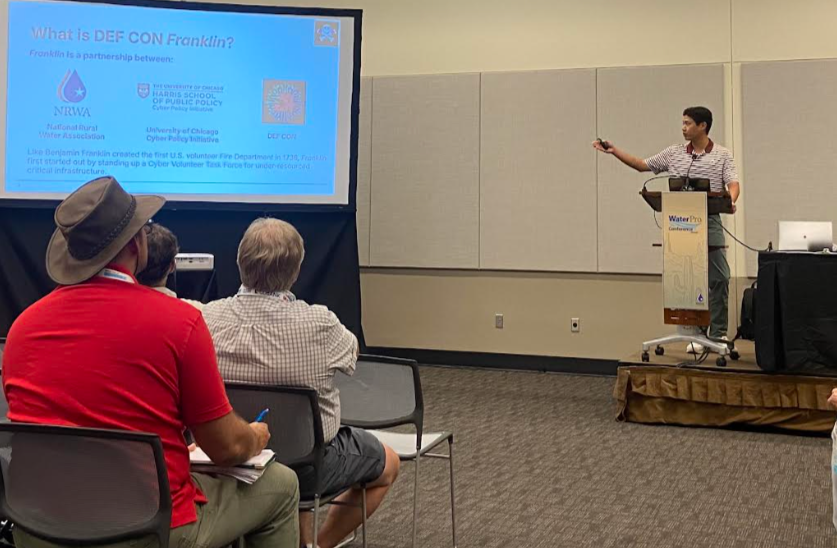
Last week, DEF CON Franklin joined the National Rural Water Association (@NRWA) at the WaterPro Conference in Phoenix to roll out the Water Watch Center and begin signing up utilities for the program’s pilot.
Franklin Program Director Paul Chang spoke with water leaders about the growing cyber threat facing small and rural utilities—and how we can help address it.
The Water Watch Center provides completely free cybersecurity support to NRWA-affiliated systems and has already helped utilities across eight states. Now, we're piloting a Managed Security Service Provider model to provide ongoing monitoring, with a growing focus on utilities serving data centers.
The goal is simple: build a network of defense that reaches the most vulnerable parts of our water infrastructure—and scale it nationwide.
#CyberCivilDefense #Take9 #WaterWatchCenter
Jake Braun, executive director of the Cyber Policy Initiative, joined Project Watershed 250 to share lessons from the Water Watch Center. As Texas works becomes the national standard for defending water systems, WWC stands with them against cyber criminals.
Congratulations to @ONCD, Chief TJ White, @GregAbbott_TX, and the State of Texas on the launch of Project Watershed 250, and on the great strides they're making on one of the most important national security issues of our time.
Honored to speak at the Project Watershed 250 working group session and share lessons learned from our work at the Water Watch Center. Texas was selected to set the national standard for defending water systems, and we're glad to ensure the Lone Star State does not fight this battle alone as the WWC stands with them to make demonstrable progress defending against the cyber criminals and nation state adversaries preying on our water systems.
Recent cyberattacks targeting water systems in multiple U.S. states have raised questions about the security of drinking water infrastructure. Water utilities must prepare for physical and digital threats. Read our latest blog to learn more.
https://t.co/G06dVdrEcU
After the recent multi-state cyber attacks on water, this piece from @NPR sums it up nicely. "Technology helps some operators monitor their systems remotely and become more efficient, but it can expose insecure devices to bad actors a world away." This is why organizations like @DefConFranklin and @NRWA are launching efforts to give small utilities more immediate support.
#CyberCivilDefense #Take9 #WaterWatchCenter
Read more👇
https://t.co/U25ltT0oBg
“You have more cybersecurity regulations for your credit card and your wallet than you do for the water systems that support our country,” IST's @joshcorman told @whyy yesterday, joining the program to break down recent cyberattacks on water utilities.
➡️ Listen now: https://t.co/KlCwS2Krgh
Last week, DEF CON Franklin and the National Rural Water Association (@NRWA) launched the Water Watch Center: round-the-clock cyber monitoring for the small water utilities that serve most of America.
Here's how the week went. 🧵
#CyberCivilDefense#Take9#WaterWatchCenter
https://t.co/IMN6tkbOeG
@NRWA 7/
This didn't start last week. Cybersecurity Dive and The Register covered what two years of volunteer work produced, including the 21 small utilities Franklin has already served.
https://t.co/fUjEEWV9qL
@NRWA 6/
The trade press dug into the model: five vetted MDR providers, threat data shared through NRWA as the hub, and Franklin volunteers on call to fix what the sensors find.
https://t.co/fCl8kqExIW
@NRWA 4/
He also joined Wolf Blitzer in The Situation Room on @CNN to talk about the threat to small water systems and the response taking shape.
https://t.co/qrWF5ugI4M
@NRWA 3/
Jake Braun joined @NPR to explain what the center gives a utility with two or three staff and no security team of its own.
https://t.co/0JmedtJxxI
@NRWA 2/
@kevincollier broke the story at @NBCNews: the water industry is turning to AI and hackers for help amid suspected Iranian cyberattacks.
https://t.co/WJ0wawFMdr
There is no such thing as being "too small to be a target" anymore. Hear @CLTCBerkeley's Ann Cleaveland discuss the challenges facing "target-rich, resource-poor" local governments and small critical infrastructure, and the growing networks of cyber defenders stepping up to protect them on KQED Forum.
The difference between a contained incident and a widespread emergency is the work happening right now to close these gaps. This is why Franklin and others are collaborating on the #WaterWatchCenter #CyberCivilDefense #Take9
🎧Listen here: https://t.co/rOr3AjEOcj