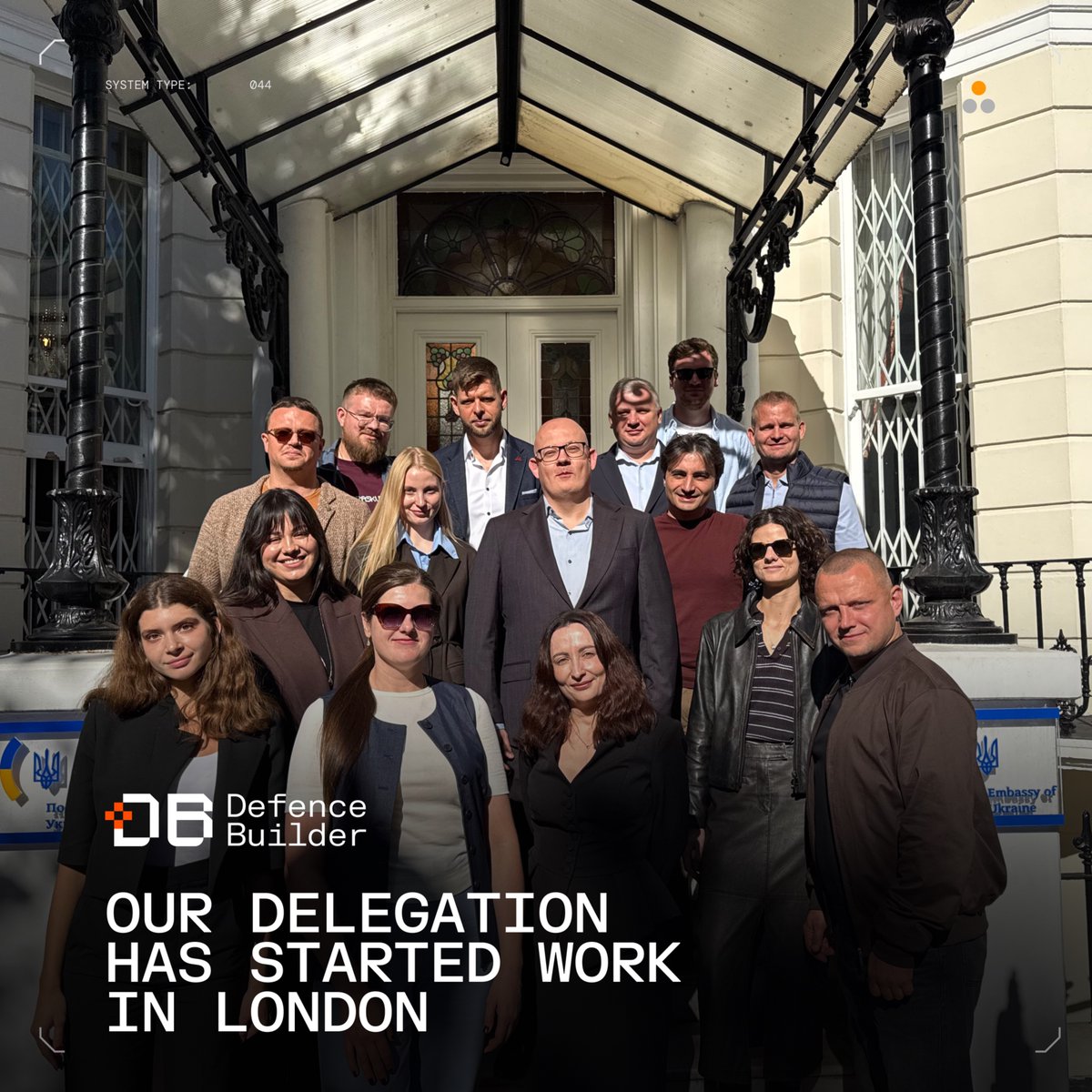
🇺🇦🇬🇧 Ukrainian defence tech delegation from Defence Builder has started its work in London!
The next three days are full from morning to night. Until 7 October we are at Resilience Media Conference in London, where Defence Builder is a partner this year, and around the conference we have meetings and round tables with British primes, industry associations and technology partners.
On 6 October, together with Resilience Media, we are hosting a closed-door investor dinner where investors and defence industry leaders will sit down with our founders.
Seven defence tech companies came with us:
🔹Sine Engineering, EW-resistant communications and navigation for drones
🔹Farsight Vision, AI geospatial intelligence and navigation without GNSS
🔹Meta Bureau, integrated UAV systems
🔹TRINITY ROBOTICS, ground robots for frontline logistics and casualty evacuation
🔹Oko Camera, thermal imaging cameras for unmanned systems
🔹MaXon Systems, autonomous interceptors against Shahed-type drones
🔹Moodro, autonomous counter-UAS systems
Also with us are Sigma Software Group and Kyiv School of Economics, two of Defence Builder's co-founders, and our legal partner AEQUO Law Firm.
We came to London for co-production and joint ventures with British companies, integration of Ukrainian components into UK platforms, joint R&D, testing against UK requirements, and investment for the companies that are raising now.
If you are in London this week and want to meet any of these teams, message us and we will set up the meeting.
Daria Yaniieva, President of Defence Builder, has written an op-ed for the @KyivIndependent on the choices that will shape Ukraine's defence industry over the next ten years.
Read the op-ed: https://t.co/ZG4TjMiFxv
In 1991, Ukraine inherited the second-largest defence complex of the Soviet Union and lost much of it within a generation. Today the industry is being built for the second time, from the bottom up, with private capital and open competition.
The op-ed describes five forks: spillover into the civilian economy, openness to exports and joint ventures, open competition, specialisation, and whether defence pulls the wider industrial base along with it.
Examples from the US, Israel, Japan, South Korea and Türkiye show where each path leads.
According to a report by Defence Builder, KSE Institute and Brave1, Ukraine's UAS market reached $6.3B in 2025, more than 90% of the country's defence tech market, and grew 137% year on year. The report names autonomy among the segment's four key development areas.
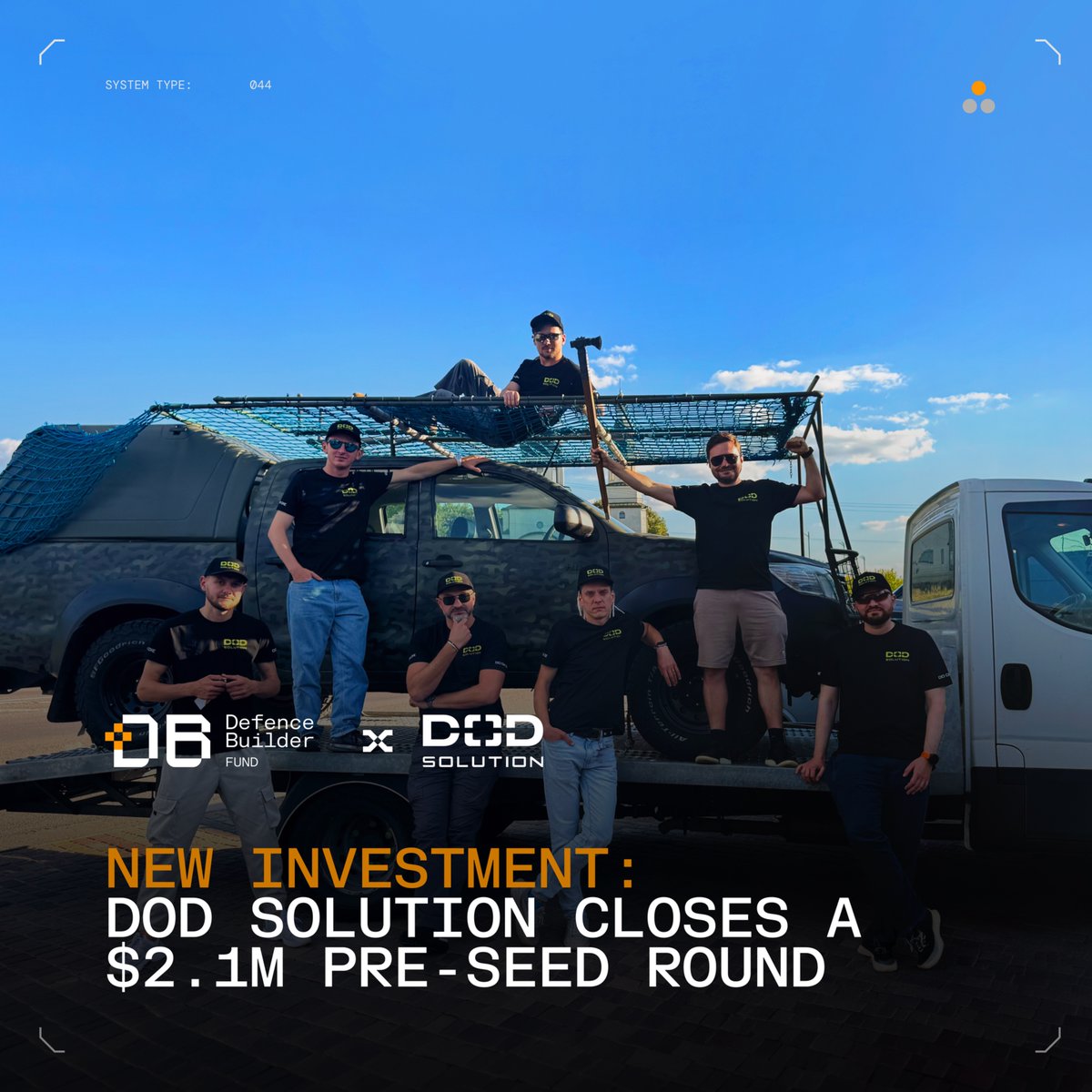
Defence Builder Fund I has invested in DOD Solution, an Estonian-Ukrainian company building onboard AI for unmanned platforms. The company closed a $2.1M pre-seed round with investors from Ukraine, Europe, the US and Canada. Draganfly joined as a strategic investor.
The round also included Angel One Fund, Better Angle, Network VC, Newfund, UAID Fund, WildField Ventures and 4C-Next Holding AG, as well as angel investors.
DOD Solution's partners include US-based Lantronix, which supplies the Open-Q 6490CS computing platform, Dutch company Axelera AI, whose Metis M.2 accelerator is being integrated into AURA AI for interceptors, and Estonia's DefSecIntel Solutions on counter-drone AI.
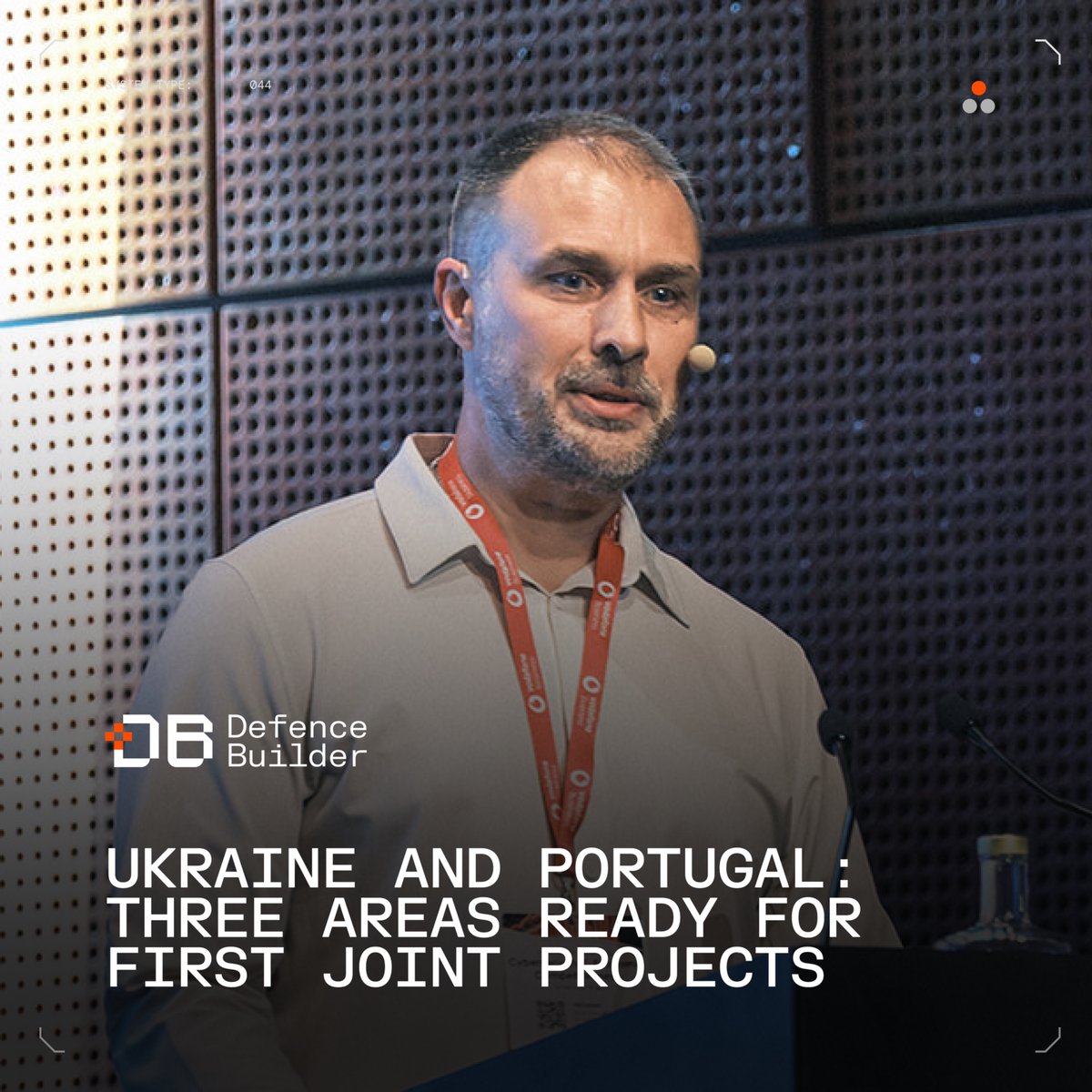
Valery Krasovsky, co-founder and board member of Defence Builder, spoke on the panel "The Public Sector and Companies on the Hybrid Warfare Chessboard" in Porto. The panel discussed how governments and industry should work when hybrid warfare is no longer a theoretical risk.
Key points from Valery's remarks:
🔹Ukrainian sea drones have destroyed or damaged more than 25 Russian vessels and pushed the Black Sea Fleet out of Sevastopol. That reopened an export corridor that has since carried more than 200 million tonnes.
🔹In the largest Shahed attacks, interceptor drones account for more than 40% of those shot down. One interceptor costs $1,000–5,000, compared with millions for an air defence missile.
🔹Ukraine's defence industry can produce about $55bn worth of equipment in 2026, and around 40% of that capacity is unfunded. Co-production with European partners can put it to use.
🔹With Portugal, three areas are ready for first projects: maritime security, critical infrastructure protection and counter-drone systems.
Ukraine brings combat-tested technology. Portugal brings industrial capacity, the REPMUS test range and access to European defence programmes. Defence Builder connects the two sides for joint R&D, testing, investment and manufacturing.
Defence Builder Accelerator Batch 4.0 is open to defence and dual-use teams from any country, including Portugal, that have a working prototype at TRL 4+. Protection from airborne threats, including counter-drone systems, is one of the seven priority areas.
Apply by 30 October: https://t.co/s7GtboMinK
Details: https://t.co/5nOEQ0Grlv
Taking a product from working prototype to military procurement and investment? Apply to Defence Builder Accelerator Batch 4.0.
Apply by 30 October: https://t.co/MO45GomJIg
Programme: https://t.co/ocqzaQpD5K
At #MSPO2026 in Kielce, Yana Shkvarovska, Director of Defence Builder Accelerator, looked at how fast the defence industry can change what it builds.
"Agreeing at a conference that the war has changed and rebuilding your work around it are two different things."
What she took away 👇
What this means in practice:
🔹Come with evidence. Combat use earns trust. Documentation, test results, consistent quality and a clear production plan turn that trust into projects.
🔹State plainly what you can do, where your limits are and what cooperation you offer. Next to the large pavilions, the Ukrainian presence looked modest.
🔹Use exhibitions to source as well as sell: components, prices, lead times, suppliers.
🔹A better module or piece of software can improve a system in service if someone owns integration, testing and support.
🔹Leave each meeting with a next step: a technical request, a sample exchange, an agreed test, a named decision-maker or funding.
What you get:
🪖 Military track: validation with 30+ units, field days, and demos to procurement officers and end-users
💼 Business track: 80+ experts, founders of leading tech & defence companies, and 1:1s with peers behind top products making headlines worldwide
💰 Capital: a starting grant in exchange for a minority equity stake, additional funding from our partners during the programme based on your performance, and access to a network of 100+ investors
🤖 New in Batch 4.0: AI support for R&D and operations, and executive roundtables with C-level defence leaders
🤝 After Demo Day: a personalized portfolio manager, a six-month roadmap, and introductions to manufacturers, integrators
Details: https://t.co/Ins2z7fDU2
Know a team that should be in Batch 4.0? Tag them in the comments 👇
🚀 Applications for Defence Builder Accelerator Batch 4.0 are open!
Our main goal is to turn your working prototype into an investable company. That means a company with validation evidence from military units, a procurement pathway, clean IP, unit economics that hold up in due diligence, and investors ready to take the meeting.
Since 2024, three cohorts have completed the programme. Our 24 portfolio companies from five countries have received $650k+ in grants.
For Batch 4.0, we're selecting 10 defence and dual-use teams from anywhere in the world with a working prototype at TRL 4+ for a four-month programme.
Apply by 30 October (20 minutes): https://t.co/7vvZy4jjLO
Thanks to the Resilience Media team for the partnership. They have built one of the few defence conferences where the room is actually balanced — founders and investors on one side, government and military buyers on the other. Around a third of tickets go to the military and national security communities, and the speaker list runs from senior British Army leadership to NATO's innovation directorate. For early-stage companies, that balance is the entire value of a conference.
Defence Builder is a partner of the Resilience Media in London, and we are taking part with a delegation of Ukrainian defence tech companies.
If you are in London in early October, let us know — we will set up the meetings.
The delegation is made up of companies from the Defence Builder ecosystem, each with external funding raised and technology already proven in operational use, across UAS and counter-UAS, EW, ground robotics, and C2 and battlefield software.
We do this deliberately and often. A company can prove its technology at the front and still have no way to reach the people who fund and buy at scale abroad — that introduction is the hardest thing for a Ukrainian team to arrange alone. Opening that access is a core part of what the ecosystem is for, for the companies and for the market they come from.
Daria Yaniieva, President of Defence Builder, took part in the U.S.-Ukraine Business Council (USUBC) discussion.
Her key points:
🔹US support is moving from grants to commercial diplomacy — credit structures, sovereign de-risking, corporate joint ventures. The Ukraine Reconstruction Trust Fund is one example, financed by penalties, taxes and tariffs on Russia rather than by the US taxpayer.
🔹The capital gap is larger than the capital available. Invest every fund currently open for Ukrainian defence into every open round, and the gap would still be there. One company Fund I backed early later became URIF's first investment — the question is how that kind of capital reaches a wider pool of companies.
🔹Ukraine's contribution is operational experience, not only technology — and that experience is now an input to the rearmament cycle of NATO countries.
Thanks to Irina Paliashvili and the USUBC team. The Roundtable featured Anders Aslund, Natalie Jaresko and Amb. Geoffrey Pyatt, joined by Artem Rybchenko, Deputy Minister for Recovery, Infrastructure and Transport of Ukraine.
Three points from her remarks:
🔹Working with the military doesn't start with a technical specification. The common assumption is that a unit hands you requirements and engineering takes it from there. The accelerator works the other way round: it starts with conversations in the units — which gaps are real on specific parts of the front, how the situation has changed since we last asked. Those conversations set the programme's priorities and the selection criteria, so a team enters acceleration with a problem already confirmed by the people who will use the product.
🔹There are around 2,000 defence-tech startups in Ukraine. This creates an opportunity not only to build something new, but to strengthen what is already in service. If a solution helps an existing drone survive enemy EW, it should be integrated into that drone, not turned into another drone next to it. Those are the R&D capabilities the accelerator is looking for.
🔹If you are not working in Ukraine, you are roughly five years behind modern warfare. Technology at the front changes in months, so partners who spend time in Ukraine — with companies, units and institutions here — plan from what is happening now rather than from last year's picture. That presence is also usually what turns an agreement into joint work.
Yana Shkvarovska, Director of the Defence Builder Accelerator, spoke at the conference hosted by the AHK Ukraine - German-Ukrainian Chamber of Industry and Commerce. The panel was moderated by Tobias Köhler (Rödl & Partner). Yana was joined by Victor Chuikovsky (Rise Technologies Ukraine) and Leopold Posch (TYTAN Technologies).
And two practical points for companies entering the market now:
1. set up dual incorporation early (a 100% Ukrainian-owned company with a holding structure) — registration and bank accounts take months;
2. diversify manufacturing sites across regions and reserve critical staff, knowing that under the current rules the whole team cannot be reserved.
Andrii Hryshchuk, Investment Manager at Defence Builder Fund, spoke at the conference hosted by the AHK Ukraine - German-Ukrainian Chamber of Industry and Commerce.
The panel was moderated by Serhii Sviatenko (AHK Ukraine). Andrii was joined by Frederik Schumann (EU Defence Innovation Office) and Olena Bilousova (Defence Research Centre, KSE Institute).
Key points:
🔹Capital is not the main thing Ukrainian companies need from a European partner. Funds are coming to Ukraine and launching local vehicles; money can be raised here. The shortage is elsewhere.
🔹Scaling. Ukrainian teams mostly come from an engineering background, not a business one. Going from 100 units to 50,000 is a question of operations, production and supply. This is where a European partner closes a real gap.
🔹China-free supply chains. A Ukrainian company often cannot build one on its own. Add a strategic reserve of critical components for two to three months: a supply chain can be cut at any moment.
🔹Access to European programmes — EDIP/SAFE. Without a European partner, the path to participation and a contract takes a Ukrainian company significantly longer.
🔹Third markets. A joint venture with a European partner behind it means a different level of trust — and the option to sell beyond Ukraine and the EU, in Asia for example. Separately — the risk that worries European companies most: producing 100,000 drones that are no longer relevant at the front by the time they are delivered.