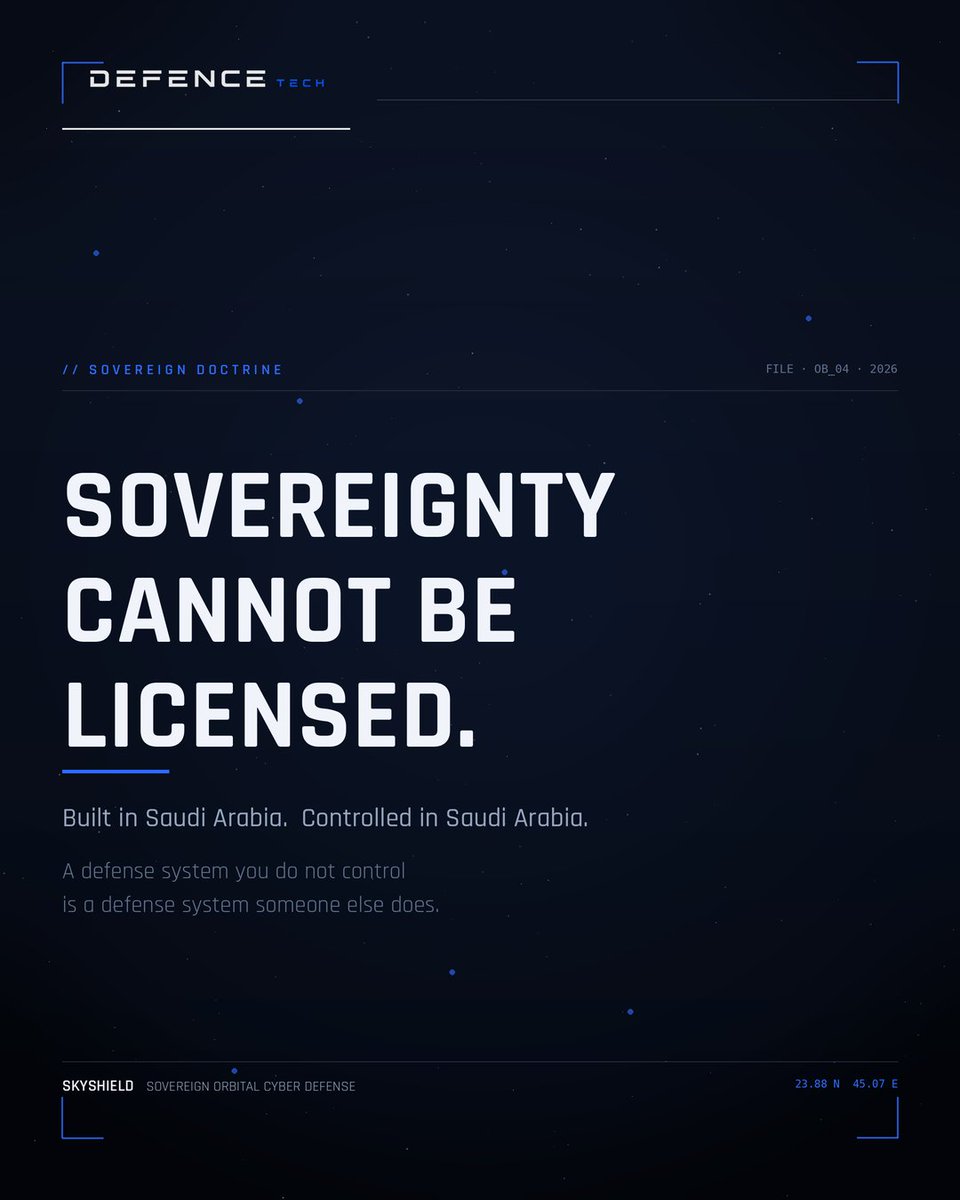
A foreign framework can be licensed in weeks. Sovereignty cannot.
When Defence Tech began building SkyShield, the faster path was obvious: license an established foreign cyber-defense framework, deploy it across national satellite infrastructure, and move on.
Our founder rejected it.
The reasoning was operational, not symbolic. A defense system you do not control is a defense system someone else does. Every foreign dependency inside a sovereign space architecture is a switch held in another capital — a kill condition written into the supply chain before the first threat ever appears.
So SkyShield was built inside the Kingdom. Air-gapped. Sovereign by design. Engineered for classified environments where the operator answers to no external vendor, license, or jurisdiction.
This is not national preference. It is threat modeling.
The systems that protect a nation's orbital assets cannot depend on the goodwill of the systems that built them.
Built in Saudi Arabia. Controlled in Saudi Arabia.
#SovereignDefense #SpaceCybersecurity #SaudiArabia #DefenseTech #SkyShield
Saudi Arabia’s space infrastructure is growing rapidly.
Its threat environment is growing faster.
73% of satellite operators report signal anomalies.
Average intrusion detection delay without AI: 14 days.
This is not a technology problem.
It is a sovereignty problem.
Loss of orbital command is not
a technical event.
It is a national security event.
SkyShield operates in that environment.
#SkyShield#SpaceSecurity#CyberDefense
SkyShield was built for this environment.
— Behavioral AI detection
— Autonomous containment
— Air-gapped deployment
— Zero foreign dependency
— No data leaves Saudi borders