“A pass should aim to create a solution for your teammate, not a problem.
The details behind the pass are what separate players who think from those who simply pass the ball.
Football is about problem solving, and those who don’t train this way often end up creating problems instead.”
��� Roberto De Zerbi
Coaches who obsess with:
- Details
- Innovation
- Simplicity
- Connection
- Learning
Are GUARANTEED to succeed.
Conversely, coaches who obsess with:
- Outcomes
- Appearance
Will ALWAYS have an excuse, be forced to make a change, or quit.
PROCESS > RESULTS
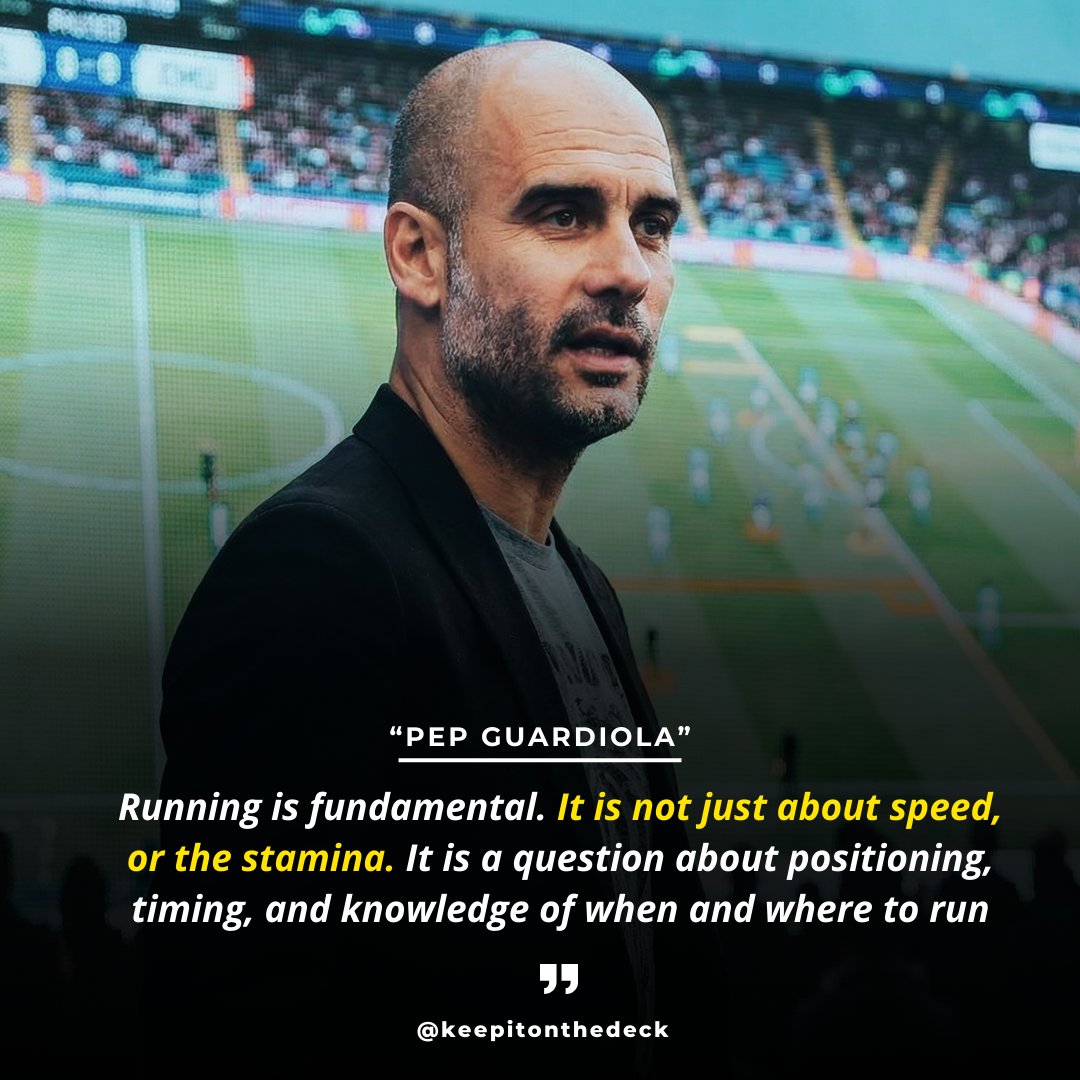
Pep Guardiola doesn’t train runners. He trains thinkers.
Running in his teams isn’t about speed or stamina, it’s about meaning.
Quote: "Running is fundamental. It is not just about speed, or the stamina. It is a question about positioning, timing, and knowledge of when and where to run"
Via BBC Sport
Be careful with videos titled:
“Why the 4-3-3 is special”
“Tuchel’s 3-4-3 broke football”
“The perfect formation”
Here’s the truth: no formation is special. 🧵
Intensity in high performance sport is a funny thing…
You’d think it would be something you can control. The reality is somewhat more complex. Somewhat more nuanced.
Intensity can be considered in two joined-up ways…
-physical intensity
-mental intensity
I can’t speak to physical intensity, but I certainly can to mental intensity. It’s devilishly difficult to optimise and get right.
Mental intensity is engagement, specifically, engagement in the game. It’s alertness (a psychological quality) and readiness (more a psycho-behavioural quality).
“I’m alert for the dangers and the opportunities. I’m ready to deal with the dangers and exploit the opportunities”
Here’s the thing - when you consider the above, mental intensity requires game knowledge and game intelligence. If I don’t know what I’m doing (for example, I don’t know the game plan or my responsibilities in my role) then I’m not going to be as alert and ready to respond to every given situation. And if I lack the ability to process information as it arises at speed during a game and recognise patterns that tend to emerge during a game (game intelligence) then my mental intensity will be lower.
Mental intensity is engagement (alertness and readiness) that is influenced by understanding, meaning, intelligence, and knowledge.
This is why it’s so important for players to be students of the game and students of their game. It’s why it’s so important for coaches to engage in optimal pedagogical processes and practices that help players establish understanding and meaning, and develop intelligence and knowledge.
Mental intensity is complex and nuanced. It’s deeper than people might think and it’s broader than players might consider.
It’s more controllable than outcomes, but it’s not completely controllable. It requires outstanding coaching to be develop and improved upon.
"The idea is very simple. Football is about creating superiority around the ball, numerical, positional, through movement, through individual quality. There are many ways to do it. When we control those aspects, we control the game."
- Luis Enrique (PSG Press Conference)
Today I reached my limit.
❌ Not because of the game.
❌ Not because of a mistake.
❌ But because of the nonstop voices coming from the touchline.
I kept hearing:
“Press him.”
“Pass it.”
“Shoot.”
“Turn.”
“Get wider.”
“Drop.”
Every action I made already had an instruction attached to it, before I’d even thought for myself.
◍ I’m trying to play, but I can’t.
◍ I’m trying to make decisions, but yours arrive before mine.
◍ I’m trying to focus, but I keep looking over, checking if you’re annoyed, disappointed, or waiting to shout again.
⇢ I’m only a young player, still learning.
⇢ I want to hear my coach.
⇢ I want to understand the game.
⇢ I want to trust my own eyes.
⇢ I want to make decisions and learn from them.
But when the sideline becomes a second coach, louder, harsher, more impatient, I stop learning.
❌ I stop thinking.
❌ I stop enjoying it.
And then the questions start:
⇨ Why do adults think their constant instructions help?
⇨ Why do they talk as if they’re in the game with me?
⇨ Why am I worried more about upsetting them than doing the right thing?
Football shouldn’t feel like a test I’m failing in real time. It shouldn’t feel like I’m being judged for every decision I don’t make because you’ve already shouted the one you want.
Here’s what nobody admits:
🔴 Children don’t struggle because they can’t think.
🔴 They struggle because adults don’t let them.
☉ Decision-making comes from freedom, not fear.
☉ Awareness grows from playing, not from being shouted at.
☉ Confidence builds from trying things, not from being corrected every five seconds.
I’m playing the game.
I see what you can’t see.
I feel the pressure you don’t feel.
I’m learning in real time.
All I’m asking for is space to think, to breathe, to grow.
If you want to help me, let me play.
Let my coach guide me.
Let my mistakes teach me.
Let the game speak.
Because when the noise stops, the learning starts.
𝐓𝐡𝐞 𝐧𝐮𝐭𝐫𝐢𝐭𝐢𝐨𝐧 𝐨𝐟 𝐁𝐚𝐲𝐞𝐫𝐧 𝐌𝐮𝐧𝐢𝐜𝐡'𝐬 𝐩𝐥𝐚𝐲𝐞𝐫𝐬
In professional football, we talk about tactics, fitness, mentality, but rarely about the factor that shapes every sprint, every recovery, every matchday: nutrition.
FC Bayern’s Head of Nutrition, Melf Carstensen, shows how modern performance eating really works and why his simple question “What feels good for me?” matters more than any strict diet rulebook.
🍽️ 1. Food First: Quality Over Supplements
Carstensen follows one core principle: “Food first.”
Before powders, shakes or pills come into play, the foundation is:
• fresh ingredients
• high-quality whole foods
• smart preparation
• and great taste
Together with Bayern’s chefs, Stefan and Jonny, he turns nutritional science into meals that are both powerful and enjoyable. Because performance nutrition isn’t just about function, it must also be delicious.
🔄 2. Periodisation – Eating According to the Training Load
Just like training varies each day, nutrition must vary too.
Carstensen works with clear nutrition periods:
• High-intensity training: increased carbohydrates
• Matchday –1: filling up glycogen stores
• Matchday: light, quick energy
• Post-match: recovery, rehydration, anti-inflammation
Low-load days: balanced, varied nutrition
Football keeps getting faster and more physically demanding — and nutrition must adapt to that reality.
🌈 3. “Eat the Rainbow” – A Simple, Powerful Immune Booster
One of Carstensen’s favorite concepts: Eat the rainbow.
Why?
Because each color brings different plant compounds that support:
immune strength
• gut health
• recovery
• inflammation control
• overall energy
His everyday rule:
➡️ The more colors on your plate, the better you feel.
Add fruits + yogurt and you get vitamins, probiotics, and a strong defence system in one simple combo.
🔁 4. Rituals Build Routine and Routine Builds Performance
Before every match, Bayern players eat almost the same type of meal:
Pasta, rice, milk rice, toast with honey or jam, and beetroot juice.
Why always the same?
Because rituals reduce stress, create consistency, and give players a sense of control no matter if they’re at home, away, or at a tournament.
Nutrition becomes part of the mental preparation.
🙌 5. Individual > Universal: One Size Never Fits All
Science gives guidelines, but every athlete is unique.
Carstensen’s philosophy:
• What feels good for me?
• What can I digest well?
• How do I get the same nutrients in a form I enjoy?
If a player doesn’t like apples, they get the same nutrients from something else.
Nutrition must be personal, practical, and enjoyable.
🧊 6. Recovery Fuel: What the Body Needs After a Match
After a game, the goals are: rest, recovery, rehydration, and reducing inflammation.
Carstensen’s go-to mix:
• Berries (fresh or frozen)
• Milk, Skyr, or Greek yoghurt → protein
• Oats → carbohydrates
• Nuts → omega-3 fats
• Sour cherries → strong anti-inflammatory effect
Blend it into a smoothie and you’ve got a Bayern-level recovery shake.
🏆 7. What Amateur Athletes Can Learn
Carstensen’s approach is surprisingly easy to apply at any level.
✔️ Before a hard session or match:
• Rice, pasta, toast with honey
• Low fibre
• Fast energy sources
• Beetroot juice optional
✔️ For everyday health:
• Eat many colors
• Choose whole foods
• Stay flexible, not dogmatic
✔️ After sport:
• Rehydrate
• Protein + carbs
• Berries + nuts
• Anti-inflammatory foods
💡 The Takeaway: Nutrition Isn’t a Rulebook, it’s a tool
Melf Carstensen proves that great nutrition isn’t about restriction or perfection.
It’s about smart choices, variety, individual taste and listening to your body.
Eat colorfully, build rituals, stay flexible and you’ll perform better, feel better, and recover faster.
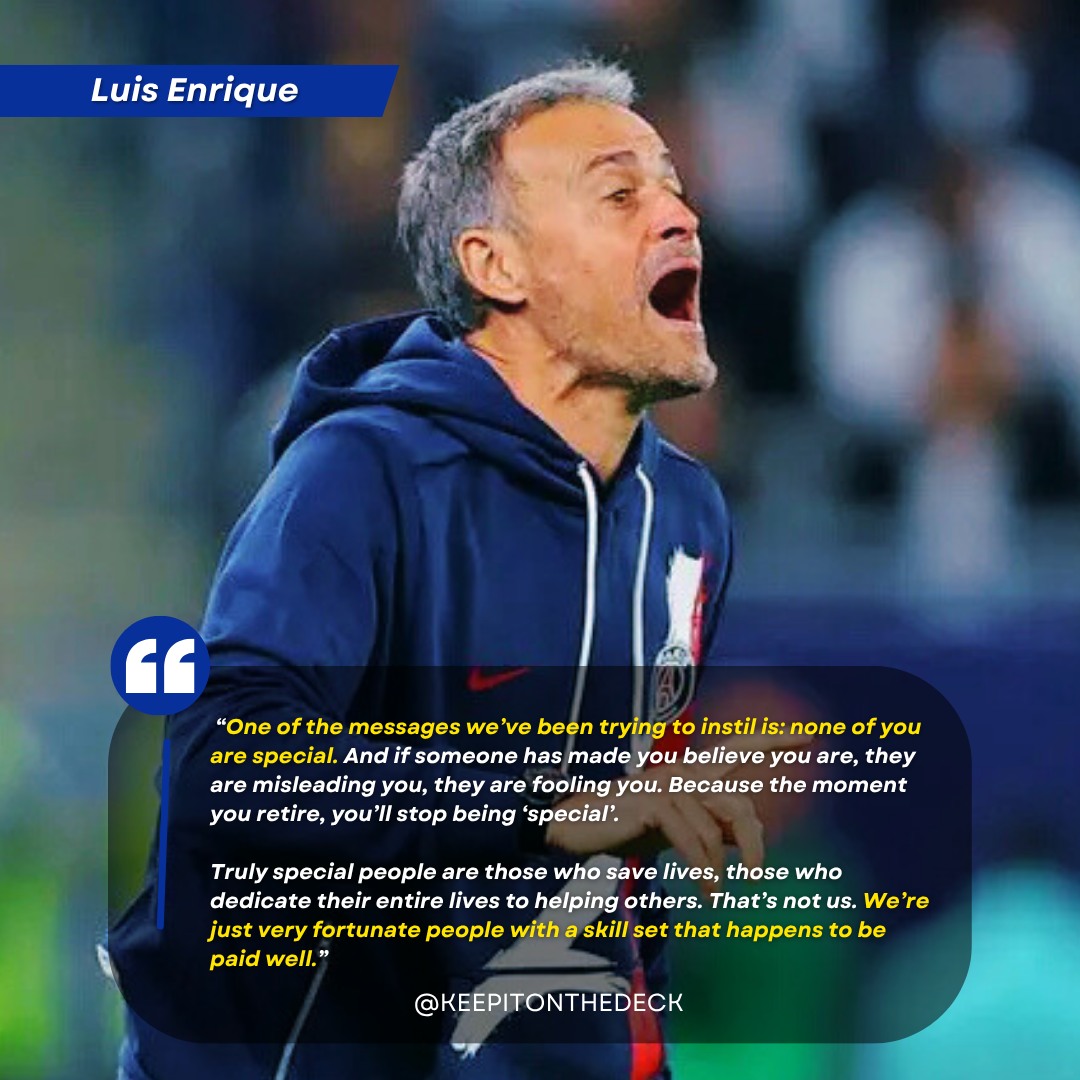
“One of the messages we’ve been trying to instil is: none of you are special. And if someone has made you believe you are, they are misleading you, they are fooling you. Because the moment you retire, you’ll stop being ‘special’.
Truly special people are those who save lives, those who dedicate their entire lives to helping others. That’s not us. We’re just very fortunate people with a skill set that happens to be paid well.”
- Luis Enrique via: You Have No F**** Idea documentary
QUOTE THIS AND READ IT FOR WHOEVER CARES TO LISTEN
A lot of coaches today are educating teams, not individuals.
But it’s the individual who shapes the collective, not the other way around.
That’s why the idea of bringing coaches who specialize in the collective game down to environments where individual development is essential is fundamentally flawed.
Coaches from the senior game often fit that level because they struggle to, or lack the experience required to connect with young players, and with all the individual challenges that come with working with them.
"The great players they have intelligence. If they don't develop their intelligence, they won't be big. You have to do more than run and use your feet"
- Marcelo Bielsa
🇦🇹🗣️ Oliver Glasner: "The system? It must fit the players. There is too much discussion about the system. The system is not important. Habits are important, the patterns and how you want your players to behave on the pitch. That is much more important."
"In my career I have played every single system. got promoted in Austria with a 4-4-2, then we switched to a 3-4-3. In Wolfsburg, we reached the Champions League with a 4-2-3-1. In Frankfurt, they played with three at the back before and it fit the squad."
"I always look at what system might suit the players we have best. My favourite system is 4-4-2 but do we have the right players for this? We are talking much more about our habits than the system. The system is very fluid."
"It's important the players know what we want to do and this is what decides about being successful or not." (Sky Sports)
Quote Source: GQ España Interview
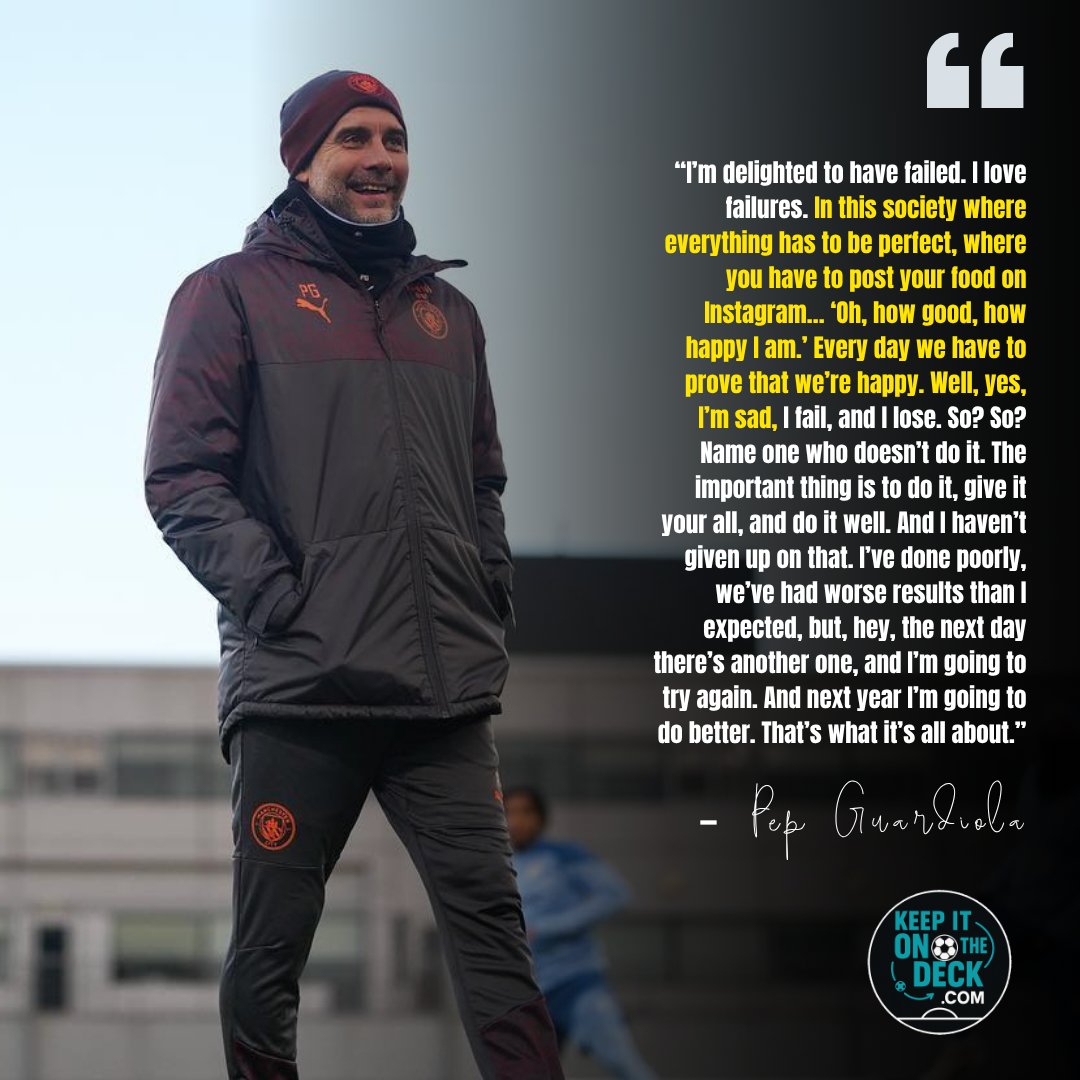
“I’m delighted to have failed. I love failures. In this society where everything has to be perfect, where you have to post your food on Instagram… ‘Oh, how good, how happy I am.’ Every day we have to prove that we’re happy. Well, yes, I���m sad, I fail, and I lose. So? So? Name one who doesn’t do it. The important thing is to do it, give it your all, and do it well. And I haven’t given up on that. I’ve done poorly, we’ve had worse results than I expected, but, hey, the next day there’s another one, and I’m going to try again. And next year I’m going to do better. That’s what it’s all about.”
- Pep Guardiola
“So my advice is, if you want to develop and improve kids, perfect. Work on them, improve their technique, which is the only thing that matters at this age, 13, 14 years old, not the tactics or physical preparation. Don’t specialise a kid for just one role. When a kid plays as a full‑back, he must know the difficulties of playing as a central midfielder or as a striker. Mostly, everyone must play! … Play them in different positions, change them and let them play because they are getting formed.”
- Luis Enrique
Quote Source: FootballHQ Website
🚨 UEFA Pro Thesis – officially released today!
Thank you all for the incredible interest and support. I'm starting the distribution process today!
"Real gold is found inside the penalty area." ⚽🧠📊
Please share and leave your email or message if you'd like to receive a copy.