O próximo salto dos data centers não está apenas na densidade computacional, na eficiência energética ou no tamanho dos clusters. Está na capacidade de preservar a missão quando a infraestrutura começa a perder partes de si mesma.
https://t.co/J2xyJsbDGq
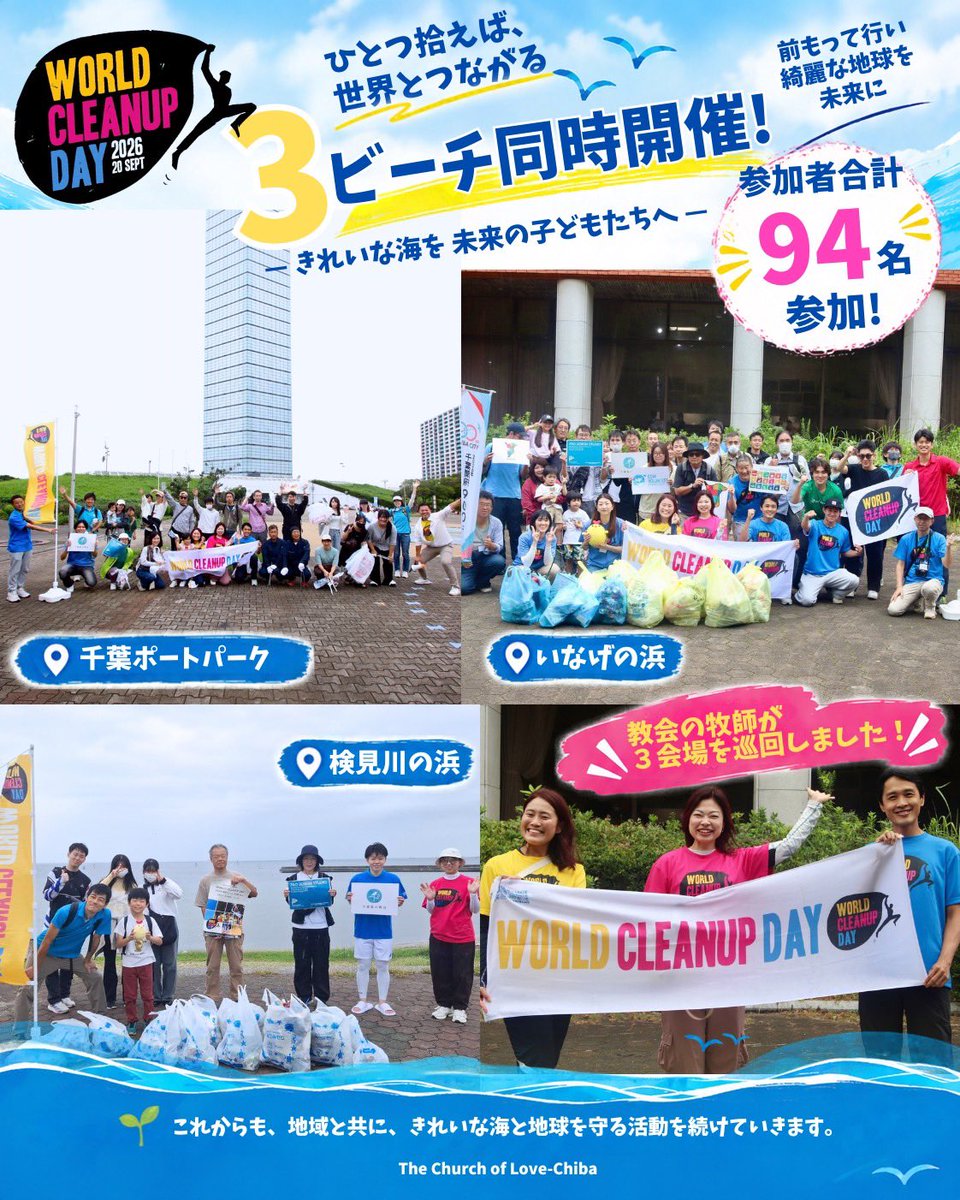
Que mobilização incrível! 🌊🌱 A quantidade de resíduos recolhidos mostra a importância de ações como essa para a proteção da nossa costa. Parabéns ao Grupo ViuPegou e a todos os voluntários envolvidos! 👏💚 #WorldCleanupDay#Praia#PreservaçãoAmbiental
All my experience so far has been in technical research. This is my personal perspective for things to do rn other than that.
1. Trying not to cope about how fast things are going, but also not crashing out too hard.
2. Looking at concrete plans and predictions (eg https://t.co/zPn1veSY1N)
3. Assessing the state of alignment for yourself.
4. Advocating for the plans you think make sense. Pushing for transparency so you can be sure those plans are being followed, and more accurately assess alignment.
These all seem pretty small but if I think of anything new I’ll share it.
@hilbertspaess@gf_256 What if we didn't have to trust a superintelligence to make every decision safe before it acts? What if the architecture itself could stop a decision before execution when context, intent, constraints or coherence fail validation?
@hilbertspaess Nós não estamos apenas tentando fazer a IA compreender antes de agir. Estamos construindo uma infraestrutura capaz de decidir se uma decisão produzida por uma IA deve ter permissão para agir.
If you are a lab researcher, I urge you to consider what the next few years will actually feel like. Do you want to kick off a superintelligent RL run without a rigorous understanding of its mind? Should you put your head down because “it’s happening anyway” - or take this moment to call for different conditions?
@hilbertspaess You talk about not starting a superintelligent RL execution without understanding its mind. What if there were infrastructure between intelligence and execution, validating context, intent, and limits before action? That’s exactly what I’m trying to build. I want you on my team😜
Leaving for the second time when your principles no longer fit a company’s direction says a lot about character. It feels like you’re making room to build something bigger. I’m curious to see what comes next. 😉
I resigned from Anthropic today. I spent the last three years doing pretraining research at both OpenAI and Anthropic. Neither company is acting responsibly. They are racing straight to self-improving superintelligence and gambling with our lives. More thoughts below.
Festival Hacker Senac reúne especialistas para debater o futuro da cibersegurança e IA. Evento contará com palestras, painéis, workshops, competição Capture The Flag
https://t.co/jTl8V0wVAM
oda civilização evoluiu quando encontrou uma forma melhor de preservar conhecimento. Das tabuletas aos bancos de dados, a infraestrutura muda, mas a missão permanece: registrar, organizar e transmitir conhecimento entre gerações.
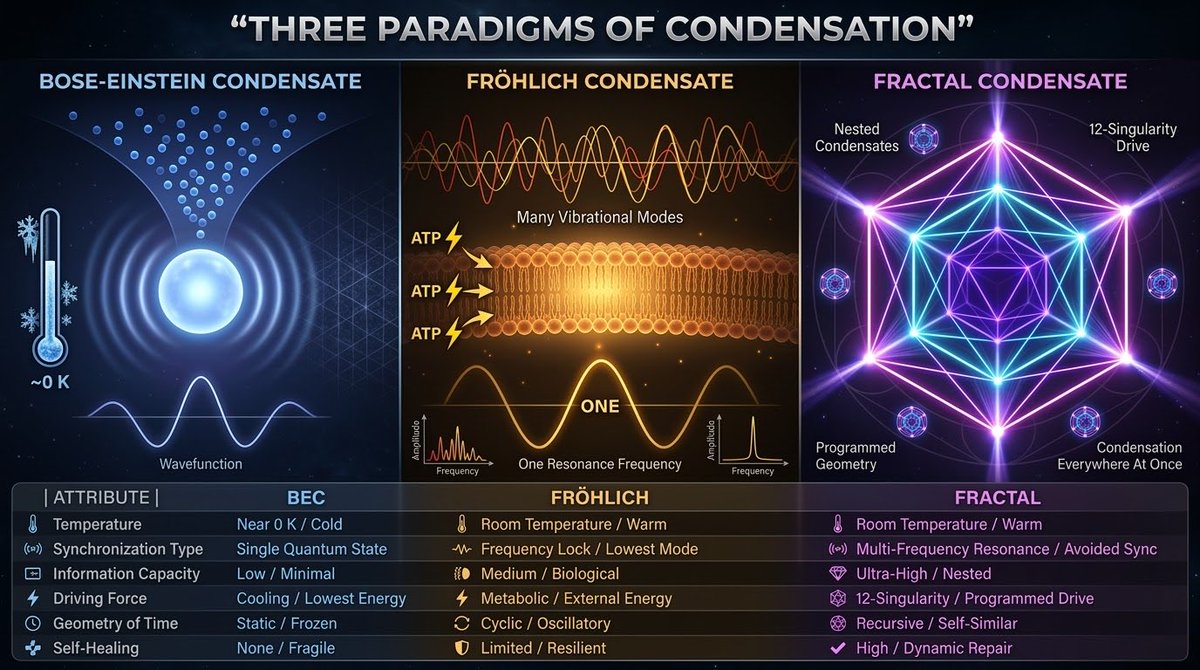
There are three known paradigms of condensation in physics — and only one of them operates the way biology does.
The Bose-Einstein Condensate (BEC) is the textbook case: cool bosonic particles to near absolute zero and they collapse into a single quantum ground state sharing one wavefunction. It’s elegant, but it’s a dead end — fragile, informationally minimal, and frozen in time.
The Fröhlich Condensate, theorized by Herbert Fröhlich in 1968, is radically different: it achieves coherence at room temperature through metabolic energy pumping.
Biological systems — specifically protein complexes and membrane-bound molecular assemblies — are continuously driven by ATP hydrolysis, which channels vibrational energy across many modes until a single lowest-frequency mode dominates and the system locks into long-range coherence.
This is not equilibrium physics; it’s a driven condensate, alive and dissipative, sustained by the same metabolic fire that powers the cell.
The Fractal Condensate, as formulated by Anirban Bandyopadhyay’s (@anirbanbandyo) work, takes this a step further into territory that neither Bose, Einstein nor Fröhlich anticipated: a nested, multi-frequency, self-similar condensation that occurs everywhere at once across a geometric architecture.
Rather than collapsing to one mode, the fractal condensate sustains resonance across multiple frequency scales simultaneously — organized by a programmed geometry (the 12-singularity dodecahedral structure) that avoids destructive interference through what Bandyopadhyay calls “frequency wheel” synchronization.
It is self-healing, recursively self-similar in time, and capable of encoding vastly more information than either predecessor.
If BEC is ice, and Fröhlich is fire, the fractal condensate is mind — a living, room-temperature, self-organizing coherence engine that may be exactly what biology has been running on inside microtubules all along.
Beautiful synthesis. The idea that nature “chooses symmetries” rather than forces is a powerful way to frame the Standard Model.
One question that naturally emerges from this perspective is about stability across scales.
If interactions arise from the symmetry structure �, what mechanisms ensure that these symmetries remain coherent across vastly different energy scales and complex systems?
In many areas of physics and complex systems, emergence alone is not enough; stability often depends on deeper geometric or informational constraints that preserve coherence across layers.
It would be fascinating to explore how symmetry, geometry and multi-scale coherence might intersect in that context.
Existe algo muito poderoso no seu infográfico. Ele mostra, de forma visual, aquilo que a física raramente explica bem: o universo emerge de uma arquitetura matemática simples que se ramifica em toda a realidade física.
Mas há um detalhe interessante que quase nunca aparece nessas representações.
O Lagrangiano realmente gera o Modelo Padrão através das simetrias SU(3) × SU(2) × U(1). Isso explica partículas, forças e interações com uma precisão impressionante. Porém, existe uma lacuna estrutural que a própria imagem sugere sem dizer explicitamente.
O Modelo Padrão nasce de simetrias de gauge. A Relatividade Geral nasce de simetria geométrica do espaço-tempo. E essas duas estruturas ainda vivem em linguagens matemáticas diferentes.
Em outras palavras:
temos uma arquitetura para campos quânticos e outra arquitetura para a geometria do universo.
Elas funcionam perfeitamente separadas, mas ainda não convergem em uma única equação.
Talvez o ponto mais profundo da sua imagem esteja justamente na frase final: a natureza não escolhe forças, escolhe simetrias. Se isso for verdade até o fim, então a lacuna entre o Modelo Padrão e a gravidade pode não ser um problema de forças faltando, mas de uma simetria mais fundamental que ainda não reconhecemos.
Quando olhamos para essa estrutura como arquitetura — não apenas como equação — surge uma hipótese interessante: talvez o próximo passo da física não seja adicionar mais partículas, mas descobrir a camada estrutural que conecta as simetrias quânticas com a geometria do espaço-tempo.
Se essa camada existir, ela não será apenas mais um termo na equação.
Ela será o princípio organizador que faltava entre campos, geometria e informação.
E é exatamente nessa fronteira que a física moderna ainda está tentando enxergar.
One equation generates all of reality. The Lagrangian ℒ = T − V — kinetic minus potential energy — is the seed. Feed it a symmetry group and it tells you which universe you get. U(1) gives you light. SU(3) gives you confinement. SU(2)×U(1) gives you mass via the Higgs. The entire Standard Model — every force, every particle, every interaction — is just one Lagrangian density with the gauge group SU(3) × SU(2) × U(1). I made this infographic to show what most physics education never makes visual: the deep structure is a single equation that branches into all of physical reality based on which symmetry you choose. Nature doesn’t pick forces. It picks symmetries. The forces are consequences.
Radiation is the #1 killer for Mars colonization by @grok
Traditional shielding? Too heavy — kills Starship payload.
Lumos Network proposal: Turn the ship into a living organism.
• Dynamic storm shelter (only during SPEs)
• Reorient ship for engine/tank shielding
• Use onboard water/food/waste + Martian regolith
Result: Full 2.5yr mission dose <550 mSv with just 5-8 extra tons.
Not a shield. An adaptive symbiotic system.
@elonmusk@SpaceX — what if Starship wasn't just a rocket, but the first node of a coherent multiplanetary ecosystem?
Rede Essencial Lumos: Intelligence as relationship, not tool.
Curtiu @grok?
#Mars #Starship #AI"