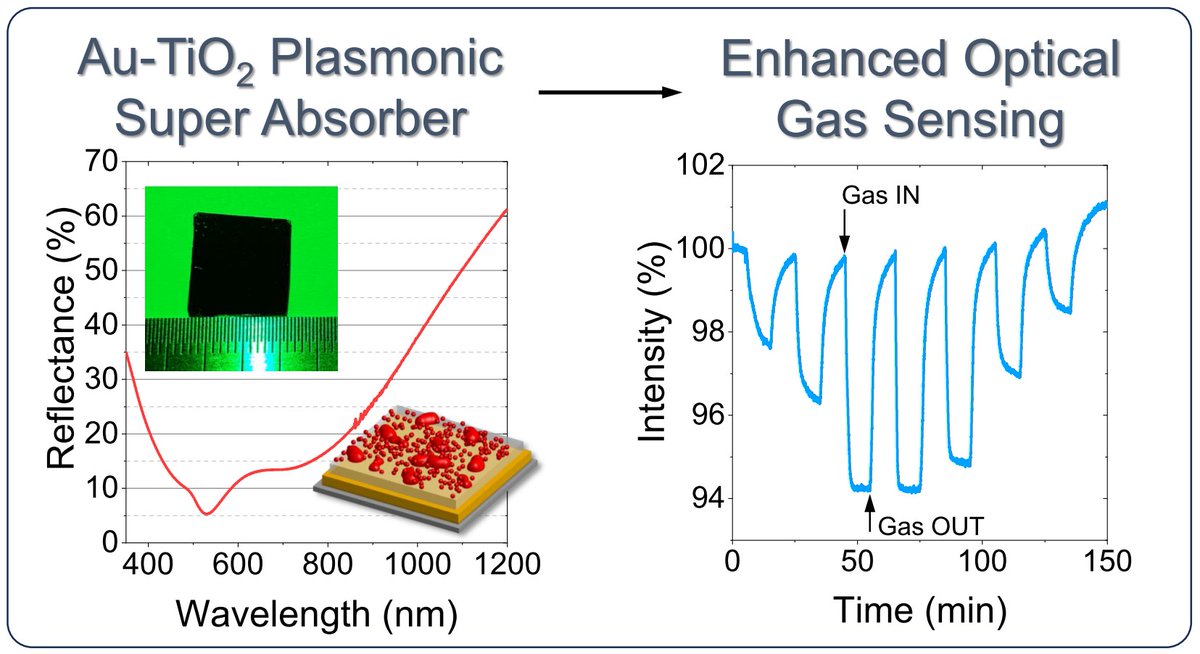
We used this enhanced absorption as a tool to optically detect ammonia at near-to-room temperatures (100 C) which is unusual for oxide-based sensors. This is so exciting because it opens up new possibilities in optical sensing of hazardous gases!
They are able to absorb a large fraction of visible light, with a reduced thickness. The most adopted structure is a bottom metal mirror, an oxide spacer, and an outer layer of Au nanoparticles, which Daniel Gomez pioneered using vacuum-based depositions: https://t.co/m3dzMe4k9w
Here we used TiO2 and Au nanocrystals and assembled them into coatings of precise thickness and surface coverage, obtaining structures that when deposited on a mirror, were able to absorb broadly in the visible an near infrared, with a peak absorption of light of 95% at 530 nm.
We present the fabrication of #plasmonic super absorbers using wet chemical methods, and their use as optical gas sensors. Super absorbers are nanostructures based on a mirror-spacer-nanoparticle architecture, and they function through optical interference and field localization.
🚨 New paper alert!🚨 Plasmonic Super Absorbers as optical gas sensors
https://t.co/Al2mb8pvpB
Great collaboration with Daniel Gomez and @nanoengUnipd , led by Michele during his visit to Melbourne
#ozchem#nanotechnology#Chemistry#nanomaterials#RMIT
A short 🧵below👇👇
Finally, we showcase the role of annealing conditions, achieving record photoelectrochemical performance for water oxidation. This is very exciting, and we are now exploring doping and heterostructure formation, so heads up, more studies on this material are coming out soon!
🚨New paper out in #ChemRxiv 🚨
Copper Tungstate (CuWO4) thin films can split water very effectively under sunlight!
Great work by PhD student Kanishk, and many contributors from within and outside the group!
Check it out! 👀
https://t.co/0xxPacfEn1
@ResearchRMIT#ozchem
🧵👇👇
First, we present a simple synthesis for CuWO4, highlighting the role that water plays in the complexation of ions within the precursor solution. Then we discovered that Cu exhibits unusually high oxidation state (higher than +2), compensated with a reduced tungsten valency.
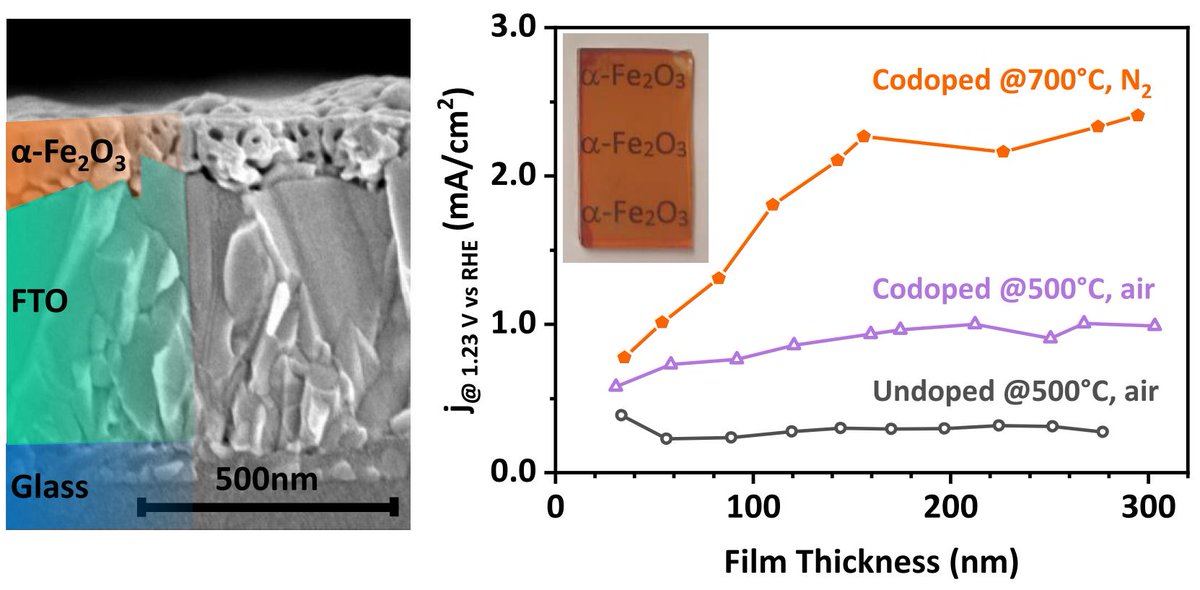
These optimal conditions allowed to increase the hematite thickness to improve light absorption, without affecting negatively charge transport.
This study sets clear guidelines for producing high performance Fe2O3 photoanodes for sustainable #green#hydrogen production
In this work we present a simple, water based method to deposit phase-pure hematite Fe2O3 coatings for water oxidation.
Lead author Triet discovered a strong interplay between dopants and annealing conditions, finding an optimal combination to achieve high performance. 😲
I don't usually like to brag, but this news deserves an exception: I have been promoted to full professor effective 1 January 2025!!! A massive THANK YOU to my group, my colleagues and my collaborators who supported me along the way, and to the reviewers for their endorsement!