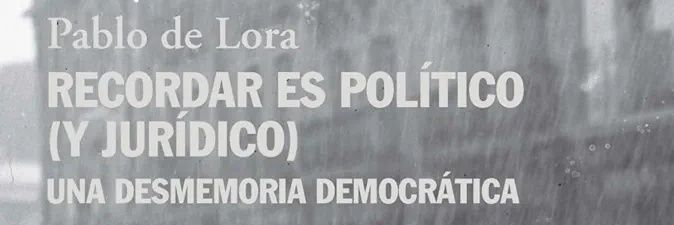
El 23 de mayo sale a la venta. En preventa en Amazon.
Un libro sobre los olvidos familiares, la memoria personal y colectiva en la Transición y la legislación memorialista.
Recordar es político (y jurídico): Una desmemoria democrática (Alianza Ensayo) https://t.co/onEjOrNRlC
No dejen, por favor, de dedicar un par de minutos a revisar el programa de este evento académico que se celebrará en la Universidad de Granada a partir del 25 de enero. Encontrarán:
- Cien horas con certificación conjunta UGR–UNL, en ocho jornadas presenciales: del 25 al 28 de enero y del 1 al 4 de febrero.
- Referentes iberoamericanos de la decisión judicial: Andrés Ibáñez, Danilo Rojas, Manuel Atienza, Marina Gascón, García Amado, Diaz Revorio, Rodolfo Vigo, Marisol Peña y muchos más. Hasta treinta ponentes, doce conferencias magistrales y ocho mesas de debate para discutir cómo se decide, cómo se motiva y cómo se limita el poder de quienes juzgamos.
- Garantizamos además contacto personal entre organizadores, ponentes y participantes, para un enriquecimiento mayor y para poder discutir en un marco informal de los temas tratados en las sesiones académicas.
- También se pueden presentar trabajos propios, hay visita al Tribunal Superior de Justicia de Andalucía y programa cultural paralelo, con visita nocturna a la Alhambra entre otras propuestas.
Será una ocasión única para formarse, capacitarse, entablar contactos profesionales y personales y pasarlo bien.
Abierto plazo de inscripción. Más información en
https://t.co/rs6XeZUS3b
A mathematician begins reading the 250,000-page proof of the Riemann hypothesis.
“What’s the main proof technique?” a colleague asks.
“Proof by exhaustion.”
“Of all possible cases?”
“No. Of all possible readers.”
WTF is the Riemann Hypothesis, and why should any of us care?
Anthropic solved what we couldn't crack for 167 years.
Lemme explain it with Google Maps 😝
You know how Maps says you'll reach somewhere in 25 mins, but you actually take 32?
The prediction was off by 7 mins.
Now imagine trying to prove just how far off a prediction could ever be.
That's roughly the idea behind the Riemann Hypothesis.
Except instead of travel time, we're talking about prime numbers.
2, 3, 5, 7, 11, 13...
These numbers appear in an irregular pattern.
There are 25 primes between 1 and 100.
But how many exist below a number with 100 digits?
Mathematicians have formulas to estimate that.
The Riemann Hypothesis predicts just how accurately we can estimate the number of primes below any given number.
More precisely, it puts a surprisingly tight theoretical limit on how far those estimates can be from the actual count.
Nobody has managed to establish a proof since 1859.
Now here's why it matters.
A LOT of mathematical results come with a catch:
"This is true IF the Riemann Hypothesis is true."
Proving it would remove that "IF" from a huge body of mathematical research.
Think of a massive codebase where an important function is used everywhere, but nobody has proved it always works as expected.
That's what this is like for mathematicians.
It would give us stronger guarantees about prime numbers, which are fundamental to number theory and have important connections to computing, algorithms and cryptography.
Does that mean your passwords become unhackable or your phone gets faster tomorrow?
Nope.
But here's where the story gets REALLY interesting 🔥
Most of us use AI to do things humans already know how to do.
Write code. Fix bugs. Summarize PDFs.
But what if AI starts helping us discover things humans DON'T know yet?
Imagine a scientist spending 10 years stuck on a problem.
What if AI helps them make a breakthrough in months? 🤯
Or helps researchers discover promising drugs, better battery materials, or more efficient algorithms?
Not because the Riemann Hypothesis directly unlocks any of these.
But because AI that can help crack genuinely hard problems could accelerate scientific discovery.
That could mean better treatments, cheaper technology, and breakthroughs that improve our lives sooner.
Think about the shift:
AI helping us do things faster → AI helping us discover things nobody knew before.
The internet gave us access to information.
Google helped us find it.
AI could help us create NEW knowledge.
Of course, the claimed proof still needs independent verification. It hasn't yet been established as a valid solution.
But if it holds up, this isn't just about solving a 167-year-old math mystery.
It's about AI helping humans push the boundaries of what we know.
And THAT'S the part I find crazy.
If AI can help crack problems we've been stuck on for generations, how many things we think are impossible today might become possible in our lifetime? 😭
Fucking excited for THIS future.
Es probablemente uno de los hitos de la historia de la humanidad. Y, de nuevo, la (inhumana) prueba y su verificación la pueden entender y confirmar algunos, muy pocos, seres humanos. No parece un acto de fe depositada en un Dios dual (IA+Lean) inefable. Sobrecoge y fascina.
It’s all over but the shouting. In the span of a single day that will echo through mathematics history, the solution to math’s hardest problem was announced—and then independently verified.
https://t.co/ZyKOawr8t7
Hay desigualdades que existirían incluso sin capitalismo ni patriarcado y que también merecen nuestra atención. Sobre estas y otras cuestiones hablé con @lhermoso en @24horas_rne, entrevista completa abajo.
¿Necesitado de una desconexión neuronal cuando aún resta casi una semana de campaña? Le propongo pensar sobre los miedos y algunos desafíos éticos que suscitan las llamadas neurotecnologias.
https://t.co/JtczwsxrNC vía @TheObjective_es
Por lo que entiendo de la mayoría de los análisis, la misión de Sánchez habría sido equivalente a un Mike Tyson encomendado a hacer el ejercicio de cinta en gimnasia rítmica.
Caballo de Gish, Firehose of Falsehoods, Shit of Bull, Candy Crush Chuche, Hand of Mandobles, Victory by elegance, San Vito's dance, Refutation by Face Blushing...La politología contemporánea hará un gran servicio si edita un Diccionario de Estrategias en Postdebates Electorales.