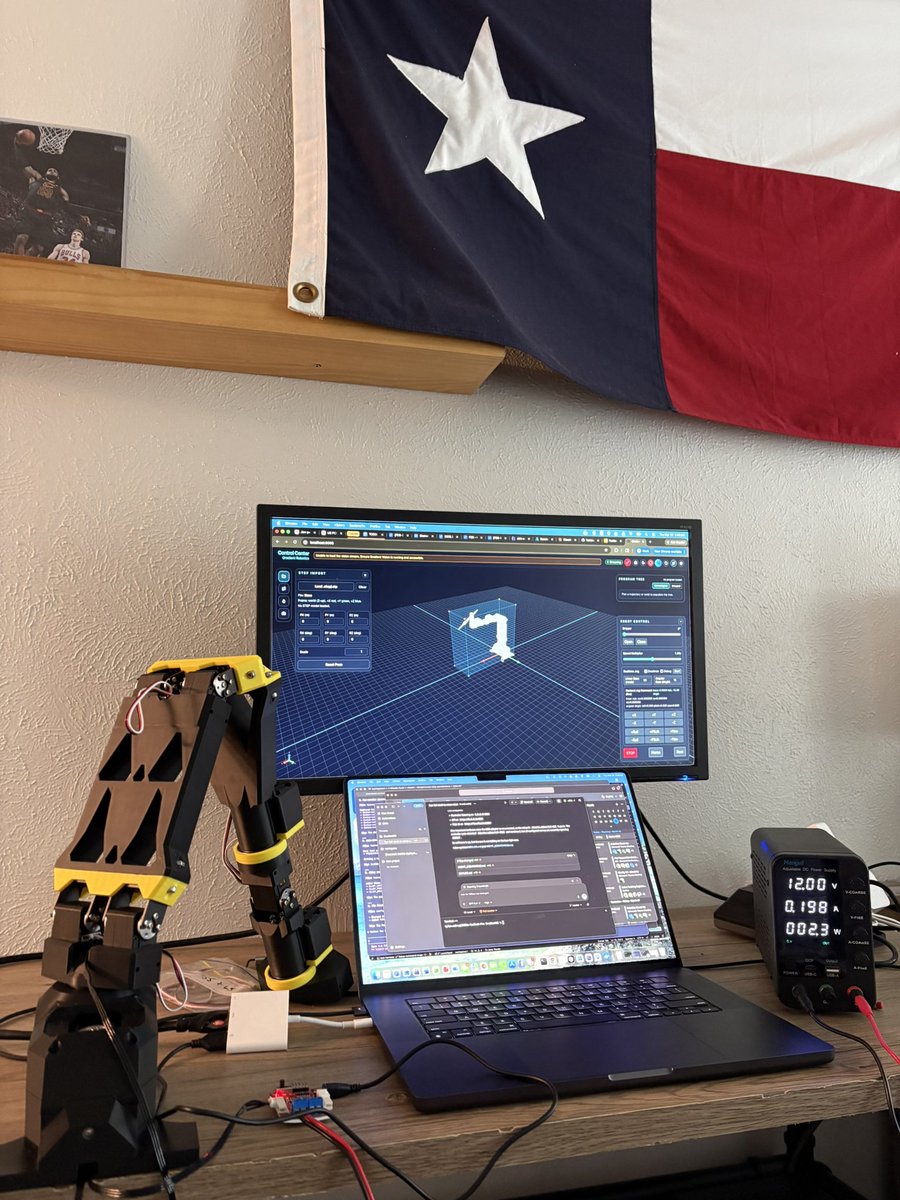
Progress
- Forked @dirtman 's GradientOS and built out a teleoperation setup using iOS ARKit -> IKFast
- Now testing different IK solver's/jog loops to try and get a better control feeling, I want the bot to be as responsive as possible; learning a ton!
Demo should be out soon
Got teleoperation working using ARKit on my iPhone, there's something funky with the IK solver so not sure I can confidently fold a t-shirt yet but working towards it
@jasonc_nc@YIMBYLAND I just mean to say that Will shouldn't counter signal Pratt's message, which to me reads much more as "hey we should build, but build with eyes toward the aesthetically beautiful" not as "we should engage in Actual Real Nimbyism"
I was researching the Weches Formation today and Lone Star Steel Company. Where I come from in East Texas you can see the limonite all over the place on the surface, the damn dirt is red!
What would it take to get that place up an running again? They were fully integrated as I understand it: owned the whole process from mining -> smelting -> refining the pig iron -> casting and rolling the steel into pipe, tubing
I’m about halfway through - the first couple chapters are about how to excel in a technical field and were what I was expecting and hoping for. As it progresses though it starts sperging out into very interesting use of calculus/ trig/ geometry to do back of the napkin math to figure out random questions like the growth of technical knowledge in a given field over time and the local optimum in a design space as dimensions/parameters increase in number or magnitude. This is one of the most compelling yet tedious parts of the book imo, especially for someone who was not expecting to see textbook style formula/equation breakdowns which last for several pages including figures and charts. I’m hoping it will return to form as the book progresses but a quick glance tells me I’m in for more textbook style math breakdowns.
For someone who hasn’t really engaged with pure math for many years and can only vaguely recall some concepts that it refers to it can be jarring and feels like, “damn if I knew what this guy was referring to I could see it being more insightful but bc I have no intuition for this math, especially at this level, a lot of it is going in one ear and out the other”
Overall, it has thus far shown to be much less palette-able to a lay audience and is not super succinctly about “learning to learn”. Also a huge caveat that I am only 150 pages in so this is likely an overall misread on the final review. For what it’s worth it has definitely made the impression that getting an intuitive grasp for calculus, trig, geometry and how to apply it in everyday situations can be a super power.
Also Also, super interesting how prescient Hamming is in regards to the future of computing. As you read you have to remind yourself that it is from 1994 because he nails so much about the last 30 years of technological advancement in his predictions. He was even very clued into AI and spends a lot of time on it (multiple chapters).