Building a Cardano dApp shouldn't require babysitting infra.
Demeter gives you managed RPC endpoints that scale with your traffic: pay per request, $0 when idle, same open-source APIs you'd run yourself.
A quick tour 🧵👇
Dolos v1.6 is out 🚀
We've been working hard on supporting more of the Blockfrost API surface. Shoutout to the @blockfrost_io team, who have been contributing these endpoints directly to the Dolos codebase.
What's in it 🧵
I'll stop the pinging, when I'm 67 🎶
To every DRep evaluating proposals and to the community at large: thank you for the support of @txpipe_tools proposals 🙏
Now, back to building. See you in the changelogs.
We've been talking to wallets, explorers, dapps. There's a common theme: we need a way to provide richer context to txs.
Knowing when a tx is a DEX swap, a prediction market bet or a loan from a lending protocol changes everything for UX, security, analytics and DevEx. 🧵
HTTP/JSON wins at simplicity, but if you care about low-latency or high throughput, gRPC makes a huge difference.
- binary serialization (compact & fast)
- HTTP/2 request multiplexing
- schema-driven, less payload
UTxO RPC is a gRPC API for Cardano nodes.
Because it's gRPC, you get something REST APIs can't easily do: server-side streaming.
You open ONE long-lived stream and the node pushes txs to you as they land on chain — a live firehose of every tx. No polling. 🧵
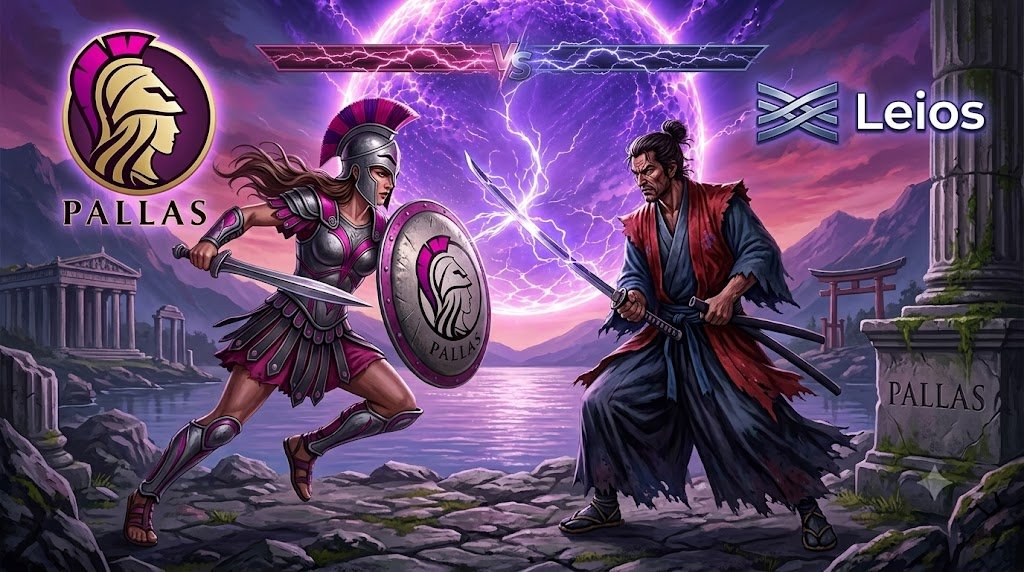
I wanted to learn more about Leios, so I vibe-coded this visualization TUI on top of Pallas.
It's not meant for operations, just a personal visual aid to understand the flow of the protocol. It was quite useful, but it also raised some new questions.
What you can see is an initiator node connected to the Musashi Dojo. The TUI is divided into two horizontal lanes:
- top lane: the Praos part, a sequence of ranking blocks (RBs)
- bottom lane: the Leios part, a sequence of endorser blocks (EBs)
The X-axis represents time, so you see blocks ordered from left to right, representing the sequence of the chain.
The interesting part to notice from the video: the heavy lifting of Leios (votes, tx processing, etc.) happens between RBs, making use of the idle time.
Being a vibe-coded PoC, the TUI uses some heuristics to work around much of the complexity and the current protocol gaps. For example:
- the link between RBs and EBs is estimated using slot proximity
- the votes are just a counter, and the denominator is the peak number of voters seen so far
One question that popped up and I'm still looking into:
the idle time doesn't seem to be enough to observe all the EB votes and download all the txs. This is probably related to data diffusion; maybe client prioritization on the responder side; maybe just bad performance on my code. 🤷
New in Pallas: Leios support 🚀
There's now a way to talk to Cardano's Leios protocol directly, with nothing but Rust 🦀. Ready to run against the live Musashi Dojo.
Here's what you can do with it. 🧵
Given the current week, it felt timely to do a refresher on the details of how Cardano wallet key generation works.
So we double-checked the different specs and summarized what we found in this thread.
From raw randomness to a shareable address 🧵
Tx3 is not a transaction builder, it's a declarative way of representing a transaction.
Describe a tx once as a spec, and via codegen you get the imperative builder in TypeScript, Rust, Go or Python.
Here's the anatomy of that transaction in Tx3. 🧵👇
Most of us interact with Cardano through an indexer or an API.
Let's go one layer down: open a raw socket to a mainnet relay and pull a block straight off the wire — in ~25 lines of Rust with Pallas. 🦀
No node, no indexer. Just you and the protocol. 🧵👇
How much disk does a Cardano data node need?
It depends on what you actually query — and most setups make you pay for full history you'll never read.
Dolos lets you pick. Three storage modes, one node. 🧵
Oura turns the Cardano blockchain into a stream you can pipe anywhere.
Stop wrestling with raw chain data — read it from a node, reshape it, and ship it wherever your app needs it.
A quick tour. 🧵👇
Dolos v1.2.0 is out 🚀
A lightweight Cardano data node with rich query capabilities.
This release brings steady improvements shaped by community feedback.
What's new 🧵
https://t.co/T5tkVZY8r7
We usually describe Dolos as a "Data Node". Although accurate, it's easier to think about it as a DB-Sync alternative.
As with everything, each option has its trade-offs.
Here's a technical comparison between the two. 🧵
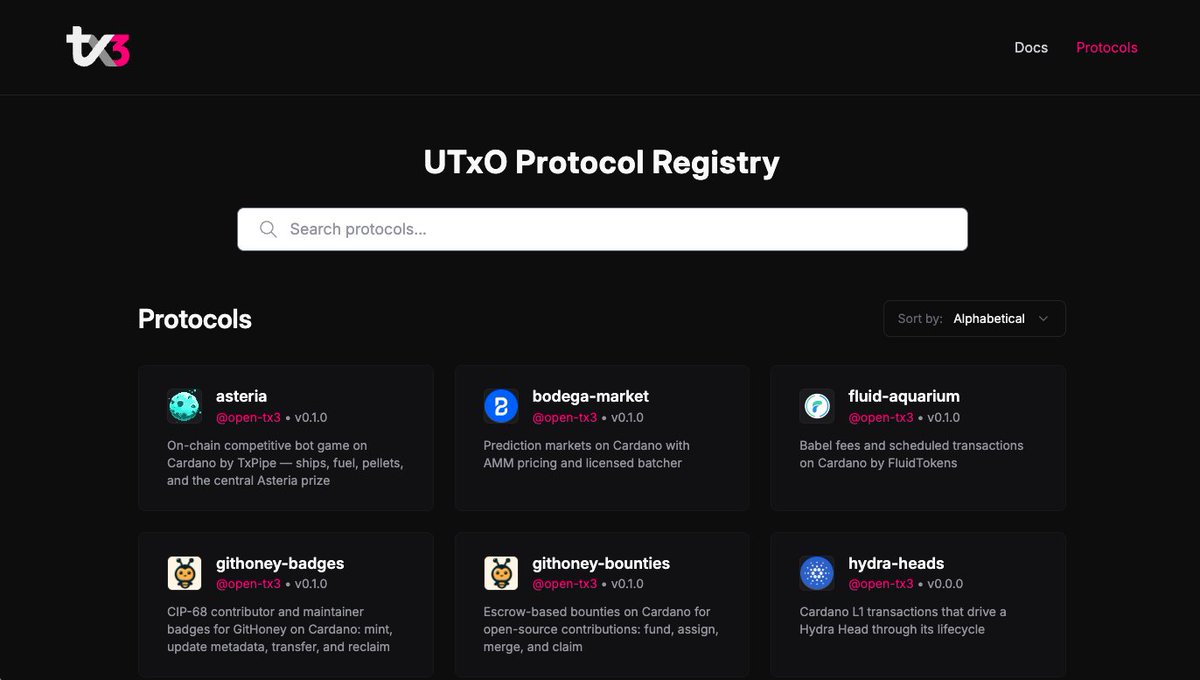
Another protocol in the Tx3 registry to check out: GitHoney Bounties.
GitHoney runs open-source bounties on Cardano: fund a GitHub issue, a contributor gets assigned, and they claim the reward once it's merged.
A quick look 🧵
https://t.co/B3h9qHrDWJ
Another protocol in the Tx3 registry to check out: Strike Staking.
@strikeperps is a decentralized derivatives platform. STRIKE is its governance token, and you can stake it on Cardano to earn a cut of trading fees.
A quick look at the protocol 🧵
https://t.co/jpoiFOQb7W
Tx3's value proposition is simple: let devs interact with UTxO protocols as if they were simple APIs.
Let's take a look at a concrete example.
Let's integrate calls to @BodegaCardano. 🧵👇