🚨NEW: The Kennedy Family, led by Former Rep. Joe Kennedy (D-MA), is suing to block Trump’s triumphal arch, claiming it would cast a shadow over JFK’s grave.
RETWEET if you stand with @JoeKennedy against Donald Trump!
Trump said that he’d pay every American $5,000 if his party won the midterms.
Somehow, the government had the money for that, but not enough to keep our airplanes in the sky.
Do I have that right?
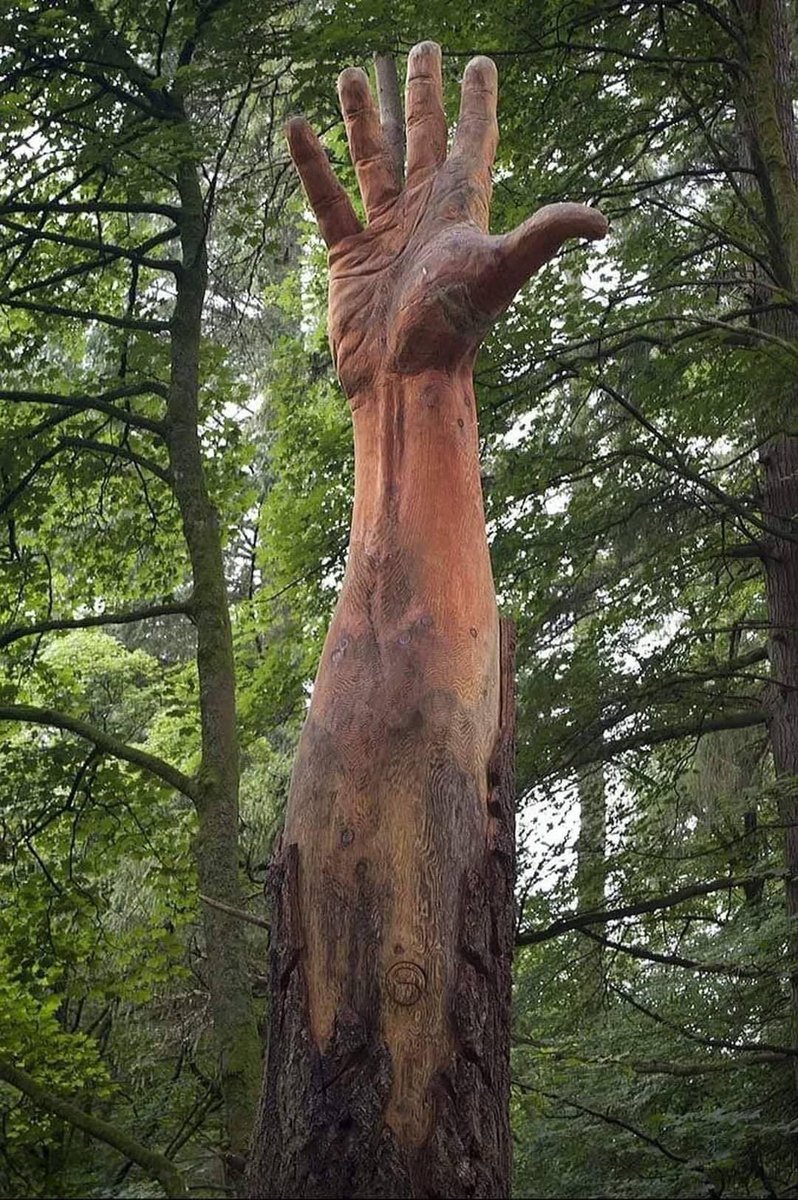
The tallest tree in Wales got damaged by a storm and was supposed to be cut down, instead chainsaw artist Simon O'Rourke found a better solution to symbolise the tree's last attempt to reach the sky.
Every instinct in a cat's body says that a squirrel is prey. This cat became their nursery.
Read that again, because the whole story lives inside it.
Millions of years of evolution went into sharpening a cat for one kind of moment: something small, quick and warm breaks cover, and the cat's body answers before the cat has time to decide anything. The freeze. The coil. The explosion. A squirrel is not a random animal in that equation. A squirrel is exactly the kind of creature the equation was written for.
So when a man who works with trees ended up with baby squirrels and a household cat under the same roof, there was a version of this story that anyone who has ever owned a cat could have predicted. It is the cautious version. It is the version where the humans spend their days closing doors, building barriers and listening to the next room.
That is not the version that happened.
What did happen is harder to explain, and it is the reason I keep coming back to it. I am not going to walk you through how it unfolded. The caption on the clip stops mid-sentence on purpose, and I think the clip earns that. What I can do is tell you why the situation is stranger than it looks, why it matters more than a sweet headline suggests, and what question it left sitting in my chest after I closed the app.
Start with the squirrels.
A newborn tree squirrel is about the most unfinished thing a mammal can be. No fur. Eyes sealed shut. Ears sealed shut. Almost no ability to hold its own body heat. It is not a small adult. It is closer to a sketch of an animal that has not yet been inked in, and for the first weeks of its life the entire survival plan is a single instruction handed to someone else: keep me warm, keep me fed, and do not leave.
Warmth is the part people underestimate. A baby that cannot regulate its temperature does not need comfort the way we use the word. It needs a heat source the way a fire needs air. Cold does not hurt them slowly and politely. It takes away appetite, strength and the ability to ask for help, all at once, and asking is the only tool they have.
That is the first layer of the stakes. These are lives with almost no margin. Every hour is a bet placed by someone else on their behalf.
Now the second layer.
The man. He is described as a lumberjack, and I want you to notice how that word sits next to the word "rescued." His line of work is the business of bringing very large living things down to the ground. It is loud, physical and not famous for tenderness. Nobody cuts a trailer around a chainsaw and promises the soft part is coming. And yet this is a person who looked at something that fits in a closed hand and decided it was worth the trouble.
I don't know what he was thinking in that moment, and I won't pretend to. The clip doesn't hand me his reasons, so I'm not going to invent them. But I know what the decision costs, because anyone who has ever taken in a creature that cannot speak knows it. It costs sleep. It costs a schedule. It costs you the ability to say "not my problem" about that particular life ever again.
Rescue is not an event. It is a debt that begins the second you say yes.
And here is where it gets interesting, because a person can take on that debt and still be only one pair of hands. A baby squirrel does not need one thing. It needs warmth around the clock, company, patience, interruptions at hours when nobody wants to be interrupted. One human cannot be a furnace. One human has to sleep, go to work, and occasionally be somewhere else.
So who covers the shifts?
I'll let that question sit, because the answer is not what anyone in the house would have signed up for.
There is a particular kind of silence that falls over a room when a predator and its natural prey are in the same space and nothing happens. Anyone who has lived with a cat knows it. You hold your breath. You watch the tail. You calculate how fast you can cross the floor.
Now imagine that silence stretching on. Not for a minute. Not for an afternoon. Imagine it turning into a routine.
This is the part of the story that I find hard to file anywhere. Cats are not villains in the squirrel's story, and they are not heroes. They are animals running old software. The software is not evil. It is simply very, very old, and it was written in a world where a cat that hesitated went hungry.
For a cat to override that software, something stronger has to be installed on top of it.
Scientists who study mammal parenting point to a cocktail of hormones, oxytocin and prolactin among them, that rewires an animal's priorities around infants. A new mother's brain treats a small, warm, helpless body very differently from how it did a month earlier. Things that used to trigger the chase start triggering the carry, the guard, the lick, the curl-around. The research is about biology, not magic, but when you see the outcome from the outside it is hard to tell the difference.
I should be careful here, because this is exactly the point where people start writing fairy tales. I don't know what that cat felt. Nobody does. I'm not going to tell you she "knew" she was saving a life, or that she "chose" kindness in the way a person might, because that would be me narrating a mind I have no window into. What I can say is that something in her went in a direction that nobody would have bet on, and the direction held.
That is already a lot.
There is a long, odd tradition of animals mothering the wrong species. Local news runs the stories every few years: a dog who nurses kittens, a cat who adopts something that has no business in a cat's nest, a hen who sits on a pile of eggs that are not hers. Zoos have deliberately paired orphaned cubs with calm domestic dogs, not because the dogs read the same books as the cubs but because a warm, steady body turns out to be a kind of medicine. Biologists generally treat these stories as a window into how deep the caregiving circuitry runs, and how little it checks paperwork.
But notice what those stories usually have in common. In most of them, the adopted baby poses no threat to the adopter. A puppy is not on the cat's menu. A kitten is not on the dog's.
This one is different. The baby is on the menu.
That single fact turns a cute coincidence into a real question. A squirrel is not just a different species. It is the species the cat's instincts were tuned against. If the caregiving drive can beat the hunting drive, then the caregiving drive is stronger than we generally give it credit for. And if it is stronger in her, it makes you wonder what it is doing, quietly, in every other animal we assume we understand.
I started this post by saying the whole story lives in one sentence. I think it lives in the gap between two words. Prey and baby. Same animal, same body, same size. The only thing that changed was how it was seen.
Let that one go through your head slowly.
How many of the things we call threats are just small, helpless things that nobody has looked at properly yet?
Let me tell you what the video did to me, because I think it's the reason it keeps traveling.
I expected sweetness. I got something that felt closer to a quiet argument.
Most of what we see online about animals is built on two feelings: pity and cuteness. Pity says look how much this creature suffered. Cuteness says look how little it is. Both are real and both are fine, but both leave the viewer in the same position, which is the position of a spectator. You feel something, you scroll, the feeling dissolves into the next thing.
This clip doesn't let me stay a spectator. It keeps making me ask what I would do in the same house, in the same hour, with the same small lives and the same unlikely helper. Would I have noticed? Would I have stopped? Would I have trusted the cat, or locked the door?
I think that last question is the sharpest one, so let me stay on it.
Trust is a weird thing to extend to an animal whose whole body is a lesson in how to kill small creatures. A responsible person would hesitate. A responsible person should hesitate. Nobody who understands cats would watch a predator approach a newborn squirrel and say "she's fine, I'm sure." There is a version of this story that ends in a way I would not wish on anyone's feed, and the people in that house had to live with that possibility every time they looked away.
So the first act of courage in this story might not be the rescue at all. It might be the moment someone allowed the possibility that the cat was going to surprise them, and stood close enough to step in if she didn't.
Watching is its own form of care. Standing guard over the guard.
Here is the contrast that keeps landing for me. There are two kinds of strength in this story. One is the strength to take down a tree, which is loud, visible and easy to admire. The other is the strength to hold something so fragile that you are afraid to breathe near it. Almost nobody gets applauded for the second one. It doesn't look like effort from the outside. It looks like sitting very still.
A man whose profession is making big things fall may have just demonstrated that the harder skill is catching the small things that are falling.
And here's what I can't tell you without ruining the thing: the clip has a second half. The caption makes that clear. There is an "and then," and the "and then" is where the story stops being about survival and starts being about something else. I'll leave it to the video to tell you what. I'll only say that when I got to that part, I realized I had been holding my shoulders up around my ears for the entire time I was watching.
It is a rare thing to be moved by a video and also feel quietly rebuked by it.
I think it's the rebuke that stays. We are surrounded by creatures who live right at the edge of our attention, in gutters, in hedges, in the gaps between buildings, and we have a very efficient system for not noticing them. A squirrel is one of the most visible wild animals in the world and also one of the least seen. We have collectively decided it is scenery.
Then someone picks one up, and it turns out to have a heartbeat you can feel through your thumb.
Let's talk about the squirrel itself for a minute, because I think the animal deserves better than to be a supporting character in someone else's miracle.
Squirrels are far smarter than their reputation. They bury food in hundreds of places and find a remarkable share of it again months later, using a mix of spatial memory and smell. Gray squirrels have been observed doing something that borders on theater: when they sense they are being watched while hiding a nut, they sometimes go through all the motions of burying it and leave the nut in their mouth. A fake stash for a real audience. They are running a deception strategy on every bird, rodent and passing human that might be tempted to steal from them.
The ones that forget their buried nuts do something quietly enormous without meaning to. Forgotten acorns sprout. A good share of the oak forests around us exist partly because a small animal buried something and lost track of it. In a sense, squirrels plant the shade that humans later sit under and the timber that lumberjacks later cut.
Take a second with that.
The animals that grow the trees. The man who takes them down. The cat who is supposed to be dangerous to the animals that grow the trees. A single household, accidentally containing three parts of the same loop.
I don't want to push that into a neat lesson, because I don't think it is one. But I do think it deepens the picture. This is not a story about a cute rodent being rescued. It is a story about a creature with a surprisingly large role in the world, arriving at the very start of its life with nothing at all, and being handed a chance by the least likely combination of strangers.
And the squirrels do not stay small.
That is the other thing nobody tells you about wild babies. The helplessness is brief. It has to be. Within a few weeks the eyes open, the fur comes in, and a creature that could not lift its head begins to want to climb things. A bit more time and it is not a baby at all, but an animal with strong opinions about furniture, curtains and the structural integrity of your shoulder. The timescale is dizzying. Something that fits in a palm one month is, a couple of months later, already close to the shape it will keep for the rest of its life.
That speed changes the nature of the debt I mentioned earlier. You are not caring for a baby. You are caring for a future. And the future has a way of arriving faster than the person who was rocking it expected.
I'll say only this about the "and then" in the caption: it is a story about time passing, and about what happens to relationships when the thing at the center of them grows.
The first weeks are about keeping something alive. Everything after that is about what you do when it is alive.
I have rarely seen that second question handled as well as it was in this clip.
Do you know how rare it is to watch an animal story that isn't just an emergency? Most of them end at the moment the danger passes. The rescue lands, the music swells, the screen goes black. We never see the long middle, where life resumes and demands things from the people who saved it. This one has a middle. And the middle turned out to be the part I could not look away from.
I want to be honest about something, because I think honesty is the only reason this post is worth reading.
Stories like this one can make people do reckless things.
I have watched people see a clip of a wild animal thriving in a human home and conclude that this is simply what you do when you find a baby squirrel. It isn't. Wild animals are wild. A tiny squirrel on a sidewalk is often not an orphan, and a mother who has stepped away may be closer than you think. Real rescue of newborn wildlife is a skilled job that involves feeding schedules, formulas, temperature control and, eventually, a plan for returning the animal to the outdoors it was born into. People who do it well usually do it with training, and they usually do it with a licensed wildlife rehabilitator at the other end of a phone.
None of that is the point of the clip. But it is the shadow behind it, and I would be doing you a disservice if I left it out.
Because here is the uncomfortable truth about every rescue story: the hardest part is rarely the first night. The hardest part is deciding what the animal is to you afterward. A guest? A patient? A pet? A neighbor? A creature on loan from the forest that you are supposed to give back?
There is no clean answer, and people who love animals have argued about it for as long as people have rescued them. Some say the only honest ending to a wildlife rescue is a release, because anything else turns a free animal into an ornament. Others point out that a creature that has grown up around humans may not survive outside. Both groups are trying to love the animal well. They just disagree about what love requires.
I don't think the clip pretends to resolve that. And I'm not going to resolve it for you either.
What I will say is that watching the relationship between these animals shifted my own answer a little. Not toward a rule. Toward a posture. The posture of someone who understands that taking responsibility for a life is not a single heroic act but a long series of small, boring, unglamorous ones: warming something up, checking on something, refilling something, staying nearby.
It is the opposite of a viral moment. It is the thing viral moments are made from.
This is the paradox at the center of every video like this. The thirty seconds that travel across the world are the visible tip of weeks of invisible effort. Nobody films the 3 a.m. check. Nobody films the cleanup. Nobody films the moment when you are tired and you do it anyway.
So when you watch, I'd ask you to hold both things at once: the warmth in what you see, and the hours of unrecorded work that made the warmth possible.
And then notice where the work was shared.
That's the line I promised to come back to. Who covers the shifts?
In this house, apparently, it wasn't only the person.
Think about what it means to be mothered by something that is not your kind.
Not metaphorically. Literally. A creature spends the most vulnerable stretch of its existence being kept warm by a body that smells different, sounds different, moves differently and, in the grand arrangement of the natural world, would normally be a hazard to it.
There is something almost philosophical about it. We tend to talk about family as a thing of blood and species, as though nature drew the lines and we are just obeying. But in every corner of the animal world there is evidence that the circuitry of care runs on something simpler. It runs on proximity. On warmth. On need that shows up at the door and makes noise.
Biologists call the drive to look after helpless young "parental investment," which is a dry phrase for an astonishing fact: that a living thing will redirect enormous energy toward another living thing that cannot repay it. In most cases the other is related by genes. Sometimes the other is not related at all, and the investment goes through anyway.
When that happens, we should not look away and call it cute. We should look closer, because what is on display is the same underlying thing that makes strangers pull children out of rivers, that makes neighbors carry soup, that makes a person without any obligation get out of bed for a creature the size of a hand.
It is a rule of the species that we call "ours" and a rule of the species we call "theirs," and the clip is a reminder that the rule is older than both labels.
I think that is why so many people who watched it did not say "aww." They said something quieter. A lot of them just went still.
Now, a note on how to watch it, if you decide to.
Do not watch it for the plot. You will be tempted to, because the caption sets up a story shape and your brain will reach for the ending. Try to resist. The ending is not the interesting part. The interesting part is the texture of the days between the start and the finish, the little proofs that the strange arrangement is holding.
Pay attention to the proportions. A big animal and a very small one. A powerful body that has to learn to be careful. A tiny body that has to learn to trust. Pay attention to who is gentle, and how they are gentle, and what the gentleness seems to cost them.
Pay attention to the human hands, too. They tell you something the narration does not.
And pay attention to how long you hold your breath, because that is information about you. It tells you how deeply you believed in the cautious version of the story, the one where it all goes wrong.
There is one more angle I keep circling, and it concerns the body.
A cat runs warm. Her normal temperature sits a few degrees above ours, which makes her, to something that cannot yet generate its own heat, a living stove. That is not sentiment. It is physics. A baby squirrel pressed against a cat is doing, with a stranger's fur, what it would otherwise do in a nest packed with its own family.
I find that unbearably elegant. Care, at its root, is often just heat moving from a body that has some to a body that has none.
Which means that whatever else was happening in that house, a very practical problem was getting solved, quietly, by someone who did not need to be asked. The humans could supply food, patience and supervision. The cat supplied the one thing they could not: a constant presence that did not need to check a clock.
I am careful not to oversell it. I do not know how the days were organized, who did which job, or what the hardest night looked like. I only know that the arrangement was real enough to be worth a video, and strange enough that the caption could not finish its own sentence.
Maybe that is why the story spreads. We share what we wish were true of ourselves: that we could be the warm body for something that has none, that our instincts could be overruled by something better, that a small life could land against us and find a place to stay.
Let me widen the lens for a moment, because I think this clip is quietly about something bigger than a cat and some squirrels.
We live in an age that is very good at sorting. By species, by tribe, by usefulness, by who is with us and who is against us. Our feeds are built to sharpen those lines, and most of the time they do. A thing is a pet or a pest. A person is a friend or an opponent. A creature is cute or it is a problem.
Then comes a story that scrambles the labels. The animal that should be the threat is the one keeping watch. The animal that should be the victim is the one being kept. And the person in the middle, whose job description would never have put him here, turns out to be the one who built the situation in the first place by deciding that something small was worth the inconvenience.
It would be easy to say this proves the world is kinder than we think. I don't think that's quite right, and I don't think it's what the clip is saying. The world is not secretly gentle. Wild places are hard and most wild babies do not get a rescue. What the clip shows is narrower and, I think, more useful: that gentleness is available as an option, even in places where nature set up the opposite, and that it usually begins with one decision by one creature who did not have to make it.
One decision. Then another one, a day later, and another, until the decisions stop being decisions and become a household.
That is how most good things are built. Not by a grand intention, but by people repeating a small, slightly inconvenient kindness long enough that it hardens into something sturdy.
And it is worth noticing that the person who started it did not need to understand the whole thing at the beginning. He did not need a plan. He needed to say yes to the first hour.
Most of us wait for the plan. We want the whole path before we take the first step, and the world is full of small lives that do not have time for us to feel ready.
I keep thinking about the version of this story where nobody stopped.
Not a tragic version. Just an ordinary one. A version where everyone was busy and the problem was somebody else's, and the day went on the way days do. That version would not have produced a video. It would not have produced anything. It would have been invisible, like almost every small thing that is not saved.
That is the quiet horror under all rescue stories: the absence of a story is the default. The ones we get to watch are the exceptions, and the exceptions exist because somebody interrupted their own day.
So the next time you see something small and in trouble, maybe the question is not whether you are the right person. Maybe it is whether anyone else is about to be.
I have watched this clip more times than I would like to admit, and I want to tell you the thing that finally made me share it.
It was not the cat. It was not the squirrels. It was not even the man.
It was the feeling that the whole arrangement was a conversation without words, and that everyone in it was understood perfectly.
No translation. No training. No shared language. Just a warm body, a small body and a person willing to let two creatures who should not trust each other try anyway.
I am aware of how that sounds. I am aware that I am putting a lot of weight on a short video. But I think we are starved for exactly this kind of evidence: proof that the lines we draw can bend, that instinct is not destiny, that something designed to chase can be convinced to guard.
There is also a detail about attention that I can't shake. Animals do not perform tenderness for an audience. A cat has no reason to act gentle for a camera, and a squirrel has no concept of being filmed. Whatever is happening between them is happening because it works for them, in their own terms, on their own schedule. That is what makes it so hard to dismiss. People can stage kindness. Animals mostly cannot. When you see it anyway, you are looking at something that did not need you to exist. So the honest question is not whether the moment is adorable. It is whether we are truly paying enough attention to the ordinary places where this kind of thing is already happening, unfilmed, in kitchens and barns and backyards.
If a cat can do that, what else are we wrong about?
What else are we certain is impossible, simply because it has never been tried in a room where the right three living things happened to be?
I don't have the answer. I have a clip, a caption that stops in the middle of a sentence, and a feeling that has not gone away.
The sentence begins with a kind man and a cat who looked after the squirrels he rescued.
It ends somewhere I will not tell you.
Watch it. See what happens next. And then tell me whether you hold your breath too.
Her tree was cut down, a mama squirrel ran into her house begging for help, she saved her two newborn babies and planted a whole new tree for them.. if your home was destroyed.
Would a stranger do this for you?
Rep. Thomas Massie is introducing EIGHT articles of impeachment against Pete Hegseth, for issuing/carrying out unlawful orders.
Let's fucking go.
Hegseth's gotta GO.