I was thrilled to join my friend @jayparsons on @RentRollPodcast! We had a great discussion about the powerful connection between demographics and rental housing—why it matters, what trends are shaping the future, and how we can better navigate the evolving landscape. @JBREC
And we know it's having an impact on housing: our Gen Z survey found that 42% of Gen Z owners and 40% of Gen Z renters report getting some sort of assistance with housing costs from family members.
"Women aren’t only stockpiling wealth from their own careers but also getting the final word on how the family nest egg is parceled out."
We know a wealth transfer is occurring -- and it's increasingly women making that call.
https://t.co/ogJkh0jjUm
There are definitely "haves" and "have-nots" in the Boomer generation, so it's not an equal transfer of wealth between the generations -- but this piece on the rising share of women making those decisions is fascinating.
I'm speaking at @PCBC_TheShow next week, presenting how demographic trends are shifting housing and the economy.
I kick off the Thursday afternoon re:think session, followed by two great panels on the home buyers of today / tomorrow.
DM me to meet up.
#jbrec#demographics
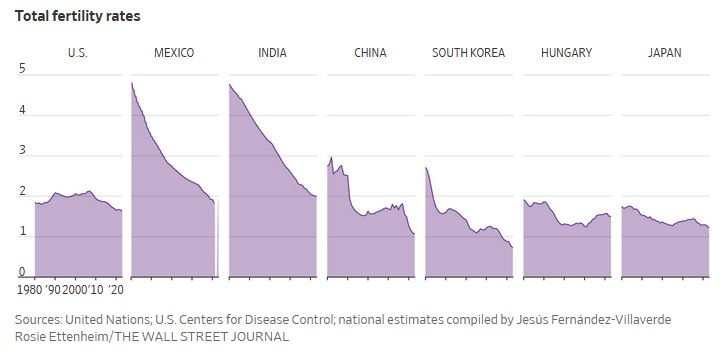
WSJ: Birthrates are falling fast across countries, with economic, social and geopolitical consequences
https://t.co/zOpZAMYrmf
US births are down, but not as much as some other developed economies.
Societal shifts mean US births of ~4m per year for the next decade.
#jbrec
New Census population estimates today suggest a return to positive growth in the urban counties.
Even that is likely understated.
Immigration appears to be stronger than reported in the Census numbers, meaning the gateway cities saw even stronger growth.
#jbrec#demographics
Excited to have this new demographics report out, which I know our clients are going to value.
For anyone who has asked about updates to our book, this is the next evolution, showing how these demographic trends are shaping housing and the economy.
#jbrec#demographics
NEW FOR JBREC CLIENTS: Demographics Clarity for Housing Executives
Watch the short video for a sneak peek, including three surprising demographic shifts already impacting your business today.
Learn how to become a research member:
https://t.co/uUgwTzV7Am
Short-term, the US has had a recent surge in population, driven by rebounding immigration.
Long-term, the US is looking at a slower population growth rate than we've been used to in decades.
But growth is still positive, which is something not every country can say.
#jbrec
Good news for the US:
The US population is set to match or outgrow most global economic superpowers over the next decade.
Of course this could change quickly if legislation, regulations, or policy suddenly clamp down on immigration flows.
Quick plug for a new JBREC demographics insights platform releasing March 7th:
Current analysis + specific recommendations to help companies and investors navigate US demographic shifts – including long-term generational shifts in housing demand.
https://t.co/ylVzYVQ8VZ
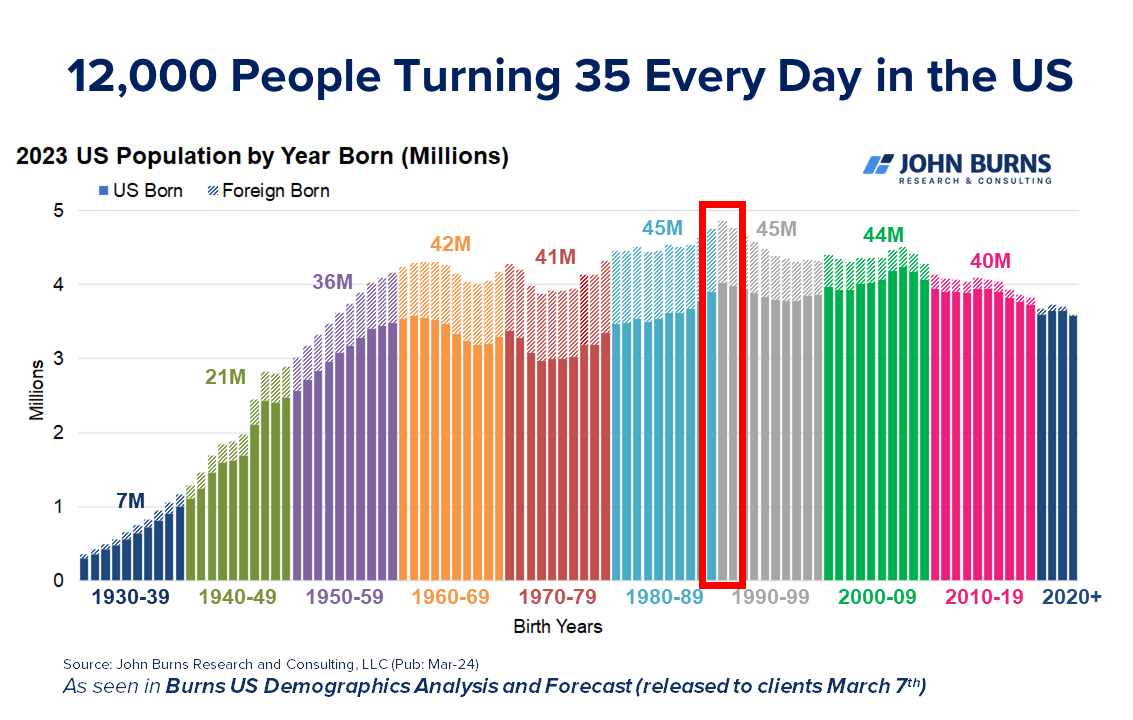
12,000+ people are turning 35 years old every day in the US.
Remember talking about 10,000 people turning 65 every day?
This is even bigger.
With the median age of first-time buyers at 35 years old, expect solid housing demand in the near-term.
Keep an eye out this week as Eric Finnigan (@EricFinnigan) and I share some demographic insights from our upcoming Burns US Demographics Analysis and Forecast report.
First up: expected retirement is much longer for the Boomers - one reasons so many of them worked past age 65.
Baby Boomers are set for longer, richer retirements than their parents.
The avg. Boomer is now 67 and will live another 21 years.
Expect 2 more decades of the avg. Boomer spending on their home and helping their adult children buy or rent.
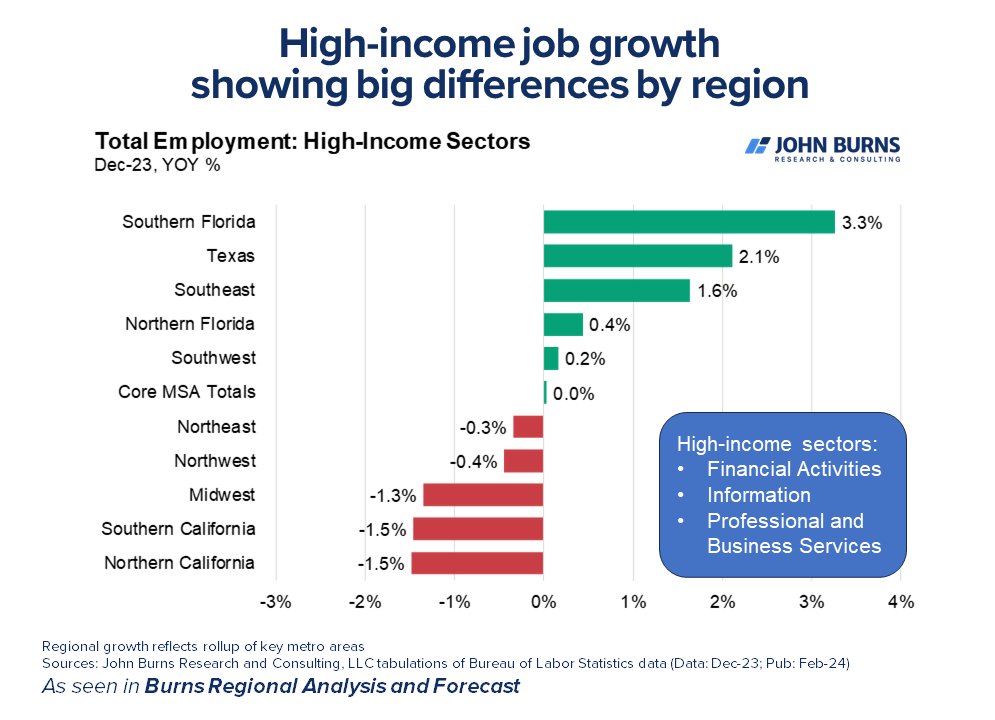
We pay close attention to the Financial, Information and Professional and Business Services sectors because they are typically higher-paying jobs, and have a stronger link to demand for for-sale (new and resale) housing.
All regions of the country are showing positive job growth year-over-year.
But the same isn't true for the high-income sectors.
Florida, Texas and the Southeast show the strongest growth in high-income sectors, while California and the Midwest lag.
#jbrec#employment
Yes, people younger than 20 work, as does an increasing share of people past age 64. But 20-64 is the great majority. (~95% of full-time jobs today.)
Note: these projections *do* include the mid-level assumptions for immigration.
Slow growth in the working-age population means the US labor market remains tight in the long term.
New Census projections show 20-64 year-old population growing at less than 0.4% per year through 2035.
And it doesn't get better after that...
#jbrec#demographics
I realize that, by 2100, we're going to have to redefine these dependency ratios -- there will be many more people working past the age of 65 than today.
But this perspective is staggering.
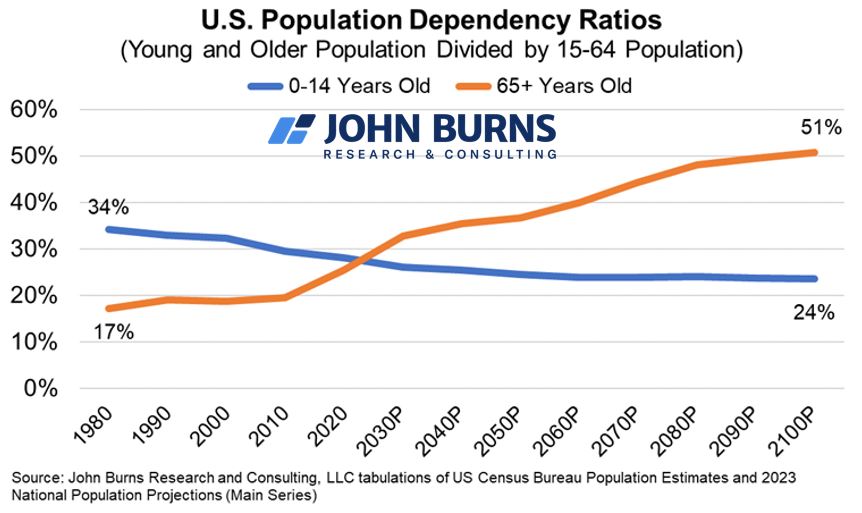
2023 is a tipping point:
For the first time, the 65+ population outnumbers the under-15 population.
New projections from the Census Bureau suggest that, by 2100:
* 65+ population will be 51% of the working-age (15-64) population
* Under-15: just 24%
#jbrec#demographics
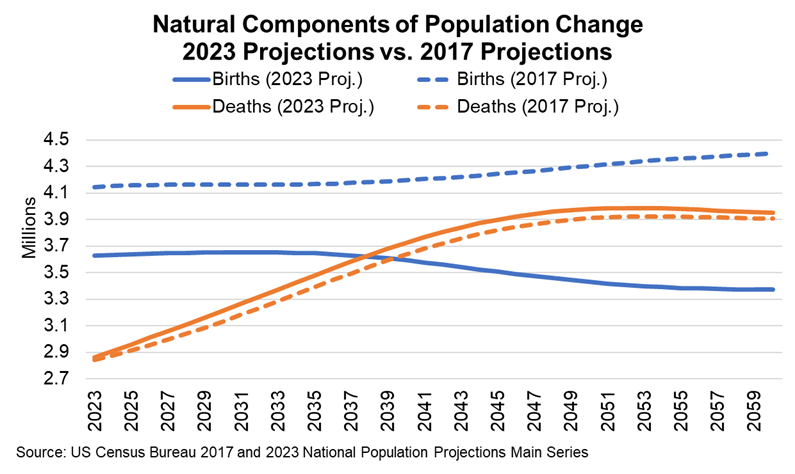
While we've known for years how outdated the 2017 forecasts are and update our own projections, others may not.
Look at the differences:
Not significant changes for deaths, but the births change is HUGE.
(Note: 2017 projections only went to 2060)
#demographics#jbrec
New population projections out from the Census Bureau - the first since 2017.
Updated (and necessary) revisions have US births down from 3.7M in 2023 to 3.1M by 2100.
Base case scenario now has deaths outpacing births by 2038, and the gap grows after that.
#demographics#jbrec