One of the reasons for why the West is slipping behind certain countries in the East is that our political elite isn’t mainly focused on serving the nation.
Instead they focus on furthering their political ideologies or their own careers.
The UAE has managed to grow their economy in a swift pace for decades because their political elite favors stability and developing the capabilities of the state and nation.
The words of Dr. Sultan Ahmed Al Jaber, the UAE Minister of Industry and Advanced Technology at the opening of ADIPEC 2026, the world’s largest annual energy event taking place in, Abu Dhabi, serve as an example:
“To serve this country is not merely a responsibility. It’s the highest privilege of my life and one I carry with me every single day”
In his speech, the Minister outlined 5 priorities for the energy sector:
- Accessible supply (more strategic storage and flexible refining)
- Secure routes to market
- Operational intelligence (including AI)
- Investment confidence
- Human capital
Hundreds of thousands of people are expected to take part in ADIPEC this year.
And yes, I used AI to produce my images and present my ideas. That doesn't remove the fact of the argument which is: the numbers they presented are misleading. Keep it going, I'm a fan!
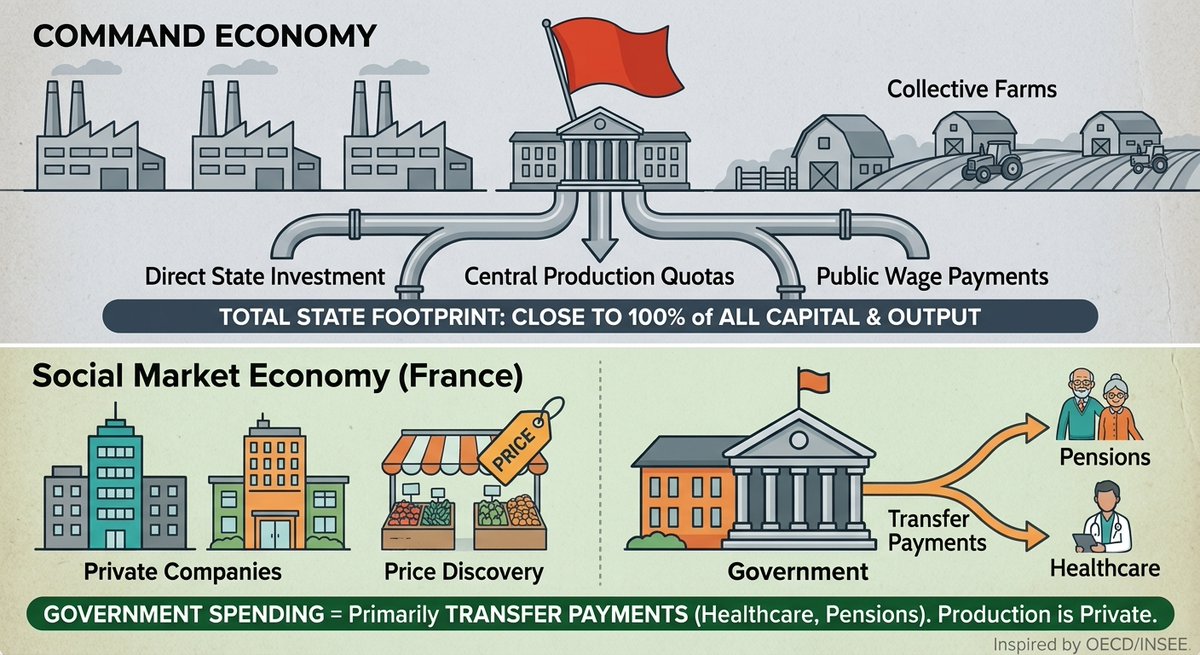
I love the @allinpod, https://t.co/oDl7RAfFvY but their recent graphic on "Public Spending % of GDP" comparing France to historical planned (Communist) economies got the macroeconomics completely wrong. Here is why comparing these numbers is fundamentally flawed 🧵👇 1/4
China's 33% excludes massive State-Owned Enterprises (SOEs) & LGFV debt that drive 50%+ of economic activity. Venezuela’s 38% ignores massive off-budget spending via PDVSA. High spending % in a social market economy ≠ state ownership in a communist regime. Accuracy matters! 4/4
Saying the USSR 50% or Romania 42% had lower state spending than France ignores how command economies worked. The state owned 90%+ of all land, factories, and housing. They used Net Material Product NMP, which excluded services, making these stats incomparable to modern GDP. 3/4
France's 57% is mostly social transfer payments (pensions, healthcare, unemployment). Private enterprise and free markets drive the actual production of that GDP. The state doesn't dictate prices, factory quotas, or own the means of production. 2/4
I've coached over 30 Olympic gold medals.
I've worked with some of the greatest athletes in history.
Here are the lessons I wish more people understood:🧵
Mucha gente impresionada por la cantidad de dólares que aparecen entre los escombros de Vargas, pero ya Pantera lo explicó hace años en La Venganza de Juan Planchard.
🚨While the US increases its presence in #Venezuela, we should pick-up thug Diosdado Cabello and bring him to justice so he can stop impeding the distribution of aid to those impacted by the earthquake.
By far my biggest advice to anyone trying to adopt AI properly:
1. Pay a little bit of money to Anthropic
2. Download Claude Code
3. Open Claude Code
4. Press 'Shift-Tab' until it says 'plan mode on'
5. Open Voice Memo on your iPhone. Just talk about all the things you want to accomplish. When you think you are done, just keep talking. Make sure it is at least 10 minutes, hopefully longer
6. Send this Voice Memo to your computer
7. Download MacWhisper and use it to transcribe this voice memo. Trust me, you will want MacWhisper and will use it later a lot
8. Type into Claude Code: "I have never used you before but I talked about some things. I will paste those things in below. Please read the things and ask me any questions you need to in order to help me figure out how to use you to be awesome. Ask me lots of questions until I tell you I am done"
9. Then paste in the transcript
10. Then press enter
Then just let Claude take the wheel, and them please send me a DM if this works.
Also, if this just sounds crazy, just literally take this entire message and paste it into whatever AI you are using and say 'some weird person told me to paste this into you, I want to use it, but I don't know how. What should I do?'
I am just trying to help you get started. Curiosity and persistence are the most important things.
Perplexity just gave every retail investor a Bloomberg Terminal. For free.
Watch this demo. It's wild.
@perplexity_ai connects to brokerage accounts via @Plaid and builds a custom investment dashboard in seconds.
Perplexity Computer pulls from 40+ live finance tools like:
- SEC filings
- FactSet
- S&P Global
- Coinbase
- LSEG.
75% of Perplexity's paying users were already asking finance questions monthly. The demand existed before the product did.
But you couldn't DO anything with that information.
---
Now you can connect it to your data for better insights.
Connect your brokerage accounts through Plaid, and suddenly an AI agent can see your actual holdings across multiple institutions — then query institutional-grade data against them.
"Show me my sector concentration risk" or "How exposed am I to rising rates" — answered in seconds with your real portfolio, not hypotheticals.
---
It still can't trade for you, though.
That's a deliberate regulatory design choice that lets Perplexity move fast while every neobank and robo-advisor is still waiting for compliance sign-off.
Fintech companies spent a decade building Plaid as pipes for fintech apps to read your bank data.
But I'm much more interested in when we give them to AI
how to build an AI-first SaaS in 2026
1. start with a big market. finance, healthcare, real estate. then zoom into a sub-niche.
2. map the niche’s workflow end-to-end. literally write every step they do daily. ex: leads → scheduling → quoting → follow-ups → payments.
3. highlight where money changes hands. deposits, invoices, negotiations. those moments are where software captures value.
4. identify the repetitive mechanical tasks. anything someone does the same way every day is an automation opportunity.
5. quantify the pain. if a business owner spends 100 hours a year on something and their time is worth $300/hour, that’s a $30k problem.
6. manually perform the workflow yourself. most AI SaaS actually starts as a service. that’s why so many new YC companies begin with humans in the loop.
7. document every step. separate judgment tasks from mechanical tasks. agents handle the mechanical work.
8. turn those steps into agent workflows and connect them to real tools (email, slack, stripe, crm, APIs).
9. build media while you build the product. post daily about the workflow. use AI to research content ideas and scripts. the audience becomes your distribution.
10. launch narrow, show proof (hours saved, revenue generated), then expand into adjacent workflows until you become the default execution layer for that niche.
people saying everyday that saas is dying
it’s evolving into agents + software + media.
full breakdown in the latest episode of
@startupideaspod
lots of sauce in this one
all for free because i can't wait to see what you build
watch
MIT released a devastating number.
95% of all corporate AI projects are failing.
Because nobody knows how to install it.
@mcuban says this is the biggest job opportunity since the personal computer.
Cuban built his first fortune doing one thing:
Walking into offices in the 1980s and showing people who had never touched a computer how to use one.
He says the exact same thing is happening right now with AI.
Except the gap is even bigger.
There are 33 million companies in the United States.
30 million of them are one person operations.
Millions more have under 500 employees.
No AI budget, team or strategy in place and they are completely in the dark.
MIT looked at generative AI inside big companies and the numbers are insane.
Most have AI initiatives and run pilots.
Almost all fail to deliver real business results.
Because nobody knows how to wire them into actual workflows.
Cuban’s advice to his own kids, ages 15, 19, and 21: Learn to implement AI,
Walk into a shoe store , law firm or a trucking company.
Show them exactly what AI does for their specific business.
That is the big opportunity now.
A guy with a YouTube channel just accidentally redesigned the most complex machine in human history.
Not an aerospace engineer. Not a SpaceX executive.
A guy with a camera who asked one obvious question.
Tim Dodd was walking around Starbase when Musk proudly explained how the Super Heavy booster eliminated its entire cold gas thruster system. Instead of a separate, heavy, complex mechanism, it just vents hot gas directly from the propellant tanks.
Elegant. Zero added mass. Zero extra failure points.
Dodd asked one question.
“But this is only for the booster, right?”
Musk stopped.
Not to defend. Not to explain. Not to reframe the question so it didn’t threaten what he had just said.
He stopped because something clicked.
Musk: “Yes. Although arguably, now you mention it… we might be wise to do this for the ship, too. Now that… we’re going to fix that.”
Mid-sentence. In real time. On camera.
No pause to protect his pride. No deflection. No “good point, let me circle back on that.” Just the immediate, unfiltered acknowledgment that a better path existed and they were going to take it.
Seven months later, Musk confirmed it was one of the biggest improvements ever made to the vehicle.
Think about what just happened.
To change a fundamental flight system at a legacy aerospace company requires years of environmental reviews, safety committees, and budget approvals.
Musk deprecated an entire subsystem in 15 seconds because a podcaster asked the obvious question that nobody inside had dared to ask.
In a traditional corporation, that cold gas system gets built anyway.
Because admitting the architecture is flawed is politically expensive.
The VP doesn’t want to lose the headcount.
The engineers don’t want to scrap the work.
The manager doesn’t want to explain the pivot to their director.
And so the mistake gets a budget. Gets a timeline. Gets a team assigned to it.
The machine gets heavier. The flaw becomes load-bearing. And eventually the flaw becomes so embedded in the structure that fixing it would require tearing down everything built around it.
So nobody fixes it.
Now think about the last time someone pointed out a flaw in something you built. Something you were proud of. Something you had already explained to twelve people without anyone questioning it.
Did you stop the way Musk stopped?
Or did you feel that heat in your chest. That reflexive need to explain why they were missing the point. Why the context was more complicated than they understood. Why the question, though interesting, didn’t really apply here.
That heat is the most expensive thing most organizations will ever pay for.
A failed launch at least tells you the truth.
A defended mistake just compounds.
This is the organizational architecture required to win the AI arms race.
The ultimate moat isn’t compute. It isn’t capital.
It is the velocity of error correction.
The geopolitical AI race will not be won by whoever starts with the best blueprint.
It will be won by whoever can feel that heat in their chest and choose the truth anyway.
A journalist asked a question. The best answer won.
The rocket got lighter.
Most egos don’t.
«Nosotros también queremos ver a Maduro de vuelta en Venezuela.
Con Delcy Rodríguez.
Con Jorge Rodríguez.
Con Diosdado Cabello…
Los cuatro en el Helicoide.»
Réplica.
@GPPopular