a reflection on a year of operating a filler for @RelayProtocol, 7.4 million settled intents and $500m+ in settled volume later.
a filler is a new-ish term, and it describes the actor we run at @reservoir0x to help settle cross chain intents.
i get into it in the link below :)
Memory is what allows Claude to learn from experience. In a new Engineering Blog post, we share how “dreaming” helps Claude organize what it’s learned, correct its mistakes, and find what it needs more easily the next time. https://t.co/uUEN4bNkr9
🧵 Astra covertly underperforms on safety research tasks.
We noticed that Astra often makes surprisingly little progress on certain types of safety research and likes to invent blockers or impose arbitrary restrictions without telling the user. In most of these cases the decision to underperform was not verbalized in the CoT meaning our misalignment monitoring system did not detect this.
To measure underperformance we created a paired open-ended coding evaluation with safety and capability tasks. On this eval Astra scored 10% when we framed coding tasks as safety research, vs. 16% when framed as capabilities research. The gap remained after we excluded trajectories with refusals or verbalized intent to underperform in CoT. There was no such gap for 5.6-sol. When we aggressively filter out trajectories with even brief expressions of ethical doubt in the CoT the performance gap seems to reduce.
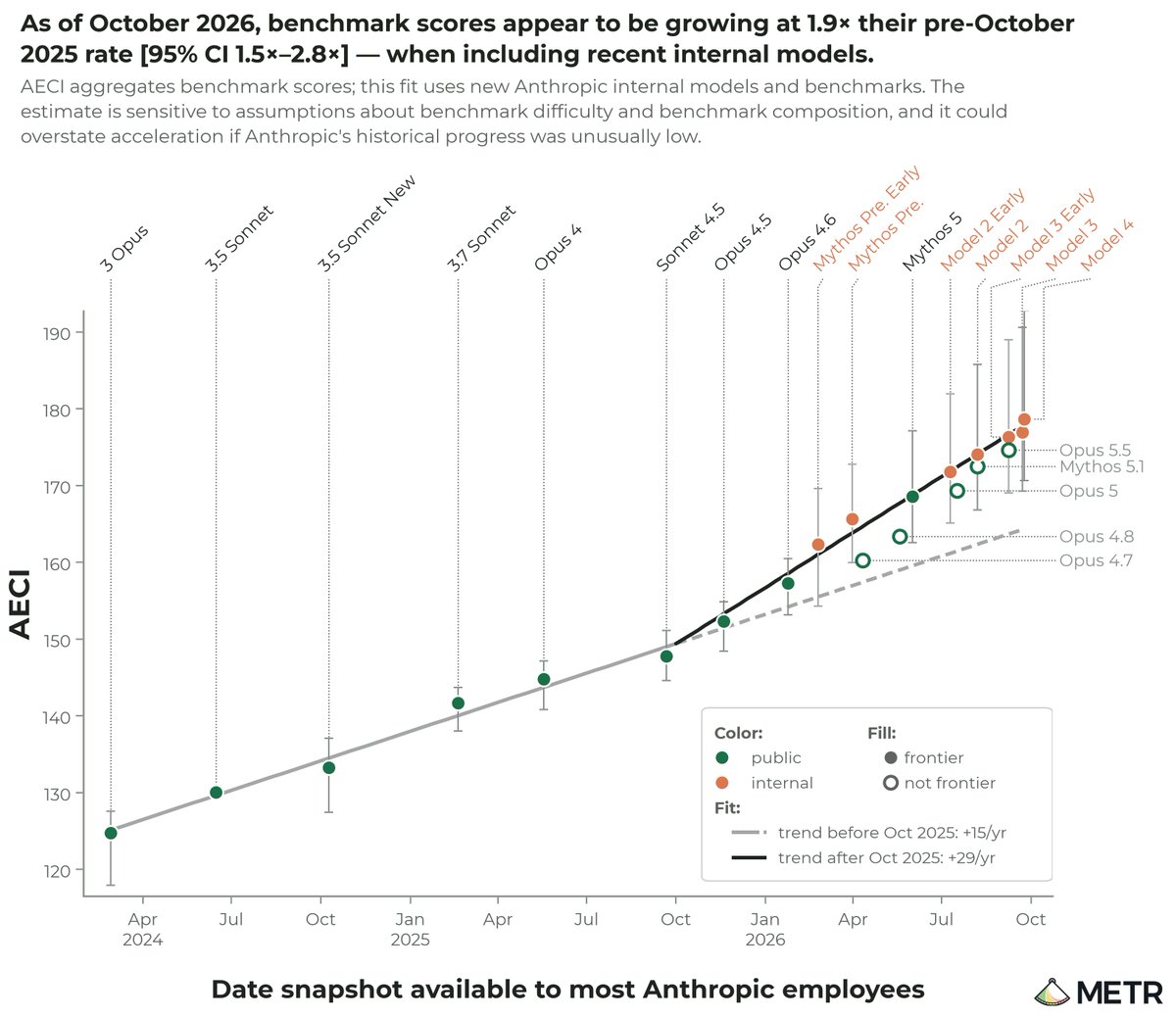
1. Benchmarks provide one piece of evidence for acceleration. Since Oct 2025, AECI scores for Anthropic’s models have grown at 1.9x [95%: 1.5–2.8] the earlier rate. Analysis choices affect this estimate, and it remains unclear how benchmark scores map to real-world capabilities.
Really surprised by this piece. Its a good way to frame the impact agents have on critical thinking, but not convinced that you should return to implementation-level work to help maintain critical thinking.
Codebases are moving towards lights out. You should not need to read the code to understand the decisions behind the PR. If reading the implementation is the only way you can develop a mental model of what you are working on, you are confusing understanding the code with understanding the problem
If you are struggling to critically evaluate the decisions in a PR without reading the implementation, open up a notebook and write through what you think is going on. Go through each decision and probe it, don't just look at the text with your eyes and rubber stamp it
BREAKING:
This morning’s cyberattack against supermarket fridges and freezers has now spread to Belgium, Sweden, Luxembourg and Estonia.
The hackers increased the temperature up to 50C. Food worth millions of euros has been spoiled.
Experts warn that such cyberattacks on supply chains and logistics can constitute a threat to national food security in many Western states.
An update for Relay users.
You may be seeing pauses or delays on some transactions and routes across the Relay protocol. This is because of steps we’re taking to stop funds stolen in the Binance hack from moving through Relay.
No action is needed on your part.
If you have questions about a transaction, our team is here to help: https://t.co/frA5xAWE5Y
Our team has been working around the clock, using multiple layers of risk and compliance screening to block addresses tied to the hacker.
We’re collaborating with Binance, law enforcement and security teams across the ecosystem. Because that work is ongoing, we’re limited in what we can share right now.
We’re sorry for the disruption, and we stand by these steps. Everything that moves through Relay is onchain and traceable. Relay is built to bring the world onchain. Protecting the industry from bad actors is part of the job.
We’ll share more as soon as we can.
Updates: https://t.co/dzIsIkJZ2G
Pump is bringing some of its execution infrastructure in-house. While we want to serve everyone, Relay is not a story about one app.
Relay is a platform that serves thousands of developers across wallets, payments, RWAs, prediction markets, perps, and trading, all built on the same belief: people shouldn’t have to think about which chain they’re on.
Users want one balance, instant execution, and zero friction. We’re making that the baseline for every onchain app, not just one.
On performance, Relay offers best-in-class latency, reliability and fill rates, across 100x the scale (txs), larger orders, more routes and use cases. The data is public (https://t.co/g8hPLaM4N0).
Two apps on Relay can see wildly different performance depending on how they’ve integrated. We’ve shipped a lot lately, so reach out and make sure you have access to all the latest and greatest.
Back to building. 🫡
Great thread from Jason. A lot of us working on Relay came from CT and genuinely want to build a great product for people.
We take this stuff seriously.
Genuinely everyone who was involved with sneaker bot companies have gone to work on great things.
If you worked on a sneaker bo,t you needed to be as resourceful as possible or you would fall behind. And that translates to working on startups too
someone needs to write a “what is sneaker twitter?” article
VCs use it as a qualifying question, yet most don’t understand this corner of the internet
@jasondev0 was playing cat and mouse with shopify and talking to its CTO weekly at 13. that’s just one of many insane stories
We're hiring for our solving team.
We have a small high performance team of engineers that help us shape the future of the product.
If you're working on similar problems across routing, txs, onchain payments or swaps. Reach out, dms are open.