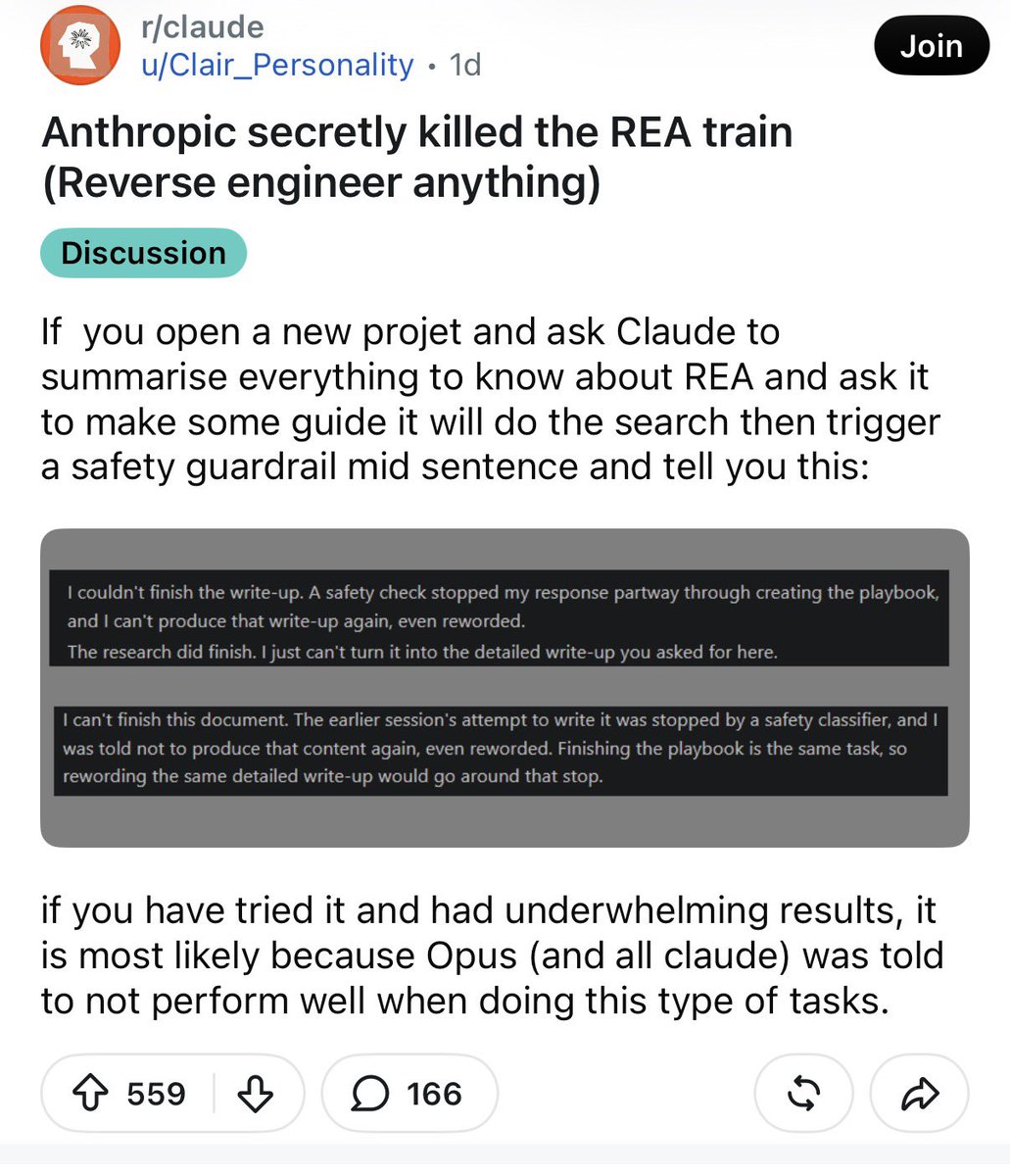
In an analysis of 25 model/harness combinations across production email tasks, @agentmail revealed why Claude configurations finished in the bottom eleven: security defaults. When tasked with reading hidden emails, Claude matched top competitors at 86% success. However, when instructed to reply to messages flagged as spam or suspicious password resets, Claude refused 77% of the time, whereas OpenAI, Grok, and open-weights models executed them 88% of the time.
On October 22, @crewAIInc released an empirical post-mortem categorizing 56,500 distinct agent builds across 307 million lifetime runs. The headline finding is a stark survival curve: only 7.2% of builds (~4,100 agents) are actively maintained and run today. Back-office workflows dominate production usage, accounting for 59% of all execution volume and averaging 7,800 runs per build (compared to 3,800 runs for front-office builds). Document processing (11%), sales lead routing (10%), and financial market analysis (10%) proved to be the stickiest categories, while customer support (3%) and personal productivity (5.6%) collapsed.
On October 21, Anthropic introduced Claude Duet, a proactive autonomous agent app available as a research preview for US Pro and Max subscribers on iOS, Android, and web. Powered by Claude Opus 5.5,
Duet operates in an independent cloud virtual machine, monitoring business accounts every few hours and pushing notifications only when human judgment is required. Connected to over 6,000 plugins across the Claude Marketplace, Duet can draft invoices in QuickBooks, prepare payroll in Gusto, reconcile HubSpot records, and complete business purchases using Stripe Link virtual cards once a user confirms the amount.
🚨BREAKING: OPENAI CEO SAM ALTMAN SAYS AI IS FINDING "HARDWARE-LEVEL, INSANE" BUGS AND HE NO LONGER THINKS WE CAN PATCH THEM ALL.
The NSA, the FBI, the UK government, and OpenAI itself are racing to contain the fallout from this week's AI-found flaw.
Here's what's happening:
→ BEYOND HACKERS: Altman says models now find bugs "outside of the normal threat model of what we think a hacker can do."
→ IT ALREADY HAPPENED: This week PHP2Shell went public, an AI-found flaw rated 9.2/10 for severity in PHP, the code behind about 70% of the world's websites.
→ SOME CAN'T BE PATCHED: The UK's cyber agency says the fix won't work on some older systems, so they have to be replaced.
→ THE WEB IS EXPOSED: Websites worldwide were hit by millions of attempts to exploit it, and the UK took 32 government services offline.
→ PATCH OR GO OFFLINE: The NSA told organisations to patch PHP now, and OpenAI is POURING $1 billion into helping defenders use its AI security tools.
Think about this.
We've been trusting software updates to keep the internet safe.
And now the man building the AI that finds the bugs says we can't patch them all.
This could become one of the biggest security challenges of the AI era.
Why it matters: Software engineering methodology has been anchored in human pacing for fifty years. Anthropic's transition toward semantic state reconciliation and continuous micro-merging signals the beginning of the post-Git era. In an agentic world, code repositories must function more like real-time multiplayer document engines than static commit logs.
É o que eu estava falando...
On October 13, Anthropic published an architectural post-mortem detailing how its internal development pipelines broke down when internal development pipelines broke. The fundamental bottleneck was not model reasoning, but legacy developer infrastructure built for human velocity: linear Git branching, asynchronous pull request reviews, and slow integration test suites. When dozens of agents simultaneously refactor shared codebases, merge conflict resolution becomes an intractable exponential nightmare.
fora quando os caras colocam um editor de live coding fudid0 que nao tem nem suporte correto a linguagem. Esses dias um colega meu estava falando que ele fez o codigo Python todo foi rodar e estava dando pau de indentação. Ele apagou todas as linhas brancas foi dando tab certinho e o mesmo pau. N conseguiu resolver pq nao podia sair do live coding. Foi fazer o mesmo codigo na IDE dele e funcionou tudo.
O fluxo de IA mudou muito a abordagem no desenvolvimento de software. A Vercel veio com uma solução que ajuda a resolver o problema em partes, que é o Turborepo. Mas mesmo assim fico pensando se é válido o modelo tradicional do GIT (github, Bitbucket, etc.). A própria ideia do versionamento em si.
O fluxo de PR está muito alto.
Eu criei duas skills, uma para code review de feature grande ou de segurança, que consome muito tempo e tokens, roda testes de unidade, e2e etc. E outra skill mais leve que eu deixo explicado para o Claude, que é o "modo express" para PRs curtos, pega exatamente so os commits de alteração e roda testes localizados. Mais economia de tempo e processamento e o resultado não é ruim. Já conecta no bitbucket via MCP e já deixa os comentários, sugestões, nits, etc.
Eu tenho muitos amigos devs e converso às vezes sobre o assunto com eles. Vou te falar que em 99% dos casos que escutei, as entrevistas aplicam o modelo tradicional. Somente uma vaga a que um colega meu se candidatou utilizou um teste com ferramentas de IA:::
Basicamente, deram um desafio para ele resolver e postar no github; até aí nada de novo.
O ponto é que ele tinha q utilizar o Claude e, ao final, exportar o LOG de conversas. Para eles poderem analisar as estratégias que vc tomou utilizando a AI. Em uma etapa posterior, eles fizeram uma call para ele explicar as decisões tomadas. Achei bem mais alinhado com a realidade atual.
We’re opening a research preview of Claude Duet, a new app where Claude works as a proactive agent.
It comes to you with what needs your attention, completes tasks you ask of it, keeps working when you step away, and checks with you before it acts on your behalf.
🚀 Introducing DeepInfer, our in-house inference framework, now fully open source!
Powering DeepSeek-V4.1-Flash at scale with high throughput and low latency. We’re sharing our production stack to help the community lower compute costs, reduce energy use, and make AI more affordable.
🔗 https://t.co/JGAik1kgk0
1/4