New publication from our WG3 member Maria Załęska. 🎉
Her new article, “The Rhetoric of Depolarizing Discourses: Part of the Solution or Part of the Problem?”, was published in "Topoi: An International Review of Philosophy."
https://t.co/YtkQHFZpAt
Jérémy Dodeigne is directing the workshop “The Rise of Hostile Communication Styles and their Consequences for the Functioning of Modern Democracies”, and WG1 member Caterina Mosca is also participating in the session.
Our network is represented at the European Consortium for Political Research (ECPR) Joint Sessions of Workshops, taking place at the University of Innsbruck from 7–10 April 2026.
https://t.co/ULRIZ0Usym
New collaborative work by members of our Cost Network: “The evolving study of political polarization”, published in Open Research Europe. An important contribution to ongoing debates on how political polarization is studied and understood. https://t.co/cTJQwcBr2p
💡 We are pleased to share a new publication on polarization by our WG3 member @ComlekciFatih, recently published in Communications:
“Partisans’ online discourses against opposing information: Affective polarization thwarting democratic debate.”
https://t.co/iiPi2ZSVBu
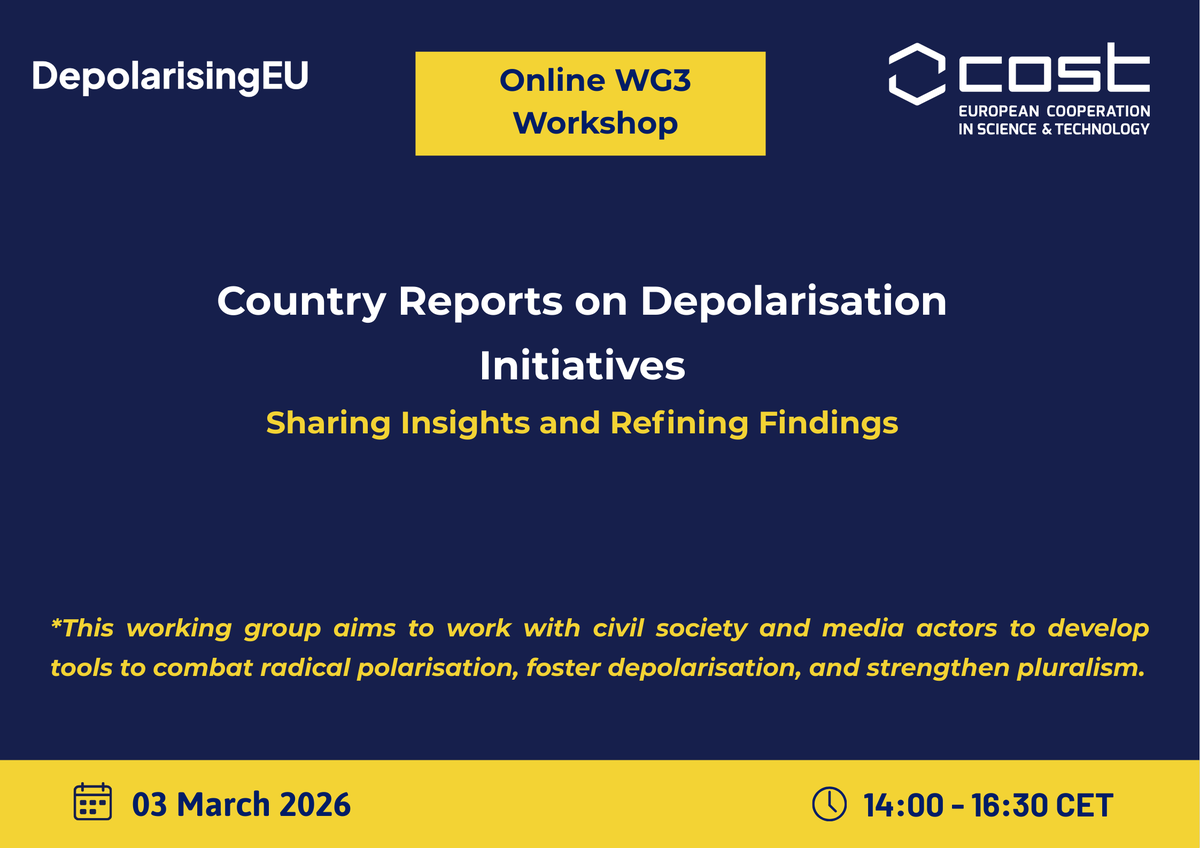
Looking forward to our upcoming online workshop "Country Reports on Depolarisation Initiatives" next week!
We’ll discuss insights from depolarisation initiatives and country reports from 12 different countries, reflect on key findings, and explore how to strengthen the report.
🚀 Our Third Grant Period Is Now Open! Deadline for applications: 31 January 2026. Grants are now available for:✔️ Short-Term Scientific Missions ✔️ ITC Conference ✔️ Young Researcher & Innovator (YRI) Conference ✔️ Dissemination Conference Grants https://t.co/jRJlgIRrwj
🚀 Our Third Grant Period Is Now Open! Deadline for applications: 31 January 2026. Grants are now available for:✔️ Short-Term Scientific Missions ✔️ ITC Conference ✔️ Young Researcher & Innovator (YRI) Conference ✔️ Dissemination Conference Grants https://t.co/jRJlgIRrwj
Calling all academics! 👩🏫👨🏫
We’re exploring privilege in academia — how language, gender & class shape our daily lives at universities.
It’s anonymous & takes just 4–5 min.
Please share widely!
👉 https://t.co/2zT17tXvz9
#HigherEd#Equity
📢 Check out the new blog post featuring our WG3 member Assoc. Prof. Fatih Çömlekçi's @ComlekciFatih recent short-term scientific mission in OsloMet, which aimed to map civil society and news media initiatives for depolarization in the Nordic countries. https://t.co/RCiIKdHMMP
“Academic freedom is meaningless if it only applies to the safest topics or the most secure researchers.”
She reminds us that protecting scholars also means safeguarding the conditions for democratic debate and knowledge production.
In a new op-ed, Prof. Hande Eslen-Ziya -@handesz- (University of Stavanger), Working Group 2 member of DepolarisingEU, shows how online violence against researchers is more than “trolling.”
https://t.co/weRomjipGr
📢 3rd Open Call for Grants — Second Grant Period (4 Nov 2024 – 31 Oct 2025)
🔹 Short-Term Scientific Missions (STSMs)
🔹 ITC Conference Grants
🔹 Young Researcher & Innovator (YRI) Conference Grants
🔹 Dissemination Conference Grants (DCGs)
https://t.co/o84gEberIG
🚨 🚨 New publication alert!! Very pleased to share our first preprint from COST Action CA22165 – Redressing Radical Polarisation
"Affect and Meaning: A Cultural Sociological Perspective on Polarization."
https://t.co/40TzgWbD5Z
@mattrevers@MariaLuengoC ✅ Their framework offers a sociological theory of polarization that is attentive to meaning-making, boundary formation, and the conditional relationship between cultural and social differentiation.
🚨 🚨 New publication alert!! Very pleased to share our first preprint from COST Action CA22165 – Redressing Radical Polarisation
"Affect and Meaning: A Cultural Sociological Perspective on Polarization."
https://t.co/40TzgWbD5Z
✅ In this article, Werner Binder, Matthias Revers (@mattrevers), Marcus Morgan, and María Luengo Cruz (@MariaLuengoC) from our network, DepolarisingEU, develop a model of political polarization as a discursive and performative struggle over meaning.
Radicalización en Europa.🗣️¿Qué hay detrás de los gritos en redes?
En esta FLASH TALK con @DepolarisingEU hablamos con expertos de más de 30 países para entender qué está pasando… y qué podemos hacer para cambiarlo.🧠
🎧 Escúchalo aquí: https://t.co/Wh4NgnZKvP
🔔 We’re excited to share the 2nd Call for the Second Grant Period under our Action DepolarisingEU!
⚠️ Deadline for applications: June 15th, 2025
ITC, YRI, and Dissemination Conferences must be completed by October 5th, 2025
https://t.co/VweUJgq2oN
Contra la polarización:
Erika Staël von Holstein: “A los extremistas no hay que intentar convencerlos, sino escucharlos”
@DepolarisingEU https://t.co/z5irlK2YFf